How to Ace the TBAS: Ethical Hack (2026)
When you purchase through links on our site, we may receive compensation at no extra cost to you.
Your PCSM score is the single most competitive number in Air Force rated officer selection. It decides whether you get a pilot or CSO training slot. The Test of Basic Aviation Skills (TBAS) is the biggest input to that score, and it is the one you can train for starting today.
The TBAS is not a knowledge test. You cannot memorize facts and pass it. You train the cognitive and psychomotor abilities it measures. That changes everything about how you prepare. No commercial TBAS prep course exists. There is no answer key. But there is a proven training method that builds the exact skills the test measures, and this guide gives it to you.
Start here (the 3-step path)
You do not need to read this whole page before you start. Do these three things today, then come back.
- Download a flight simulator. Microsoft Flight Simulator or X-Plane. Plug in a joystick or game controller and fly for 30 minutes. This is your first training session for the psychomotor component that carries the most weight on the TBAS.
- Check your AFOQT Pilot composite. Your AFOQT Pilot score feeds your PCSM alongside your TBAS. If you have not taken the AFOQT yet, that comes first. If you scored below 50 on the Pilot composite, plan a retake before investing heavy time on TBAS training.
- Follow the training plan below. The 30-day plan is the recommended default. If your test is in two weeks, use the 14-day version.
- AFOQT online course: Timed practice for all 12 AFOQT subtests including the aviation sections that overlap with TBAS skills.
- AFOQT Guide Book: Full-length practice exams scored by composite. Target your Pilot composite.
TBAS basics you must understand before training
Training without understanding what the test measures wastes time. This section covers the four components, the attempt rules, and how the TBAS differs from the AFOQT.
What the TBAS measures
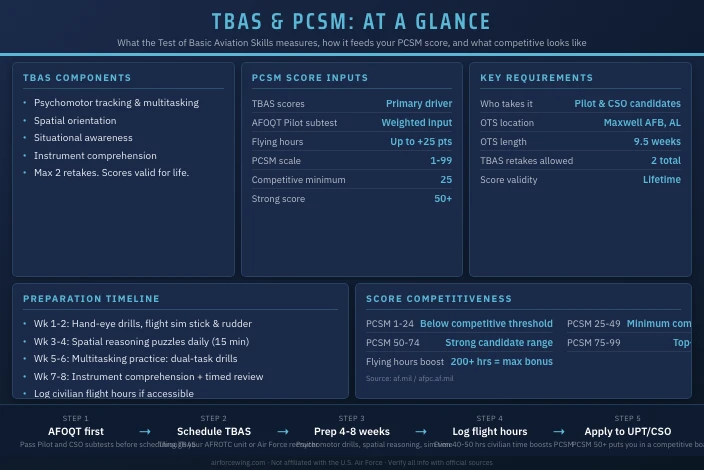
The TBAS is a computer-based assessment given at an Air Force testing facility. It takes about two hours including instructions. The test measures four categories of cognitive and psychomotor ability.
Psychomotor tracking and multitasking. The most heavily weighted component. You sit at a workstation with a joystick. A crosshair drifts on a screen. Your job is to keep it centered while responding to other stimuli: numbers flashing on screen, audio cues, secondary tracking tasks. The test measures tracking accuracy, reaction time, and fine motor control while your attention is split.
Spatial orientation. Tests how well you mentally rotate objects and interpret aircraft attitude. You see a horizon indicator and must determine whether the aircraft is banking left, climbing, or diving. The format demands fast recognition of attitude changes from unfamiliar angles. This skill is trainable with daily practice.
Situational awareness. Measures how fast you process dynamic visual information and identify what matters. You watch screens with multiple data streams. Some information changes. You must spot anomalies, track moving elements, and answer questions about what you observed.
Instrument comprehension. Cockpit instrument displays are shown and you read the aircraft’s state from them: airspeed, altitude, heading, bank angle, pitch. This component rewards candidates who have spent time learning the six basic instruments, even without flight time.
Why this is a performance test, not a knowledge test
The AFOQT is a knowledge test. You study, you memorize, you recall. The TBAS is a performance test. It measures how well you do something, not what you know about it.
That changes your training method entirely. You do not read about joystick tracking. You track with a joystick. You do not study spatial reasoning theory. You solve spatial puzzles under time pressure until pattern recognition becomes automatic. Candidates who treat TBAS prep like academic study waste their training time. Candidates who treat it like skill training improve measurably within two weeks.
TBAS vs AFOQT
Both feed your PCSM, but they test different things.
| Feature | AFOQT | TBAS |
|---|---|---|
| Test type | Academic knowledge and aptitude | Cognitive and psychomotor performance |
| Study method | Textbook study, practice questions | Skill training, simulation, timed drills |
| Lifetime attempts | 3 (90-day wait, Wing/CC waiver for 3rd) | 3 (original plus 2 retakes) |
| Score format | Percentile composites (0 to 99) | Raw scores fed into PCSM formula |
| Feeds PCSM | Pilot composite only | All components |
| Score expiration | Valid for life | Valid for life |
| Time to complete | About 5 hours | About 2 hours |
The TBAS carries more weight in the PCSM formula than the AFOQT does.
Test format
You sit at a workstation with a monitor, joystick, and headset. Components load sequentially. Each runs on its own clock. There is no scratch paper, no calculator, no going back. You cannot skip ahead or return to a finished section. The interface is straightforward. The challenge is performing under divided attention and time pressure.
3 lifetime attempts, scores valid for life
You get three total attempts: your original plus two retakes. There is no waiver for a fourth. Three is the hard cap. A 90-day wait is required between administrations under DAFMAN 36-2664. Exception-to-policy requests for early retest or additional attempts go to AFPC/DPPDA.
Scores never expire. A score from five years ago still counts toward your PCSM today. That cuts both ways. A strong score stays strong. A weak score follows you. Do not take the test until you are trained. Once you produce a number, it exists.
How TBAS feeds your PCSM score
Your PCSM (Pilot Candidate Selection Method) score is the number rated boards use to compare pilot and CSO candidates. Understanding the formula tells you where to invest your preparation time.
The PCSM formula
The PCSM runs from 1 to 99. It combines three inputs:
| PCSM Input | Source | Weight |
|---|---|---|
| TBAS scores | All four TBAS components | Highest weight, primary driver |
| AFOQT Pilot composite | Math Knowledge, Instrument Comprehension, Table Reading, Aviation Information | Moderate weight |
| Documented flying hours | Civilian flight time with an instructor or solo | Supplemental weight |
AFPC runs these inputs through a statistical formula. You do not receive your PCSM on test day. AFPC calculates it after your scores are processed, typically within a few weeks.
You can update your PCSM by logging new flight hours after the test. AFPC recalculates when updated logbook documentation is submitted. TBAS and AFOQT inputs stay fixed, but flight hours can grow.
PCSM competitive ranges
| PCSM Range | Competitive Standing |
|---|---|
| 1-24 | Below threshold for most boards |
| 25-49 | Minimally competitive. Rest of package must be strong. |
| 50-74 | Strong candidate range for most board cycles |
| 75-99 | Top-tier applicant pool |
A PCSM of 25 gets your application on the board. It does not guarantee selection. Most competitive pilot candidates score 50 or higher. Strong UPT packages often carry 70 and above.
UPT and CSO boards
UPT boards select candidates across AFROTC, OTS, and USAFA pipelines. GPA, commander ranking, fitness scores, and leadership all matter, but the PCSM is the most directly comparable number across commissioning sources.
- Below 25: very unlikely to be selected unless your overall package is exceptional.
- 25 to 49: possible but difficult. GPA, fitness, and leadership must compensate.
- 50 to 69: competitive. Most selected candidates fall here.
- 70 and above: strong position. Selection is likely if the rest of the package is solid.
Combat Systems Officer boards set a lower PCSM bar. Candidates in the 30s are often competitive if the rest of the officer package is strong. Above 50 is well positioned. If you are applying for a CSO slot, do not assume a lower bar means less preparation. A PCSM cushion protects you against board-cycle variability.
Where to invest your time
The practical takeaway: TBAS training first, AFOQT Pilot improvement second, flying hours third.
| Your Situation | Best Investment |
|---|---|
| Have not taken the TBAS yet | Train 30 days, then test |
| TBAS done, AFOQT Pilot below 50 | Retake AFOQT after 90-day wait |
| Both tests done, PCSM in the 40s | Log 20 to 40 flight hours |
| Both tests done, PCSM above 60 | Strengthen GPA, fitness, leadership |
Flying hours and your PCSM
Civilian flight hours are the one PCSM input you can add after both tests are done.
The flight hours bonus scale
The bonus is not linear. Early hours give a larger proportional jump than later hours.
| Documented Flight Hours | Approximate PCSM Effect |
|---|---|
| 0 hours | No bonus. Baseline from TBAS plus AFOQT only. |
| 1 to 20 hours | Small but measurable improvement |
| 21 to 100 hours | Meaningful gain. Steepest part of the curve. |
| 101 to 200 hours | Substantial improvement over zero-hours baseline |
| 200+ hours | Maximum bonus range. Diminishing returns above 200. |
Exact point gain depends on your other scores. A candidate with moderate test scores gains more PCSM points from the same hours than one already scoring in the 90s.
Private pilot certificate (PPL)
A PPL requires a minimum of 40 hours under FAA regulations. Most students complete it in 50 to 70 hours, which puts you well into the meaningful range.
- Cost: $8,000 to $15,000 depending on location and aircraft rental rates.
- Timeline: training 2 to 3 times per week, expect 4 to 6 months. Once per week stretches to 8 to 12 months and costs more total.
- Beyond PCSM: the PPL itself demonstrates aviation commitment on your officer application.
You do not need a full PPL. Even 20 to 30 hours of logged dual instruction moves your PCSM. At $150 to $250 per flight hour, 20 hours costs $3,000 to $5,000. Hours must be in an actual aircraft with a CFI or solo (after endorsement). Home simulator time does not count for PCSM flight hours.
Where to find affordable flight time
- Flying clubs: member-owned clubs often charge $80 to $130 per hour, well below FBO rates. Search AOPA’s flying club finder.
- University flight programs: student rates are often discounted. Some AFROTC detachments have informal relationships with university flight departments.
- Part 141 vs Part 61: Part 141 schools (FAA-approved curriculum) may allow fewer total hours. Part 61 offers scheduling flexibility. Compare total cost, not hourly rate.
- Civil Air Patrol: some squadrons offer orientation rides. Limited logged hours but useful to confirm interest.
The fastest way to raise your TBAS scores
TBAS preparation follows different rules than academic test prep. You are training skills, not memorizing content.
Training rules for psychomotor tests
Rule 1: Practice the actual skill. Reading about joystick tracking does not improve tracking. Flying a simulator does.
Rule 2: Short daily sessions beat long weekly sessions. Thirty minutes daily for two weeks outperforms one six-hour marathon. Psychomotor skills develop through repetition with recovery time between sessions.
Rule 3: Increase difficulty gradually. Start simple (one target, no distractions). Add complexity once accuracy is consistent. Jumping to maximum difficulty teaches you to fail, not perform.
Rule 4: Rest is part of training. Cognitive fatigue degrades psychomotor performance. If accuracy drops during a session, stop. Pushing through reinforces bad patterns.
What transfers and what does not
| Transfers well | Transfers poorly |
|---|---|
| Flight simulator with joystick | Fast-twitch video games (wrong skill type) |
| Spatial reasoning puzzles under time pressure | Reading about spatial reasoning |
| Instrument reading practice sets | Watching cockpit videos passively |
| Divided-attention dual-task drills | Single-focus reading or listening |
| Mental rotation exercises | General math or vocabulary study |
A note on gaming: fast decision-making from games provides a head start. But TBAS tracking requires smooth, precise control, not twitchy inputs. If you are a gamer, expect to retrain your control style from fast and reactive to smooth and sustained. That takes about a week of deliberate practice.
The “fix your weakest first” method
- Identify your weakest component. If you have never trained, assume psychomotor tracking.
- Train it for 5 days, 30 to 45 minutes daily.
- Self-test on day 6 using a standardized drill. Record your score.
- If you improved, move to the next weakest. If not, lower drill difficulty and train 3 more days.
- Cycle through all four components across your training plan.
You cannot cram psychomotor skills. Thirty minutes daily for 30 days beats 8 hours the day before.
Track these numbers daily
- Tracking accuracy: percent of time the crosshair stayed in target during a 5-minute sim exercise.
- Spatial drill time: seconds to solve 10 mental rotation problems, plus accuracy.
- Instrument reading: of 20 instrument displays, how many answered correctly in under 15 seconds each.
- Dual-task performance: during divided-attention drills, did primary accuracy stay above 70% when the secondary task was added.
Write the numbers down. A notebook or spreadsheet both work. After one week, trends appear. After two weeks, you see measurable improvement in at least one component.
Your TBAS training plan (choose 14, 30, or 60 days)
The 30-day plan is the recommended default. If you can choose your test date, schedule it 30 days out and work backward. If your test is locked in sooner, use a shorter plan.
How many hours you actually need
| Your Starting Profile | Suggested Plan | Daily Training Time |
|---|---|---|
| No sim, no aviation background | 60-day plan | 45 to 60 minutes |
| Some gaming/controller experience, no flying | 30-day plan | 45 to 60 minutes |
| Flight sim experience or intro lessons | 30-day plan | 30 to 45 minutes |
| Private pilot or significant sim hours | 14-day plan | 30 to 45 minutes |
Consistency matters more than volume. Forty-five minutes every day beats three hours on Saturday. Total sim hours matters less than the number of separate training sessions. Sleep between sessions consolidates the gains.
The daily training routine
- Warm-up (5 min): quick spatial puzzle or instrument reading exercise.
- Primary skill drill (20 to 30 min): sim tracking, spatial puzzles, or instrument sets. One primary focus per session.
- Divided-attention exercise (10 to 15 min): sim flying while responding to audio cues, or tracking while doing mental math.
- Progress check (5 min): record your numbers.
Total: 40 to 55 minutes. If you want more, split into morning and evening sessions rather than one long block.
The 30-day plan (recommended)
Assumes 5 to 6 training days per week with one light review day.
| Week | Main Focus | Daily Activities | Checkpoint |
|---|---|---|---|
| Week 1 | Sim basics, spatial reasoning | 25 min sim (heading holds), 15 min spatial puzzles, 5 min instrument ID | Hold heading within 5 degrees for 2 minutes |
| Week 2 | Tracking accuracy, instruments | 25 min sim (tracking, altitude), 10 min instrument drills, 10 min spatial | Read all 6 instruments correctly 80% of the time |
| Week 3 | Multitasking, situational awareness | 20 min sim with secondary tasks, 15 min divided-attention drills, 10 min pattern recognition | Tracking stays above 70% with a secondary task |
| Week 4 | Integration, test conditions | 30 min sim under time pressure, 10 min timed spatial, 5 min instrument speed | All four component types at 75%+ under time pressure |
Ahead of schedule: if Week 2 looks strong, shift more time to multitasking in Weeks 3 and 4. Divided attention is where most candidates lose points.
Behind schedule: if Week 2 tracking is below 60%, stay on Week 1 and 2 drills for an extra week. Push the plan to 5 weeks total.
- AFOQT online course: Structured daily practice for the officer qualifying test. Instrument and aviation sections pull double duty for TBAS prep.
- AFOQT Guide Book: Full walkthrough of each subtest with practice questions and composite score analysis.
The 14-day plan (already have flight experience)
Use this if you have sim time, intro lessons, or a PPL.
- Day 1: assessment. 30 min sim, identify weakest component.
- Days 2 to 4: train weakest component. 30 min focused drills daily.
- Days 5 to 7: multitasking. Sim flying with secondary tasks. 30 min daily.
- Days 8 to 10: spatial orientation and situational awareness. 20 min spatial puzzles, 15 min pattern recognition under time pressure.
- Days 11 to 12: integrated training. 30 min sim under test-like conditions.
- Day 13: light review. 20 min of instruments and spatial puzzles. No sim.
- Day 14: rest. Light stretching, good sleep.
If Day 1 reveals more work needed on basic tracking than expected, switch to the 30-day plan if your date allows. Two weeks is enough to sharpen existing skills, not to build them from scratch.
The 60-day plan (zero aviation background)
For candidates with no flight, no sim, and no instrument exposure.
- Weeks 1 to 2: sim introduction. Learn controls, practice straight and level. Study the six basic instruments. Goal: stable tracking by end of Week 2.
- Weeks 3 to 4: spatial foundation. 15 min daily spatial puzzles plus 20 min sim. Add heading changes and altitude holds. First instrument drills.
- Weeks 5 to 6: multitasking introduction. Add secondary tasks during sim flights. Goal: 65% tracking accuracy with one secondary task.
- Weeks 7 to 8: situational awareness. Pattern recognition, anomaly detection, timed response. Goal: accurate pattern ID within 5-second windows.
- Week 9: integration. All four component types in a single session. Simulated test-day timing.
- Week 10 (buffer): target weakest component from Week 9. Rest the last two days.
Improvement feels slow for the first 3 weeks because your brain is building neural pathways. Trust the process. Weeks 5 through 8 are where scores climb.
Weekly checkpoint
Every week, run this assessment:
- Sim tracking test. Heading hold for 3 minutes. Record heading and altitude deviation.
- Spatial puzzle test. 10 mental rotation problems timed. Record time and accuracy.
- Instrument reading test. 10 displays. How many correct within 15 seconds each.
- Multitasking test. Heading hold while answering 10 verbal math problems. Record tracking accuracy and math accuracy separately.
Compare to last week. If any component dropped, that gets more time. If numbers plateau for two consecutive checkpoints, change one variable: switch the drill, raise difficulty, or change the spatial puzzle format.
Component-by-component game plan
Read the section for your weakest component, train it for a week, then come back for the next one.
Psychomotor tracking and multitasking
The highest-weighted TBAS component and the most trainable single skill for PCSM improvement.
Training tool: Microsoft Flight Simulator or X-Plane with a basic USB joystick ($25 to $50). Rudder pedals are not necessary.
Training progression:
Phase 1: Basic tracking (Days 1 to 5). Clear weather, no wind, cruise altitude. Hold heading within 5 degrees for 5 minutes. Hold altitude within 100 feet for 5 minutes. Small, gentle corrections.
Phase 2: Precision tracking (Days 6 to 10). Add crosswind. Hold heading against the wind. Execute smooth 30-degree bank turns. Heading within 3 degrees, altitude within 50 feet.
Phase 3: Divided attention (Days 11 to 20). Have someone read numbers aloud every 10 seconds while you fly. Add or subtract them and call out the total. Goal: 70%+ tracking accuracy while completing a secondary task at 70%+ accuracy.
Phase 4: Multi-stream integration (Days 21 to 30). Fly a pattern (takeoff, departure, crosswind, downwind) while responding to audio cues and monitoring a secondary visual element. Push to three simultaneous demands.
Mastery check: hold heading within 3 degrees and altitude within 50 feet for 5 minutes while responding correctly to 10 secondary-task prompts. Two sessions in a row.
Spatial orientation
Second most trainable after psychomotor tracking.
The skill: when you see a horizon tilted 20 degrees right with the nose 10 degrees above, you must instantly recognize: 20-degree right bank, climbing. Response time matters.
Tools: mental rotation apps (Spatial Vis, Mental Rotation on iOS; Spatial Reasoning Test on Android). Free university psychology mental rotation tests online. Printed spatial sets from any AFOQT guide. For attitude indicator practice, free instrument trainer apps and FAA materials provide diagrams.
Daily 15-minute drill:
- Minutes 1 to 5: 10 mental rotation problems (same object rotated vs different object). Focus on accuracy.
- Minutes 6 to 10: read 10 attitude indicator images. Write bank direction, bank angle, pitch.
- Minutes 11 to 15: repeat the attitude set with 8 seconds per image. This trains the speed-accuracy balance.
Progression: Week 1 untimed, 80% accuracy goal. Week 2 add time pressure (10 sec per problem). Week 3 harder problems (complex shapes, unusual attitudes). Week 4 mixed problem types at 8 seconds each, 75% accuracy.
Mastery check: 80% or better on a 20-problem mixed set (10 mental rotation, 10 attitude) at 8 seconds per problem. Two sessions in a row.
Situational awareness
Measures how quickly you detect changes, track multiple moving elements, and identify anomalies in dynamic displays.
Drills:
- Scan pattern drill (10 min): fly straight and level. Every 10 seconds scan airspeed, attitude, altitude, heading, fuel, engine. Call each value in order. Build a consistent scan in 3 to 4 seconds.
- Change detection drill (10 min): display a grid of 12 numbers. Study 5 seconds, cover, change one, reveal. Identify the change. Start with grids of 6 and work up.
- Dynamic tracking drill (10 min): watch 4 moving dots. Two move in a pattern, two random. Identify which is which.
- Anomaly detection drill (10 min): use a sim with traffic. Identify the aircraft behaving differently from the others. Call out the anomaly as soon as you detect it.
Progression: Week 1 learn the drill formats. Week 2 add time pressure (reduce study window from 5 to 3 sec). Week 3 combine drills. Week 4 full integration, no single task below 60% accuracy.
Mastery check: during a 5-minute integrated session (sim flying plus anomaly detection), maintain heading within 5 degrees and identify 4 of 5 anomaly prompts. Two sessions in a row.
Instrument comprehension
The most “studyable” TBAS component because instruments follow fixed rules.
The six basic flight instruments:
| Instrument | What It Shows | What to Read |
|---|---|---|
| Airspeed indicator | Aircraft speed through the air (knots) | The number the needle points to |
| Attitude indicator | Pitch and bank | Horizon position relative to the miniature aircraft |
| Altimeter | Height above sea level (feet) | The number on the needle and drum |
| Turn coordinator | Rate and direction of turn | Ball position and miniature aircraft tilt |
| Heading indicator | Compass heading | The number at the top of the display |
| Vertical speed indicator | Climb or descent rate (fpm) | Needle above zero (climb) or below (descent) |
Drills:
- Single instrument drill (10 min): 20 images of one instrument type. Write each reading. Rotate through all six instruments across the week.
- Combined reading drill (15 min): look at a full 6-instrument panel. In 10 seconds write heading, altitude, airspeed, bank, pitch, climb/descent. Work down from 15 seconds to 8.
- State description drill (10 min): for each panel write one sentence: “Climbing through 5,000 feet, heading 270, 30-degree left bank, 150 knots, 500 fpm climb.”
Progression: Week 1 each instrument individually, untimed, 90% accuracy. Week 2 combined reading at 15 sec per panel, 80%. Week 3 speed drills at 10 sec, 75%. Week 4 integrate with the sim, scan under 4 seconds.
Mastery check: 10 panels in sequence. All six readings each within 10 seconds. 80%+ across all panels. Two sessions in a row.
- AFOQT online course Structured practice for all 12 subtests including the instrument and aviation sections that overlap with TBAS skills.
- AFOQT Guide Book Full-length timed practice exams scored by composite. Target your Pilot composite alongside TBAS training.
Practice and simulation strategy
Flight simulators are the best single training tool for TBAS prep. The sim does not replicate the test interface. It replicates the cognitive demand: controlling something with a joystick while monitoring instruments and processing changing information.
Sim activity to TBAS mapping
| Sim Activity | TBAS Component |
|---|---|
| Joystick heading and altitude holds | Psychomotor tracking |
| Flying with secondary tasks | Multitasking |
| Reading sim instruments | Instrument comprehension |
| Maintaining orientation in turns and climbs | Spatial orientation |
| Monitoring traffic and weather | Situational awareness |
Structured vs free flying
Free flying is fun and produces minimal TBAS improvement after the first few hours. Structured sessions with specific objectives train the skills that transfer.
Structured 30-minute session:
- Minutes 1 to 5: takeoff and climb to cruise. Smooth control.
- Minutes 6 to 15: heading hold and altitude hold. Record deviations.
- Minutes 16 to 25: add a secondary task. Math, number memory, audio response.
- Minutes 26 to 30: pattern work (downwind, base, final). Precise turns and altitude management.
Your first 30 minutes (if you’ve never used a sim)
Setup (10 min): install the sim (MSFS is available through Xbox Game Pass for PC at $10/month). Plug in joystick. Start a free flight in a Cessna 152 or 172. Clear skies, no wind, daytime. Aircraft on the runway.
First flight (20 min): advance throttle to full. Pull back gently at about 65 knots. Keep wings level with small inputs. Climb to 3,000 feet, then level off. Pick a heading and hold it. Do not try to land. Just fly straight, hold heading, hold altitude. That is the core TBAS skill.
If you crash, restart. No penalty.
Training frequency
- Daily sessions: 30 to 45 minutes. The sweet spot.
- Maximum per day: 90 minutes. Beyond that, fatigue reinforces errors.
- Rest days: one full rest day per week. Consolidation happens during rest.
- Signs of overtraining: tracking drops below your last session, you feel unfocused within 5 minutes, response time slows. Take a rest day.
- Two-a-day option: if you want more than 45 minutes, split into morning and evening sessions.
Common time wasters
- Flying without objectives. General familiarity is not testable skill.
- Reading forum posts about other people’s experiences. Limit research to 30 minutes total.
- Skipping the secondary-task component.
- Training at max difficulty from day one.
- Ignoring instrument comprehension entirely.
Test-day strategy
Good test-day execution adds meaningful points. Poor execution throws away weeks of training.
Managing focus across components
Reset between components. When one section ends and the next loads, take 3 deep breaths. Drop your shoulders. Unclench your jaw. A 10-second reset prevents fatigue from one component degrading the next.
Stay in the current task. If you feel you performed poorly on the last component, do not think about it during the next one. Losing focus because you are worrying costs you points twice.
Manage your scan pattern. If you trained with a consistent scan (airspeed, attitude, altitude, heading), use that same pattern on test day. Familiarity reduces cognitive load.
Accept imperfection. You will miss prompts. The crosshair will drift. Steady 75% accuracy beats wild swings between 95% and 40%.
Physical preparation
- Sleep: 7 to 8 hours the night before. If you sleep poorly before big events, get 8 hours two nights before as well.
- Nutrition: normal breakfast. Nothing heavy. Avoid excessive caffeine. One cup if that is your routine.
- Hydration: drink water the day before and morning of. The test runs about two hours.
- Exercise the day before: light only (30-min jog, walk, stretching). Heavy exercise causes next-day fatigue that hurts fine motor control.
Testing environment
The TBAS is given at Air Force testing sites: AFROTC detachments, MEPS, or other approved locations. The room may have other test-takers at adjacent stations. Expect ambient noise. Practice with background noise so the environment does not surprise you.
The joystick may feel different from what you trained with. Spend the first few seconds of the psychomotor section calibrating your hand to the stick. Light, relaxed grip. A death grip from anxiety produces jerky tracking.
Week-of checklist
- 5 days out: final training session, light difficulty. Confirm test date, time, location, and room.
- 3 days out: drop to 20 minutes of instrument reading and light spatial puzzles. No high-intensity sim. You are tapering, not cramming.
- 1 day out: no training. Review your progress log for confidence. Prepare what you need to bring. Set two alarms.
- Morning of: normal breakfast. One coffee if that is your routine. Arrive 15 to 20 minutes early. Stretch your hands. Open and close your fists 10 times. Three deep breaths before the first section.
Where you take it and what to bring
The TBAS is not a walk-in test. Scheduling requires coordination with your commissioning source.
Scheduling
- AFROTC cadets: your detachment’s operations or training officer schedules testing. Ask cadre early about when testing windows open.
- OTS applicants: your OTS recruiter coordinates scheduling as part of the rated application. Testing occurs after you are identified for a rated position.
- USAFA cadets: the Academy has its own schedule. Your Air Officer Commanding or rated advisory officer provides timing.
You must have taken the AFOQT before the TBAS. The AFOQT Pilot composite is a prerequisite.
What to bring
- Military ID or government-issued photo ID
- Your AFOQT score report (some sites request this)
- Nothing else. No study materials, no electronics, no notes.
Wear comfortable clothing. Avoid bulky watches or bracelets that interfere with joystick grip. Arrive at least 15 minutes early.
Common delays
- Slot scarcity: request your slot as early as your commissioning timeline allows.
- Missing prerequisites: confirm AFOQT scores are on file before your date.
- Administrative errors: verify your name and SSN match across all testing records.
- PCSM processing: allow several weeks after the TBAS for AFPC to calculate your PCSM. Taking the TBAS two weeks before a board cuts it close.
Retakes (use them strategically)
Three lifetime attempts under DAFMAN 36-2664 A3.7. Exception-to-policy requests go to AFPC/DPPDA. Some candidates treat the first attempt as a practice run. That is a mistake. Board members see your testing history.
When a retake makes sense
- You trained minimally before the first attempt and now have a structured plan.
- Your PCSM is below competitive thresholds and TBAS improvement is the most efficient lever vs AFOQT retake or flight hours.
- Test-day circumstances degraded your performance (illness, anxiety, equipment) and your trained ability exceeds your recorded score.
When a retake does not make sense
- You trained seriously and scored near your ceiling. Marginal gain is unlikely.
- Your PCSM is already competitive and retake risk outweighs gain.
- You have not changed your training approach.
- Your weakness is the AFOQT Pilot composite, not the TBAS.
Training between attempts
Plan a minimum of 30 days of structured training. Do not simply repeat the same training. Focus on what felt weakest during the test: if tracking was the problem, put 60% of training time on sim drills. If spatial was the issue, 60% on spatial drills.
Keep a training log. Dates, durations, performance metrics. Most units require evidence of additional preparation before approving a retake.
Strategic timing
- Early testing (6+ months before the board): more time to retake or add flight hours. Risk: less trained.
- Late testing (1 to 2 months before): maximum prep time. Risk: no room for a retake.
- Recommended: schedule your first attempt 4 to 5 months before your target board. That gives 30 days of training, a first attempt, and if needed 30 days of retraining and a retake before the deadline.
If you have one retake remaining, consider logging 20 to 40 flight hours before it. Real flight time improves TBAS-relevant skills and adds to your PCSM flight hours bonus at the same time. Double return.
Best prep options
No commercial TBAS prep product exists. The training tools for each component are flight simulators, spatial reasoning apps, and instrument practice sets. For the AFOQT Pilot composite that feeds your PCSM, structured study guides and courses help.
Flight simulator setup
- Microsoft Flight Simulator (2020/2024): the most realistic consumer flight sim. Accurate panels, realistic physics. PC or Xbox.
- X-Plane 12: strong instrument modeling. Popular with real pilots for procedure training. PC or Mac. Free demo provides enough for basic TBAS training.
- Joystick: a basic USB stick like the Logitech Extreme 3D Pro ($30 to $40) is enough. HOTAS adds realism but is not required.
AFOQT course
If your AFOQT Pilot composite is below 50, improving it is one of the most efficient ways to raise your PCSM alongside TBAS training. The Pilot composite combines Math Knowledge, Instrument Comprehension, Table Reading, and Aviation Information. Targeted study on those four subtests feeds the number that goes into your PCSM.
A structured online AFOQT course gives you a daily plan, timed sets, and full-length practice tests.
- Get this AFOQT online course we recommend for Air Force applicants. Covers every AFOQT composite that feeds your rated officer selection package.
AFOQT study guide
A guide covers all 12 AFOQT subtests with practice questions and composite targeting. For rated candidates, study time on the aviation subtests (Instrument Comprehension, Table Reading, Aviation Information) pulls double duty: it directly trains the same instrument reading and rapid visual scanning the TBAS measures.
For the full breakdown, see our AFOQT study guide.
- AFOQT Guide Book (Print or Digital): Full walkthrough of the verbal, quantitative, and aviation subtests.
Daily reps: flashcards
Flashcards do not replace PBM-style coordination drills. They cover the small facts that fade between TBAS practice sessions: aviation terms, instrument names, formula recall. Five to ten minutes per day, cards pulled only from your error log.
- AFOQT Flashcards: Daily aviation terms, instrument names, and formula reps to keep recall sharp between TBAS practice sessions.
Building the complete rated package
Your rated application includes more than test scores:
- PCSM score (TBAS plus AFOQT Pilot plus flight hours)
- AFOQT composites (Pilot, CSO, ABM depending on target)
- GPA (cumulative and technical)
- Commander’s ranking (AFROTC) or selection board scores (OTS)
- Physical Fitness Assessment score
- Leadership and extracurricular record
- Letters of recommendation
- Flight hours (counted in PCSM, but boards note them separately)
Boards look at all of these. A 90 PCSM with a 2.5 GPA and weak commander ranking is not a guaranteed selection. A balanced 60 PCSM, strong GPA, and top-third ranking often performs better. Invest your time proportionally. If your PCSM is competitive and your GPA is weak, study for classes. If your GPA is strong and PCSM is 30, TBAS training is the highest return.
Browse Air Force officer careers for the full picture. For career fields that require PCSM, see the 11X Pilot and 12X Combat Systems Officer profiles.
FAQs
What PCSM score do I need for pilot?
No published minimum exists. A score of 25 makes you eligible for consideration. Most selected candidates score 50 or higher. Strong UPT boards see winners at 70 and above. The threshold shifts each cycle with applicant numbers and available slots. Prepare for a competitive floor, not a minimum.
Can I improve my TBAS score with practice?
Yes, significantly. The TBAS measures trainable cognitive and psychomotor skills, not fixed intelligence. Flight sim training, spatial drills, instrument practice, and divided-attention exercises all produce measurable improvement. Candidates who train 30 days using structured methods perform better than those who walk in cold.
Do I need a pilot license to score well?
No license required. A PPL helps your PCSM through the flight hours bonus, and flying builds transferable skills. But many candidates score competitively without ever sitting in a real cockpit. Sim training and spatial drills cover the core. A license is a bonus, not a requirement.
How long should I train before taking the TBAS?
Thirty days is the recommended minimum for candidates with no prior flight or sim experience. With existing sim or flight time, 14 days of focused training may be enough. Starting from zero, 60 days lets you build skills gradually. Consistent daily training matters more than calendar time.
What happens if I score low on TBAS but high on AFOQT?
Your PCSM lands in the middle. A strong AFOQT Pilot partially compensates for a weak TBAS, but TBAS carries more weight. A candidate with AFOQT Pilot at 85 and weak TBAS will have a lower PCSM than one with AFOQT Pilot at 65 and strong TBAS. If TBAS is your weak link, a retake with serious training is the most efficient fix.
Can flying hours compensate for a low TBAS?
Only partially. Hours provide a real bonus, and 200+ delivers the maximum effect. But hours alone cannot rescue a low TBAS. If your TBAS and AFOQT produce a PCSM of 25, adding 100 flight hours might push you into the 30s or low 40s. That helps, but does not make you competitive for boards selecting from 50+. TBAS training first, AFOQT improvement second, flight hours third.
Is the TBAS the same as the BAT?
No, the BAT is retired. The Basic Attributes Test was the predecessor. The Air Force replaced it with the TBAS to better predict pilot training success. If you see BAT references in older forum posts, treat them as outdated. The TBAS uses a different format, scoring system, and administration process.
When should I take the TBAS relative to the AFOQT?
Take the AFOQT first. The AFOQT Pilot composite is a prerequisite for rated position consideration, and you need that score before deciding how to allocate TBAS prep time. If your AFOQT Pilot is strong (60+), focus TBAS training fully on psychomotor and cognitive skills. If it is moderate (40 to 59), consider an AFOQT retake before the TBAS, since improving both inputs raises your PCSM more than improving one.
For baseline academic preparation, see the ASVAB study guide.
For the officer qualifying test that feeds your PCSM, see the AFOQT study guide.