TBAS Study Guide for Air Force Pilot Candidates
Your PCSM score is one of the most competitive numbers in Air Force officer selection. It can make or break your shot at a pilot or Combat Systems Officer training slot. The Test of Basic Aviation Skills (TBAS) is the single biggest lever you have to move it.
This guide covers every TBAS component in detail, explains how the PCSM formula works, and gives you concrete preparation strategies for each section of the test.
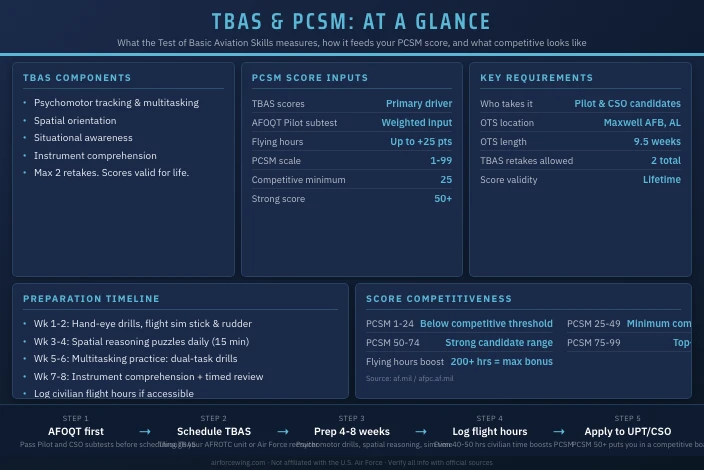
What the TBAS Tests
The TBAS is a computer-based assessment that measures the cognitive and psychomotor skills that predict success in aviation training. It’s not a knowledge test. You can’t study facts to ace it the way you can memorize ASVAB material. What you can do is train the underlying abilities each component measures.
There are four main testing areas.
Psychomotor tracking and multitasking is the most heavily weighted component. You’ll use a joystick to keep a crosshair centered on a moving target while simultaneously responding to other stimuli on screen. This directly simulates divided-attention cockpit tasks. Your tracking accuracy, reaction time, and ability to maintain control while distracted all feed into this score.
Spatial orientation tests how well you mentally rotate objects and understand your position relative to a reference frame. Aircraft attitude problems, where you interpret whether a plane is banking left or right based on a horizon indicator, are common formats. Strong spatial reasoning is a measurable, trainable skill.
Situational awareness measures how quickly you process multiple data streams and identify the item that doesn’t belong or requires immediate action. Think of it as pattern recognition under time pressure. You’re given a visual scene and need to pick out anomalies or answer questions about dynamic information that changes on screen.
Instrument comprehension presents cockpit instrument displays and asks you to identify the aircraft’s attitude from them. Bank angle, pitch, and heading indicators all appear in various combinations. This component rewards candidates who have spent time studying or flying with basic flight instruments.
How TBAS Feeds Into Your PCSM Score
Your PCSM (Pilot Candidate Selection Method) score is a composite number from 1 to 99. It combines three inputs:
| Input | Notes |
|---|---|
| TBAS scores | Primary driver of your PCSM |
| AFOQT Pilot subtest | Weighted input from your AFOQT |
| Flying hours | Documented civilian flight time |
The Air Force Personnel Center runs these three inputs through a statistical formula to produce a single score. The exact weighting isn’t published, but TBAS performance carries the most weight. A candidate with a weak AFOQT Pilot score can partially compensate with a strong TBAS showing, but there’s no substitute for solid psychomotor performance.
PCSM scores are calculated by AFPC after you’ve completed the TBAS. You don’t receive a PCSM score on test day.
PCSM Score Breakdown
The competitive threshold for rated aviation slots depends on the career field and the competitiveness of the board year. These benchmarks reflect general competitive ranges:
| PCSM Range | Competitive Standing |
|---|---|
| 1-24 | Below the threshold for most boards |
| 25-49 | Minimally competitive; strong everything else needed |
| 50-74 | Strong candidate range |
| 75-99 | Top-tier applicant pool |
The minimum competitive PCSM is 25. That number gets you on the board, not a slot. Most selection boards for pilot training are looking at candidates in the 50+ range. For the most competitive Undergraduate Pilot Training (UPT) boards, top candidates often score 70 or higher.
CSO (Combat Systems Officer) boards typically set a lower competitive bar than pilot boards, but a strong PCSM still distinguishes your package.
How to Prepare for the TBAS
Preparation for the TBAS looks different than studying for a written test. You’re training cognitive patterns and fine motor control, not memorizing content.
For the psychomotor and multitasking component:
- Get hands-on time with a flight simulator. Even consumer-grade software like Microsoft Flight Simulator or X-Plane trains the stick-and-rudder control habits the psychomotor section measures. An hour a day for four weeks builds real muscle memory.
- Practice dual-task activities deliberately. Keep a target centered while counting numbers read aloud. The goal is learning to split attention without losing performance on either task.
- If you have access to an Xbox or PlayStation controller, use it. Fine joystick control translates directly.
For spatial orientation:
- Work through spatial reasoning puzzles for 15 minutes daily. Free apps and test-prep workbooks both offer these. The format that helps most: mental rotation problems where you identify whether a 3D object matches a reference after rotation.
- Practice reading aircraft attitude indicators. Dozens of free resources online show attitude indicator displays. Get to where you can instantly read bank angle and pitch from a given instrument depiction.
For instrument comprehension:
- Learn the six basic flight instruments: airspeed indicator, attitude indicator, altimeter, turn coordinator, heading indicator, directional gyro. You don’t need to fly one. You need to read one.
- Spend time with instrument comprehension practice sets specific to aviation aptitude tests. Many TBAS prep resources include these in dedicated sections.
TBAS and Pilot Selection Resources
When you purchase through links on our site, we may receive compensation at no extra cost to you.
- AFOQT study guide with practice tests, covers all 12 AFOQT subtests that rated candidates share with every officer applicant
- AFOQT online preparation course, video instruction and practice for the officer qualifying test you take alongside the TBAS
TBAS Retake Rules
The TBAS allows a maximum of two retakes. That means three attempts total: your original test plus two more.
Your TBAS score is valid for life. If you took it five years ago and are now applying for a rated position, that score still counts. This also means a poor score follows you. There’s no expiration date that gives you a clean slate.
A few strategic points:
- Don’t retake the TBAS without meaningful preparation between attempts. Walking in without additional training rarely improves scores.
- Plan your prep schedule so your strongest attempt comes when you’re ready, not when you feel pressure from an application deadline.
- If you performed significantly below expectations on your first test due to illness or other circumstances, document that. It gives context if you request a retake.
Maximize Your PCSM Score
- AFOQT study guide, covers every composite that feeds your rated officer selection package
- AFOQT online course, structured practice for the verbal, quantitative, and aviation subtests
Flying Hours: How They Boost Your PCSM
Civilian flight hours are the one PCSM input you can control after the test is over. The formula gives measurable credit for documented flight time.
The hours bonus scales up significantly with more time in the cockpit:
| Flight Hours | Approximate PCSM Effect |
|---|---|
| 0 hours | No bonus |
| 1-20 hours | Small but real improvement |
| 21-100 hours | Meaningful gain |
| 101-200 hours | Substantial improvement |
| 200+ hours | Maximum bonus applied |
Getting a private pilot certificate requires roughly 40 hours of flight time, often more. Solo cross-country flights, ground instruction, and instrument training all count toward your logged total.
The cost runs $8,000 to $15,000 to reach private pilot, depending on your location and training pace. That’s a real barrier. But even 20 to 30 hours of instruction, short of a full certificate, still moves your PCSM in the right direction.
If a local flying club or university flight program offers discounted rates, that’s worth investigating. AFROTC detachments sometimes have informal relationships with flight schools. Ask your recruiting officer or detachment commander.
More Information
To schedule the TBAS, contact your AFROTC detachment or Air Force Officer Accessions recruiter. The test is not walk-in. You’ll need to be at a point in the application process where a rated position is being actively considered.
Official information on rated officer selection is published by the Air Force Personnel Center. Rated board timelines, PCSM calculation details, and accession requirements are updated there as policies change.
For the AFOQT requirements that come before the TBAS in your application timeline, see our AFOQT study guide. If you’re still working through earlier test requirements, the ASVAB study guide covers the foundational subtests.
Browse Air Force officer careers for a full picture of the rated and non-rated paths available at commissioning. For specifics on the career fields that require TBAS scores, see the 11X Pilot and 12X Combat Systems Officer profiles.
Start Your Pilot Preparation
- AFOQT preparation course, build the foundation for the officer qualifying test you take before rated boards
- AFOQT study guide, full walkthrough of every subtest and composite that matters for pilot selection
This site is not affiliated with the U.S. Air Force or any government agency. Verify all information with official Air Force sources before making enlistment or career decisions.