How to Ace the Air Force PiCAT: Ethical Hack (2026)
When you purchase through links on our site, we may receive compensation at no extra cost to you.
The Pending Internet Computerized Adaptive Test (PiCAT) lets you take the ASVAB from home, on your own time, with no clock running. That sounds easier. In one way it is. But the test has a catch most applicants miss until it is too late.
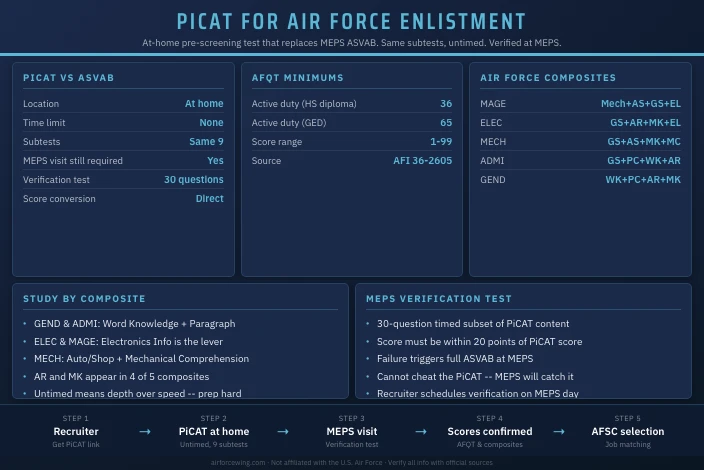
After you finish the PiCAT, you go to MEPS for a short proctored verification test. That one is timed. If your verification performance does not match your PiCAT score closely enough, your PiCAT results are discarded and you sit for the full ASVAB on the spot. Under time pressure. After you already thought you were done.
The applicants who fail verification did not fail because the test was hard. They failed because they built surface recognition at home instead of real understanding. This guide prevents that.
Start here (the 3-step path)
- Confirm with your recruiter that you are eligible for the PiCAT and find out when your access window expires.
- Take one full timed practice test under verification-style rules (no notes, no pauses, quiet room).
- Follow the 30-day plan below until your practice score is repeatable across at least two full tests on different days.
- PiCAT and ASVAB online course: Timed practice tests for every subtest the PiCAT covers.
- PiCAT and ASVAB Guide Book: Full-length exams scored by subtest. Start with the diagnostic.
- ASVAB Flashcards Daily vocabulary and formula reps. Builds the quick recall verification demands.
PiCAT basics you must understand before studying
What the PiCAT is (and what it is not)
The PiCAT is an unproctored version of the computer-based ASVAB. You take it away from MEPS, often at home.
The content base is the same. Your scores still feed AFQT and the five Air Force composites (MAGE, ELEC, MECH, ADMI, GEND). Those composites still decide which AFSCs are open to you.
| Factor | PiCAT | Standard CAT-ASVAB |
|---|---|---|
| Location | Approved location, often home | Proctored MEPS or test site |
| Format | Computer adaptive in some sections | Computer adaptive |
| Time limit | No per-question time limit | Per-section time limits |
| Content | Same nine ASVAB subtests | Same nine ASVAB subtests |
| Follow-up | Proctored verification test required | No separate verification test |
| Main risk | Inflated or unstable score | Test-day pressure |
The PiCAT is not “easier.” It is the same test in a different room. Anyone who treats it as a chance to inflate their score gets caught at verification.
Who is eligible for the PiCAT
PiCAT is available only to applicants who have not previously taken the ASVAB. If you have already tested at MEPS or another testing site, you are not eligible.
PiCAT availability is also controlled by your recruiter. Ask three direct questions:
- Am I eligible for PiCAT?
- When does my access window expire?
- Where and when would I take the verification test?
The access code is typically valid for a limited window (often 30 days). Build your study schedule backward from that expiration, not forward from today.
The untimed advantage and its hidden risk
The PiCAT has no per-question time limit. You can take as long as you need on each problem.
Used well, that is an advantage. Read every question fully. Check your math. Eliminate wrong answers carefully. The absence of a clock lets you maximize accuracy.
Used poorly, it is a trap. If you spend 10 minutes per question to grind out an answer that you could not solve in 90 seconds, your at-home score reflects deliberation, not ability. The verification test will then expose the gap.
A practical rule: spend 1 to 3 minutes per math question and 30 to 90 seconds per verbal or knowledge question. That pace is careful enough to catch errors but sustainable enough that your performance is real.
PiCAT versus CAT-ASVAB decision
| Situation | Better fit | Reason |
|---|---|---|
| You have a quiet room and follow rules well | PiCAT | The lower-stress setting may help your focus |
| You need a score quickly | CAT-ASVAB at MEPS | It avoids a separate verification step |
| You practice honestly without notes | PiCAT | Your verification score is more likely to match |
| You rely on open-book practice | CAT-ASVAB after more study | Verification will expose the gap |
| You freeze in crowded rooms | PiCAT if your recruiter offers it | The test setting may reduce pressure |
Do not choose PiCAT because it feels easier. Choose it only if your practice score is real and repeatable.
The MEPS verification test (the make-or-break step)
The verification test is the trust check. It asks whether your proctored performance at MEPS matches your at-home PiCAT score closely enough to accept the PiCAT result.
If your verification performance matches, your PiCAT score becomes your official ASVAB score of record. If it does not match closely enough, you take the full ASVAB at MEPS that day. The PiCAT result is discarded.
What verification is checking
The verification test is not trying to trick you. It is trying to confirm that the skills shown at home are actually yours.
Stable scores usually come from honest prep:
- Timed practice without notes
- No internet help during practice sets
- A quiet room that matches the testing routine
- Review of missed questions before each new practice test
- A score trend that holds across several sessions
Unstable scores usually come from open-note habits, rushed practice, or outside help during the at-home test.
The verification window
The verification test is shorter than a full ASVAB, typically 25 to 30 minutes. It samples your skills across the four AFQT subtests and some technical sections.
The bar is not “every answer must be right.” The bar is “your proctored performance is plausibly the same person who took the PiCAT.”
What happens if verification fails
If your verification scores deviate too much from your PiCAT scores, the PiCAT is discarded and you take the full ASVAB at MEPS that same day. Your full ASVAB result becomes your official score of record.
The PiCAT cannot be retaken. If verification fails, you proceed under standard ASVAB retesting rules: 1 month wait after the first attempt, 1 month after the first retest, 6 months after that.
How to reduce verification risk
Verification risk drops when your practice sessions look like the real process.
Set these rules before your next full practice test:
- Same desk each time
- Phone outside the room
- Scratch paper only
- No pausing the timer
- No answer checking until the section ends
Take two full practice tests on different days. If the scores are close, your skill is more stable. If they swing hard, study more before using the PiCAT link.
| Score pattern | What it means | Next move |
|---|---|---|
| Two close scores above target | Good stability | Schedule only after recruiter confirms timing |
| One high score and one low score | Weak repeatability | Drill missed sections and retest |
| Strong untimed score, weak timed score | Pacing problem | Do shorter timed sets daily |
| Good at home, poor under quiet-room rules | Practice habits are too loose | Use verification-style rules for a week |
Air Force score planning still matters
The PiCAT does not change Air Force score logic. You still need to care about AFQT first (36 minimum for HS diploma, 65 for GED), then the composites your target AFSCs require.
| Composite | Built from | AFSC families |
|---|---|---|
| MAGE | MC + AS + GS + EI | Aircraft maintenance, vehicle ops |
| ELEC | GS + AR + MK + EI | Cyber, electronics, communications |
| MECH | GS + AS + MK + MC | Aerospace, engine, hydraulic systems |
| ADMI | GS + PC + WK + AR | Intelligence, paralegal, force support |
| GEND | WK + PC + AR + MK | Medical, cyber-adjacent, broad assignment |
Key insight: GEND uses the same four subtests as the AFQT (WK, PC, AR, MK). When you study for AFQT, you are also studying for GEND. Since GEND drives many of the most popular AFSCs (cyber, intelligence, medical), AFQT prep and GEND prep are the same work.
If you have not built a target AFSC list yet, pause here and use the Air Force ASVAB study guide. PiCAT prep works best when you know which composites you need.
Build a score cushion before you schedule
| Current practice result | Planning move |
|---|---|
| Below minimum | Do not schedule yet |
| At or barely above minimum | Study until you have margin |
| 10 to 15 points above target | Better scheduling range |
| High but unstable | Keep practicing under verification rules until two sessions match |
Your PiCAT study plan (choose 7, 14, 30, or 60 days)
The best PiCAT plan has two goals at the same time. First, raise the score. Second, make the score repeatable during verification.
How many hours you actually need
- 7 days: Scores already at target. 60 to 90 minutes a day for a stability check.
- 14 days: Close, but one or two sections drag. 90 minutes a day.
- 30 days (recommended): Real score jump plus stable verification. 60 to 90 minutes a day, 5 to 6 days a week.
- 60 days: Rebuilding fundamentals. 45 to 75 minutes a day.
The daily routine that works
Each study day uses this loop:
- Learn one skill (15 to 25 minutes), one topic at a time
- Timed practice set (20 to 30 minutes), no notes, no pause, same desk
- Review with error log (15 to 25 minutes), fix patterns, redo missed questions correctly
- Quick retention (5 minutes), flashcards from your error log
This matches verification-style rules, so the discipline does not need to “switch on” the day you test.
The 30-day plan (best default for Air Force PiCAT applicants)
| Week | Goal | What you do on study days | Checkpoint |
|---|---|---|---|
| Week 1 | Build a real baseline | Full practice test under PiCAT rules + AR/WK fundamentals + error log | Mini-test: AR + WK |
| Week 2 | Raise score drivers | AR, MK, WK, PC daily. Verification-style discipline. | Mini-test: MK + PC |
| Week 3 | Add composite work | Keep core in maintenance. Add GS, EI, MC, or AS for your target composites. | Mixed test |
| Week 4 | Make it repeatable | Two full timed tests under PiCAT rules. Compare. | Final test, decide whether to use the PiCAT link |
- PiCAT and ASVAB online course: Built-in daily schedule, timed sets, and full practice tests.
- PiCAT and ASVAB Guide Book: Follow the same 30-day plan using the book's lessons and drill sets.
- ASVAB Flashcards Add daily reps for vocabulary and formulas. Five minutes a day.
Two-session stability is the verification gate. If your two Week 4 tests are within roughly 5 AFQT points of each other and both above your target, you are ready. If they swing wider, keep working on stability.
The 7-day plan (last-week stability check)
Only if your scores are already at target.
- Day 1: Full timed practice test (PiCAT rules)
- Day 2: AR drill + error log review
- Day 3: MK drill + error log review
- Day 4: WK + PC drills, daily vocabulary review
- Day 5: Technical subtests tied to target composite
- Day 6: Full timed practice test. Compare to Day 1.
- Day 7: Light error log review
If Day 1 and Day 6 are within 5 points, your score is stable. If they swing wider, delay the PiCAT.
The 14-day plan
- Days 1 to 6: build AR, MK, WK, PC fundamentals under PiCAT rules
- Day 7: full timed test + deep error log review
- Days 8 to 13: focus on two weakest sections + technical sections
- Day 14: second full test. Compare to Day 7.
The 60-day plan
- Weeks 1 to 4: core skills (AR, MK, WK, PC), slower pace, deeper review
- Weeks 5 to 6: add technical sections for your target composites
- Weeks 7 to 8: two full PiCAT-style tests, error log cleanup, stability check
Section-by-section game plan
Use this section as a playbook. Pick the subtest you are working on today and follow the steps in order. Keep your error log open while you practice.
Arithmetic Reasoning (AR)
AR is the highest-impact subtest. It feeds three composites (ELEC, ADMI, GEND) and is one of the four AFQT subtests.
What to study first
- Percents: percent of, percent change, discounts
- Ratios and proportions
- Rates: distance/time, work rate, unit pricing
- Averages and basic probability
- Multi-step word problems
The 5-step translation method
- Underline what the question asks. Circle the unit.
- List the given numbers with units.
- Choose the operation plan.
- Compute carefully. One step per line.
- Sanity check. Compare answer size to inputs. Check units.
Common AR traps and fix rules
| Trap | Fix rule |
|---|---|
| “More than” / “less than” flips | Translate the phrase to a sentence before writing math |
| Percent of vs percent off | “Of” means multiply. “Off” means subtract from total. |
| Unit mismatch | Put units next to every number until the end |
| Round too early | Keep full decimals until the last step |
AR drills + mastery check
- Percent sprint: 10 problems, 12 minutes
- Rate sprint: 10 problems, 12 minutes
- Two-step mix: 15 problems, 20 minutes
Ready when: percent and ratio misses are rare, misses cluster into one or two patterns, setups look neat.
Mathematics Knowledge (MK)
MK feeds ELEC, MECH, and GEND. Direct math, not word problems.
What to study first
Algebra, order of operations, exponents, linear equations, geometry (area, perimeter, volume, angles), basic inequalities.
Method: write less, win more
Rewrite cleanly. One move per line. Check by plugging in.
MK formula list
- Rectangle area: A = lw
- Triangle area: A = 1/2 bh
- Circle area: A = πr²
- Circle circumference: C = 2πr
- Rectangular prism volume: V = lwh
- Slope: m = (y₂ − y₁) / (x₂ − x₁)
- Pythagorean theorem: a² + b² = c²
MK mastery check
Ready when: you solve linear equations without pausing, catch sign errors before logging them, geometry feels like formula application.
Word Knowledge (WK) and Paragraph Comprehension (PC)
WK and PC together feed VE through GEND and ADMI. Daily flashcard work plus evidence-based reading practice. For PC, point to the supporting sentence for every answer before you commit.
Technical sections (brief notes)
If your target AFSCs require MAGE, ELEC, or MECH:
- General Science (GS): biology, chemistry, earth science, physics terms. Feeds four composites.
- Electronics Information (EI): Ohm’s law (V=IR), series and parallel circuits, basic components.
- Mechanical Comprehension (MC): levers, gears, pulleys, pressure, simple machines. Draw the system.
- Auto and Shop (AS): hand tools, engine parts, drivetrain, four-stroke cycle.
- Assembling Objects (AO): does not feed any AF composite. Skip unless time is plentiful.
- PiCAT and ASVAB Guide Book Full-length timed practice tests to feed the review method. Score by subtest and verify under time pressure.
- ASVAB Flashcards Daily vocabulary roots and math formula reps. Builds the quick recall verification demands.
How to practice for verification
Your practice rules should match the verification problem. You need to prove the score without notes, help, or extra time.
The verification-style practice rules
- Phone off and out of the room
- No notes, no open browser tabs, no other people in the room
- Timer running
- Scratch paper only for math
- Answer review only after the section ends
- Error log after scoring, not during
The error log
For every missed question, record:
- Section
- Mistake type: concept gap, misread, rushed math, bad guess, ran out of time
- Fix rule: one sentence
- One redo: solve the question again correctly, without looking
When you review, do not reread your notes. Redo the question. That is where the learning sticks.
What not to do during PiCAT prep
- Taking practice tests with notes nearby
- Looking up formulas during timed sections
- Pausing a section when you get stuck
- Letting someone else explain questions during the test window
- Treating the at-home score as final before verification
What to do after your PiCAT
After you finish the PiCAT, do not stop studying. The verification test may happen days or weeks later. Skills fade fast when you stop touching them.
Use the waiting period like this:
- 10 minutes of vocabulary or formulas each day
- One short math set every other day
- One reading set every other day
- One review of your error log before verification
- No open-note practice
Decay timeline to watch
| Days since PiCAT | Risk level | Action |
|---|---|---|
| 1-3 days | Low | Light maintenance is fine |
| 4-7 days | Moderate | Daily 15-minute loop matters |
| 8-14 days | High | Add a full verification rehearsal at day 10 |
| 15+ days | Very high | Daily loop plus 2 verification rehearsals in the final week |
The day before verification
Light review only. Confirm logistics and required ID. Real bedtime.
The morning of verification
Eat something simple with protein. Arrive early and calm. One question at a time. Use the same methods you practiced.
If verification fails
This is recoverable. Treat it as a signal that your at-home score was not repeatable enough.
First, identify the gap:
- Which sections felt worse under supervision?
- Which misses came from time pressure?
- Which misses came from weak content?
- Which composite do you actually need for your target AFSC?
Then move to the Air Force ASVAB study guide and rebuild around the weak sections.
Retest planning after a full ASVAB
MEPS waiting rules: 1 month after the first attempt, 1 month after the first retest, 6 months after that. The Air Force uses your most recent score, not your highest. A rushed retake that drops can cost you the AFSC options the first score earned.
The PiCAT itself cannot be retaken. If verification fails, you proceed under standard ASVAB retesting rules.
Best Air Force PiCAT prep options (course vs book vs flashcards)
You do not need a paid tool to use this plan. A paid tool is useful only if it helps you practice honestly and repeat the score under supervision.
What good prep must include
- Timed practice across the ASVAB subtests
- Answer explanations that teach the missed concept
- Practice that can be done without notes
- Progress tracking by section
- A way to review mistakes
If you want the fastest improvement: a structured online course
Best for applicants who need a daily plan and tend to skip review without one. Use it for timed sets and weak-section review, not passive video time.
- Get this PiCAT and ASVAB online course we recommend for Air Force applicants. Structured lessons covering every subtest the PiCAT and verification test use.
If you want low cost and simple: a guide book
Best for self-starters with discipline and time. Take the diagnostic first. Read the chapters for your weakest sections first. Use the book’s full tests as weekly checkpoints under PiCAT rules.
- PiCAT and ASVAB Guide Book (Print or Digital): Follow this same game plan using the book's lessons and drills.
If you want daily reps: flashcards
Best for WK growth, MK formula recall, and GS term retention. They cover the small facts that fade between PiCAT and verification.
- ASVAB Flashcards: Portable cards for daily drilling. Covers the same content the PiCAT tests.
The best combo for most applicants
- Primary tool: online course or a good book
- Support tool: flashcards built from your error log
FAQs
Is the PiCAT easier than the ASVAB?
No. The PiCAT is the same test in a different room. The content base, the adaptive format on some sections, and the scoring are identical.
Can I look up answers during the PiCAT?
Technically yes, since there is no proctor. Practically, doing so destroys the score. Verification at MEPS will catch the gap, the PiCAT result will be discarded, and you will take the full ASVAB that day. The PiCAT is a one-time path. Treating it as a chance to cheat throws it away.
How long does the PiCAT take?
Most applicants finish in 2 to 3 hours. There is no per-question time limit, but the test has an overall completion window (often 48 hours from start).
What happens at MEPS after the PiCAT?
You take the verification test, typically 25 to 30 minutes. If verification performance matches, the PiCAT becomes your score of record. If not, you take the full ASVAB that day.
Should I take the PiCAT or the ASVAB?
PiCAT if you focus better in a quiet room, follow rules without a proctor, your recruiter offers it, and your practice scores are at target. Proctored ASVAB if your timeline is tight, you study with notes, or your practice scores swing widely.
What if I score lower on verification?
If verification deviates too much from PiCAT, the PiCAT is discarded. You take the full ASVAB at MEPS that day. The full ASVAB becomes your score of record. The PiCAT cannot be retaken.
Do Air Force recruiters prefer PiCAT or ASVAB?
Recruiter preferences vary by station. Some default to PiCAT to reduce scheduling friction at MEPS. Others prefer to send everyone through the proctored ASVAB. Ask whether you are eligible if it has not been offered.
What is the single biggest mistake applicants make with PiCAT prep?
Practicing with notes, then losing the score at verification. The PiCAT is not a different test. The bar is the same as the proctored ASVAB.
For section-level ASVAB prep, use the Air Force ASVAB study guide. Officer applicants need the AFOQT, and rated officer candidates also need the TBAS.