PiCAT Study Guide for the Air Force
Most recruits sit down for a timed ASVAB at a Military Entrance Processing Station, often on their first visit. The PiCAT skips that. You take it at home, without a time limit, before you ever set foot at MEPS. Your recruiter sends you a link, you complete all nine subtests on your own schedule, and your scores feed directly into the Air Force’s job selection process.
The PiCAT doesn’t replace the MEPS experience entirely, you still go in for the verification test, but it changes the pressure dynamic in your favor. Here’s everything you need to know to use it well.
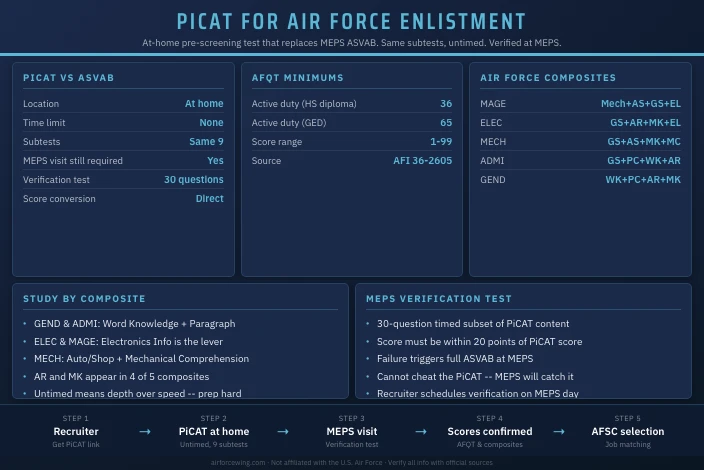
What the PiCAT Is
PiCAT stands for Pending Internet Computerized Adaptive Test. The Department of Defense created it as an alternative entry point for the standard ASVAB. Scores convert directly to ASVAB-equivalent scores, so Air Force recruiters and job counselors treat them the same way.
The test covers all nine ASVAB subtests:
- General Science (GS)
- Arithmetic Reasoning (AR)
- Word Knowledge (WK)
- Paragraph Comprehension (PC)
- Mathematics Knowledge (MK)
- Electronics Information (EI)
- Auto and Shop Information (AS)
- Mechanical Comprehension (MC)
- Assembling Objects (AO)
Your scores on these subtests feed into two outputs: your AFQT score and your Air Force line score composites. The AFQT determines basic eligibility. The composites determine which jobs you qualify for.
How the PiCAT Works
Your recruiter provides access through a secure DoD portal. You complete the test on your own device, in your own space, at whatever pace you want.
There is no time limit. The adaptive format means the difficulty of questions adjusts based on your answers, similar to how the standard ASVAB behaves at MEPS. The total number of questions is roughly the same as the ASVAB, but the experience feels different when you’re not watching a clock.
A few important ground rules apply:
- You may only take the PiCAT once before your MEPS visit
- You must complete it honestly. MEPS will verify your results
- You cannot look up answers or use outside help during the test
That last point isn’t just an honor rule. MEPS runs a verification test specifically to confirm your PiCAT scores are real.
PiCAT vs. ASVAB at MEPS
The PiCAT and the standard ASVAB test the same content. What differs is the setting, the timing structure, and what happens afterward.
| Factor | PiCAT | ASVAB at MEPS |
|---|---|---|
| Location | At home | MEPS test center |
| Time limit | None | Strictly timed per subtest |
| When | Before MEPS visit | During MEPS visit |
| Retake policy | Once before MEPS | 30-day wait for retakes |
| Verification required | Yes (30 questions at MEPS) | No |
| Score use | Same as ASVAB | Same as PiCAT |
The practical upside is meaningful. You can take the PiCAT on a Tuesday morning when you’re rested, not after a three-hour drive to MEPS on a Wednesday when you slept four hours. That alone can move scores.
The downside is the verification step. If your PiCAT score doesn’t hold up at MEPS, you’ll end up taking the full computerized ASVAB anyway.
The MEPS Verification Test
Every PiCAT taker completes a verification test during their MEPS visit. It’s 30 questions, timed, covering the same content areas as the PiCAT. The purpose is to confirm your at-home performance was genuine.
If your verification score lands within 20 points of your PiCAT score, your PiCAT results stand and get used for job qualification. If the scores diverge beyond that threshold, MEPS will require you to take the full computerized ASVAB before any job offers proceed.
This is not a formality. The 20-point window is real and enforced. Someone who got outside help on the PiCAT, or who simply had an unusually good day at home, can end up retesting anyway.
The verification test is short, but preparation still matters. If you studied seriously for the PiCAT, the 30-question check won’t catch you off guard.
How to Study for the PiCAT
The content is identical to the ASVAB. Every study method that works for the ASVAB works for the PiCAT. The difference is that you have no time limit, which removes the pacing problem but doesn’t make the material easier.
The subtests that move your Air Force scores the most:
Math (AR and MK) appears in four of the five Air Force composites. If you’re weak in arithmetic reasoning or algebra, prioritize those before anything else. One point of improvement there ripples across most job categories.
Electronics Information feeds the ELEC and MAGE composites, which gate high-demand technical jobs. If you’re aiming for anything in cyber, communications, or avionics maintenance, your EI subtest score matters.
Word Knowledge and Paragraph Comprehension drive the ADMI and GEND composites. These subtests are also two of the fastest to improve with focused vocabulary work.
A practical study sequence:
- Take a full practice test under realistic conditions, timed, no breaks, to see your baseline
- Review your weakest subtest first; don’t spread effort evenly
- Use an error log: write down every question you miss and why you missed it
- Review that log before each study session, not after
- Take another full practice test two weeks in to measure improvement
The untimed format of the PiCAT means you should push yourself to fully understand each answer, not just recognize it. At MEPS, the verification questions will be timed. If you built real understanding, that holds under pressure.
PiCAT and ASVAB Study Resources
When you purchase through links on our site, we may receive compensation at no extra cost to you.
- ASVAB and PiCAT study guide with practice tests, covers all nine subtests with detailed explanations and drills
- Online course with video lessons for every subtest, self-paced instruction built for the format both tests use
What Your PiCAT Scores Mean for Air Force Jobs
Your PiCAT produces two score types: the AFQT and the Air Force composite scores.
AFQT is your Armed Forces Qualifying Test score. It’s calculated from four subtests. AR, MK, WK, and PC, and expressed as a percentile from 1 to 99. The Air Force requires a minimum AFQT of 36 for high school diploma holders. GED holders must score at least 65.
The AFQT gates eligibility. It doesn’t determine job placement. That’s what composites are for.
Air Force composite scores group subtests into five categories per AFI 36-2605:
| Composite | Full Name | Subtests |
|---|---|---|
| MAGE | Mechanical Aptitude General Electronics | Mechanical Comprehension + Auto/Shop + General Science + Electronics |
| ELEC | Electronics | General Science + Arithmetic Reasoning + Mathematics Knowledge + Electronics |
| MECH | Mechanical | General Science + Auto/Shop + Mathematics Knowledge + Mechanical |
| ADMI | Administrative | General Science + Paragraph Comprehension + Word Knowledge + Arithmetic Reasoning |
| GEND | General | Word Knowledge + Paragraph Comprehension + Arithmetic Reasoning + Mathematics Knowledge |
Each Air Force Specialty Code (AFSC) requires a minimum score on one or more of these composites. A job in the Air Force medical career group uses different composites than a cyber operations role. Your PiCAT results will show scores across all five, and your recruiter will use them to map out which jobs are in range.
Higher composite scores don’t just open more options, they open better-funded training pipelines, more selective schools, and jobs with stronger civilian equivalency after service.
More Information
Your recruiter is the starting point for accessing the PiCAT. They provide the login link and handle scheduling your MEPS visit once you complete the test. If you haven’t spoken with a recruiter yet, Air Force enlisted careers gives you an overview of the groups and AFSCs to research before that conversation. High-demand AFSCs worth researching before your PiCAT include 4N0X1 Aerospace Medical Technician, 1B4X1 Cyber Warfare Operations, and 2A3X3 Tactical Aircraft Maintenance.
For deeper preparation strategy, the Air Force ASVAB study guide covers test-taking tactics and time management that apply directly to the MEPS verification test.
Prepare for Your PiCAT
- PiCAT and ASVAB study guide, full review with practice questions for all nine subtests
- Online video course, structured lessons for every ASVAB subtest, the same content the PiCAT tests
This site is not affiliated with the U.S. Air Force or any government agency. Verify all information with official Air Force sources before making enlistment or career decisions.