How to Ace the Air Force ASVAB: Ethical Hack (2026)
When you purchase through links on our site, we may receive compensation at no extra cost to you.
You take the Armed Services Vocational Aptitude Battery (ASVAB) once to get your first set of Air Force options. After that, your score shapes almost everything: which AFSC you can qualify for, how much flexibility your recruiter has, and how fast you can lock in a job you actually want.
This guide gives you a simple plan that works, plus the Air Force-specific score basics most applicants learn too late.
Start here (the 3-step path)
- Take a baseline practice test today. You need a starting point before you “study hard.”
- Pick 5 to 10 target Air Force AFSCs you would accept. That list tells you which subtests matter most.
- Follow the 30-day plan in this guide. It is built around the Air Force composite scores: MAGE, ELEC, MECH, ADMI, and GEND.
- ASVAB online course: Timed practice tests with progress tracking. Tells you exactly where you stand.
- ASVAB Guide Book: Full-length exams scored by subtest. Start with the diagnostic test.
- ASVAB Flashcards Daily vocabulary and formula reps to build alongside your study plan.
ASVAB basics you must understand before studying
What the ASVAB measures (and what it does not)
The ASVAB measures skills, not character. It checks how well you can solve problems, understand written information, and work with technical and mechanical ideas.
A strong score can open more Air Force AFSCs. A weak score can block them, even if you are motivated and in great shape.
AFQT vs line scores (the difference that decides your options)
You will hear two score types. They are not the same thing.
AFQT (Armed Forces Qualification Test)
- This is the score used to decide if you qualify to enlist.
- It is a percentile from 1 to 99.
- It is built from four ASVAB subtests: Arithmetic Reasoning (AR), Mathematics Knowledge (MK), Paragraph Comprehension (PC), and Word Knowledge (WK).
- PC and WK combine into a Verbal Expression (VE) score used in the AFQT math.
Line scores (also called composite scores)
- The Air Force uses five: MAGE, ELEC, MECH, ADMI, and GEND.
- Each AFSC has a minimum on one or two composites.
- One weak area can block the AFSC you actually want, even when your AFQT is high.
Simple example: Two applicants can both score AFQT 70, but one qualifies for cyber and electronics AFSCs because their AR, MK, and EI subtests are stronger. The other qualifies for far fewer technical fields. Same AFQT, different options.
Computer adaptive format (CAT-ASVAB)
The ASVAB is computer adaptive. The test adjusts question difficulty based on your answers. Get a question right, and the next one gets harder. Get one wrong, and it gets easier.
That changes your strategy:
- Early questions carry more weight. The first 5 to 10 questions in each section set the difficulty range. Rushing them costs you disproportionately.
- You cannot skip questions or go back. Once you answer, it is locked.
- Time management is section-by-section. Each subtest has its own clock. You do not get to borrow time from one section to use on another.
The adaptive format rewards accuracy over speed, especially at the start of each section.
Where you take it (MEPS) and why that matters
Most applicants test at a Military Entrance Processing Station (MEPS). MEPS is a joint Department of War organization that processes applicants for every service.
That matters because:
- Testing rules are standardized.
- The retest schedule follows a set policy.
- Your results feed directly into the systems your recruiter uses to qualify you for AFSC options.
Retakes and timing rules (know this before you gamble)
Retesting is possible, but it is not instant.
The MEPCOM rule is:
- Wait 1 calendar month after your first test to retest.
- Wait another 1 calendar month after your first retest to test again.
- After that, wait 6 months between later retests.
The Air Force uses your most recent ASVAB score, not your highest. If you retake and score lower, that lower number is what your recruiter works with. You cannot fall back to a previous result.
Do not retest “just to see.” Retest when your practice results show a real, stable jump.
Air Force enlistment scores and AFSC qualification, explained simply
The minimum to enlist vs the score that gives you choices
Plan for two targets, not one.
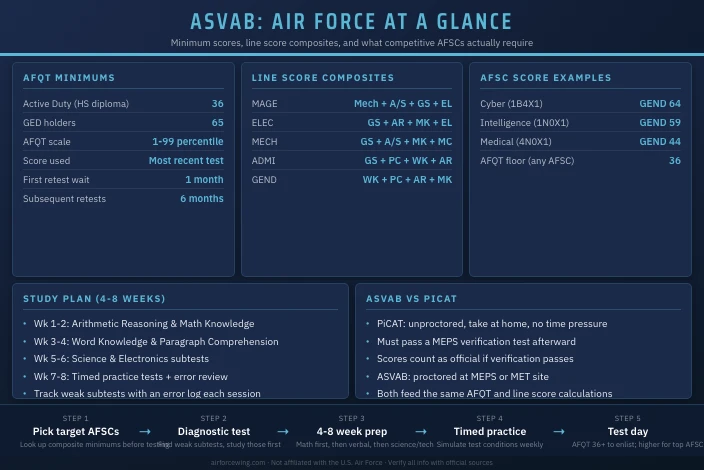
Target 1: Qualify to enlist. The Air Force minimum AFQT is 36 for applicants with a high school diploma and 65 for GED holders. The Air Force accepts very few GED-only applicants, and those who qualify usually score well above the general minimum.
Target 2: Qualify for the AFSC you want. The minimum gets you in the door. It does not guarantee good options. Most desirable AFSCs require composite scores well above the enlistment floor. An AFQT of 50 gives you a reasonable selection. An AFQT of 70 or higher gives you access to most career fields.
If you want flexibility, plan to score well above the minimum.
The five Air Force composites
Air Force composite scores are built from ASVAB subtests. The formulas matter because they tell you exactly where to spend study time.
| Composite | Built from | What to study first |
|---|---|---|
| MAGE | MC + AS + GS + EI | Mechanical reasoning, tools, science, electronics |
| ELEC | GS + AR + MK + EI | Science, math, electronics |
| MECH | GS + AS + MK + MC | Science, tools, math, mechanical reasoning |
| ADMI | GS + PC + WK + AR | Science, reading, vocabulary, word problems |
| GEND | WK + PC + AR + MK | Vocabulary, reading, word problems, algebra |
Key insight: GEND is built from the exact same four subtests as the AFQT (WK, PC, AR, MK). If you study to maximize your AFQT, you are also maximizing your GEND score. Since GEND is required for many of the most popular AFSCs (cyber, intelligence, medical), AFQT prep and GEND prep are the same work.
AR appears in three composites (ELEC, ADMI, GEND). GS appears in four (MAGE, ELEC, MECH, ADMI). MK appears in three (ELEC, MECH, GEND). That overlap means improving math and science moves multiple composites at once.
How the Air Force actually matches you to an AFSC
The Air Force uses composite minimums to set the gate for each AFSC. Some AFSCs require minimums on two composites. A few examples:
- 1B4X1 Cyber Warfare Operations: ELEC 70
- 1N0X1 All-Source Intelligence Analyst: ADMI 60
- 4N0X1 Aerospace Medical Technician: GEND 50
Check the profile page for each AFSC on your target list for its composite minimums. Then identify which subtests feed those composites. Everything else is secondary.
Build your AFSC target list before you study
Do not start with one dream job and no backup. AFSC availability depends on the needs of the Air Force, your scores, medical screening, moral screening, timing, and open contracts.
Build a short list that gives your recruiter room to work.
| List | What to include | Why it matters |
|---|---|---|
| First choice | The AFSC you would pick if every gate opened | Sets your top score target |
| Strong backups | 3 to 5 AFSCs you would still accept | Keeps one closed gate from ending the process |
| No-go AFSCs | Jobs you would not sign for | Prevents pressure decisions at contract time |
After you have the list, mark the composite that appears most often. If GEND shows up across most of your preferred AFSCs, GEND is your first target. If ELEC or MECH controls your technical options, shift study time there.
Good score planning is specific. “I want a better ASVAB score” is too vague. “I need more AR and EI because ELEC controls most of my list” is a plan.
Your next step (before you study hard)
Do this in order:
- List 5 to 10 Air Force AFSCs you would accept.
- Look up the composite minimums for each.
- Circle the subtests that appear most often. Those are your study priority.
The fastest way to raise your score (the score-priority approach)
Most ASVAB gains come from two moves: study the sections that drive your score, and turn every mistake into a rule you do not miss again. This section shows the method that gets you there without wasting hours.
The score-priority rules (what high scorers do differently)
Rule 1: Earn points where the test gives them fastest. For most Air Force applicants, that means AR, MK, WK, PC, and GS first. Those five feed your AFQT and your most-used composites (GEND, ADMI, ELEC, MECH).
Rule 2: Fix accuracy before speed. Speed only helps after you stop making the same errors. On the CAT-ASVAB, the adaptive algorithm rewards a correct answer on a hard question more than two correct answers on easy ones.
Rule 3: One notebook runs the whole prep. That notebook is your error log. It is the fastest way to turn weak areas into strong ones.
The 80/20 topics that move scores the most
These are the topics that show up often and pay off quickly. If your time is limited, start here.
| Subtest | Highest-payoff skills | What “good” looks like |
|---|---|---|
| Arithmetic Reasoning (AR) | Percent, ratios, rates, averages, multi-step word problems | You translate words into math cleanly and check units |
| Math Knowledge (MK) | Linear equations, basic algebra, exponents, simple geometry | You solve without guessing and catch sign mistakes |
| Word Knowledge (WK) | Common roots, prefixes, suffixes, context clues | You eliminate wrong choices fast |
| Paragraph Comprehension (PC) | Main idea, best-supported answer, inference | You match answers to what the passage actually says |
| General Science (GS) | High school biology, chemistry, earth science, physics basics | You recognize core terms and apply simple concepts |
AR is not “hard math.” It is reading plus math. Many Air Force applicants lose points because they rush the reading part.
The technical subtest trap: Some applicants spend weeks studying Electronics Information and Mechanical Comprehension because those topics feel hard. But if your target AFSCs only require GEND or ADMI, those hours are wasted. Always check your composite requirements before deciding what to study.
The “fix your weakest first” method (simple and ruthless)
This is the highest-return way to plan your week.
- Take one baseline practice set per key section. Keep it short. Aim for 15 to 25 questions each.
- Rank your sections by pain level. Focus only on the ones that feed your target composites.
- Attack one weak section for 5 straight days. Do not bounce around. Reps matter.
- Retest that section on day 6. If it improves, move it into maintenance and start the next weak area.
Steady focus builds a skill stack. Scattered studying builds stress.
The error log that turns missed questions into points
Your error log is not a list of wrong answers. It is a list of patterns.
For every missed question, record:
- Section: AR, MK, WK, PC, GS, EI, MC, AS, or AO
- Mistake type: concept gap, misread, rushed math, bad guess, ran out of time
- Fix rule: one sentence that prevents the miss next time
- One redo: solve the same question again, correctly, without looking
Common mistake types that show up across Air Force applicants, with clean fix rules:
- Misread the question: Circle what the problem is asking before you compute.
- Dropped a negative sign: Write signs large and check them after each step.
- Percent confusion: Convert percent to decimal before you multiply.
- Rate problems: Write units on every number so the math stays honest.
- Vocabulary guess: Eliminate two choices first, then pick from the best two.
When you review, do not reread your notes. Redo the question. That is where the learning sticks.
Do this today and this week
Today:
- 25 minutes of AR practice (timed), then log every miss using the format above.
This week:
- One full verbal block (WK + PC) and one full math block (AR + MK). Review both with your error log.
Your Air Force ASVAB study plan (choose 7, 14, 30, or 60 days)
A good plan does two things at the same time. It builds skills, and it builds test stamina. You need both to score high.
This section gives you four timelines. The daily structure stays the same. The only change is how fast you cycle through topics.
How many hours you actually need (based on your starting point)
Use your baseline practice results to pick a track:
- 7 days: You already score near your target and you need a final polish. Plan 60 to 90 minutes a day.
- 14 days: You are close, but one or two sections drag you down. Plan 90 minutes a day.
- 30 days (recommended for most applicants): You want a real score jump without burning out. Plan 60 to 90 minutes a day, 5 to 6 days a week.
- 60 days: You are rebuilding fundamentals or you have been out of school for a while. Plan 45 to 75 minutes a day, 5 to 6 days a week.
If you can only do 30 minutes, do not quit. Tight sessions still work when you stay consistent and log mistakes.
The daily routine that works (skills + timed practice + review)
Each study day uses this loop:
- Learn one skill (15 to 25 minutes) Focus on one topic, not a whole chapter.
- Timed practice set (20 to 30 minutes) Use a small set. Stay strict on time.
- Review with an error log (15 to 25 minutes) Fix patterns. Redo missed questions correctly.
- Quick retention (5 minutes) A short flashcard run or formula review.
This routine keeps you moving. It also prevents the common trap of “studying” without improving.
The 30-day plan (best default for Air Force applicants)
This plan puts the score drivers first, then adds technical sections as needed for your target composites.
Weekly rhythm
- Mon to Thu: two core sections (math + verbal)
- Fri: targeted weak-area day
- Sat: practice test and deep review
- Sun: rest or light review only
30-day plan table
| Week | Main goal | What you do on study days | What you do on checkpoint day |
|---|---|---|---|
| Week 1 | Build clean fundamentals | AR focus (word problems) + WK/PC basics. Short timed sets. Heavy error log. | 1 mini-test: AR + WK. Review every miss. |
| Week 2 | Raise speed without losing accuracy | MK focus (algebra, geometry) + PC reading strategy. Timed sets get slightly longer. | 1 mini-test: MK + PC. Update your weak-topic list. |
| Week 3 | Add Air Force composite work | Keep AR/MK in maintenance. Add GS, EI, MC, or AS based on whether MAGE, ELEC, or MECH controls your list. | 1 mixed test across your needed sections. Deep error log review. |
| Week 4 | Perform like it is test day | More full-length practice. Fewer new lessons. More timed sets and review. | 1 full practice test. Score it. Build a final 7-day tune-up list. |
- ASVAB online course: Built-in daily schedule, timed sets, and full practice tests.
- ASVAB Guide Book: Follow the same 30-day plan using the book's lessons and drill sets.
- ASVAB Flashcards Add daily reps for vocabulary and formulas. Five minutes a day.
If you already have a book, keep it. Use the error log method and follow this plan.
What to track each day
- Total timed questions completed
- Accuracy percentage for each section
- Top 3 mistake patterns from the error log
- One “fix rule” you will apply tomorrow
This tracking keeps the plan honest. You will know if you are improving or just staying busy.
The 7-day plan (fast polish)
Use this only when your baseline is already close to your goal.
- Day 1: baseline test + build error log
- Day 2: AR high-frequency topics + timed set
- Day 3: WK + PC elimination practice + timed set
- Day 4: MK algebra essentials + timed set
- Day 5: weakest section day + redo missed questions
- Day 6: full practice test + deep review
- Day 7: light review + sleep plan + logistics
Keep sessions short. Protect sleep. Do not cram new topics late.
The 14-day plan (tight improvement)
This plan uses two mini cycles.
- Days 1 to 6: build AR, MK, WK, PC fundamentals
- Day 7: full practice test + review
- Days 8 to 13: focus on your two weakest sections, then add any needed technical sections
- Day 14: full practice test + final tune-up list
The 60-day plan (steady rebuild)
This track is calmer and usually less stressful.
- Weeks 1 to 4: core skills first (AR, MK, WK, PC), slower pace, deeper review
- Weeks 5 to 6: add the technical sections that match your target composites
- Weeks 7 to 8: practice tests, timed sets, and final weak-area cleanup
The key is consistency. A steady 60 days beats a chaotic 14.
Weekly checkpoint (practice test, error log, score projection)
Once a week, do a checkpoint that forces growth:
- Take a timed practice test (full test weekly if you can, or two half-tests)
- Mark every miss in your error log with a fix rule
- Redo the missed questions correctly
- Pick two weak topics for next week’s focus
Do this today: pick your timeline, then schedule your checkpoint day on your calendar.
Section-by-section game plan (what to study and how)
Use this section like a playbook. Pick the subtest you are working on today, then follow the steps in order. Keep your error log open while you practice.
Arithmetic Reasoning (AR)
AR is the highest-impact subtest for Air Force applicants. It feeds three composites (ELEC, ADMI, GEND) and is one of the four AFQT subtests. Every AR point you gain shows up in four numbers.
What to study first (highest payoff)
Focus on these topic groups before anything else:
- Percents: percent change, discounts, tax, tip, markups
- Ratios and proportions: mixtures, scale, map style problems
- Rates: miles per hour, work rate, cost per unit, unit pricing
- Averages: mean, weighted average, “combined groups”
- Basic probability: simple odds and counting, when it appears
- Multi-step word problems: two or three operations with clean setup
The 5-step translation method
Use the same process every time. It prevents careless misses.
- Underline what the question asks for. Circle the unit if it exists.
- List the given numbers with units. Keep them in a column.
- Choose the operation plan. Add, subtract, multiply, divide, or a mix.
- Compute carefully. Write one step per line.
- Sanity check the result. Compare the size to the inputs. Check units.
If your answer unit is wrong, your setup is usually wrong.
Common AR traps and clean fixes
| Trap | What it looks like | Fix rule you write in your error log |
|---|---|---|
| “More than” and “less than” flips | 20 less than x becomes x − 20, not 20 − x | Translate the phrase into a quick sentence before you write math |
| Percent of vs percent off | 30% of 50 vs 30% off 50 | “Of” means multiply. “Off” means subtract the result from the total |
| Unit mismatch | minutes and hours mixed, dollars and cents mixed | Put units next to each number until the end |
| Wrong average | average of averages without weights | Use total sum divided by total count, not average of averages |
| Round too early | rounded a mid-step result and the final answer drifted | Keep full decimals until the last step |
AR drills that build points fast
Do these in short timed sets.
- Percent sprint: 10 problems, 12 minutes. Focus on percent of, percent change, and discount.
- Rate sprint: 10 problems, 12 minutes. Write units on every number.
- Two-step mix: 15 problems, 20 minutes. Aim for clean setup, not speed.
After each set, log every miss. Redo the missed questions correctly.
AR mastery check
You are in a good place when:
- You rarely miss percent and ratio questions.
- Your misses come from one or two patterns, not everything.
- Your setups look neat and consistent.
Math Knowledge (MK)
MK feeds ELEC, MECH, and GEND. It is direct math, not word-problem math, so the section rewards clean steps and a small formula list.
What to study first (highest payoff)
Start with the math that shows up often:
- Order of operations
- Fractions, decimals, and percent conversions
- Exponents and roots (basic rules)
- Algebra basics: solve for x, simplify expressions
- Linear equations: one variable, then two-step and multi-step
- Systems and inequalities: basic forms
- Geometry essentials: area, perimeter, volume, angles
- Coordinate basics: slope and simple graphs, when they appear
The “write less, win more” solving method
MK rewards simple, consistent steps.
- Rewrite the problem cleanly. Do not solve in your head.
- Do one move per line. This cuts sign mistakes.
- Check by plugging in. If you solve for x, test it in the original equation.
Plugging in takes seconds and saves points.
Common MK mistakes and fix rules
| Mistake | What it looks like | Fix rule you write in your error log |
|---|---|---|
| Sign errors | − becomes + during simplification | Circle negatives before you start and re-check after each line |
| Distribution errors | a(b + c) becomes ab + c | Distribute to every term inside parentheses |
| Exponent mix-ups | (x²)³ becomes x⁵ | Multiply exponents when you raise a power to a power |
| Inequality flip | divided by a negative without flipping the sign | Write “FLIP” in the margin when dividing or multiplying by a negative |
| Geometry formula gaps | blanking on area or volume | Keep a short formula list and review it daily |
The small formula list worth memorizing
Keep this list tight. You do not need a textbook.
- Rectangle area: A = lw
- Triangle area: A = 1/2 bh
- Circle area: A = πr²
- Circle circumference: C = 2πr
- Rectangle perimeter: P = 2l + 2w
- Rectangular prism volume: V = lwh
- Slope: m = (y₂ − y₁) / (x₂ − x₁)
- Pythagorean theorem: a² + b² = c²
If a formula keeps showing up in your misses, add it to your list.
MK drills that build speed without losing accuracy
- Equation ladder: 12 problems, 18 minutes. Mix two-step and multi-step equations.
- Algebra simplify set: 15 problems, 20 minutes. Focus on distribution and combining like terms.
- Geometry quick set: 10 problems, 15 minutes. Use the formula list and show units.
MK mastery check
You are ready to shift more time into timed practice when:
- You solve linear equations without pausing.
- You catch sign errors in review before you log them.
- Geometry questions feel like formula application, not guesswork.
Word Knowledge (WK)
WK feeds VE through GEND and ADMI. It is the easiest section to train in small daily blocks.
What to study first
- Common prefixes, roots, and suffixes
- High-frequency words seen in test prep sets
- Context clue habits, not random memorization
A simple method for most WK questions
- Replace the word with a simple synonym in your head.
- Eliminate choices that do not fit that meaning.
- If two remain, choose the one that fits best with the tone of the sentence.
WK drill
- Daily 10: 10 questions, 10 minutes, then add 3 new words to flashcards with a short definition. Pull cards only from words you missed, not random vocabulary lists.
WK mastery check
You are ready when you can score 80% or better on a timed 20-question WK set and you can break unfamiliar words into root, prefix, and suffix in under five seconds.
Paragraph Comprehension (PC)
PC also feeds GEND and ADMI. It rewards calm reading and strict answer selection. It punishes “close enough” choices.
What to focus on
- Main idea and purpose
- Best-supported answer
- Simple inference that stays inside the passage
The reliable PC approach
- Read the question first if it is short and clear.
- Read the passage once at a steady pace.
- For each answer choice, point to the sentence that supports it.
- If you cannot support it from the passage, eliminate it.
PC drill
- Short passage set: 6 passages, 20 minutes. For each miss, write which sentence should have guided you.
PC mastery check
You are ready when you can finish a timed PC set above 80% accuracy and you can name the supporting sentence for every right answer.
General Science (GS)
GS feeds four of the five Air Force composites (MAGE, ELEC, MECH, ADMI). That makes it the highest-overlap technical subtest for the Air Force, even though it is not always the loudest.
What to study first
- Life science: cells, organ systems, basic genetics
- Earth science: layers, weather, plate tectonics
- Chemistry basics: elements, compounds, basic reactions
- Physics terms: motion, energy, waves, electricity
A high school general science review covers most of what GS tests. You are looking for fast recognition of terms and concepts, not deep understanding.
GS drill and mastery check
- 15-question timed set in 8 minutes. Score it. Add every missed term to a flashcard set.
You are ready when you score 80% or better on timed GS sets and you can match each missed term to its broader topic (chemistry, biology, physics, earth) without rereading.
Electronics Information (EI)
EI feeds MAGE and ELEC. It matters for cyber, communications, avionics, and any electronics maintenance AFSC.
Learn Ohm’s law (V = IR), series and parallel circuits, current, resistance, voltage, and basic components (resistors, capacitors, transistors, diodes).
Drill set: 15 EI problems, 8 minutes. Tight clock. The section moves fast.
Mechanical Comprehension (MC) and Auto/Shop (AS)
MC feeds MAGE and MECH. AS feeds MAGE and MECH. Together they cover the maintenance and mechanical AFSC family.
For MC, study levers, gears, pulleys, pressure, springs, ramps, and simple machines. Draw the system before you solve.
For AS, study hand tools, engine parts (especially the four-stroke cycle), drivetrain terms, brakes, fuels, and shop safety. If you have never worked around vehicles or tools, AS needs its own study time.
Quick note on Assembling Objects (AO)
AO does not feed any of the five Air Force composites. If your time is tight, skip it. Spend the hours on AR, MK, GS, or whichever subtest controls your target composite.
- ASVAB Guide Book with practice tests Full-length timed tests to feed the review method above. Score by subtest and track improvement.
- ASVAB Flashcards Daily vocabulary roots and math formula reps. Five minutes a day builds the retention the drills demand.
Practice tests that actually work (and practice tests that waste time)
Practice tests can raise your score fast, or they can lock in bad habits. The difference is not the test. The difference is how you use it.
What a practice test is for (and what it is not)
Use practice tests to:
- Build comfort with timing
- Find weak topics with proof, not guesses
- Train your focus for longer sessions
Do not use practice tests to:
- Collect scores like trophies
- “Hope” your score jumps without changing your process
- Replace learning and review
A practice test is a flashlight. It shows where to work next.
The right way to run a full-length practice test
Use this exact setup so your results mean something.
Simulate the test
- Quiet room, phone away
- Timed sections
- No looking up answers mid-test
Mark questions while you test
Use quick marks, not long notes.
- “C” for concept gap
- “R” for rushed mistake
- “M” for misread
- “T” for time trouble
Score it, then stop
Do not start “reviewing” during scoring. Keep the line clean between test mode and learning mode.
The review method that creates points
Most score jumps come from review, not from taking more tests.
Step 1: Sort every missed question into a mistake type
Use the same categories you already log:
- Concept gap
- Misread
- Rushed math
- Bad guess
- Ran out of time
Step 2: Write one fix rule per miss
Keep it short and usable. One sentence.
Examples:
- “Convert percent to decimal before multiplying.”
- “Underline what the question asks for before solving.”
- “Write units next to every number in rate problems.”
Step 3: Redo the question correctly
Redo it without looking at the explanation first. If you still miss it, study the concept and redo again later.
Step 4: Build a “Top 10 misses” list
At the end of review, list the 10 patterns that cost you the most points. This list drives your next week.
Timed sets vs untimed learning (and when to use each)
Both matter. They do different jobs.
Untimed learning
- Use it when you are building a skill from scratch.
- Stop once you can solve it cleanly.
Timed sets
- Use them after you know the steps.
- The goal is steady accuracy under a clock.
Approximate per-question time on the real CAT-ASVAB:
| Subtest | Questions | Time (min) | Per question |
|---|---|---|---|
| GS | 15 | 8 | ~32 sec |
| AR | 15 | 39 | ~2 min 36 sec |
| WK | 15 | 8 | ~32 sec |
| PC | 10 | 22 | ~2 min 12 sec |
| MK | 15 | 18 | ~1 min 12 sec |
| EI | 15 | 8 | ~32 sec |
| AS | 25 | 15 | ~36 sec |
| MC | 15 | 20 | ~1 min 20 sec |
| AO | 15 | 16 | ~1 min 4 sec |
AR and PC give you the most time per question. GS, WK, EI, and AS demand fast recall. Factor this into your practice: drill speed on the fast sections and accuracy on the slow ones.
How often to take practice tests without burning out
Use a weekly rhythm that keeps you improving.
- Once a week: one full practice test, or two half-tests split across two days
- Two to four times a week: short timed sets (10 to 25 questions) in your focus sections
- Daily: error log work, even if you only do 10 minutes
If you take full tests too often, your review quality drops. That slows improvement.
Practice tests that waste time (avoid these patterns)
These habits look productive, but they do not move scores much.
- Retaking the same test too soon and remembering answers
- Skipping review after a test because you feel tired
- Reviewing by reading explanations only instead of re-solving problems
- Doing huge question banks with no tracking and no error log
- Studying every section equally even when your target AFSCs only need GEND
If you spot one of these habits, fix it the same day. Small corrections add up.
Your next action
Do this week: run one timed practice test, then complete a full review using your error log format.
Pick two weak topics from that review and schedule them as your first focus blocks next week.
Test-taking strategy for a higher score on the same knowledge
Good prep gives you the skill. Good strategy protects that skill under time pressure. This section covers the rules that prevent score leaks on test day.
Time management rules that keep you in control
Rule 1: Start steady, not fast. Rushing early creates avoidable misses. On the CAT-ASVAB, early questions also set your difficulty band, so a rushed start can drop the range of points you are testing in.
Rule 2: Spend time where it earns points. If a question is turning into a puzzle, it is draining your clock. Move on and protect the rest of the section.
Rule 3: Never leave a question blank. The CAT-ASVAB requires an answer before you can advance. There is no penalty for guessing beyond the time it takes to guess. If you are stuck, eliminate what you can and pick.
Rule 4: Do not reread the same text three times. If you are rereading, you are usually stuck. Reset by restating the question in your own words, then choose a clean next step.
Guessing strategy that saves time without turning sloppy
You will guess on some questions. Make those guesses smarter.
Step 1: Eliminate wrong answers first. Even removing one or two choices helps a lot.
Step 2: Guess and move when you hit a time wall. If you cannot make progress after a short attempt, choose the best remaining option and go.
Step 3: Avoid “emotional guessing.” Do not change an answer just because you feel uneasy. Change it only when you can name a clear reason from the problem.
Staying accurate under time pressure
Accuracy drops for predictable reasons. Here are fixes that work.
Use micro-checks on math
These are quick and high value:
- Recheck negative signs
- Confirm you answered what was asked, not what was easy
- Check units on rate questions
- Sanity check size of the answer
Ten seconds of checking can prevent a full minute of regret.
Control your scratch work
Messy work causes mistakes. Keep it readable:
- One step per line
- Circle the final answer you plan to choose
- If you restart, draw a line and begin cleanly below
Use the same methods you practiced
Test day is not the time to invent a new trick. Use the translation method for AR, the one-line steps for MK, and strict evidence selection for PC.
The week-of checklist (sleep, schedule, logistics)
This is where applicants lose points for no good reason. Keep it simple.
7 days out
- Take your last full practice test.
- Build a short “tune-up” list from your error log. Focus on patterns, not new chapters.
3 days out
- Do short timed sets only.
- Review formulas and vocabulary in small blocks.
- Stop staying up late to “catch up.” That usually backfires.
1 day out
- Light review only. No marathon sessions.
- Confirm your MEPS instructions and required items.
- Set a real bedtime.
Morning of
- Eat something simple with protein.
- Arrive early and calm.
- Keep your focus narrow. One question at a time.
Mental reset tools during the test
Use these when you feel yourself slipping.
- The 10-second reset: sit up straight, slow one breath, then reread the question once.
- The “next best step” rule: do one clean step, then reassess.
- The permission to move on: you do not need to win every question to score well.
Your next action
Do this today: choose one strategy rule to practice in your next timed set, then write it as a fix rule in your error log.
Examples: “guess and move at the 90-second mark,” or “one step per line,” or “underline what is asked.”
MEPS day and the ASVAB. What to expect
MEPS runs on a schedule. The easiest way to have a smooth day is to show up prepared, follow instructions, and keep your energy steady.
The basic flow of a MEPS visit
Your exact schedule can vary by location and by what you still need to complete, but many applicants go through a pattern like this:
- Check-in and briefing: staff confirms identity and gives instructions for the day
- Testing block: you take the ASVAB if you have not already completed a valid score of record
- Other processing: this can include paperwork, interviews, and other screening steps
- Medical processing: many applicants complete medical steps during a MEPS visit, depending on their plan and timing
- Service liaison counseling: if you are eligible and contracts are available, you may review AFSC options and next steps with your Air Force liaison
Treat the day like a job interview. Stay respectful, stay alert, and follow directions the first time.
Identification and what to bring
MEPS testing requires valid identification. If you do not show up with what MEPS accepts, you can get turned away and rescheduled.
Bring:
- A valid photo ID that matches your name
- Social Security card or number
- Anything your recruiter told you to bring, especially paperwork related to your application
Do not bring phones, calculators, electronic devices, notes, or study materials into the testing room.
If you took the PiCAT, expect a verification step
If you completed the PiCAT, MEPS or a test site will administer a proctored verification test to confirm the legitimacy of your PiCAT results.
How to handle this the right way:
- Study for the PiCAT like it is the real ASVAB, because it is treated as a real score.
- Keep your skills fresh before verification day. Use short timed sets in math and verbal.
- Show up ready to perform. Do not rely on memory from the earlier test.
Your best protection is simple. Prepare well and answer honestly.
What the testing room is like
Testing rules are strict.
- Staff will control the room.
- You follow instructions and keep your focus on your screen.
- Your recruiter is not permitted in the testing room.
Stay calm. If something feels confusing, raise your hand and ask the test administrator. Do not guess on procedures.
Small mistakes that cause big delays
These issues show up often:
- Arriving late
- Forgetting required identification
- Showing up tired from late-night studying
- Wearing contacts without bringing glasses (the vision test may require removing contacts)
A smooth MEPS day usually comes from boring discipline. Good sleep, early arrival, and clean paperwork win.
What happens after you test
After you test, your results move into the process your recruiter uses to check qualifications.
A few practical notes:
- Your AFQT determines enlistment eligibility.
- Your composite scores determine which AFSCs you can qualify for.
- If you are aiming for specific AFSCs, expect a conversation that focuses on composite scores, not just the AFQT number.
Your ASVAB scores are valid for 2 years from the test date. If you do not enlist within that window, you will need to retest.
Do this next: write down your target AFSC list before you go. That keeps the conversation focused on real options.
Retakes, score updates, and smart next steps
A retake can open doors. It can also close them if you treat it like a lottery ticket. Use retesting as a planned move, not a reaction.
The retest waiting periods you must plan around
MEPS follows a standard waiting schedule for the ASVAB:
- After your first ASVAB, you must wait 1 calendar month to retest.
- After your first retest, you must wait another 1 calendar month to test again.
- After your second retest, you must wait 6 months between any later attempts.
These timelines are firm. Your recruiter cannot waive them. Plan your study schedule around these windows.
A fast score jump can trigger a confirmation test
If your AFQT jumps by a large amount on a retest, MEPS can require a short confirmation test to verify the gain. Some rules allow this confirmation step to happen immediately instead of waiting another month.
The clean way to avoid stress here is simple. Earn your improvement through real prep, not shortcuts.
Know this risk: the most recent score is the one that counts
The Air Force uses your most recent ASVAB score, not your highest. If you scored AFQT 62 the first time and retake hoping for 70 but score 55, you are stuck with 55. There is no appeals process and no option to revert to the earlier score.
This rule applies to your composite scores too. If your original MAGE was 58 (qualifying you for several maintenance AFSCs) and your retest MAGE drops to 49, you lose those qualifications even if your AFQT went up.
Treat every retest like the real test, because it is.
When a retake makes sense
A retake is usually worth it when at least one of these is true:
- Your baseline practice results now sit above your prior score by a clear margin.
- You missed a target AFSC by a small gap and you can name the exact subtests that need improvement.
- You improved fundamentals and you can prove it in timed sets, not just untimed work.
A retake is usually a bad move when:
- You want a different result but your weekly practice scores did not change.
- You cannot name your top mistake patterns from the last test.
- You scored well overall but just missed one composite by a point or two (the risk of dropping another composite is too high).
How to avoid retesting without improving
Use this three-part retake standard. If you cannot meet it, delay the retest.
- Timed proof: two full practice tests within the past 7 days at or above your target
- Pattern proof: your error log shows fewer repeated mistakes
- Stamina proof: you can stay focused through a full practice test without rushing the final sections
If you meet all three, a retest is a reasonable next step.
What to do if you miss a target AFSC score
Stay practical and keep options open.
- Adjust your study focus: composite gaps usually trace back to one or two subtests.
- Expand your target list: many career fields have multiple AFSCs with different composite requirements.
- Enlist in a qualifying AFSC and retrain later. After meeting time-in-service requirements, you can apply to retrain without taking the ASVAB again.
You are not stuck with one path. You are choosing the path that gives you the best chance at the AFSC you want.
Your next action
Do this today: write down your current score goal and the two subtests that matter most for your target AFSCs.
Do this week: run one timed practice test, then decide on retesting only after you complete a full review and update your error log.
Best ASVAB prep options (course vs flashcards vs book)
The best prep tool is the one you will use every week. A perfect book that sits on a shelf does not help. A simple system you follow does.
Use this section to choose one main tool, then add a support tool only if it helps you stay consistent.
What good prep must include (non-negotiables)
No matter what you buy or use, it should give you:
- Realistic practice questions that match ASVAB style
- Full-length practice tests or section-length tests with timing
- Clear explanations for right and wrong answers
- Progress tracking so you can see weak areas
- A way to review mistakes (your error log still runs the show)
If a resource is missing two or more of these, skip it.
If you want the fastest improvement: a structured online course
A good course acts like a coach. It keeps you on a schedule and forces review.
Best for
- Low baseline score
- Weak math or weak verbal
- Applicants who need a clear daily plan
What to look for
- A built-in study plan that matches 7/14/30/60-day timelines
- Timed practice sets by section
- Full-length practice tests
- Strong explanations and review tools
- Progress dashboard that highlights weak topics
How to use it for the Air Force
- Spend most time on AR, MK, WK, PC, and GS first.
- Add EI, MC, or AS only if your target AFSCs need MAGE, ELEC, or MECH.
- Get this ASVAB online course we recommend for Air Force applicants. It includes timed sets, full practice tests, and detailed explanations.
If you want low cost and simple: a guide book
A good book can work well when you have discipline and time.
Best for
- Self-starters who follow a schedule
- Applicants who want a single reference for concepts and drills
What to look for
- Clear lessons for AR and MK
- Plenty of practice questions with explanations
- At least one full-length practice test
- A clean answer key and scoring guidance
How to use it
- Do not read it like a textbook.
- Study one topic, then do a timed set, then review mistakes.
- ASVAB Guide Book (Print or Digital): Follow this same game plan using the book's lessons and drills.
If you want daily reps: flashcards
Flashcards work because they fit into real life. Five minutes here and there adds up.
Best for
- Word Knowledge growth
- Quick math facts and formulas
- General Science term recall
- Short review during busy days
What flashcards do well
- Build recall speed
- Reduce blank moments on test day
- Keep skills fresh between longer sessions
Where flashcards fail
- They do not teach problem-solving steps well.
- They do not replace timed practice.
How to use them
- 5 to 10 minutes a day
- Add cards only from your error log and weak-topic list
- Keep cards short. One fact per card.
- ASVAB Flashcards: Add our recommended ASVAB flashcards for daily Word Knowledge and formula reps.
The best combo for most applicants (simple and effective)
Most Air Force applicants do best with this pairing:
- Primary tool: online course or a good book
- Support tool: flashcards built from your error log
That setup covers learning, timing, and memory without turning your prep into a cluttered mess.
Avoid these common buying mistakes
- Buying three resources and using none consistently
- Choosing “hardest questions” instead of realistic ones
- Skipping explanations because you want to move fast
- Taking practice tests without deep review
One strong tool used well beats a pile of tools used poorly.
Your next action
Pick one path and commit for 14 days:
- Need the fastest structure: online course + your error log
- Need simple and steady: guide book + your error log
- Need daily retention: flashcards from your error log, as support only
FAQs
What ASVAB score do I need for the Air Force?
The Air Force uses your AFQT to decide enlistment eligibility and your composite scores to decide AFSC eligibility.
The minimum AFQT for Air Force enlistment is 36 with a high school diploma or 65 with a GED. The Air Force accepts very few GED-only applicants. The Air Force is also the most competitive branch for ASVAB minimums (Army, Navy, and Marines accept 31). Most desirable AFSCs require composite scores well above the enlistment minimum.
What is a good Air Force ASVAB score for top AFSCs?
“Good” depends on the AFSC. Technical AFSCs care more about specific composites, not just the AFQT.
A practical way to think about it:
- An AFQT of 50 gives you a reasonable selection of AFSCs.
- An AFQT of 70 or higher opens most career fields.
- High-demand AFSCs in cyber, intelligence, and medical often require composites like ELEC 70 (1B4X1), ADMI 60 (1N0X1), or GEND 50 (4N0X1).
If you want “top AFSC” flexibility, build your plan around your target AFSC list and aim 10 points above each composite minimum to give yourself test-day margin.
How long does it take to improve 10 points?
Most applicants do not improve by guessing better. They improve by fixing repeat mistakes.
A realistic improvement timeline depends on your starting point:
- If your foundation is already solid, a 30-day plan with consistent timed sets and deep review can produce a meaningful jump.
- If your math or reading skills are weak, a 60-day plan is often more reliable and less stressful.
The best predictor is not time. It is your weekly proof:
- Higher timed accuracy
- Fewer repeated error log patterns
- Better stamina on longer practice blocks
Is the PiCAT worth it?
PiCAT can be a good option when you want to test in a controlled home setting first, then validate the result later.
Two things matter:
- You still need to pass a proctored verification test to make the score official.
- You should prepare the same way you would for the ASVAB, because the result becomes a score of record only when it validates.
If you like calmer testing conditions and you can stay disciplined, PiCAT is often worth considering. See the PiCAT preparation guide for the full breakdown.
Can I pick my AFSC before I test?
You can talk about AFSCs before you test, but your actual eligibility depends on your scores.
A clean approach:
- Pick 5 to 10 acceptable AFSCs.
- Look up the composite minimums on each profile page.
- Use your study plan to target the subtests that feed those composites.
That is how you avoid studying everything equally and still missing the AFSC you wanted.
What happens if I do not score high enough?
If your score does not reach your goal, you still have options:
- Accept an AFSC you qualify for and plan to retrain into your preferred job after meeting time-in-service requirements.
- Wait for the retest window (1 month for the first two retakes, 6 months after that) and test again after focused preparation.
- Expand your job preferences. Related AFSCs in the same career group often have lower composite requirements.
The worst option is retesting without changing your process. The most recent score replaces the old one. If you are going to retest, make sure you have actually changed something about how you prepared.
What is the single biggest mistake applicants make with ASVAB prep?
Studying without knowing which composites their target AFSCs require. They spend weeks improving subtests that do not feed the composites they need.
Before you study a single hour, look up the composite requirements for your target jobs. Then study the subtests that feed those composites. Everything else is secondary.
The second biggest mistake is not keeping an error log. Without one, you will repeat the same mistakes across every practice test and wonder why your score is not moving.
Do I need to study all nine subtests?
Only if your target AFSCs require composites that pull from all nine. Most Air Force applicants focused on GEND-heavy jobs (cyber-adjacent, intelligence, medical support) only need to study AR, MK, WK, and PC seriously, plus GS because it overlaps four composites. Check your target composites first. Study the subtests that feed them. Skip the rest unless you have extra time.
If you are pursuing the officer track instead of enlisted, the ASVAB alone will not be enough. Officers need the AFOQT, and rated positions (pilot, combat systems officer, air battle manager, RPA pilot) require the TBAS as well.
Browse enlisted Air Force careers to explore specific AFSCs and their requirements. Each profile page includes composite minimums, training pipeline, and career outlook for that job.