How to Ace the ASVAB for Air Force OTS: Ethical Hack (2026)
When you purchase through links on our site, we may receive compensation at no extra cost to you.
You already took the ASVAB. You already proved you could enlist. Now you want a commission through Officer Training School.
The path from enlisted to officer is real and well-traveled. But it uses a different test, a different evaluation system, and a different mindset. Your ASVAB background gives you a head start on the academic subtests that overlap between the two tests. It does not prepare you for the aviation and spatial subtests the AFOQT throws at you.
This guide is built for one person: the prior-enlisted Airman or veteran applying to OTS. It covers what your old ASVAB score means for an officer application, what the AFOQT actually tests, and how to study without wasting time on material that does not apply.
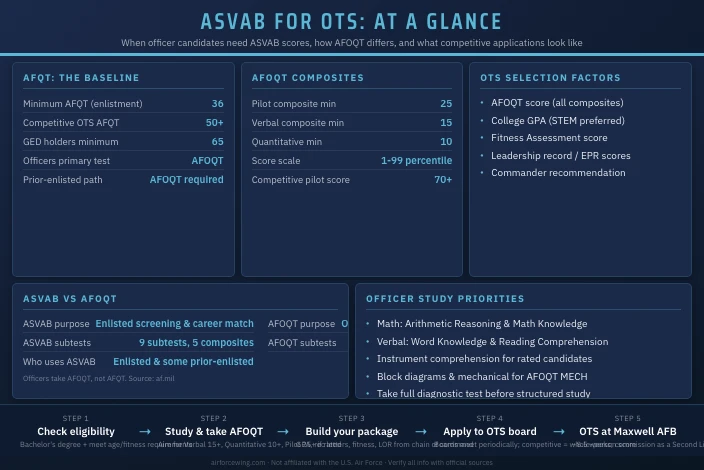
Start here (the 3-step path)
- Pull your existing ASVAB scores from your service record. Write down your AFQT and every subtest score. Your AR, MK, WK, and PC numbers tell you how much academic prep you still need.
- Register for the AFOQT through your unit education office or an officer recruiter. The AFOQT is the test that decides your commission. Your ASVAB got you in the door; the AFOQT gets you the bars.
- Follow the 30-day study plan in this guide. It is built for candidates who have ASVAB experience and need to layer AFOQT-specific skills on top.
- ASVAB Guide Book: Rebuild your math and verbal foundation. These skills transfer directly to the AFOQT.
- AFOQT online course: Video instruction and timed practice for all 12 officer qualifying subtests.
ASVAB and AFOQT basics for OTS applicants
Two tests, two purposes
Officers take the AFOQT. The Air Force Officer Qualifying Test is the standard selection instrument for OTS, AFROTC, and the Air Force Academy. The ASVAB is the enlisted screening test that decides who can enlist and which enlisted AFSCs they qualify for.
If you apply to commission as an officer, you take the AFOQT regardless of any prior ASVAB score. There is no waiver, substitution, or equivalency.
Comparison table
| ASVAB | AFOQT | |
|---|---|---|
| Primary purpose | Enlisted screening, AFSC matching | Officer selection, career field placement |
| Number of subtests | 9 | 12 (Form T) |
| Score outputs | AFQT percentile plus 5 Air Force composites (MAGE, ELEC, MECH, ADMI, GEND) | 6 composite scores (Pilot, CSO, ABM, Academic Aptitude, Verbal, Quantitative) |
| Score scale | 1 to 99 percentile (AFQT) | 1 to 99 percentile per composite |
| Who takes it | All enlisted applicants | All officer candidates (OTS, ROTC, USAFA) |
| Lifetime attempts | Retestable (1 month, 1 month, then 6 months between attempts) | 3 administrations; 90-day wait between attempts |
The AFOQT is broader and longer. It includes subtests on instrument comprehension, block counting, table reading, aviation information, and situational judgment that have no equivalent on the ASVAB.
When ASVAB scores still apply to officer applicants
Prior-enlisted applicants. Your original ASVAB scores sit in your service record. The OTS selection board can see them but does not score them. Your ASVAB proves you were eligible to enlist. It does not replace, supplement, or influence your AFOQT evaluation.
Early-stage recruiter screening. Some officer recruiters glance at a candidate’s AFQT before investing time in their package. A strong AFQT signals academic readiness. A weak AFQT raises questions about whether the candidate can handle the AFOQT’s academic sections. This is informal, not part of the board scoring, but it shapes how much support a recruiter gives your application.
When they do not apply
Your ASVAB scores do not count toward your OTS board score. They do not substitute for the AFOQT, do not influence career field placement as an officer, and do not factor into rated board evaluations for pilot, CSO, or ABM slots.
Once you commission, the ASVAB is a relic. Your officer career is built on AFOQT composites, officer performance evaluations, and professional education.
Where you take the AFOQT
The AFOQT is administered at base education offices, ROTC detachments, and certain MEPS sites by approved test control officers. Active-duty Airmen schedule through their education office. Civilians applying through OTS schedule through their recruiter.
Retakes and timing rules
You get up to three administrations of the AFOQT. A 90-day wait separates each attempt. A third administration requires a waiver from the applicable delegated authority under DAFMAN 36-2664.
The Air Force uses super-scoring on the AFOQT. If your Pilot composite was 71 on attempt one and 65 on attempt two, your record holds the 71. Super-scoring protects individual composites; it does not guarantee a better overall profile.
Score requirements for OTS
This is where the most confusion happens for prior-enlisted candidates. The short answer: your old ASVAB score does not gate your officer application, but your AFOQT score does.
No formal ASVAB minimum for OTS commissioning
The Air Force does not publish a minimum ASVAB score for OTS eligibility. The ASVAB is an enlisted screening instrument. Officer selection uses the AFOQT.
Your ASVAB score does not appear on any OTS board scoring rubric. It is not a pass/fail gate, and it is not weighted against other applicants.
AFOQT commissioning floors
The commissioning eligibility floors are Verbal 15 and Quantitative 10. Scoring below either one disqualifies you from commissioning through any path.
For rated positions:
- Pilot: Pilot composite 25
- CSO: CSO composite 25
- ABM: ABM composite 25
These are eligibility thresholds, not competitive scores.
Competitive benchmarks for OTS boards
Minimums get you eligible. They do not get you selected.
- Rated boards (pilot, CSO, ABM): composites in the 70s and 80s across the relevant rated composites. A Pilot composite of 50 meets the floor but lands at the bottom of the applicant pool.
- Non-rated boards (intelligence, cyber, space, logistics, finance): Academic Aptitude in the 60s or above, with strong Verbal and Quantitative.
- Prior-enlisted candidates who compete successfully tend to have balanced profiles: test scores above the 50th percentile, strong EPRs, and a completed bachelor’s degree with a 3.0 or higher GPA.
What your old ASVAB score signals
Even though the ASVAB is not a board scoring element, your existing score tells you something about your readiness for the AFOQT.
- AFQT 36: the floor for Air Force enlistment. If you scored near this floor, your math and verbal skills need real work before the AFOQT.
- AFQT 50+: a realistic indicator that your academic foundation can support AFOQT prep without rebuilding fundamentals.
- AFQT 65+: a strong signal. Your math and verbal likely transfer well; your study time can focus on aviation and spatial subtests.
- AFQT 80+: strong academic base. Spend most prep time on the AFOQT subtests that have no ASVAB equivalent.
How EPRs, GPA, and test scores interact
Think of your application as a three-legged stool: test scores, academic record, and military performance. Weakness in one area can be offset by strength in another, but only to a point.
AFOQT scores set your eligibility floor and signal academic readiness. Scores below the minimums (Verbal 15, Quantitative 10) disqualify you outright. Scores in the 50s to 60s are average. Scores in the 70s and above make you competitive.
GPA demonstrates sustained academic performance. A 3.0 or higher is generally considered competitive. STEM degrees carry slight preference in technical career fields, but liberal arts graduates commission in large numbers every year.
EPRs are where prior-enlisted candidates either stand out or blend in. A record of “Promote Now” ratings, leadership of work centers, mentoring, community involvement, and professional development paints a picture the board values. A string of average EPRs with no evidence of growth tells a different story.
A strong enlisted record can compensate for an average AFOQT. A poor AFOQT with an excellent record still creates risk because the board questions whether you can handle OTS academics and officer-level professional education.
The prior-enlisted commissioning pathway
Active-duty enlisted Airmen apply to OTS through programs managed by their Military Personnel Flight and the Air Force Personnel Center. The two main tracks are the Scholarships for Outstanding Airmen to ROTC (SOAR) program and the direct OTS application through the annual rated and non-rated boards.
The process starts with your chain of command. You need your commander’s recommendation, a complete application package, and the AFOQT on file before a board reviews your case. The timeline from decision to commission typically spans 12 to 24 months depending on board cycles, OTS class availability, and your degree completion status.
Basic eligibility for OTS:
- Bachelor’s degree from a regionally accredited institution (completed or within one semester at time of application)
- Age requirements vary by commissioning source and career field. Rated positions have stricter age limits (generally under 33 for pilot at commissioning).
- Commander’s recommendation with documented endorsement
- Physical fitness meeting Air Force Fitness Assessment standards
- AFOQT scores on file. Required regardless of prior ASVAB performance.
- Security clearance eligibility for your target career field
- Time in service and grade requirements per current Air Force instruction
Rated vs non-rated officer paths
Rated positions (pilot, combat systems officer, air battle manager) require additional testing beyond the AFOQT. Pilot and CSO candidates take the TBAS (Test of Basic Aviation Skills), which feeds into the PCSM (Pilot Candidate Selection Method). PCSM combines your AFOQT Pilot composite, TBAS score, and logged civilian flight hours into a single number from 1 to 99 that rated boards use to rank candidates.
Non-rated positions (intelligence, cyber, space operations, logistics, finance, and others) do not require the TBAS. Non-rated boards weigh Academic Aptitude, Verbal, and Quantitative composites more heavily alongside GPA and leadership indicators.
Prior-enlisted candidates can and do earn rated slots through OTS. Your enlisted experience in operations, maintenance, or flight-line support can strengthen a rated application if you frame it effectively.
The fastest way to raise your scores
Your ASVAB experience is both an advantage and a trap. It gives you a head start on math and verbal. It creates a false sense of readiness on the sections that do not transfer.
The score-priority rules
Rule 1: Earn points where the test gives them fastest. For prior-enlisted candidates, that is usually aviation and spatial subtests, because those are the gap. For candidates with weak ASVAB academics, it is rebuilding AR and MK first.
Rule 2: Fix accuracy before speed. A fast wrong answer on Table Reading is still wrong.
Rule 3: One notebook runs the prep. That notebook is your error log. It is the highest-return prep tool you have.
The 80/20 topics
If you are studying for both tests (refreshing ASVAB foundation while building AFOQT skills), focus on the topics that move the most composites:
- Math Knowledge. Feeds five of six AFOQT composites and three of five ASVAB composites. Highest cross-test payoff.
- Arithmetic Reasoning. Feeds AFOQT Academic Aptitude and Quantitative, plus ASVAB AFQT. Second highest-impact.
- Instrument Comprehension. New to you, but feeds Pilot and ABM composites. If you want a rated slot, this is where AFOQT time goes after math.
- Table Reading. Feeds Pilot, CSO, and ABM. Speed drills, not content study. Buildable in 2 to 3 weeks of focused practice.
- Word Knowledge. Feeds four composites across both tests. Vocabulary is a slow build, so 10 minutes a day starting early.
Skills that transfer (and skills that do not)
The overlap is concentrated in math and verbal:
- Arithmetic Reasoning appears on both tests at the same difficulty. Your ASVAB AR performance predicts your AFOQT AR performance closely.
- Math Knowledge is equivalent between the two tests: algebra, geometry, exponent rules, formula application.
- Word Knowledge tests vocabulary through synonym identification on both tests. The AFOQT version is faster (12 seconds per question) but the content is the same.
- Reading Comprehension (AFOQT) and Paragraph Comprehension (ASVAB) test the same skill.
If you scored well on those four ASVAB subtests, you can compress the academic portion of AFOQT study significantly.
The gap is on the other side. The AFOQT includes Instrument Comprehension, Table Reading, Aviation Information, Block Counting, Physical Science, and Situational Judgment. None of these appear on the ASVAB.
- Instrument Comprehension: reading aircraft attitude indicators, altimeters, and heading indicators. Learnable, but requires specific instruction. Nothing in the ASVAB prepares you for it.
- Table Reading: finding values at the intersection of row and column headers in large data tables. About 10 seconds per question. The skill is speed and accuracy under pressure.
- Aviation Information: general aeronautical knowledge including lift, drag, control surfaces, basic navigation, and aircraft types. If you worked on a flight line, some of this is familiar. If not, it is all new.
- Block Counting: spatial reasoning under about 6 seconds per question. One of the hardest subtests to master.
- Physical Science: introductory physics and chemistry. Replaced General Science on Form T. Partial physics overlap with ASVAB General Science, but chemistry content is different.
Most prior-enlisted candidates who underperform on the AFOQT do so on the aviation and spatial subtests, not the academic ones. The study plan below is designed to prevent that.
The error log
Keep a running log of every question you miss during practice. For each miss, write:
- Section (AR, MK, IC, TR, etc.)
- Mistake type (concept gap, misread, rushed math, ran out of time, bad guess)
- Fix rule (one sentence that prevents the same mistake)
Review your error log before every study session. After two weeks, patterns emerge. You will see the same 3 to 5 mistake types causing 80% of your errors. Fix those patterns and your score jumps.
Do this today and this week
Today: pull your ASVAB scores from your records. Identify which subtests are above 60 (your transfer strengths) and which are below 50 (your rebuild areas).
This week: take a full-length AFOQT practice test under timed conditions. Score by composite. Compare your AFOQT academic subtest scores to your ASVAB scores. The gaps tell you exactly where to focus.
Your study plan (30-day default plus variants)
This plan assumes you have prior ASVAB experience and a foundation in math and verbal skills. The default is 30 days. Variants for 7, 14, and 60 days follow.
Daily routine
Each study day uses this loop:
- Skill block (15 to 25 minutes): one topic, not a whole chapter.
- Timed practice set (20 to 30 minutes): small set, strict time.
- Error log review (15 to 25 minutes): fix patterns, redo missed questions correctly.
- Retention (5 minutes): flashcard run or formula review.
The 30-day plan (best default for prior-enlisted candidates)
This plan front-loads AFOQT-specific subtests because that is where the prior-enlisted gap usually sits. Academic subtests run in maintenance mode.
| Days | Focus | Daily time |
|---|---|---|
| 1 | Full timed AFOQT practice test. Score every composite. Baseline. | 5 hours |
| 2 to 4 | Instrument Comprehension plus Aviation Information. Learn instruments, study aerodynamics. | 60 min |
| 5 to 7 | Table Reading speed drills plus Block Counting spatial practice. | 60 min |
| 8 to 10 | Physical Science (basic physics and chemistry). | 45 min |
| 11 to 13 | Math review (AR plus MK). Timed practice to confirm your foundation still holds. | 45 min |
| 14 | Full timed practice test. Compare to Day 1. Update error log. | 5 hours |
| 15 to 17 | Focus on the two weakest composites from Day 14. Drill the contributing subtests. | 60 min |
| 18 to 20 | Aviation subtests round two. IC and TR speed drills. AI flashcard review. | 60 min |
| 21 to 23 | Verbal subtests (VA, WK, RC). Timed sets. Vocabulary flashcards. | 45 min |
| 24 to 25 | Situational Judgment and Self-Description Inventory. Familiarize with format. | 30 min |
| 26 | Full timed practice test. Final composite check. | 5 hours |
| 27 to 28 | Error log cleanup. Redo every missed question from the past month. | 45 min |
| 29 | Light flashcard review. 20 minutes max. Rest. | 20 min |
| 30 | Test day. | Full day |
Expected result: 5 to 15 percentile point improvement on target composites, with the largest gains on aviation and spatial subtests that were new to you.
- ASVAB online course: Strengthen math and verbal skills that feed both the AFQT and AFOQT Academic Aptitude composite.
- AFOQT Guide Book: Full coverage of the 12 officer qualifying subtests with timed practice exams.
The 7-day plan (final polish)
Use this only when your baseline is already close to your target.
- Day 1: baseline test plus error log build
- Day 2: Instrument Comprehension plus Aviation Information drills
- Day 3: Table Reading plus Block Counting speed sets
- Day 4: math review (AR and MK)
- Day 5: weakest subtest day plus redo missed questions
- Day 6: full practice test plus deep review
- Day 7: light review, sleep plan, logistics
The 14-day plan (tight improvement)
Two mini cycles.
- Days 1 to 6: aviation and spatial fundamentals (IC, TR, BC, AI) plus a Physical Science block
- Day 7: full practice test plus review
- Days 8 to 13: focus on your two weakest composites, plus verbal subtest cleanup
- Day 14: full practice test plus final tune-up list
The 60-day plan (rebuild)
For candidates whose ASVAB scores were below 50 on AR, MK, WK, or PC. You need to shore up the foundation before layering AFOQT-specific skills.
- Weeks 1 to 4: rebuild AR, MK, WK, and RC. Short timed sets, heavy error log.
- Weeks 5 to 8: build AFOQT-specific subtests (IC, TR, AI, BC, Physical Science).
- Weeks 9 to 10: full-length timed practice, integration, test-day simulation.
Expected result: 10 to 25 percentile point improvement on target composites depending on starting level and consistency.
Weekly checkpoint
Every checkpoint follows the same process:
- Take a full timed practice test under real conditions.
- Score every subtest separately. Write the numbers next to last week’s.
- Calculate composite estimates using the composite table below.
- Update your error log with new mistake patterns.
- Decide next week’s focus. Your lowest composite-relevant subtest gets the most time.
If your scores plateau for two consecutive checkpoints, change your study method. Same input produces same output.
Score projection: after 3 or more practice tests, calculate your average score for each composite. That average predicts your real test performance better than any single test.
Section-by-section game plan
Use this section like a playbook. Pick the subtest you are working on today, then follow the steps in order.
What the AFOQT covers (Form T)
Form T has 12 subtests. Total test time runs close to five hours including instructions and breaks.
Academic subtests:
- Verbal Analogies (25 questions, 8 min): word relationships and reasoning
- Arithmetic Reasoning (25 questions, 29 min): applied math in real-world contexts
- Math Knowledge (25 questions, 22 min): algebra, geometry, quantitative concepts
- Word Knowledge (25 questions, 5 min): vocabulary depth
- Reading Comprehension (25 questions, 24 min): conclusions and inferences from passages
- Physical Science (20 questions, 10 min): basic physics and chemistry
Aviation and spatial subtests (no ASVAB equivalent):
- Instrument Comprehension (20 questions, 6 min): aircraft attitude from cockpit instruments
- Table Reading (40 questions, 7 min): rapid data lookup under time pressure
- Aviation Information (20 questions, 8 min): general aeronautical knowledge
- Block Counting (30 questions, 3 min): how many blocks touch a given block in a 3D stack
Personality and judgment subtests:
- Self-Description Inventory (240 questions, 45 min): personality assessment
- Situational Judgment (16 scenarios, 35 min): officer-relevant decision scenarios
The 6 composites and what each controls
| Composite | Subtests included | What it controls |
|---|---|---|
| Pilot | AR + MK + TR + IC + BC + AI | Pilot selection boards, PCSM calculation |
| CSO | WK + MK + RC + TR + BC + AI | CSO selection boards |
| ABM | VA + AR + WK + MK + RC + TR + BC | ABM selection boards |
| Academic Aptitude | VA + AR + WK + MK + RC | All commissioning paths, non-rated career selection |
| Verbal | VA + WK + RC | Commissioning eligibility |
| Quantitative | AR + MK + TR | Commissioning eligibility |
Math Knowledge feeds five of six composites. Arithmetic Reasoning feeds five. Table Reading feeds four. Every point you gain on math moves almost everything.
Instrument Comprehension: the 3-reading method
Each IC question shows two instruments and asks for the aircraft’s position or direction. Read three things in order:
- Attitude indicator. A miniature aircraft sits against a horizon line. Wings tilting left means banking left. Nose above horizon means climbing. Practice pitch and bank separately before combining.
- Heading indicator. A compass card from above. North 0/360, East 090, South 180, West 270. The top shows current heading as a three-digit number.
- Combine. “Climbing, banking left, heading 270.” That is the answer format.
Drill progression: untimed pitch/bank identification first (week 1), add heading (week 2), timed 20 questions in 6 minutes (week 3).
Mastery check: you finish 20 questions in under 6 minutes with 90% accuracy.
Table Reading: the trace-intersection method
40 questions in 7 minutes. About 10 seconds each.
- Find the X value on the column header.
- Trace straight down.
- Find the Y value on the row header.
- Trace straight across.
- Read the value at the intersection.
Speed comes from disciplined eye movement, not rushing. Train your eyes to snap to the column header first, then the row header, then the intersection.
Drill progression: 10x10 tables for 20 intersections timed (week 1), full-size tables (week 2), 40 questions in 7 minutes (week 3).
Mastery check: 75% accuracy or higher under full time pressure. Speed without accuracy produces wrong answers faster.
Block Counting: the systematic face method
Each question shows a 3D arrangement and asks how many blocks touch a specific block. About 6 seconds per question.
- Check each of the six faces: top, bottom, front, back, left, right.
- Count how many are in contact with another block.
- That count is the answer.
The common mistake is forgetting hidden blocks. Always assume blocks fill the space if they would be needed to support visible blocks above them.
Drill progression: simple arrangements (week 1), complex 3D stacks (week 2), 30 questions in 3 minutes (week 3).
Mastery check: under 8 seconds per question on complex stacks with 80% accuracy.
Aviation Information: the 6 knowledge categories
- Four forces of flight: lift, weight, thrust, drag. Lift increases with airspeed and angle of attack up to the critical angle. Drag increases with speed and surface area.
- Control surfaces: ailerons (roll), elevator (pitch), rudder (yaw).
- Flight instruments: altimeter, airspeed indicator, attitude indicator, heading indicator, vertical speed indicator, turn coordinator.
- Basic navigation: headings 000-360, runway numbers equal heading divided by 10 (runway 27 faces 270), standard traffic pattern is left turns.
- Aircraft types and parts: fixed-wing vs rotary-wing; fuselage, empennage, landing gear, propeller vs jet engine basics.
- Weather effects: headwind reduces ground speed, tailwind increases it, crosswind requires correction, icing is dangerous on control surfaces.
Drill: flashcards by category, 15 minutes per day. The test rewards breadth over depth.
Physical Science: the high-yield topics
Physics: Newton’s three laws, F = ma, work = force x distance, kinetic and potential energy, simple machines, Ohm’s law (V = IR), wave properties.
Chemistry: elements vs compounds vs mixtures, periodic table structure (groups, periods, metals vs nonmetals), ionic vs covalent bonding, states of matter, pH scale, basic chemical reactions (combustion, oxidation).
Drill: alternate physics and chemistry days, 15 minutes per session, 20-question timed set at week’s end.
Math subtests: AR and MK
Arithmetic Reasoning rewards translating words into math without guessing. Highest-payoff topics: percent change, ratios and proportions, rates (unit pricing, work rate), averages, multi-step word problems.
Use the 5-step translation method on every problem:
- Underline what the question asks for. Circle the unit.
- List the given numbers with units.
- Choose the operation plan.
- Compute carefully, one step per line.
- Sanity check against the inputs.
If your answer unit is wrong, your setup is wrong.
Math Knowledge is the cleanest section to improve because it is skill-based and repeatable. Highest-payoff topics: order of operations, fractions and percent conversions, exponents and roots, linear equations, basic algebra, geometry essentials (area, perimeter, volume, angles).
Keep a short formula list: rectangle area (A = lw), triangle area (A = 1/2 bh), circle area (A = πr²), circle circumference (C = 2πr), rectangular prism volume (V = lwh), slope (m = (y₂ - y₁) / (x₂ - x₁)).
Mastery check: 80% accuracy under time on a mixed AR plus MK set.
Verbal subtests: VA, WK, RC
Verbal Analogies: identify the relationship between two words, then find the pair with the same relationship. Practice common relationships (synonym, antonym, part-to-whole, function, cause-effect).
Word Knowledge: vocabulary through synonym identification. 12 seconds per question. Replace the test word with a simple synonym in your head, then eliminate choices that do not match. Build vocabulary through roots, prefixes, and suffixes. 10 new words daily compounds quickly.
Reading Comprehension: read the passage at a steady pace, then for each answer choice point to the sentence that supports it. If you cannot support it, eliminate it. The trap on RC is the “close enough” answer that matches the passage’s topic but not its claim.
Mastery check: 80% accuracy timed across all three.
- ASVAB Guide Book Timed practice for AR, MK, WK, and RC. Feeds the Phase 1 foundation and your error log.
- AFOQT online course Video instruction for all 12 subtests including the instrument and aviation sections you just learned above.
Practice tests and the review method
Practice tests can raise your score fast, or they can lock in bad habits. The difference is how you use them.
What practice tests are for
Use them to: build comfort with timing, find weak topics with proof, train focus for longer sessions.
Do not use them to: collect scores like trophies, hope your score jumps without changing your process, replace learning and review.
A practice test is a flashlight. It shows where to work next.
The right way to run a full-length test
- Quiet room, phone away
- Timed sections
- No looking up answers mid-test
- Mark questions while you test: C (concept gap), R (rushed), M (misread), T (time trouble)
- Score it, then stop. Keep test mode and review mode separate.
The review method that creates points
- Sort every miss into a mistake type.
- Write one fix rule per miss. One sentence, usable. “Convert percent to decimal before multiplying.” “Underline what the question asks before solving.”
- Redo the question correctly without looking at the explanation first.
- Build a Top 10 misses list. These patterns drive next week’s focus.
Timed sets vs untimed learning
Both matter. They do different jobs.
Untimed learning is for building a skill from scratch. Use it when you are learning the attitude indicator for the first time, or working through a new MK concept. Stop once you can solve cleanly.
Timed sets are for after you know the steps. The goal is steady accuracy under a clock. A clean pattern that works for most candidates:
- Learn for 20 minutes
- Timed set for 25 minutes
- Review for 20 minutes
How often to test
- Once a week: one full practice test (or two half-tests across two days)
- 2 to 4 times a week: short timed sets in your focus sections
- Daily: error log work, even 10 minutes counts
If you test too often, review quality drops and improvement slows.
Practice habits that waste time
These habits look productive but do not move scores much:
- Retaking the same test too soon and remembering answers
- Skipping review because you feel tired after the test
- Reviewing by reading explanations only instead of re-solving problems
- Doing huge question banks with no tracking and no error log
- Studying every subtest equally when the rated composites you need only pull from a subset
If you spot one of these in your routine, fix it the same day.
Test-day strategy
Good prep gives you the skill. Good strategy protects that skill under time pressure.
Time management rules
- Start steady, not fast. Rushing early creates avoidable misses.
- Spend time where it earns points. If a question is turning into a puzzle, it is draining the clock. Move on.
- Two-pass approach when possible. Easy questions first, return to hard ones with time remaining. Works well on Table Reading and Block Counting.
- Do not reread the same text three times. Reset by restating the question in your own words.
Guessing rules
- Eliminate wrong answers first. Removing one or two choices helps a lot.
- If you hit a time wall, choose the best remaining option and go.
- Do not change an answer just because you feel uneasy. Change it only when you can name a clear reason from the problem.
Accuracy under pressure
Use micro-checks on math: recheck negative signs, confirm you answered what was asked, check units on rate questions, sanity check the size of the answer.
Keep scratch work readable: one step per line, circle the final answer, draw a line and restart if you need to.
Use the same methods you practiced. Test day is not the time to invent a new trick.
The week-of checklist
7 days out: last full practice test. Build a short tune-up list from your error log.
3 days out: short timed sets only. Review formulas and vocabulary in small blocks. No marathon study.
1 day out: light review only. Confirm test instructions and required items. Set a real bedtime.
Morning of: simple breakfast with protein. Arrive early and calm. One question at a time.
Mental reset tools during the test
- 10-second reset: sit up straight, slow one breath, reread the question once.
- Next best step rule: do one clean step, then reassess.
- Permission to move on: you do not need to win every question to score well.
Test day logistics (the OTS commissioning path)
The AFOQT is administered at base education offices and ROTC detachments by approved test control officers. The day looks different depending on where you test.
What to bring
- Valid photo ID (military ID for active duty; state ID for civilians)
- Anything your education office or recruiter told you to bring
- A simple snack for allowed breaks
Do not bring extra items. Phones and outside materials are not permitted in the testing room.
What the testing room is like
Staff control the room. You follow instructions and keep your focus on your screen. Raise your hand if you have a procedural question. Do not guess on procedures.
Common mistakes that cause big delays
- Arriving late
- Forgetting required identification
- Showing up tired from late-night studying
- Bringing items you cannot keep with you during testing
A smooth test day usually comes from boring discipline.
What happens after you test
Your AFOQT scores feed into your OTS application package. Combined with your GPA, EPRs, commander’s recommendation, fitness assessment, and personal statement, they form the whole-person package the board evaluates.
If you are applying for a rated slot, your Pilot composite combined with your TBAS score and any civilian flight hours feeds into your PCSM. See our TBAS preparation guide for the rated path.
Retakes and the most-recent-score risk
A retake can open doors. It can also close them if you treat it like a lottery ticket.
The retest waiting periods
- 90 days between AFOQT administrations
- Three lifetime attempts maximum
- The third attempt requires a waiver from the applicable delegated authority under DAFMAN 36-2664
These calendar gaps shape your study timeline.
Super-scoring protects composites
The Air Force uses super-scoring on the AFOQT. Your record holds the highest composite from any attempt. If your Pilot composite was 71 on attempt one and 65 on attempt two, your official Pilot composite stays at 71.
Super-scoring protects individual composites. It does not guarantee a better overall profile. Preparation before the first test is still the highest-return investment you can make.
When a retake makes sense
A retake is usually worth it when:
- Your baseline practice results now sit above your prior score by a clear margin
- You missed a target composite by a small gap and you can name the exact subtests that need work
- You improved fundamentals and can prove it in timed sets
A retake is usually a bad move when:
- You want a different result but your weekly practice scores did not change
- You cannot name your top mistake patterns from the last test
- You are tired and trying to swing for it without a plan
The three-part retake standard
If you cannot meet all three, delay the retest:
- Timed proof: two timed sets per focus section with stable accuracy
- Pattern proof: your error log shows fewer repeated mistakes
- Stamina proof: you can stay focused through a longer practice block without rushing
Studying while on active duty
If you are active duty, you are fitting study time around shift work, additional duties, and PT. A few adjustments:
- Morning study is more reliable than evening. Evening study after a 12-hour shift produces diminishing returns.
- Use lunch breaks for flashcards. Vocabulary and aviation terminology flashcards fit into 15-minute blocks.
- Protect weekends. Your weekend practice test is the non-negotiable checkpoint.
- Talk to your supervisor. If your unit supports professional development, your commander may approve adjusted scheduling during your study period.
Best prep options
You need two types of study materials: one that covers the ASVAB-level math and verbal foundation, and one that covers the AFOQT-specific subtests.
What good prep must include
No matter what you buy, it should give you:
- Realistic practice questions that match AFOQT style (Form T)
- Full-length practice tests scored by composite
- Clear explanations for right and wrong answers
- Progress tracking for weak areas
- A way to review mistakes (your error log still runs the show)
If a resource is missing two or more of these, skip it.
For the math and verbal foundation: ASVAB-style review
If your original ASVAB scores were below 60 on AR, MK, WK, or PC, rebuild those skills first. A strong ASVAB study guide covers all four with practice questions, answer explanations, and full-length practice tests.
Even if your ASVAB scores were strong, it may have been years. A refresher ensures the skills are sharp when you walk into the AFOQT. For a full breakdown of the ASVAB and how each subtest feeds the Air Force composites, see our ASVAB study guide.
- ASVAB Guide Book (Print or Digital): Build the math and verbal foundation that transfers directly to the AFOQT.
For the officer-specific subtests: AFOQT prep
The AFOQT has subtests the ASVAB does not touch. You need dedicated AFOQT materials for Instrument Comprehension, Table Reading, Aviation Information, Block Counting, Physical Science, and Situational Judgment.
Good AFOQT prep resources include:
- Full-length timed AFOQT practice tests scored by composite
- Instrument reading guides with diagrams showing pitch, bank, and heading
- Aviation Information sections covering lift, drag, control surfaces, and navigation
- Speed drill sets for Table Reading and Block Counting
For a complete guide to each AFOQT subtest with strategies, drills, and mastery checks, see our AFOQT study guide.
- Get this AFOQT online course we recommend for Air Force applicants. Covers all 12 subtests including the aviation and spatial sections unique to the AFOQT.
Daily reps: flashcards
Flashcards cover the small facts that fade between full practice tests. Use them for AFOQT vocabulary (Verbal Analogies, Word Knowledge), the math formulas you keep forgetting, and aviation terminology. Ten minutes daily, cards added only from your error log.
- AFOQT Flashcards: Daily vocabulary, formula, and aviation-term reps. Best for the small facts that fade between full practice tests.
The one resource gap: aviation subtests
Neither ASVAB nor standard AFOQT prep materials fully prepare you for the speed demands of Table Reading and Block Counting. These subtests test processing speed more than knowledge. The best preparation is repetitive timed drills. Look for practice sets with at least 200 questions for each of these subtests so you can drill without repeating the same questions.
For Instrument Comprehension and Aviation Information, candidates with zero aviation background benefit from supplementary resources. A basic private pilot ground school reference can build the conceptual framework that makes IC and AI questions feel intuitive rather than foreign.
Building the complete OTS package
Test scores are one leg of the stool. While you study, also work on:
- Finishing your degree if you have not already. A completed bachelor’s is a hard requirement.
- Getting your EPRs in order. Review your records for accuracy. Strong EPRs with documented leadership carry significant weight.
- Drafting your personal statement. Start early. Connect your enlisted experience to your officer goals.
- Physical fitness. Train now. A passing fitness score at application shows the board you are ready.
- Commander’s recommendation. Talk to your commander early about your goals.
Candidates who get selected treat the entire application as a project: AFOQT, fitness, EPRs, and personal statement in parallel, not sequentially.
FAQs
Do I need the ASVAB for OTS?
No. The ASVAB is not required for OTS. Officer candidates take the AFOQT. If you are prior enlisted, your ASVAB scores sit in your service record but they are not evaluated by the OTS selection board. You cannot substitute one for the other.
Can my old ASVAB score help my officer application?
Not directly. Your ASVAB is not a scored element on any OTS board rubric. It helps you indirectly. A strong ASVAB indicates your math and verbal skills were solid at enlistment, and those same skills feed the AFOQT’s Verbal, Quantitative, and Academic Aptitude composites. A weak ASVAB signals you need extra time on academic subtests before the AFOQT.
How different is the AFOQT from the ASVAB?
The tests share four overlapping skill areas (math reasoning, math knowledge, vocabulary, reading comprehension) at roughly the same difficulty. Beyond that, they diverge. The AFOQT adds six subtests the ASVAB does not cover: Instrument Comprehension, Table Reading, Aviation Information, Block Counting, Physical Science, and Situational Judgment. The AFOQT is also longer (about 5 hours vs 1.5 to 2 hours) and has stricter retake limits (three administrations with 90-day waits).
Should I retake the ASVAB before applying for OTS?
No. The OTS board does not use ASVAB scores. Your time is better spent preparing for the AFOQT. The only reason to retake the ASVAB is if you plan to re-enlist (not commission) and need higher line scores for a different enlisted AFSC.
What GPA do I need for OTS?
The Air Force does not publish a minimum GPA. In practice, a 3.0 or higher is considered competitive. A 3.5 or above strengthens your package. GPA below 2.5 is a significant disadvantage. STEM degrees are not required but carry slight preference for technical career fields.
How long is OTS?
Officer Training School runs approximately 9.5 weeks at Maxwell Air Force Base, Alabama. Graduates commission as Second Lieutenants (O-1). Healthcare, legal, and chaplain candidates complete a shorter Commissioned Officer Training course of about 5 weeks instead.
Can prior-enlisted candidates get pilot slots through OTS?
Yes. You will need to meet age requirements (generally under 33 at commissioning for pilot), pass a flight physical, take the AFOQT with competitive Pilot composite scores (70s or above), take the TBAS, and earn a competitive PCSM. Your enlisted experience can strengthen the application if it demonstrates operational awareness, leadership, and discipline.
What is the AFOQT minimum to commission?
Verbal 15 and Quantitative 10. Scoring below either disqualifies you from commissioning through any path. Rated minimums are higher: Pilot composite 25 for pilot, CSO composite 25 for CSO, ABM composite 25 for ABM.
Browse all Air Force officer careers to explore specific career fields. For the primary officer test, see the AFOQT study guide. For the rated selection process, read the TBAS preparation guide. For the complete ASVAB deep-dive including enlisted line score composites, see the ASVAB study guide.