ASVAB for Air Force OTS
Most Air Force officer candidates never take the ASVAB. The primary officer selection test is the AFOQT: the Air Force Officer Qualifying Test, and it measures different skills than the ASVAB does. But ASVAB scores still matter in specific situations, and if you’re prior enlisted or in the early stages of exploring the officer path, knowing the difference between these two tests will save you significant time and confusion.
This guide covers when officers need ASVAB scores, what AFOQT scores OTS requires, how to study effectively, and how test scores factor into a competitive application package.
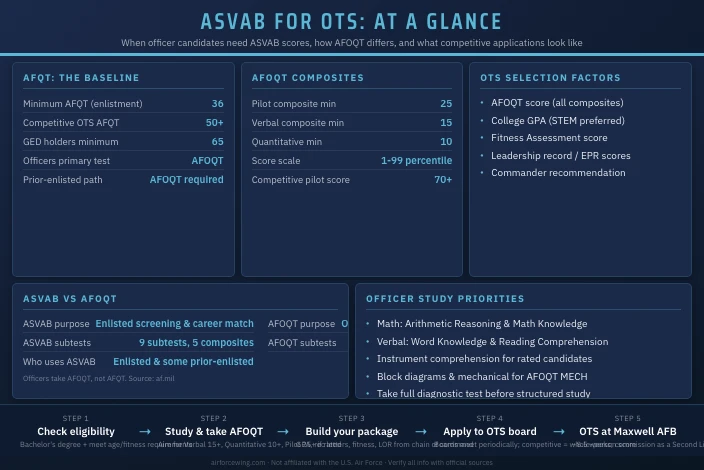
ASVAB vs AFOQT: Which Test Do Officers Take
The short answer: officers take the AFOQT. The ASVAB is the enlisted screening test, used to determine who can enlist and which career fields (AFSCs) enlisted recruits qualify for. Officers follow a separate path.
Here’s how the two tests differ:
| ASVAB | AFOQT | |
|---|---|---|
| Primary purpose | Enlisted screening and AFSC matching | Officer selection and career field placement |
| Number of subtests | 9 | 12 |
| Score outputs | AFQT percentile + 5 line score composites | 6 composite scores (Pilot, CSO, ABM, Academic, Verbal, Quantitative) |
| Score scale | 1-99 percentile (AFQT) | 1-99 percentile per composite |
| Who takes it | All enlisted applicants | All officer candidates (ROTC, OTS, USAFA) |
The AFOQT has broader scope than the ASVAB. It includes subtests on instrument comprehension, block counting, table reading, and aviation-specific spatial tasks that have no equivalent on the ASVAB.
When ASVAB Scores Apply to Officers
There are two situations where ASVAB scores become relevant on the officer path.
Prior-enlisted applicants. If you currently serve as an enlisted airman and are applying for OTS, your original ASVAB scores are part of your service record. However, the OTS selection board does not use ASVAB scores in its evaluation. You’ll still need to take the AFOQT. Your ASVAB scores show your recruiter you were eligible to enlist, nothing more.
Early stage eligibility screening. Some officer recruiters check whether a candidate meets the basic AFQT threshold before investing time in their package. The minimum AFQT for Air Force enlistment is 36, but officer candidates are expected to perform significantly above that floor. An AFQT under 50 signals potential academic risk to a board. In practice, most competitive OTS applicants score well above 50 on the AFQT, because the skills that drive a high AFQT (math, verbal reasoning) are the same skills the AFOQT tests.
ASVAB Score Requirements for OTS
The Air Force does not publish a formal ASVAB minimum for OTS commissioning. Officers are selected primarily on AFOQT scores, GPA, leadership record, fitness, and whole-person evaluation.
That said, some practical benchmarks apply:
- AFQT 36: Minimum for Air Force enlistment. Anyone scoring below this is ineligible for any Air Force path, officer or enlisted.
- AFQT 50+: The realistic floor for an officer candidate who wants to be taken seriously. Scores in this range suggest adequate preparation for the AFOQT.
- AFQT 65+: The GED holder minimum for enlisted applicants. Worth knowing if your background includes a GED rather than a high school diploma.
If you scored near the minimums on your original ASVAB and are now pursuing OTS, treat that score as a signal to prepare seriously for the AFOQT before submitting your package.
The Prior-Enlisted Path to OTS
Enlisted airmen can apply for OTS through the Enlisted Commissioning Program. The basic eligibility requirements include:
- Bachelor’s degree from a regionally accredited institution (or senior status in a degree program)
- Meet age requirements for commissioning
- Commander’s recommendation
- Physical fitness standards
- AFOQT: taken regardless of prior ASVAB scores
Your performance evaluations (EPRs) carry significant weight in the board review. A strong enlisted record can offset a marginal AFOQT score, but a poor AFOQT score with a strong record still creates risk. Prepare for the AFOQT as seriously as a direct-commission applicant would.
What the AFOQT Covers
The AFOQT consists of 12 subtests. Scores from those subtests combine into 6 composites that the Air Force uses for different selection purposes.
| Composite | Used For |
|---|---|
| Pilot | Pilot training selection |
| CSO | Combat Systems Officer selection |
| ABM | Air Battle Manager selection |
| Academic Aptitude | General officer program eligibility |
| Verbal | All officer program eligibility |
| Quantitative | All officer program eligibility |
The minimum scores for commissioning eligibility are Verbal 15 and Quantitative 10. Pilot candidates must also score at least 25 on the Pilot composite. These are floors, not goals.
Competitive scores for board selection are significantly higher. Historical OTS selection data shows that successful applicants typically achieve scores in the 70s-80s across the rated composites. Non-rated officer candidates (intelligence, logistics, finance, etc.) are evaluated more heavily on Academic Aptitude, Verbal, and Quantitative.
The 12 AFOQT subtests include:
- Verbal Analogies
- Arithmetic Reasoning
- Word Knowledge
- Mathematics Knowledge
- Instrument Comprehension
- Block Counting
- Table Reading
- Aviation Information
- General Science
- Rotated Blocks
- Hidden Figures
- Self-Description Inventory (personality inventory, not scored on a scale)
The AFOQT is administered through Pearson VUE testing centers. You can take it twice in a lifetime. The second attempt score is the one the Air Force uses, regardless of whether it’s higher or lower. That rule makes preparation before your first attempt critical.
How to Study for the ASVAB (Officer Path)
If you’re studying the ASVAB as part of officer candidate prep, either to strengthen your AFQT score or to build the math and verbal foundation the AFOQT requires: the approach is the same: fix your weakest areas first.
The AFQT pulls from four ASVAB subtests: Arithmetic Reasoning, Mathematics Knowledge, Paragraph Comprehension, and Word Knowledge. These four subtests are also the foundation of the AFOQT’s Verbal and Quantitative composites. Time spent on these areas pays off on both tests.
Step 1: Identify your weakest subtest first. Take a full diagnostic practice test before studying anything. Your weakest subtest is where you gain the most ground per hour studied.
Step 2: Build math first. Arithmetic Reasoning and Mathematics Knowledge feed three of the Air Force’s five enlisted line score composites and drive both AFOQT quantitative composites. If math is your weak point, start there and spend at least two weeks on it.
Step 3: Add verbal work in weeks three and four. Word Knowledge and Paragraph Comprehension are the highest-yield subtests for verbal score improvement. Read actively, build vocabulary systematically, and practice comprehension with timed passages.
Step 4: Layer in science and technical content. General Science, Electronics Information, and Mechanical Comprehension round out the subtest picture. These matter more for enlisted AFSCs than for officer selection, but General Science also appears in AFOQT instrument comprehension and aviation information subtests.
Step 5: Simulate test conditions. The ASVAB is timed. Taking untimed practice sections gives you false confidence. Use timed full-length practice tests in your final two weeks of prep.
Study Resources for Officer Candidates
When you purchase through links on our site, we may receive compensation at no extra cost to you.
- ASVAB study guide with full-length practice tests, covers all nine subtests with answer explanations
- ASVAB online course with video lessons, self-paced video instruction for every subtest
Study Resources
The ASVAB and AFOQT share enough foundational math and verbal content that strong ASVAB prep materials also build your AFOQT base. The divergence comes in the aviation-specific subtests (Instrument Comprehension, Block Counting, Table Reading, Rotated Blocks), which require AFOQT-specific preparation beyond what any ASVAB guide covers.
For the math and verbal foundation, look for materials that offer:
- Full-length timed practice exams with answer explanations (not just answer keys)
- Section-by-section score breakdowns so you can track improvement
- Coverage of all nine ASVAB subtests, including Mechanical Comprehension and General Science
Use an error log throughout your prep: after every practice section, write down every question you missed and identify whether it was a knowledge gap or a reasoning error. Patterns in your errors reveal the fastest path to improvement.
Build a Competitive Application
- ASVAB study guide, full-length practice exams and subject review
- Online video course, structured lessons for score improvement
The Officer Selection Process
OTS is located at Maxwell AFB, Alabama. The course runs approximately 9.5 weeks and commissions graduates as Second Lieutenants (O-1). There are three main paths to an Air Force commission: OTS, Air Force ROTC, and the Air Force Academy.
OTS draws from three applicant pools:
- Civilians with bachelor’s degrees applying directly through Air Force Recruiting
- Prior enlisted airmen applying through the Enlisted Commissioning Program
- Healthcare, legal, and ministry professionals who complete a five-week Commissioned Officer Training (COT) course instead of the full OTS curriculum
The selection board evaluates applications using a whole-person concept. No single factor determines selection.
Factors that carry the most weight:
- AFOQT scores across all composites
- College GPA (STEM majors and higher GPAs are preferred, but not required)
- Physical fitness: candidates are expected to meet fitness standards before arriving
- Leadership potential: demonstrated through work history, community involvement, military performance evaluations for prior-enlisted applicants
- Commander recommendation for current and prior enlisted members
Test scores open doors but don’t guarantee selection. A Verbal 15 and Quantitative 10 make you eligible. Scoring in the 70s and 80s across composites makes you competitive. Officers are selected to lead, so board members look for evidence of leadership in every part of a package.
Rated vs Non-Rated Officers
If you’re applying for a rated position (pilot, combat systems officer, or air battle manager), your selection involves additional tests beyond the AFOQT. Pilot and CSO candidates take the TBAS (Test of Basic Aviation Skills), which feeds into a composite score called the PCSM (Pilot Candidate Selection Method). PCSM ranges from 1-99 and incorporates TBAS scores, AFOQT Pilot subtest scores, and logged civilian flight hours.
Non-rated officer applicants, intelligence, logistics, finance, public affairs, and others, do not take the TBAS. Their board evaluation leans more heavily on AFOQT Academic, Verbal, and Quantitative composites alongside GPA and leadership record.
The three commissioning paths produce officers across all career fields. OTS has historically commissioned between 600 and 1,200 officers per year, varying with Air Force end-strength requirements.
More Information
The official source for OTS program information is the Air Force Accessions Center at afaccessionscenter.af.mil. The Air Force Personnel Center at afpc.af.mil covers officer career field requirements and assignment policies.
For official AFOQT test information and administration details, the test is delivered through Pearson VUE testing centers. Your Air Force recruiter or ROTC detachment can help you schedule.
Browse Air Force officer careers to see which career fields interest you and what they require before you finalize your application strategy. Popular officer career fields include Intelligence, Cyber Operations, and Space Operations.
For the primary officer test that every candidate takes, see our AFOQT study guide. If you’re pursuing a pilot or CSO slot, read our TBAS preparation guide to understand the full rated selection process. For the complete ASVAB deep-dive including enlisted line score composites, see the ASVAB study guide for the Air Force.
Start Preparing Today
- ASVAB study guide with practice tests, full review of all subtests
- ASVAB online course, video lessons and practice questions
This site is not affiliated with the U.S. Air Force or any government agency. Verify all information with official Air Force sources before making enlistment or career decisions.