ASVAB Study Guide for the Air Force
The Air Force turns away more applicants over ASVAB scores than almost any other reason. A low score doesn’t just mean you can’t enlist. It means the jobs you actually want are off the table before you even walk into a recruiter’s office.
This guide breaks down exactly how the Air Force uses your scores, what you need for competitive AFSCs, and how to raise your numbers before test day.
How the Air Force Uses ASVAB Scores
The ASVAB produces two types of output that matter for Air Force enlistment: the AFQT score and line score composites.
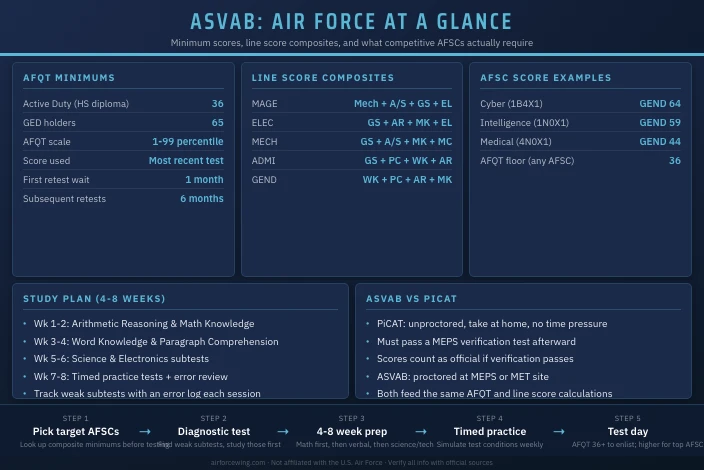
The AFQT (Armed Forces Qualification Test) is a percentile score from 1 to 99. It determines whether you can enlist at all. It’s calculated from four ASVAB subtests: Arithmetic Reasoning, Mathematics Knowledge, Paragraph Comprehension, and Word Knowledge.
Line score composites are separate calculations that determine which AFSCs you qualify for. Each composite combines scores from specific ASVAB subtests. An AFSC might require a minimum score on one or more composites, not just the AFQT.
Think of it this way: the AFQT gets you in the door. Line scores determine which rooms you can walk into.
Air Force ASVAB Composite Scores
The Air Force uses five line score composites, per AFI 36-2605. Each one is built from different subtest combinations.
| Composite | Subtests |
|---|---|
| MAGE | Mechanical Comprehension + Auto/Shop + General Science + Electronics |
| ELEC | General Science + Arithmetic Reasoning + Mathematics Knowledge + Electronics |
| MECH | General Science + Auto/Shop + Mathematics Knowledge + Mechanical Comprehension |
| ADMI | General Science + Paragraph Comprehension + Word Knowledge + Arithmetic Reasoning |
| GEND | Word Knowledge + Paragraph Comprehension + Arithmetic Reasoning + Mathematics Knowledge |
Each composite is a raw sum of the contributing subtest scores. The required minimum varies by AFSC. A cyber role might require GEND 64 while a maintenance job requires MAGE 47. These are completely separate calculations with no overlap in how they’re scored.
Most AFSCs pull from one primary composite. Some require two. Read the specific AFSC profile before you start studying so you know which subtests actually move the needle for you.
Minimum Scores You Need
The floor for Air Force enlistment is AFQT 36. Score below that and you’re ineligible regardless of the job.
GED holders face a harder cutoff: AFQT 65. That’s not a typo. The Air Force accepts very few GED applicants, and those who do qualify must score in the 65th percentile or higher.
But here’s the practical reality: an AFQT of 36 barely gets you through the door. Most recruits scoring near the minimum qualify for only a handful of jobs, often in general support roles. The jobs with the best training, the best post-military careers, and the highest pay potential in fields like intelligence, cyber, special operations support, and medical all require composite scores that demand real preparation.
Some benchmarks by career field:
- Cyber (1B4X1): GEND 64 minimum
- Intelligence (1N0X1): GEND 59 minimum
- Aerospace Medical (4N0X1): GEND 44, MECH 44 minimum
If you want a specific job, look up that AFSC’s composite minimums before you test, not after.
How to Study for the ASVAB
The most common mistake is treating the ASVAB like a general knowledge test and cramming everything at once. That’s inefficient. Study strategically.
Step 1: Identify your target AFSCs first. Look up the composite requirements for the jobs you want. That tells you exactly which subtests matter most. If you want a cyber or intel job, GEND is your priority. If you’re aiming for maintenance or avionics, MAGE and ELEC matter more.
Step 2: Take a full diagnostic practice test. Don’t start studying blind. Find your weak subtests first, then attack those. An hour spent on your weakest subtest improves your composites faster than an hour on something you’re already solid on.
Step 3: Build a 4-to-8-week plan. Most people need four weeks minimum to see meaningful score improvement. Eight weeks is realistic for someone with significant math gaps.
A basic weekly structure:
- Week 1-2: Arithmetic Reasoning and Mathematics Knowledge (these feed three out of five composites)
- Week 3-4: Word Knowledge and Paragraph Comprehension (feeds ADMI and GEND)
- Week 5-6: Science and Electronics subtests (feeds MAGE, ELEC, MECH)
- Week 7-8: Timed practice tests and weak-spot review
Step 4: Keep an error log. After every practice section, write down every question you missed and why. Wrong answer patterns reveal knowledge gaps faster than re-reading chapters.
Step 5: Do timed practice under real conditions. The ASVAB is computerized and adaptive. Practice with timed sections so pacing feels automatic on test day.
Recommended Study Resources
When you purchase through links on our site, we may receive compensation at no extra cost to you.
- ASVAB study guide with full-length practice tests: covers all nine ASVAB subtests with answer explanations
- ASVAB online course with video lessons: self-paced video instruction for every subtest
Practice Tests and Study Materials
Practice tests are the most effective study tool you have. They do three things nothing else can: show you your actual score range, identify which subtests need the most work, and build the pacing that the computer-adaptive format demands.
One full-length practice test per week is a good baseline. Two per week in your final two weeks before the real test is better.
What to look for in study materials:
- Full-length practice exams with answer explanations (not just answer keys)
- Coverage of all nine ASVAB subtests, including the ones that rarely get attention (Assembling Objects, Mechanical Comprehension)
- Score breakdowns by subtest so you can track improvement week over week
Practice Makes the Difference
- ASVAB flashcard set for quick review: portable cards for daily drilling
- Full ASVAB study guide with practice exams: timed practice tests that match the real format
ASVAB vs PiCAT
The PiCAT (Pending Internet Computerized Adaptive Test) is an unproctored version of the ASVAB you can take at home. It’s not a practice test. If you pass a short verification test at MEPS afterward, your PiCAT scores count as your official ASVAB scores.
The main difference: you take the PiCAT in your own environment, with as much time as you need, without the pressure of a testing center. That’s a meaningful advantage if test anxiety affects your performance.
The catch is that you still have to pass the verification test, which is a shorter adaptive test taken at MEPS. You can’t study between the PiCAT and the verification. Your scores need to be consistent with what you showed at home.
The PiCAT is worth exploring if your recruiter offers it. See the PiCAT preparation guide for how it works and whether it’s the right option for you.
If you’re on the officer path instead of enlisted, the ASVAB still matters, but you’ll also need the AFOQT. The AFOQT study guide covers what officers need.
Retesting Rules
You can retake the ASVAB, but the rules limit how often.
- First retest: You must wait one calendar month after your initial test
- Second retest: Another one-month wait after the first retest
- Subsequent retests: Six months between each attempt
The Air Force uses the most recent valid ASVAB score, not the highest. That matters. If you score lower on a retest, that lower score is what your recruiter works with. Don’t retake the test unless you’ve genuinely prepared and have reason to believe your scores will improve.
There’s no limit to how many times you can eventually test, but the six-month gap after the second retest means rushing into retakes is a bad strategy.
More Information
The official ASVAB program is managed by the Department of Defense. You can find official test information and sample questions at officialasvab.com.
For AFSC-specific composite requirements, the primary source is the Air Force Personnel Center at afpc.af.mil. Each AFSC’s formal requirements are codified in AFI 36-2605.
Browse specific enlisted Air Force careers to look up the exact composite minimums for jobs you’re interested in before you decide where to focus your studying. Some of the most searched AFSCs by ASVAB requirements include 1B4X1 Cyber Warfare Operations, 1N0X1 All-Source Intelligence Analyst, and 4N0X1 Aerospace Medical Technician.
If you want to weigh your testing options before scheduling, the PiCAT preparation guide covers the at-home alternative. Officers should see the AFOQT study guide instead.
Start Preparing Today
- ASVAB online course: structured lessons covering every subtest
- ASVAB study guide: full subject review with practice questions
- ASVAB flashcards: quick-review cards for on-the-go studying
This site is not affiliated with the U.S. Air Force or any government agency. Verify all information with official Air Force sources before making enlistment or career decisions.