How to Ace the AFOQT: Ethical Hack (2026)
When you purchase through links on our site, we may receive compensation at no extra cost to you.
Your Air Force Officer Qualifying Test (AFOQT) score shapes your entire officer career. It decides whether you commission, which career fields you can access, and whether you are competitive for rated aviation slots. For pilot candidates, the AFOQT Pilot composite feeds directly into your PCSM score, the ranking number boards use to separate competitive applicants from everyone else.
You get up to three authorized administrations. A 90-day wait separates each attempt. Most applicants who underperform on the AFOQT did not lack ability. They studied the wrong material, skipped the aviation subtests, or walked in without a timed practice test behind them.
This guide gives you a study method, a score target, and a day-by-day plan built for officer candidates.
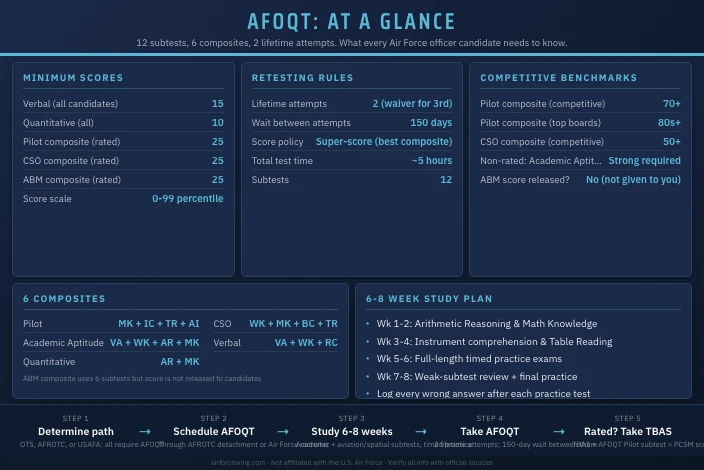
Start here (the 3-step path)
- Take a baseline practice test today, timed, across the academic subtests. Score every section separately.
- Identify your target commission path (OTS, AFROTC, USAFA) and whether you need a rated composite (Pilot, CSO, ABM). That tells you which composites matter most.
- Follow the 30-day plan in this guide. Protect your first authorized attempt. Super-scoring rewards a strong first attempt across the board.
- AFOQT online course: Timed practice tests with video instruction for all 12 subtests.
- AFOQT Guide Book: Full-length exams scored by composite. Start with the diagnostic.
- AFOQT flashcards Daily review for aviation terms, formulas, and vocabulary.
AFOQT basics you must understand before studying
What the AFOQT measures (and what it does not)
The AFOQT is a multi-section aptitude test used to qualify Air Force officer candidates. It measures verbal, quantitative, spatial, and aviation aptitudes. It does not measure character, leadership, or commissioning fitness directly. Those come from your application package.
Your scores produce six composite numbers used for different commissioning decisions and rated aviation selection.
The 12 subtests (Form T)
| Subtest | What it tests |
|---|---|
| Verbal Analogies (VA) | Vocabulary and logical relationships between words |
| Arithmetic Reasoning (AR) | Word problems using basic math |
| Word Knowledge (WK) | Vocabulary, synonyms |
| Math Knowledge (MK) | Algebra, geometry, basic math concepts |
| Reading Comprehension (RC) | Reading passages with inference and detail questions |
| Situational Judgment (SJ) | Officer decision scenarios |
| Self-Description Inventory (SDI) | Personality and trait inventory |
| Physical Science (PS) | High school physics and chemistry |
| Table Reading (TR) | Reading two-axis data tables quickly |
| Instrument Comprehension (IC) | Reading aircraft attitude and heading instruments |
| Block Counting (BC) | Counting blocks in 3D figures with hidden faces |
| Aviation Information (AI) | Aviation knowledge, terms, regulations |
The aviation subtests (IC, BC, TR, AI) only matter if you need a Pilot, CSO, or ABM composite. If your commission path does not require a rated composite, you can deprioritize these.
The 6 composite scores (and what each one controls)
| Composite | Built from | What it controls |
|---|---|---|
| Pilot | AR + MK + TR + IC + BC + AI | Rated pilot selection (feeds PCSM) |
| CSO | WK + MK + RC + TR + BC + AI | Combat Systems Officer selection |
| ABM | VA + AR + WK + MK + RC + TR + BC | Air Battle Manager selection |
| Academic Aptitude (AA) | VA + AR + WK + MK + RC | General officer commissioning |
| Verbal | VA + WK + RC | Verbal aptitude for officer roles |
| Quantitative | AR + MK + TR | Quantitative aptitude for officer roles |
The Academic Aptitude composite is the single most-used score. Every commission path looks at it. Verbal and Quantitative are required minimums for most paths.
Super-scoring
The Air Force uses your best composite scores across all your AFOQT attempts. If your second attempt improves Verbal but drops Pilot, you keep the higher Verbal and the higher Pilot from your earlier attempt. Super-scoring rewards retesting strategically, not blindly.
Three authorized administrations (why your first one matters most)
You can take the AFOQT up to three times in your lifetime, with a 90-day wait between attempts. Each attempt counts against your total. A wasted attempt early closes your options later.
Super-scoring protects strong individual composites, but you only have three swings. Do not take the test cold “to see how it feels.” Use practice tests for that.
Score requirements and competitive benchmarks
Minimum scores for commissioning eligibility
The Air Force sets minimum AFOQT composite scores for officer candidates. The most common gates are:
- Verbal: 15
- Quantitative: 10
- Combined Verbal and Quantitative thresholds may apply depending on commissioning path
These minimums qualify you to commission. They do not make you competitive for selective career fields, rated positions, or strong OTS boards.
Rated position minimums
For rated aviation positions, the Air Force sets composite minimums:
- Pilot composite: 25
- Combat Systems Officer composite: 25
- Air Battle Manager composite: 25
The Pilot minimum is just the gate. Competitive Pilot composites for OTS rated boards are typically much higher and pair with strong PCSM scores.
What “competitive” actually means for OTS and AFROTC boards
Selective boards do not run on minimums. They rank applicants on the full package: GPA, AFOQT, PCSM (for pilots), references, leadership record, and interview performance.
For rated pilot slots, PCSM is the most-used ranking number. PCSM combines:
- AFOQT Pilot composite
- TBAS score
- Self-reported flight hours
Strong Pilot composites and TBAS scores can offset zero flight hours, but flight hours give you the cheapest PCSM bump available. Plan for that when comparing prep options.
The fastest way to raise your AFOQT scores
Most AFOQT gains come from two moves: study the subtests that drive your target composites, and turn every mistake into a rule you do not miss again.
The priority rules
Rule 1: Earn points where your target composite gives them fastest. For most officer candidates, that means AR, MK, WK, RC, and VA first. Those five feed Academic Aptitude, Verbal, and Quantitative, plus several rated composites.
Rule 2: Fix accuracy before speed. The AFOQT is timed. Speed without accuracy locks in mistakes that the timer makes worse.
Rule 3: One notebook runs the whole prep. Your error log captures every missed question with the section, the mistake type, the fix rule, and a correct redo.
The 80/20 topics that move composites the most
| Subtest | Highest-payoff skills | What “good” looks like |
|---|---|---|
| AR | Percent, ratio, rate problems, unit conversion | Translate words to math quickly and check units |
| MK | Algebra, geometry, exponents, basic functions | Solve cleanly without guessing |
| VA | Word relationships, root words, common patterns | Identify the relationship before reading options |
| WK | Latin/Greek roots, prefixes, suffixes, context clues | Eliminate wrong answers from word parts |
| RC | Main idea, inference, detail location | Match answers to passage support |
For rated candidates, add aviation subtests (IC, BC, TR, AI) after you have a solid academic base.
The “fix your weakest first” method
- Take your baseline test. Score every subtest separately.
- Rank subtests by impact: focus only on the ones that feed your target composites.
- Attack your weakest priority subtest for 5 days. Daily study: 45 to 60 minutes on that subtest.
- Retest that subtest on day 6.
- If it improved, move to the next weakest. If not, spend 3 more days before moving on.
The error log
For every missed question, record:
- Section
- Mistake type: concept gap, misread, rushed math, bad guess, ran out of time
- Fix rule: one sentence that prevents the miss next time
- Redo: solve the question correctly without looking
Common mistake types with fix rules:
- Misread the question: Underline what the question asks before solving.
- Sign error: Write signs large and check them after each step.
- Percent confusion: Convert percent to decimal before multiplying.
- Vocabulary guess: Eliminate two options before picking from the remaining two.
Review your error log at the start of every study session, not the end.
Do this today and this week
Today: Take a full timed baseline practice test. Score every section. Set up your error log.
This week: Identify your target composites. Rank your subtests from weakest to strongest within those composites. Start your first “fix weakest first” cycle on your lowest-scoring priority subtest.
Your AFOQT study plan (choose 7, 14, 30, or 60 days)
Pick the plan that matches your timeline. The 30-day plan is the best default. Use a shorter plan only if your test date is already locked.
How many hours you actually need
| Your baseline AA composite | Realistic goal | Suggested plan | Daily study time |
|---|---|---|---|
| 60+ | Polish weak spots, push to 75+ | 7-day plan | 1.5 to 2 hours |
| 40 to 59 | Solid improvement, target 60 to 70 | 14-day plan | 2 to 2.5 hours |
| 25 to 39 | Meaningful score jump | 30-day plan | 1.5 to 2 hours |
| Below 25 | Rebuild fundamentals | 60-day plan | 1 to 1.5 hours |
Consistency beats marathon sessions. Sixty minutes every day outperforms four hours on Saturday.
The daily routine that works
Every study day uses the same four-step loop:
- Learn one skill (15 to 25 minutes), one topic per session
- Timed practice set (20 to 30 minutes), match the per-question pace of the real test
- Error log review (15 to 25 minutes), redo each missed question correctly
- Quick retention (5 minutes), yesterday’s error log entries
Total: 55 to 85 minutes per study day.
The 30-day plan (recommended for most candidates)
| Week | Main goal | Study days | Checkpoint day |
|---|---|---|---|
| Week 1 | VA, WK, and AR fundamentals | 5 to 6 days on verbal + math | Full timed practice, score all sections |
| Week 2 | MK and RC | 5 to 6 days on math knowledge + reading | Full timed practice, compare to Week 1 |
| Week 3 | Aviation subtests (if rated) or weakest academic subtests | 5 to 6 days targeted | Full timed practice, compare to Week 2 |
| Week 4 | Timed full tests, error log cleanup, pacing | 3 study days + 2 full timed tests | Final practice test |
- AFOQT online course: Structured video lessons and timed practice for every section.
- AFOQT Guide Book: Follow the weekly plan using the book's lessons and practice tests.
- AFOQT flashcards Daily retention for vocabulary, formulas, and aviation terms.
If you are not pursuing a rated composite, replace Week 3’s aviation block with deeper work on your weakest academic subtest.
The 7-day plan (fast polish)
Only use this when your baseline is already at or above target.
- Day 1: full timed practice test, identify top 2 weak subtests
- Day 2: weak subtest 1, lesson + 20 timed questions + error log
- Day 3: weak subtest 2, same structure
- Day 4: mixed practice, 15 questions from each weak subtest, timed
- Day 5: full timed practice test, compare to Day 1
- Day 6: review all error log entries, redo missed questions, flashcards
- Day 7: light review, 20 minutes flashcards, sleep, no new material
Expected result: 3 to 7 point composite improvement on each targeted composite. The 7-day plan works for polishing, not rebuilding.
The 14-day plan (tight improvement)
Two mini-cycles.
- Days 1 to 7 (Cycle 1): baseline + AR/MK + WK/PC + weakest from baseline + full test
- Days 8 to 14 (Cycle 2): review error log, top 2 weak from Day 7, technical/aviation if rated, full timed test, light review
The 60-day plan (steady rebuild)
For composite scores well below target.
- Weeks 1 to 2: math fundamentals, no timed pressure
- Weeks 3 to 4: AR word problems and MK geometry, start timing yourself
- Weeks 5 to 6: WK vocabulary building, RC passage strategy, first full timed test
- Weeks 7 to 8: targeted weak-spot work, aviation subtests if rated
- Week 9: full timed tests (2 this week)
- Week 10: one more timed test Monday, light review, rest Friday, test Saturday
Weekly checkpoint
Every checkpoint day uses the same process:
- Take a full timed practice test, simulate real conditions
- Score every subtest separately, compare to last week
- Calculate your composite estimates for your target rated composite
- Update your error log
- Decide next week’s focus: your lowest priority subtest gets the most time
If your practice scores have plateaued for two consecutive weeks, change your study method.
Section-by-section game plan
This section gives you the methods, drills, and traps for each subtest. Start with the subtest your error log says needs the most work.
Verbal Analogies (VA)
VA tests word relationships. Each question shows two pairs of words connected by some relationship (synonym, antonym, function, category, etc.). Your job is identifying that relationship.
Method
- Read the first pair. State the relationship in one sentence (“X is the opposite of Y”).
- Apply the same relationship to the answer pairs.
- Eliminate pairs that do not match the relationship.
- If two pairs remain, pick the one with the strongest match.
Common relationships
- Synonym / antonym
- Part to whole / whole to part
- Cause and effect
- Tool and use
- Category and example
- Worker and product
VA drill and mastery check
- 15 timed questions in 8 minutes. Score it. Add missed words to flashcards.
Ready when: you state the relationship in under 5 seconds and miss fewer than 3 out of 15.
Arithmetic Reasoning (AR)
AR is word-problem math. It feeds Pilot, CSO, ABM, AA, and Quantitative composites. Every AR point you gain shows up in five composites.
What to study first
- Percentages (percent of, percent change, percent off)
- Ratios and proportions
- Rate, time, distance problems
- Multi-step word problems
- Unit conversion
The 5-step translation method
- Underline what the question asks. Circle the unit.
- List the given numbers with labels.
- Choose the operation. “Total” = add. “Of” = multiply. “Per” = divide.
- Compute carefully. Write every step.
- Sanity check. Does the answer make sense?
Common AR traps and fix rules
| Trap | Fix rule |
|---|---|
| Answered the wrong question | Re-read the underlined question after solving |
| Unit mismatch | Write units next to every number |
| Percent of vs percent off | “Of” multiplies. “Off” subtracts from the total. |
| Multi-step order error | Number your steps before computing |
| Rounded too early | Keep full decimals until the final answer |
AR drills + mastery check
- Translation drill (untimed, 15 min): 10 problems, write only the equation
- Speed drill (timed, 20 min): 16 AR questions in 20 minutes
- Error-type drill (15 min): 10 questions from your error log
Ready when: 16 questions in 20 minutes at 75% accuracy, two sessions in a row.
Math Knowledge (MK)
MK is direct math without word problems. Feeds Pilot, CSO, ABM, AA, and Quantitative composites.
What to study first
- Solve for x (one-step and two-step equations)
- Order of operations (PEMDAS)
- Area and perimeter of rectangles, triangles, circles
- Basic exponent rules
- Factoring simple expressions
- Functions and inequalities
Method: write less, win more
- Identify the problem type before touching your pencil.
- Write only the steps that change something.
- Check your answer by plugging back in.
Common MK mistakes and fixes
| Mistake | Fix |
|---|---|
| Sign error | Circle every negative before moving it |
| PEMDAS violation | Write “P-E-M/D-A/S” at the top of your scratch paper |
| Wrong formula | Underline “area” or “perimeter” in the question |
| Forgot to square radius | Write the formula first, then plug in |
Formula list to memorize
- Area of rectangle: l × w
- Area of triangle: (b × h) / 2
- Area of circle: π × r²
- Perimeter of rectangle: 2(l + w)
- Circumference of circle: 2 × π × r
- Pythagorean theorem: a² + b² = c²
- Slope: (y₂ − y₁) / (x₂ − x₁)
MK drills + mastery check
- Formula recall (5 min): Write all 7 from memory daily until clean
- Equation speed drill (15 min): 12 solve-for-x problems
- Geometry drill (15 min): 10 area/perimeter problems, drawn before solving
Ready when: you write all 7 formulas from memory and solve 12 mixed MK questions in 16 minutes at 80%.
Word Knowledge (WK)
WK tests vocabulary. Each question gives a word (sometimes in a sentence) and asks for the closest synonym. Feeds CSO, ABM, AA, and Verbal composites.
What to study
- Common Latin and Greek roots (30 roots cover hundreds of words)
- Prefixes that change meaning (un-, re-, pre-, dis-, mis-, anti-, non-)
- Suffixes that signal parts of speech (-tion, -ous, -ify, -able)
- Context clue strategies
The root-word method
Break unfamiliar words into prefix, root, suffix. Even a partial root narrows the options. If you learn 30 roots and 20 prefixes, you can make educated guesses on words you have never seen.
WK drills + mastery check
- Flashcard drill (10 min daily): 10 new words per day, root + meaning + sentence
- Root deconstruction drill (10 min): 10 unfamiliar words, break into parts, guess meaning, check
- Speed synonym drill (timed, 8 min): 20 words
Ready when: you can define 8 of 10 random words from your study list and narrow unfamiliar words to 2 choices.
Reading Comprehension (RC)
RC gives short passages with main idea, detail, inference, and tone questions. Feeds CSO, ABM, AA, and Verbal composites.
Method: read the question first
- Read the question before the passage.
- Identify question type: main idea, detail, inference, or vocabulary in context.
- Read the passage with that question in mind.
- Answer based on what the passage says, not what you know from outside.
Common RC traps
| Trap | Fix |
|---|---|
| Outside knowledge | Only accept answers the passage directly supports |
| “Too broad” answer | Match the answer’s scope to the passage’s scope |
| “Too narrow” answer | For main idea, ask “Does this cover the WHOLE passage?” |
| Missed “not” / “except” | Circle “not” or “except” in every question |
RC drills + mastery check
- Passage summary drill (untimed, 15 min): 5 passages, write one-sentence summaries
- Speed reading drill (timed, 10 min): 5 passages, 2 minutes per passage
- Inference drill (untimed, 10 min): list passage facts, then list conclusions
Ready when: 80% or better on timed passage sets, supporting evidence identifiable for every answer.
Physical Science (PS)
PS tests high school physics and chemistry concepts. Feeds the Verbal and Academic Aptitude composites in some forms, plus rated composites.
Study: forces and motion, energy, waves, basic chemistry (atoms, compounds, reactions), simple electricity and magnetism. The depth is high school general science, not college level.
Drill: 20 questions in 10 minutes. Add missed terms to flashcards.
Instrument Comprehension (IC)
IC shows aircraft attitude and heading indicators. You read them and identify the aircraft’s bank, pitch, and heading. Required for Pilot composite.
Study: the six-pack of flight instruments, especially attitude indicator (artificial horizon) and heading indicator. Practice reading attitude indicators where the airplane symbol shows bank and pitch against the artificial horizon line.
Drill: 20 IC questions in 6 minutes. Speed matters more than precision here, but accuracy is required.
Table Reading (TR)
TR shows a two-axis data table. You match a row and a column to find a value. The skill is speed and accuracy under a tight clock.
Study: practice with sample tables. The trick is using your finger or pencil to trace from row label to column label.
Drill: 40 TR questions in 7 minutes. The clock is the entire challenge.
Aviation Information (AI)
AI tests aviation knowledge: aircraft parts, flight controls, instruments, regulations, airspace. Required for Pilot and CSO composites.
Build flashcards:
- Four forces of flight (lift, weight, thrust, drag)
- Primary flight controls (ailerons, elevator, rudder)
- Aircraft parts
- Class A through G airspace basics
- VFR vs IFR concepts
- Pattern terms (downwind, base, final, crosswind)
Drill: 20 AI questions in 8 minutes. Add missed terms to flashcards daily.
Block Counting (BC)
BC shows 3D block figures and asks you to count specific blocks (often hidden faces). Required for Pilot, CSO, and ABM composites.
Method: count systematically (row by row, layer by layer). Mark each block with a finger or pencil so you do not double-count or miss hidden ones.
Drill: 20 BC problems in 4.5 minutes. The section is short. Pacing pressure is the main challenge.
Self-Description Inventory (SDI)
SDI is a personality inventory. Answer honestly and consistently. Do not try to game it. The Air Force is looking for consistency across answers, and inconsistent responses can be flagged.
Situational Judgment (SJ)
SJ shows officer scenarios with response options. You rank or select the best and worst responses. There is no single right answer for every scenario, but there are clearly wrong choices.
Approach: select responses that are professional, mission-focused, and respect chain of command. Avoid responses that escalate conflict or undermine subordinates or supervisors.
- AFOQT Guide Book with practice tests Full-length timed tests scored by composite. Includes instrument reading and block counting sets.
- AFOQT flashcards Daily review for aviation terms, physics formulas, and vocabulary roots across all 12 subtests.
Practice tests that actually work
Practice tests are your single most effective study tool, but how you use them matters.
What a practice test is for
Use them to:
- Measure your current composite range
- Identify weakest subtests
- Build pacing and stamina across 5 hours of testing
Do not use them to:
- Replace studying (the review is where learning happens)
- Memorize specific questions
- Inflate confidence with untimed or easy tests
The right way to run a full-length AFOQT practice
Simulate real conditions:
- Desk and chair, not couch
- No phone in the room
- No breaks between sections
- Timer running per section
- No answer checking mid-test
Mark each question with C (Confident), R (Reasoned), G (Guessed), T (Time pressure). Score the test, then stop. Review the next day with fresh eyes.
The review method that creates points
- Sort misses by C/R/G/T type
- Write fix rules for each miss
- Redo missed questions correctly without looking at the explanation
- Build a Top 10 list of mistake patterns
The Top 10 list is what connects practice tests to daily study. Without it, you take a test, get a score, and study the same things.
Timed vs untimed
Untimed for learning new material. Timed for building test performance. Switch from untimed to timed once you can solve 8 of 10 questions correctly untimed.
How often to practice test
- Weeks 1 to 3 of a 30-day plan: one full practice test per week
- Final week: two full practice tests
- Between full tests: short timed sets daily
Practice habits that waste time
- Taking tests without reviewing them
- Redoing the same test (you remember answers)
- Using untimed tests to estimate your real score
- Taking practice tests every day
- Scoring tests but skipping error log work
Test-day strategy
Time management across 12 subtests (5-hour stamina)
The AFOQT runs about 5 hours including instructions and breaks. Stamina is part of the test.
| Subtest | Questions | Time |
|---|---|---|
| Verbal Analogies | 25 | 8 min |
| Arithmetic Reasoning | 25 | 29 min |
| Word Knowledge | 25 | 5 min |
| Math Knowledge | 25 | 22 min |
| Reading Comprehension | 25 | 38 min |
| Situational Judgment | 50 | 35 min |
| Self-Description Inventory | 240 | 45 min |
| Physical Science | 20 | 10 min |
| Table Reading | 40 | 7 min |
| Instrument Comprehension | 25 | 5 min |
| Block Counting | 30 | 4.5 min |
| Aviation Information | 20 | 8 min |
Speed sections (WK, TR, IC, BC) demand fast recall. Pace yourself differently in each.
Guessing strategy
You will guess on some questions. Make those guesses smarter:
- Eliminate one or two wrong answers first
- Pick the best of the remaining options
- Move on without changing the answer later
There is no penalty for wrong answers on the AFOQT. Never leave a question blank.
Accuracy under pressure
- Recheck negatives in math
- Confirm you answered what was asked, not what was easy
- Sanity check answer size
- Use the same methods you practiced
The week-of checklist
7 days out:
- Take your final timed practice
- Build a “tune-up” list from your error log
3 days out:
- Light review only
- Confirm test location and time
- Confirm what to bring
1 day out:
- Light review, no new material
- Set two alarms
- Pack documents and ID
- Bed by 10 PM
Morning of:
- Eat protein + carbs
- Arrive 30 minutes early
- No cramming in the parking lot
Where you take the AFOQT and what to bring
Scheduling
AFROTC cadets: through your detachment AS-300 office OTS applicants: through your recruiter or processing office USAFA cadets: through the USAFA testing office
Most candidates test at an Air Force base, a base education center, or a designated testing facility. Travel may be required.
What to expect at the testing location
You arrive, present ID, and check in. The proctor places you at a workstation. You will not have your phone in the testing room. Test booklets and answer sheets are provided. Scratch paper rules vary by location, so ask the proctor.
The day is long. Expect 5 hours of testing plus check-in time.
Common mistakes that cause delays
- Forgetting your ID
- Arriving late
- Not knowing the test format on test day
- Bringing items you cannot keep in the testing room
Retakes and limits (use them strategically)
The 90-day wait and three authorized administrations
You can take the AFOQT up to three times in your lifetime, with a 90-day wait between attempts. Each attempt counts against your total. Once you exhaust your three attempts, the AFOQT is done for you.
Super-scoring: how it helps and how it misleads
The Air Force uses your best composite scores across all your AFOQT attempts. This protects you from a bad day on a single composite.
The catch: super-scoring does not let you “fix” a weak first attempt indefinitely. You have three swings. If your first two attempts both produced weak Pilot composites and your third also misses, you do not get another shot at Pilot.
When a retest makes sense
A retest is worth it when:
- Your practice scores consistently beat your official scores by 10+ points across 3 or more timed tests
- You can identify specific subtests where you closed gaps (your error log shows fixes)
- You had a genuinely bad test day (sick, no sleep, extreme anxiety)
- Your target composite needs to move 5 to 15 points
A retest is a bad idea when:
- Your practice scores are about the same as your last AFOQT
- You have not changed your study approach
- You scored well overall but missed one composite by a point or two
The three-part retake standard
Before scheduling a retest:
- Timed proof: 2 full timed practice tests within the past 7 days, both at or above your target
- Pattern proof: your error log shows the old mistake patterns are fixed
- Stamina proof: you can sit through a 5-hour timed test without concentration loss in the final sections
If any check fails, keep studying.
AFOQT vs ASVAB (quick comparison)
| Factor | AFOQT | ASVAB |
|---|---|---|
| Purpose | Air Force officer commissioning | Enlisted military entrance |
| Length | ~5 hours, 12 subtests | ~3 hours, 9 subtests |
| Scoring | Six composites (Pilot, CSO, ABM, AA, V, Q) | AFQT percentile + 5 composites |
| Attempts | 3 lifetime, 90-day wait | Unlimited with retesting rules |
| Super-scoring | Yes, best composites across attempts | No, most recent score only |
| Aviation sections | Yes (IC, BC, TR, AI) | No |
| Personality | Yes (SDI) | No |
| Situational judgment | Yes (SJ) | No |
The AFOQT is longer, has more subtests, and rewards strategic retesting. The ASVAB is shorter and uses your most recent score only.
Best AFOQT prep options (course vs book vs flashcards)
The right prep tool depends on your timeline, your weak sections, and your study style.
Before choosing one, use the seven-point AFOQT prep buying checklist to check test coverage, timing, explanations, and format fit.
What good prep must include
Any prep tool you use should have:
- Full-length timed practice tests with composite scoring
- Coverage of all 12 subtests including aviation sections
- Answer explanations that show the solving method
- Score tracking by subtest and composite
- Content that matches the actual AFOQT format
If a product is missing any of these, skip it.
Online course
Best for candidates who need a daily plan and tend to skip review without one. Use it for timed sets and weak-section review, not passive video time.
- Get this AFOQT online course we recommend for Air Force applicants. It includes timed sets, full practice tests, and composite score tracking.
Guide book
Best for self-directed candidates who prefer reading over video. Take the diagnostic test first. Read chapters for your weakest subtests first, not front to back. Use the book’s full tests as weekly checkpoints.
- AFOQT Guide Book (Print or Digital): Covers all 12 subtests and 6 composites with answer explanations.
Flashcards
Best for vocabulary, aviation terms, formulas, and physical science recall. Use them daily for 10 to 15 minutes.
- AFOQT Flashcards: Quick-review cards for vocabulary, math, and aviation concepts.
Best combo
- Primary tool: online course or guide book
- Support tool: flashcards built from your error log
Buying mistakes
- Buying three resources and finishing none
- Choosing prep based on reviews alone (ASVAB-focused reviews do not transfer)
- Paying for “guaranteed score increase” programs
- Starting with flashcards instead of a diagnostic test
- Using only free practice tests (often missing aviation subtests)
FAQs
What AFOQT score do I need for pilot?
The minimum Pilot composite is 25. Competitive pilot candidates score well above that, often in the 80s and 90s. The Pilot composite combines with TBAS and flight hours to produce your PCSM score, which boards use for rated selection. Aim 15 to 20 points above the minimum to be competitive.
How hard is the AFOQT compared to the ASVAB?
The AFOQT is harder. The math is harder than the ASVAB, the verbal sections move faster, and the aviation subtests have no ASVAB equivalent. ASVAB-only prep is not enough.
Can I study for the AFOQT in 2 weeks?
Only if your baseline scores are already near target. For real composite improvement, plan 30 to 60 days. Aviation subtests in particular need dedicated study time that cannot be cleared in 2 weeks.
Do I need flight experience for the aviation subtests?
No, but you do need to study aviation knowledge. The Aviation Information subtest tests terms, regulations, and aircraft parts. The Instrument Comprehension subtest tests reading attitude and heading indicators. Both can be studied from books and flashcards without flight experience.
What happens if I fail the AFOQT?
You wait 90 days and retest. Super-scoring means your best composites across all attempts are used. After three attempts, you cannot retest. Use your three attempts wisely.
How does the AFOQT affect my PCSM score?
PCSM (Pilot Candidate Selection Method) combines your AFOQT Pilot composite, your TBAS score, and your self-reported flight hours. Boards use PCSM to rank rated pilot candidates. A strong AFOQT Pilot composite plus 30 to 50 flight hours can produce a competitive PCSM even without a private pilot license.
For the at-home enlistment test path, see the Air Force PiCAT study guide. For aviation aptitude beyond the AFOQT Pilot composite, see the TBAS study guide. For enlisted-to-officer applicants who need the ASVAB, see ASVAB for OTS.