AFOQT Study Guide for Air Force Officer Candidates
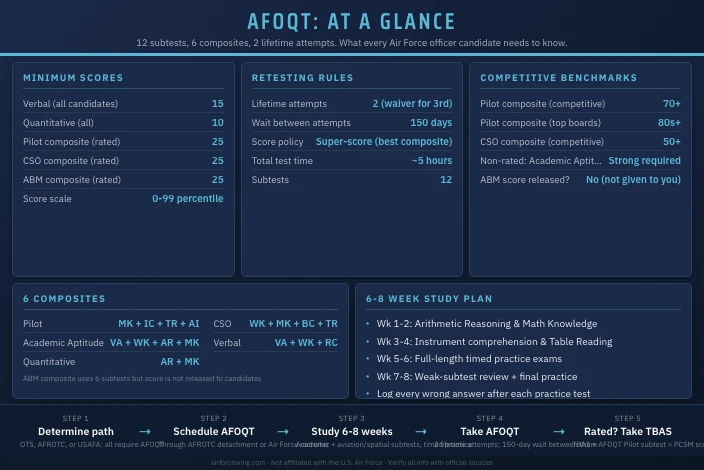
Every Air Force officer candidate takes the AFOQT. It doesn’t matter whether you’re going through OTS, AFROTC, or the Air Force Academy. The test follows you into the commissioning process and shapes which career fields you can access. For rated aviation positions, your AFOQT Pilot composite also feeds directly into your PCSM score.
You get two lifetime attempts. After your first test, a 150-day wait is required before you can retest. The stakes are real. Treat your first attempt like your only one.
What the AFOQT Tests
The current AFOQT (Form T) has 12 subtests. Total test time runs close to five hours when you include instructions and breaks. The subtests break down into three groups by what they measure.
Academic subtests cover the core math and verbal skills evaluated in any officer selection process:
- Verbal Analogies (25 questions, 8 min): word relationships and vocabulary reasoning
- Arithmetic Reasoning (25 questions, 29 min): applied math problems in real-world contexts
- Math Knowledge (25 questions, 22 min): algebra, geometry, and quantitative concepts
- Word Knowledge (25 questions, 5 min): vocabulary depth and precision
- Reading Comprehension (25 questions, 24 min): draws conclusions and inferences from passages
- Physical Science (20 questions, 10 min): basic physics and chemistry concepts
Aviation and spatial subtests are unique to the AFOQT and matter most for rated career fields:
- Instrument Comprehension (20 questions, 6 min): reads aircraft attitude from cockpit instruments
- Table Reading (40 questions, 7 min): fast data lookup under time pressure
- Aviation Information (20 questions, 8 min): general aeronautical knowledge
- Block Counting (30 questions, 3 min): counts how many blocks touch a given block in a 3D stack
Personality and judgment subtests are not scored the same way as the cognitive sections:
- Self-Description Inventory (240 questions, 45 min): personality assessment, not a pass/fail subtest
- Situational Judgment (16 scenarios, 35 min): rates your responses to officer-relevant situations
AFOQT Composite Scores
Subtest scores combine into six composites. Composite scores are percentile-based, ranging from 0 to 99. A score of 72 means you scored better than 72% of your cohort.
| Composite | Subtests Included | Used For |
|---|---|---|
| Pilot | Math Knowledge + Instrument Comprehension + Table Reading + Aviation Information | Pilot selection, PCSM calculation |
| Combat Systems Officer (CSO) | Word Knowledge + Math Knowledge + Block Counting + Table Reading | CSO selection boards |
| Air Battle Manager (ABM) | Verbal Analogies + MK + TR + IC + BC + Aviation Information | ABM selection boards |
| Academic Aptitude | Verbal Analogies + Word Knowledge + Arithmetic Reasoning + Math Knowledge | All commissioning, non-rated selection |
| Verbal | Verbal Analogies + Word Knowledge + Reading Comprehension | All commissioning |
| Quantitative | Arithmetic Reasoning + Math Knowledge | All commissioning |
One important detail: the Air Force does not release your ABM composite score to you. You receive five scores on your report, not six.
Score Requirements and Competitive Benchmarks
Two minimums apply to every officer candidate regardless of career path:
- Verbal: 15 minimum
- Quantitative: 10 minimum
Candidates pursuing rated positions must also clear the following floors:
| Rated Role | Additional Minimums |
|---|---|
| Pilot (including RPA) | Pilot 25, CSO 10 |
| Combat Systems Officer | Pilot 10, CSO 25 |
| Air Battle Manager | ABM 25 |
Clearing the minimums gets you eligible. It doesn’t make you competitive. Selection boards at OTS and AFROTC look at full officer packages, and composite scores are weighed against other candidates in the same pool.
For the Pilot composite, competitive scores typically start around 70. Top-tier UPT candidates often score in the 80s or above. The CSO minimum is much lower, but competitive CSO packages still push past 50. For non-rated officers, the Academic Aptitude, Verbal, and Quantitative composites carry the most weight.
AFOQT Study Resources
When you purchase through links on our site, we may receive compensation at no extra cost to you.
- AFOQT study guide with practice tests, covers all 12 subtests and 6 composites with strategies and full-length practice exams
- AFOQT online preparation course, video instruction and timed practice for every section of the officer qualifying test
How to Study for the AFOQT
Six to eight weeks is a realistic preparation window if you’re starting from scratch. Candidates with strong math and verbal foundations can compress to four weeks. Those with gaps in either area should budget the full eight.
Weeks 1-2: Build the academic foundation. Arithmetic Reasoning and Math Knowledge feed three of the six composites and represent the largest time investment for most candidates. Work through algebra, geometry, and word-problem strategies before moving on. Word Knowledge and Reading Comprehension respond quickly to structured vocabulary study.
Weeks 3-4: Tackle the aviation and spatial subtests. Instrument Comprehension is trainable. Learn to read the six basic flight instruments: attitude indicator, altimeter, heading indicator, airspeed indicator, turn coordinator, and directional gyro. You don’t need flight experience. You need pattern recognition from repetition. Table Reading is a pure speed drill; practice reading data tables as fast as possible. For Block Counting, work through spatial reasoning practice sets daily.
Weeks 5-6: Full-length timed practice tests. Sit for at least two complete practice exams under real timing conditions. The AFOQT is long. Stamina and pacing matter. After each test, log every wrong answer and the reason you missed it. Patterns in your error log reveal exactly which subtests need more work.
Weeks 7-8: Targeted weak-spot review and final practice. Stop reviewing what you already know. Focus entirely on the subtests where your practice scores are lowest. A second full-length practice test in the final week builds confidence and exposes any remaining gaps.
A few things to avoid:
- Don’t study general knowledge at the expense of spatial and aviation subtests; most candidates underinvest there
- Don’t neglect the Self-Description Inventory; while it isn’t a knowledge test, reading sample scenarios helps you understand the format
- Don’t schedule your test before you’ve taken at least two full-length timed practice exams
AFOQT Retesting Rules
You are authorized two lifetime attempts at the AFOQT. A 150-day wait is required between your first and second attempt. A third attempt requires a waiver from the Air Force Personnel Center and is granted only in documented exceptional circumstances.
The Air Force uses super-scoring: your best composite score from either attempt is recorded. If your Pilot composite was 71 on your first test and 65 on your second, your official Pilot composite is 71. This is a meaningful change from the older policy that only recognized the most-recent score.
Super-scoring helps on paper, but it doesn’t change the strategic reality. Candidates who rely on a second attempt to fix a poor first showing often score inconsistently across composites. The 150-day gap also means a retest can delay your commissioning timeline by five months. Prepare as if your first attempt is your only chance to hit competitive numbers.
Prepare Before Your First Attempt
- AFOQT study guide, full walkthrough of each subtest with practice questions
- AFOQT flashcard set, quick-review cards for key concepts across all 12 subtests
AFOQT vs. ASVAB
Both tests matter for Air Force careers, but they serve different purposes and evaluate different populations.
| AFOQT | ASVAB | |
|---|---|---|
| Purpose | Officer selection | Enlisted screening |
| Who takes it | Officer candidates (OTS, AFROTC, USAFA) | Enlisted applicants at MEPS |
| Number of subtests | 12 | 9 |
| Score outputs | 6 composites (percentile 0-99) | AFQT + 5 line score composites |
| Minimum to proceed | Verbal 15, Quantitative 10 | AFQT 36 |
| Lifetime attempts | 2 (waiver for 3rd) | No hard cap; 6-month gap after 2nd retest |
Prior-enlisted candidates commissioning through OTS face both tests. If you enlisted with ASVAB scores on file, those don’t replace the AFOQT. Officer selection requires the AFOQT regardless of prior service. The ASVAB for OTS guide covers how prior ASVAB scores factor into the officer application process.
More Information
AFOQT scheduling is managed through Air Force Officer Accessions. You can’t walk in and take it on your own; the test is administered through AFROTC detachments, OTS applications, or Air Force recruiting channels. Selection board policies and composite minimums are maintained by the Air Force Personnel Center.
If your career goal involves a rated position, the AFOQT is the first test in a two-test sequence. The TBAS comes after, and your PCSM score combines both results. The TBAS study guide covers that second step in detail.
For specific career fields, see the 11X Pilot profile for rated requirements, 14N Intelligence Officer for a high-demand non-rated track, and 17S Cyber Operations Officer if you’re targeting cyber. Browse all Air Force officer careers to find the fields where your composite scores are most competitive.
If you’re still deciding between the enlisted and officer paths, the ASVAB study guide covers what the enlisted test requires.
Start Your Officer Test Preparation
- AFOQT online course, structured video lessons and timed practice for all 12 subtests
- AFOQT study guide, full-length practice exams and score analysis for all 12 subtests
If you’re preparing a full rated officer application package, the TBAS study guide covers the aviation aptitude test that feeds into your PCSM score alongside the AFOQT.
This site is not affiliated with the U.S. Air Force or any government agency. Verify all information with official Air Force sources before making enlistment or career decisions.