Air Force Officer Qualification
When you purchase through links on our site, we may receive compensation at no extra cost to you.
The path from “I want to serve as an officer” to a commissioning ceremony is not a single test or a single application. It is a multi-year track where academic record, AFOQT scores, fitness, character, and leadership history are all weighed against each other on the same package. This guide covers what qualifies you, what doesn’t, what each piece of the package weighs, and how to time your preparation so you walk into a selection board with the strongest version of yourself on paper.
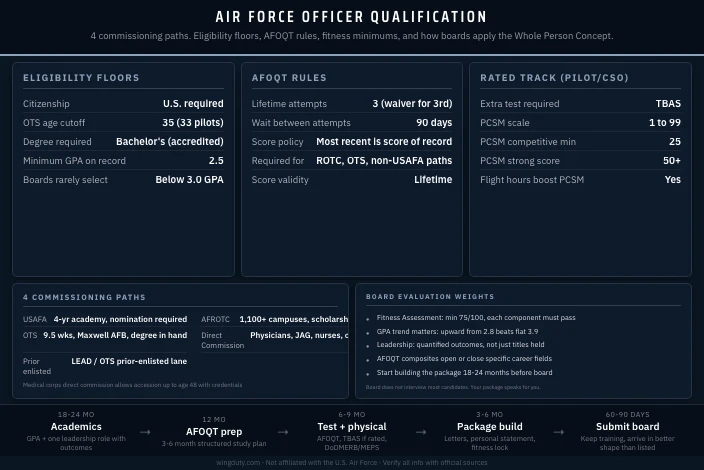
Officer accession boards do not pick the highest GPA or the fastest 1.5-mile run. They build a class. A package with a 3.0 GPA, strong leadership evidence, and a high AFOQT can outrank a 3.9 GPA with no leadership and an average AFOQT. The boards refer to this evaluation method as the “Whole Person Concept,” and understanding it is the difference between a competitive application and a compliant one.
Who Qualifies for an Air Force Commission
Officer commissioning has a fixed set of baseline requirements. If you do not meet these, no amount of strong AFOQT performance will get a package boarded.
Citizenship. You must be a U.S. citizen at the time of commissioning. For ROTC scholarship and USAFA cadets, citizenship is required at entry. OTS candidates must have citizenship in hand before they ship to Maxwell.
Age. For OTS, you must be commissioned before age 35 in most career fields. Pilot candidates have a stricter cutoff and must be commissioned before age 33. ROTC and USAFA candidates have their own age windows tied to enrollment dates. A small set of professional career fields, particularly in the medical corps, allow accession up to age 48 with appropriate credentials and a waiver.
Education. All officers commission with at least a bachelor’s degree from a regionally accredited institution. The minimum GPA of record is 2.5, but boards rarely select packages below 3.0 unless other elements are exceptional.
Character. Background investigations look at criminal record, drug history, financial responsibility, and prior conduct. Honesty during the process matters more than the record itself. Boards will pass a candidate with a minor youthful offense who disclosed it. They will not pass a candidate who concealed one.
Medical. Officer candidates pass a medical screening sized to the career field. ROTC scholarship cadets and USAFA candidates go through DoDMERB (Department of Defense Medical Examination Review Board). OTS candidates and direct commissionees process through a Military Entrance Processing Station (MEPS) or an Air Force-approved provider. Rated candidates also clear a flight physical with vision, depth perception, and hearing standards.
The Four Commissioning Paths
There are four ways to commission as a U.S. Air Force or Space Force officer. The right one depends mostly on where you are in your education timeline, what kind of college experience you want, and whether you already have a degree.
U.S. Air Force Academy (USAFA) at Colorado Springs is a four-year federal service academy. Cadets earn a Bachelor of Science along with their commission. Admission requires a congressional nomination and is the most selective of the four paths. Best fit for high school seniors who want military life from day one.
Air Force ROTC (AFROTC) runs at over 1,100 colleges and universities, either as a host detachment or through a crosstown agreement. Cadets balance regular college courses with military science classes and leadership labs. The program splits into the General Military Course (freshman and sophomore years) and the Professional Officer Course (junior and senior years), with a field training session in between. Scholarship slots are competitive but cover tuition, fees, and a stipend.
Officer Training School (OTS) at Maxwell AFB, Alabama is a 9.5-week program for people who already have a bachelor’s degree. Most non-academy, non-ROTC officers commission through OTS. It is academically and physically demanding, with an expectation that candidates arrive in condition rather than building fitness on site.
Direct Commission is reserved for specialists whose civilian credentials substitute for traditional officer training. Physicians, nurses, dentists, judge advocates (JAG), and chaplains commonly enter through this route. The accession path is shorter, the rank at entry is often O-2 or O-3, and the focus is on military orientation rather than basic officer development.
If you are already serving as an enlisted Airman and want to commission, see the Prior Service guide. Internal commissioning programs (LEAD, Scholarships for Outstanding Airmen, OTS prior-enlisted lanes) carry their own application timelines.
The AFOQT
The Air Force Officer Qualifying Test is the cognitive baseline for officer accession. It is the officer-track counterpart to the ASVAB and is required for ROTC, OTS, and most non-academy paths.
The test breaks into subtests grouped under composite scores. The composites that matter most:
- Verbal, Quantitative, and Academic Aptitude: required minimums for almost any officer career field
- Pilot and Navigator/CSO: required for rated career fields, weighted heavily by rated selection boards
- Situational Judgment: scored separately, used for officer suitability evaluation
You can take the AFOQT up to three times in a lifetime. A 90-day wait is required between attempts, and the third attempt requires a waiver. The most recent attempt is the score of record on most boards. Some commissioning paths and rated boards may consider your best composites across attempts, but treat the test as a one-shot rather than betting on a retake. Take it ready, not first.
Preparation should start at least three to six months before your scheduled test date. Verbal and quantitative sections respond well to GRE-style practice. The spatial and aviation-specific subtests (rotated blocks, instrument comprehension, table reading) reward dedicated drill. Speed matters as much as accuracy. Many candidates miss questions not because they didn’t know the answer, but because they ran out of time.
For deeper coverage of test structure, score interpretation, and study sequencing, see the AFOQT study guide. Pilot and CSO candidates should also review TBAS preparation since those scores combine with the AFOQT into the PCSM index.
Rated vs Non-Rated Career Tracks
Officer career fields split into two categories that change what qualifications you need.
Rated careers are the flying jobs: Pilot, Combat Systems Officer, Air Battle Manager, and RPA Pilot. These require:
- AFOQT Pilot or Navigator/CSO composite scores at or above the career-field cutoff
- Test of Basic Aviation Skills (TBAS): a computer-based psychomotor and spatial assessment
- Pilot Candidate Selection Method (PCSM) score, which blends AFOQT pilot score, TBAS results, and logged flight hours into a 1-99 ranking
- Flight physical, stricter than the general entry physical
- Color vision pass (Pilot and CSO)
A competitive PCSM score for rated boards starts around 25. Strong applicants score 50 or higher. The Air Force runs a Rated Preparatory Program that offers prospective candidates introductory flight hours, which can lift PCSM scores for applicants who lack a private pilot license or other flight time.
Non-rated careers cover everything else: cyber, intelligence, logistics, acquisitions, civil engineering, force support, public affairs, finance, communications, and the medical, legal, and chaplain corps. These require the standard AFOQT but do not need TBAS or a flight physical. Many non-rated career fields are technical in their own right, with their own initial skills training pipelines after commissioning.
Explore the full set of Air Force officer career fields to see what each track requires and where it leads.
Physical Fitness Standards
The Air Force Fitness Assessment is the standard for officer training and continuing service. It consists of:
- 1.5-mile run (up to 60 points)
- Push-ups, 1 minute (up to 10 points)
- Sit-ups, 1 minute (up to 10 points)
- Waist circumference or alternate body composition measure (up to 20 points)
Composite score is out of 100. The minimum passing score is 75, with each component having its own minimum. Scoring is age- and gender-normed.
For OTS specifically, arriving in shape is not optional. The program does not have a build-up phase the way enlisted Basic Military Training does. Candidates who cannot meet the 1.5-mile run standard in week one face evaluation consequences that affect class ranking.
Build a six-month fitness plan before you ship: progressive run mileage, structured push-up and sit-up volume, and waist measurement tracking. Treat the Fitness Assessment as you would the AFOQT, an event you prepare for, not a checkbox you handle in the last two weeks.
How Selection Boards Evaluate Candidates
The Air Force calls its evaluation framework the Whole Person Concept. Boards score each candidate package across multiple categories rather than ranking on a single number. The categories that carry the most weight:
Academics. GPA is one input. Trend matters as much as the final number. A candidate who improved from 2.8 to 3.7 over four years signals different things than one who declined from 3.9 to 3.1. Major matters in some career field selections. STEM degrees are weighted favorably for rated and technical tracks, particularly anything related to aerospace, computer science, or engineering.
AFOQT performance. Strong verbal, quantitative, and (for rated) aviation composites open career fields. Low scores in a specific composite close the matching career field even if other composites are high.
Leadership history. Boards look for evidence of taking responsibility for outcomes, not just titles held. “Captain of the debate team” is less compelling than “rebuilt the chapter’s recruiting process and grew membership by 40 percent.” Quantify what you can.
Recommendations. Letters from supervisors, professors, or current officers should describe specific observed behavior, not generic praise. A letter from a current Air Force officer who can speak to your potential to lead in uniform is worth more than a letter from a senator’s office.
Fitness indicator. Self-reported fitness scores or recent Fitness Assessment equivalents help. Boards know a candidate who arrives at OTS unfit will struggle.
Volunteer and community involvement. Boards look for sustained, voluntary contributions over time, not one-off resume entries.
The selection board does not interview most candidates. Your package speaks for you. This is why the application is closer to a written portfolio defense than a job interview.
Building a Competitive Application
A strong package is built over months, not weeks. Sequence matters.
18 to 24 months out: Lock in your academic trajectory. If you are still in school, prioritize a strong final-year GPA and at least one significant leadership role you can describe with specific outcomes. Begin a structured fitness build.
12 months out: Schedule your AFOQT. Begin a structured study plan of three to six months. Identify recommenders and tell them what to expect.
6 to 9 months out: Take the AFOQT. Build your TBAS prep if rated. Schedule your DoDMERB or MEPS physical. Begin assembling letters of recommendation.
3 to 6 months out: Complete your physical. Finalize letters. Draft your personal statement and have it reviewed by a current officer or recruiter. Confirm your fitness benchmarks.
60 to 90 days out: Submit your application package to the upcoming board. Continue training so you arrive at OTS or your follow-on training in better condition than the package describes.
Mentorship is the single highest-return investment you can make. Officers who have recently sat on accession boards know what reads well and what reads poorly. Most ROTC detachment commanders, current officers, and recently retired officers will review a package if you ask directly and accept critical feedback.
The path to commissioning is competitive on purpose. The Air Force accessions roughly the same number of officers each year against a much larger applicant pool, and the people selected are the ones who treated the application as a multi-year project. Start now, build the package piece by piece, and you walk into a board with a file that does the talking for you.
Explore more about each commissioning path in the Officer Training School guide, the Air Force ROTC guide, the Air Force Academy guide, and the Direct Commission guide. To prepare for the AFOQT itself, see the AFOQT study guide, and rated candidates should also review the TBAS guide.