Air Force TACP vs Combat Control
Tactical Air Control Party specialists and Combat Controllers both direct aircraft from the ground in contested environments, but the two careers are built around different missions and different levels of technical qualification. TACP is Army-embedded and focused on fires; Combat Control is SOF-assigned and requires an FAA air traffic controller certification on top of everything else.
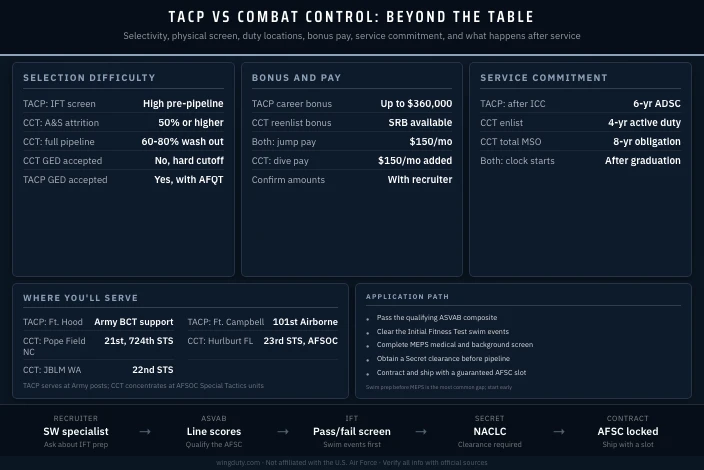
Quick Comparison
| Decision point | TACP | CCT |
|---|---|---|
| Core role | Embeds with Army and Marine ground units to plan and execute close air support, control airspace, and coordinate joint fires as a certified Joint Terminal Attack Controller. | Deploys with ground forces to control airspace, call in close air support, and direct airdrops in contested environments. Every CCT is also an FAA-certified air traffic controller. |
| Test gate | ASVAB, GEND 49 minimum | ASVAB, MECH 55 and GEND 55 |
| Score summary | Requires a GEND composite of 49 and AFQT 36. The GEND combines Word Knowledge, Paragraph Comprehension, Arithmetic Reasoning, and Mathematics Knowledge. A TAPAS personality score of 30 is also required. | Requires MECH 55 and GEND 55 composites plus AFQT 36. A high school diploma is mandatory and GEDs are not accepted. |
| Training path | About 60 weeks: BMT, Special Warfare Candidate Course (7 weeks), TACP Apprentice Course (21 weeks), Airborne School, SERE, ICC Phase 1 (16 weeks at Camp Bullis), and ICC Phase 2 (5 weeks at Nellis AFB) for JTAC certification. | About 12 to 13 months: BMT, Special Warfare Prep, Assessment and Selection, combat dive school, SERE, airborne and military freefall, the 15.5-week air traffic control course at Keesler, and Combat Control School. |
| Work setting | Embedded with Army brigade combat teams at Army installations. Work is field-based and combat-integrated rather than inside an Air Force wing. | Special Tactics Squadrons under AFSOC, small units of roughly 20 to 50 operators, with frequent off-base training alongside Army and joint special operations forces. |
| Deployment pattern | High tempo. Conventional TACPs deploy every 18 to 36 months for 6 to 12 months. SOF-assigned TACPs deploy more frequently at shorter intervals. Workup cycles fill calendar between rotations. | Deploys frequently, with 6 to 9 month rotations common. CCTs usually attach in small teams to supported special operations task forces rather than deploying as a full unit. |
| Best fit | Best for people who want to control airstrikes in direct combat, work alongside ground forces, and earn the SEI 914 JTAC credential, and who can sustain both the physical and communications demands of the role. | Best for people who can perform technical tasks while physically exhausted, handle academic air traffic control training, and want to be the Air Force's lone air-control expert on a joint team. |
| Less ideal if | Less ideal if you need stable schedules or Air Force wing life, are not confident in swimming or sustained physical operations, or cannot commit to a 6-year active-duty service obligation after JTAC certification. | Less ideal if you need predictable schedules and assignment flexibility, cannot accept long separations, or are not confident in the water. |
If controlling airstrikes while embedded with an Army brigade combat team is the draw, start with the 1C4X1 TACP profile. If you want to build air traffic control infrastructure in denied territory alongside special operations forces, read the 1C2X1 Combat Control profile.
Qualification Gates
Both careers run through the ASVAB and require passing a physical Initial Fitness Test before you can contract. The ASVAB split is the first difference.
- 1C4X1 TACP requires a GEND composite of 49 plus a TAPAS personality score of 30. A high school diploma or equivalent is accepted.
- 1C2X1 Combat Control requires MECH 55 and GEND 55. A high school diploma is mandatory. GEDs are not accepted for Combat Control, full stop.
Both require AFQT 36, both require passing the swim events on the IFT, and both impose a physical screening that eliminates candidates before the pipeline starts. The swim is the most common failure point for applicants who arrive unprepared.
Your ASVAB scores are the first gate. Our ASVAB study guide covers both the GEND and MECH composites and explains which subtests drive each score.
Work Environment
Both careers put Airmen in physically demanding, forward-deployed environments. The institutional home is where they part ways.
1C4X1 TACP specialists are assigned to Army brigade combat teams at Army installations. The duty day mirrors the Army unit’s battle rhythm, not the Air Force wing. Airmen live and train alongside soldiers, operate on an Army schedule, and are often the only Air Force presence in their unit.
1C2X1 Combat Controllers are assigned to Special Tactics Squadrons under Air Force Special Operations Command. The typical STS has 20 to 50 operators. There is no predictable schedule: 60-to-80-hour weeks are routine, physical training happens every duty day, and TDY travel is constant even between deployments.
Training Path
Both pipelines run through JBSA-Lackland for BMT, then diverge sharply in length and technical content.
- TACP runs about 60 weeks from BMT to JTAC certification. The pipeline includes the Special Warfare Candidate Course (7 weeks), the TACP Apprentice Course (21 weeks), Airborne School, SERE, and two phases of the Initial Certification Course at Camp Bullis and Nellis AFB.
- Combat Control runs about 12 to 13 months. The pipeline adds combat dive school (8 weeks at Panama City), military freefall school (4 weeks), and the Combat Control Operator Course (15.5 weeks at Keesler AFB) where the FAA air traffic controller certification is earned, before Combat Control School at Pope Field.
CCT’s extra length comes from two qualification blocks that TACP does not require: military combat diving and FAA-credentialed air traffic control. TACP’s pipeline is shorter but still carries significant attrition at the ICC phases.
Which One Fits You
Choose TACP if you want to be embedded with Army units, control airstrikes as a certified JTAC, and are comfortable with the Army’s operational tempo and culture. The GEND 49 ASVAB floor is more accessible than CCT’s dual composite requirement.
Go with Combat Control if you want to build air traffic control infrastructure in denied territory with SOF, are willing to complete a full combat diver and FAA controller pipeline, and have the physical and academic baseline to clear Assessment and Selection.
Both careers earn the SEI 914 JTAC designation. Both deploy frequently and carry meaningful physical and personal demands. TACP has a longer conventional component; CCT is more concentrated in SOF assignments at a smaller number of installations.
Next Step
Start with the swim. Both pipelines require passing the IFT’s underwater swim events, and that is the element that eliminates the most otherwise-qualified candidates.
- Target your ASVAB composites. Use the ASVAB study guide to work specifically on the subtests that drive GEND and MECH.
- Start water training before your MEPS date. The 25-meter underwater swim and 500-meter surface swim require specific technique, not just general fitness.
- Talk to an Air Force Special Warfare recruiter, not a general recruiter, to get accurate information about current seat availability and the full IFT preparation standards for whichever pipeline you are targeting.