Air Force Pilot vs RPA Pilot
Both 11X and 18X are rated Air Force officer careers with flight pay, a commissioning requirement, and real combat responsibilities, but one puts you in a cockpit at altitude and the other in a ground control station in Nevada. The pilot commands from inside the aircraft; the RPA pilot flies the same lethal mission from thousands of miles away.
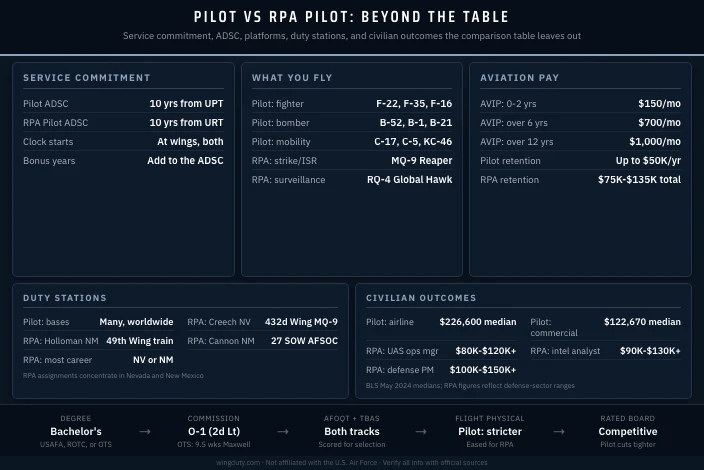
Quick Comparison
| Decision point | Pilot | RPA Pilot |
|---|---|---|
| Core role | Flies Air Force aircraft and leads the crew or flight, making real-time tactical decisions and answering for the aircraft, the mission, and the people on board. | Flies MQ-9 Reapers and RQ-4 Global Hawks from ground control stations, executing ISR, close air support, and precision strike missions as a rated officer accountable for crew and mission outcomes. |
| Test gate | AFOQT and TBAS (feeds PCSM) | AFOQT and TBAS (feeds PCSM) |
| Score summary | AFOQT Pilot composite minimum is 25 and Navigation is 10, though selected candidates often score in the 60s. PCSM needs at least 25 to apply, 50 and up is competitive, and 75 or higher is top-tier. | AFOQT Pilot composite minimum is 25, Verbal 15, Quantitative 10. PCSM minimum to list for an RPA slot is 10, though boards compare candidates and a PCSM in the 30s or 40s is more competitive. Vision: 20/400 correcting to 20/20 is acceptable. |
| Training path | Commission through OTS, ROTC, or the Academy, then about 52 weeks of Undergraduate Pilot Training on the T-6A and either the T-38C or T-1A, followed by 6 months to over a year of aircraft-specific training. | Commission through OTS, ROTC, or the Academy, then approximately 59 weeks total: RPA Instrument Qualification and Fundamentals at JBSA-Randolph (about 20 weeks), MQ-9 Transition Training at Holloman AFB, NM (about 21 weeks), followed by Mission Qualification Training at the operational unit. |
| Work setting | Flight line, operations desk, and mission planning rooms, flying sorties that range from one hour to more than ten hours. | Ground control stations with rotating shifts including nights and weekends, because MQ-9 missions run around the clock. |
| Deployment pattern | Varies by airframe. Total time away can run 120 to 200 days per year in a high-tempo assignment, from short fighter rotations to 90 to 120 day mobility deployments. | Most combat missions flown from CONUS via satellite link. Some pilots rotate through 30 to 90 day Launch and Recovery Element assignments at austere airfields. Geographic concentration at Nevada and New Mexico bases. |
| Best fit | Best for competitive candidates who make high-stakes decisions under pressure, absorb technical information fast, and want to lead as officers first and aviators second. | Best for officers who want to fly real combat missions with direct operational impact, are comfortable with sustained concentration over long sorties, and can handle rotating shift work at home station. |
| Less ideal if | Less ideal if you want to fly exclusively and avoid staff tours, or are drawn mainly by pay or prestige rather than the mission and the lifestyle. | Less ideal if you wanted manned aviation and view RPA as a fallback, or cannot adapt to years of rotating night shifts at a small number of desert bases. |
If you want to fly the aircraft in the traditional sense, start with the 11X Pilot profile. If you want to fly real combat missions from a ground control station and are drawn to the ISR and precision strike mission, start with the 18X RPA Pilot profile.
Qualification Gates
Both careers require commissioning as an Air Force officer, the AFOQT, and the TBAS. The scores that matter differ by track.
- Pilot (11X) requires an AFOQT Pilot composite minimum of 25 and Navigation of 10, with competitive boards often selecting in the 60s. The PCSM minimum is 25, with 50 and above considered competitive and 75 or higher top-tier. Civilian flight hours logged before the TBAS raise the PCSM score.
- RPA Pilot (18X) requires an AFOQT Pilot composite minimum of 25, Verbal 15, and Quantitative 10. The PCSM minimum is only 10 to list for an RPA slot, though boards still compare candidates and a score in the 30s or 40s is more competitive than the floor. Vision standards are less restrictive: 20/400 correcting to 20/20 is acceptable, versus stricter standards for manned pilots.
Both paths open with the same two tests. Build your TBAS study guide plan first to protect your PCSM score, then close gaps with the AFOQT study guide since both tracks depend on the AFOQT Pilot composite.
Work Environment
The daily environment is where these two careers diverge most sharply.
Pilots work on the flight line, in mission planning rooms, and at the operations desk. Sorties range from one hour to more than ten, and the cockpit is the primary workspace. The work follows the flying schedule, with significant time in simulators, briefing rooms, and maintenance coordination.
RPA Pilots work in ground control stations: climate-controlled trailers or hardened facilities with flight control interfaces, communications terminals, and sensor displays. Most combat flying happens from CONUS installations, primarily Creech AFB in Nevada, with satellite links connecting the crew to missions 7,000 miles away. Rotating shifts including nights, weekends, and holidays define the schedule because MQ-9 missions run around the clock.
Training Path
Both officers commission through OTS, ROTC, or the Air Force Academy before any flight training. The pipeline lengths and locations then split.
- Pilot: approximately 52 weeks of Undergraduate Pilot Training on the T-6A followed by either the T-38C or T-1A, then 6 months to over a year of aircraft-specific formal training. UPT can be conducted at Vance AFB, Laughlin AFB, Columbus AFB, or the Euro-NATO Joint Jet Pilot Training (ENJJPT) program.
- RPA Pilot: approximately 59 weeks total, starting with RPA Instrument Qualification and Fundamentals at JBSA-Randolph (about 20 weeks), then MQ-9 Transition Training at Holloman AFB, NM (about 21 weeks), followed by Mission Qualification Training at the operational unit. The 18X pipeline does not include T-6 or T-38 training.
Both tracks carry a 10-year Active Duty Service Commitment from the completion of their respective undergraduate training program.
Which One Fits You
Choose Pilot if you want to fly the aircraft in person, are prepared to compete on PCSM and log civilian flight hours before the TBAS, and can accept a broader range of duty stations and airframe assignments.
Go with RPA Pilot if you want real combat flying with direct operational impact, are comfortable with sustained concentration over 10 to 14 hour sorties, and can build a career at a small number of bases in Nevada and New Mexico on rotating shift work.
Both careers carry Aviation Incentive Pay on the same rate table, the same 10-year ADSC from undergraduate training, and the same officer progression path through flight commander, operations officer, and squadron command. The rated community treats both as full members of the aviation family.
Next Step
Rated boards reward early preparation. Two moves matter most regardless of which track you pursue.
- Build your TBAS study guide plan now and log civilian flight hours before you test. Hours flown before the TBAS raise your PCSM score, and both tracks benefit from a stronger PCSM even though the RPA floor is lower.
- Lock in your AFOQT study guide approach. Both tracks require the AFOQT Pilot composite, you get only three attempts with a 90-day wait between them, and boards see all prior scores.
Then talk with an Air Force officer recruiter or your ROTC detachment about current rated board timelines and slot availability for each track.