Air Force Pilot vs Combat Systems Officer
Pilot and Combat Systems Officer are both rated Air Force aviation careers, and they often fly the same aircraft. The pilot flies the jet and commands the crew, while the Combat Systems Officer runs the weapons, sensors, and navigation systems that make the mission work.
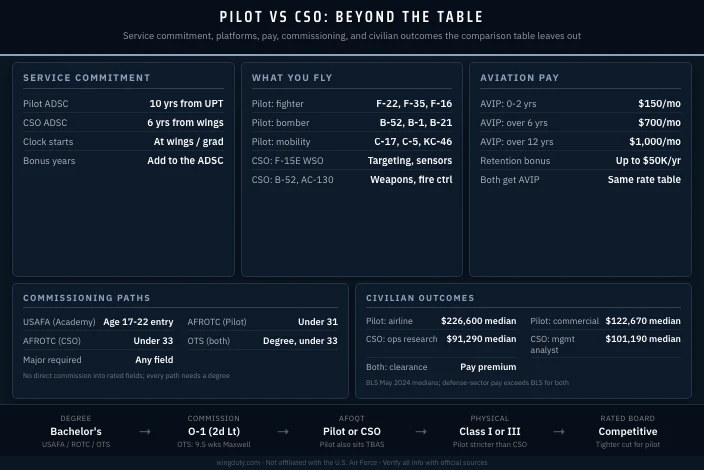
Quick Comparison
| Decision point | Pilot | CSO |
|---|---|---|
| Core role | Flies Air Force aircraft and leads the crew or flight, making real-time tactical decisions and answering for the aircraft, the mission, and the people on board. | Runs the weapons, electronic warfare, navigation, and sensor systems aboard aircraft, working alongside the pilot while leading Airmen and training programs. |
| Test gate | AFOQT and TBAS (feeds PCSM) | AFOQT, CSO composite 25 minimum (TBAS not required) |
| Score summary | AFOQT Pilot composite minimum is 25 and Navigation is 10, though selected candidates often score in the 60s. PCSM needs at least 25 to apply, 50 and up is competitive, and 75 or higher is top-tier. | AFOQT minimums are CSO 25, Verbal 15, Quantitative 10, and Pilot 10, though boards select well above. A CSO composite in the 50s or higher is competitive. |
| Training path | Commission through OTS, ROTC, or the Academy, then about 52 weeks of Undergraduate Pilot Training on the T-6A and either the T-38C or T-1A, followed by 6 months to over a year of aircraft-specific training. | Commission through OTS, ROTC, or the Academy, complete Initial Flight Training in Pueblo, then about 52 weeks of Undergraduate CSO Training at NAS Pensacola, followed by 4 to 8 months of aircraft-specific training. |
| Work setting | Flight line, operations desk, and mission planning rooms, flying sorties that range from one hour to more than ten hours. | Operations center, flight line, simulator, and deployed locations, flying sorties from a few hours to well over ten. |
| Deployment pattern | Varies by airframe. Total time away can run 120 to 200 days per year in a high-tempo assignment, from short fighter rotations to 90 to 120 day mobility deployments. | Usually 90 to 180 days per year away from home station, with special operations platforms running the highest tempo. |
| Best fit | Best for competitive candidates who make high-stakes decisions under pressure, absorb technical information fast, and want to lead as officers first and aviators second. | Best for technically minded people who thrive in a small crew, handle spatial tasks well, and communicate clearly under pressure. |
| Less ideal if | Less ideal if you want to fly exclusively and avoid staff tours, or are drawn mainly by pay or prestige rather than the mission and the lifestyle. | Less ideal if you want to minimize moves and deployments, or need to be the sole decision-maker rather than half of a crew. |
If you want to fly the aircraft, start with the 11X Pilot profile. If you want to run the mission systems from the other seat, start with the 12X Combat Systems Officer profile.
Qualification Gates
Both careers start the same way: commission as an officer, then pass the AFOQT. After that, the testing splits.
- Pilot candidates must also take the TBAS, which feeds the PCSM score that rated boards weigh heavily.
- Combat Systems Officer candidates do not take the TBAS. Selection runs on AFOQT scores, GPA, and board performance.
So the pilot track has one more gate to clear. Build your AFOQT study guide plan first, since both paths depend on it. If you are aiming for the cockpit, add the TBAS study guide and start logging civilian flight hours, because hours logged before the test raise your PCSM score.
Work Environment
Both jobs fly demanding schedules with long sorties and heavy mission planning.
Pilots spend the day on the flight line, at the operations desk, and in mission planning rooms. Sorties run from one hour to more than ten.
Combat Systems Officers split time between the operations center, the simulator, the flight line, and deployed locations. The crew arrives hours before takeoff, and the post-flight debrief can take as long as the sortie.
Training Path
Both officers commission through OTS, ROTC, or the Air Force Academy before any flight training. Each pipeline then runs about a year of formal training, followed by months of aircraft-specific work.
- Pilot: about 52 weeks of Undergraduate Pilot Training on the T-6A and then the T-38C or T-1A.
- Combat Systems Officer: Initial Flight Training in Pueblo, then about 52 weeks of Undergraduate CSO Training at NAS Pensacola.
After graduation, both report to a formal training unit for their assigned airframe. That phase adds several more months of training before either officer is mission ready.
Which One Fits You
Choose Pilot if you want to fly the aircraft and command from the front seat, and you are ready to compete hard on the PCSM score.
Go with Combat Systems Officer if you want to run the weapons and sensors as half of a crew, and you would rather not gate your career on the TBAS.
Both are rated careers with flight pay, the same path to command, and the same heavy deployment tempo. Each also requires staff tours and professional military education at regular intervals throughout a career.
Next Step
The rated board rewards candidates who prepare early. Two moves matter most.
- Lock in your AFOQT study guide plan now. Both tracks depend on the AFOQT, and you get only three attempts with a 90-day wait between them.
- If you want pilot, follow the TBAS study guide and log civilian flight hours before you test, since those hours raise your PCSM score.
Then talk with an Air Force officer recruiter or a nearby ROTC detachment about current rated board timelines.