Air Force Pararescue vs Combat Control
Pararescue and Combat Control are both Air Force special warfare careers, but they are not the same job. Pararescuemen go into hostile territory to recover and treat the wounded, while Combat Controllers move in with ground forces to control airspace and direct airstrikes.
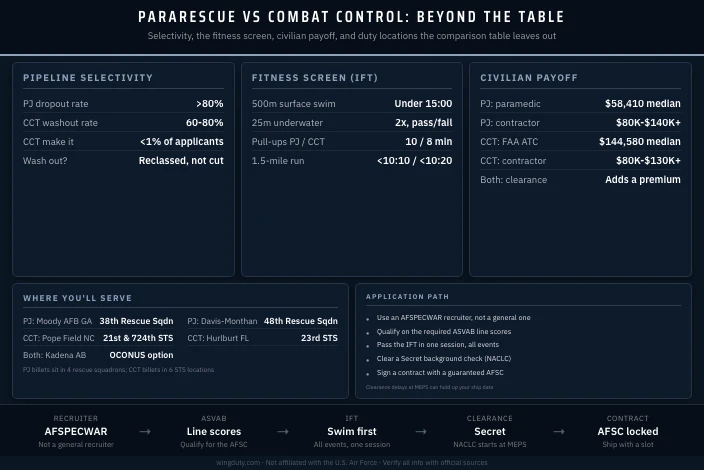
Quick Comparison
| Decision point | PJ | CCT |
|---|---|---|
| Core role | Recovers and treats wounded or isolated personnel in hostile environments, combining special operations infiltration with paramedic-level trauma care. | Deploys with ground forces to control airspace, call in close air support, and direct airdrops in contested environments. Every CCT is also an FAA-certified air traffic controller. |
| Test gate | ASVAB, GEND 44 minimum | ASVAB, MECH 55 and GEND 55 |
| Score summary | Requires a GEND line score of 44 and AFQT 36, plus a TAPAS score of 60 on the PJ selection model. Most who finish the pipeline score well above the GEND floor. | Requires MECH 55 and GEND 55 composites plus AFQT 36. A high school diploma is mandatory and GEDs are not accepted. |
| Training path | About 18 months: BMT, Special Warfare Prep, Assessment and Selection, combat dive school, SERE, airborne and military freefall, the 34-week paramedic course (MP3), and the Pararescue Apprentice Course. | About 12 to 13 months: BMT, Special Warfare Prep, Assessment and Selection, combat dive school, SERE, airborne and military freefall, the 15.5-week air traffic control course at Keesler, and Combat Control School. |
| Work setting | AFSOC rescue squadrons under Rescue Wings, working from helicopters, fixed-wing aircraft, and small boats across desert, jungle, and Arctic environments. | Special Tactics Squadrons under AFSOC, small units of roughly 20 to 50 operators, with frequent off-base training alongside Army and joint special operations forces. |
| Deployment pattern | Deploys regularly on 3 to 6 month rotations. Expect 6 to 9 months away from home station in a given year once pre-deployment workups are counted. | Deploys frequently, with 6 to 9 month rotations common. CCTs usually attach in small teams to supported special operations task forces rather than deploying as a full unit. |
| Best fit | Best for strong athletes with a swimming base who want to practice emergency medicine in austere environments and find meaning in recovering the wounded. | Best for people who can perform technical tasks while physically exhausted, handle academic air traffic control training, and want to be the Air Force's lone air-control expert on a joint team. |
| Less ideal if | Less ideal if you want predictable hours and stable duty locations, cannot sustain the swim training, or are drawn to the role for its image rather than the medical mission. | Less ideal if you need predictable schedules and assignment flexibility, cannot accept long separations, or are not confident in the water. |
If your pull is combat medicine and rescue, start with the 1T2X1 Pararescue profile. If it is air traffic control and calling in airpower, start with the 1C2X1 Combat Control profile.
Qualification Gates
Both are enlisted special warfare jobs, so both run through the ASVAB and a demanding physical screening. The difference is the line score.
- Pararescue needs a GEND score of 44.
- Combat Control needs MECH 55 and GEND 55.
Each path also needs an AFQT of 36 and a high school diploma, and neither accepts a GED. The test keeps you eligible. The physical screening decides whether your body is ready for the pipeline.
Do not treat the ASVAB as a formality. A weak score can block the contract before your fitness ever matters. Our ASVAB study guide covers the MECH and GEND prep these jobs depend on.
Work Environment
Both careers live inside Air Force Special Operations Command, but the daily setting differs.
Pararescue works in rescue squadrons under Rescue Wings. PJs operate from helicopters, fixed-wing aircraft, and small boats, and they train across desert, jungle, and Arctic conditions.
Combat Control serves in Special Tactics Squadrons, small units of roughly 20 to 50 operators. CCTs spend heavy time off base, training alongside Army and joint special operations teams.
Training Path
Both pipelines are long and selective, and they share the same early phases: special warfare conditioning, Assessment and Selection, combat dive school, SERE, and military freefall.
The split comes near the end:
- Pararescue runs about 18 months, including a 34-week paramedic course that ends in a National Registry Paramedic credential.
- Combat Control runs about 12 to 13 months, including a 15.5-week air traffic control course at Keesler that ends in FAA certification.
The real question is which credential you want to spend more than a year earning.
Which One Fits You
Choose Pararescue if you want to practice emergency medicine in the worst conditions on earth and you have the swimming and athletic base to survive the pipeline.
Go with Combat Control if you want to control airspace and direct airpower, and you can handle a demanding academic air traffic control course on top of the physical screening.
Both punish vague motivation. You need strong fitness, real water confidence, and a clean enough record to pass a Secret clearance. Qualifying is only the start.
Next Step
Before you chase either contract, build two tracks at once: ASVAB readiness and physical readiness.
- Hit the line scores. Use the ASVAB study guide to target GEND for Pararescue or MECH and GEND for Combat Control.
- Train the swim early. Most candidates who fail the fitness screening fail the underwater events, not the run.
- Talk with an Air Force Special Warfare recruiter about current contract availability.