Air Force 13CX Combat Rescue vs 19Z Special Warfare Officer
Both the 13CX Combat Rescue Officer and the 19Z Special Warfare Officer commission through the same sources, train at the same AFSOC installations, and lead the Air Force’s most physically demanding enlisted operators. The mission axis separates them: a CRO leads pararescue teams on personnel recovery and combat search and rescue, while the broader 19Z designation covers rescue command, special tactics leadership, and TACP officer roles under a single special warfare umbrella.
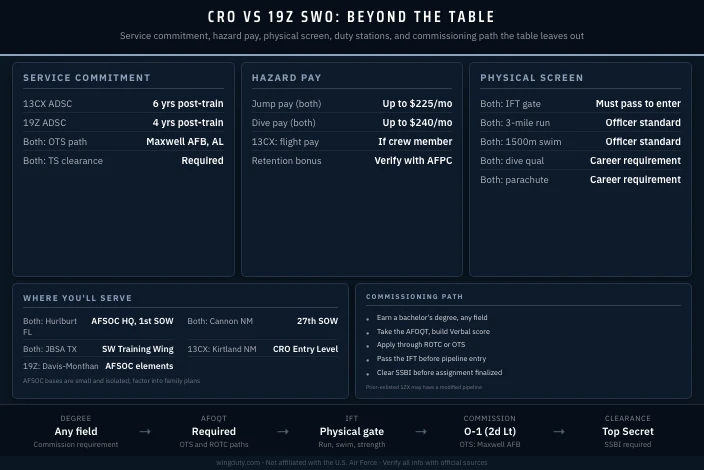
Quick Comparison
| Decision point | 13CX CRO | 19Z SWO |
|---|---|---|
| Core role | Plans, leads, and commands personnel recovery operations in hostile environments, serving as the officer in charge of pararescue teams conducting combat search and rescue, isolated personnel recovery, and reintegration operations. | Leads Air Force special operations forces across three shredouts: Special Tactics (19ZXA), TACP (19ZXB), and Combat Rescue (19ZXC). Commands small teams in denied and contested environments and serves as the officer bridge between ground teams and the air component. |
| Test gate | AFOQT, Verbal 15 and Quantitative 10 minimum | AFOQT, Verbal 15 and Quantitative 10 minimum |
| Score summary | Published minimums are Verbal 15 and Quantitative 10, but these are floors. Competitive CRO candidates score well above both. The TBAS is not required for this non-rated path. | Published minimums are Verbal 15 and Quantitative 10; selection is competitive and candidates near the floor are at a disadvantage. The TBAS is not required for the special warfare officer path. |
| Training path | Commission through OTS, ROTC, or USAFA, then pass the Initial Fitness Test (IFT), followed by an approximately 18-month pipeline: CRO/Pararescue Indoctrination (10 weeks), Combat Dive Course (6 weeks), Army Airborne (3 weeks), Military Free-Fall (4-5 weeks), SERE (4 weeks), and CRO Entry Level Course at Kirtland AFB (17 weeks). | Commission through OTS, ROTC, or USAFA, then pass the Initial Fitness Test (IFT), followed by shredout-specific pipeline training at Hurlburt Field (19ZXA), JBSA-Lackland and Camp Bullis (19ZXB), or JBSA-Lackland and Kirtland AFB (19ZXC). Prior-enlisted 1ZX Airmen commissioning into 19Z may have a modified pipeline. |
| Work setting | Operational assignments at AFSOC special tactics and rescue units. Field environments during training workups and deployment. Staff billets at AFSOC headquarters and MAJCOM staffs between command tours. | AFSOC special warfare units, plus OCONUS rotational billets through theater special operations commands. |
| Deployment pattern | Regular deployments at high tempo. Typical lengths run 90 to 180 days. Dwell time between rotations varies by unit. Pre-deployment workup cycles add to total time away from home station. | High tempo by design. Approximately 180-day deployments with comparable dwell time is a reasonable expectation. Some units run shorter rotational cycles with more frequent trips. |
| Best fit | Best for officers who want to lead pararescue teams in the most demanding recovery environments, accept sustained elite physical requirements, and find meaning in bringing isolated personnel home. | Best for officers who want the most physically demanding officer career in the Air Force with direct involvement in special operations, and who lead by earning trust from enlisted operators rather than relying on rank. |
| Less ideal if | Less ideal if you need geographic flexibility or family stability beyond what AFSOC bases can offer, cannot sustain the physical demands after pipeline graduation, or want a career without repeated long separations. | Less ideal if family stability and geographic flexibility are priorities, you cannot sustain elite physical performance over a decade-long career, or you need regular conventional office hours. |
If leading pararescue teams specifically on personnel recovery and combat search and rescue missions is the draw, start with the 13CX Combat Rescue Officer profile. If commanding special operations forces across the full range of special tactics, TACP, or rescue missions interests you, start with the 19Z Special Warfare Officer profile.
Qualification Gates
Both careers require the AFOQT for officers commissioning through OTS, ROTC, or the Air Force Academy. Published minimums for both are a Verbal score of 15 and Quantitative score of 10. These are floors, not competitive targets. Selection for both fields is highly competitive, and candidates scoring near the minimum are at a structural disadvantage.
Neither career requires the TBAS, which is reserved for rated aviation positions. Both require a full Single Scope Background Investigation for a Top Secret clearance before pipeline assignment is finalized.
The more demanding gate for both fields is physical, not academic. All candidates must pass the Initial Fitness Test before any pipeline training begins. The officer IFT for special warfare requires a 3-mile run, a 1,500-meter surface swim, pull-ups, sit-ups, and push-ups in a single uninterrupted session. Begin physical preparation months before you apply.
Your AFOQT scores are the first written gate. Our AFOQT study guide covers how to prepare for the Verbal and Quantitative composites that matter most.
Work Environment
Both careers are based at AFSOC installations and spend significant time in field environments. The specific mission context differs.
13CX Combat Rescue Officers operate with pararescue flights at Hurlburt Field, Cannon AFB, JBSA-Lackland, and Kirtland AFB. As a junior CRO, you operate in the field alongside PJs during training and deployment, carrying weapons and holding command authority over the team. The work is physically intensive in garrison, with pre-dawn physical training, range work, and mission planning filling the operational workday. Staff billets between command tours run more conventional hours.
19Z Special Warfare Officers are distributed across the same AFSOC installation footprint, with shredout determining the specific unit and location. Special Tactics Officers concentrate at Hurlburt Field; TACP Officers work at JBSA-Lackland and Camp Bullis; Combat Rescue Officers work at JBSA-Lackland and Kirtland AFB. The garrison schedule starts early across all shredouts, and pre-deployment workup cycles extend hours and days significantly.
Neither field offers remote work options. Both require sustained elite physical performance throughout the operational career, not just through the training pipeline.
Training Path
Both pipelines start at commissioning and run through the same IFT gate.
- 13CX enters an approximately 18-month pipeline: CRO/Pararescue Indoctrination at JBSA-Lackland (10 weeks), Air Force Combat Dive Course in Panama City, FL (6 weeks), Army Airborne Course at Fort Benning, GA (3 weeks), Military Free-Fall at Yuma Proving Ground, AZ (4 to 5 weeks), Advanced SERE at Fairchild AFB, WA (4 weeks), and the CRO Entry Level Course at Kirtland AFB, NM (17 weeks). The Active Duty Service Commitment is 6 years from training completion.
- 19Z enters shredout-specific pipeline training after commissioning and SERE. Special Tactics Officers train at Hurlburt Field. TACP Officers train at JBSA-Lackland and Camp Bullis. Combat Rescue Officers train at JBSA-Lackland and Kirtland AFB. Prior-enlisted 1ZX personnel who commission may have a modified pipeline. The standard ADSC is 4 years from training completion.
High attrition is a planned part of both pipelines. Not every candidate who starts will finish.
Which One Fits You
Choose 13CX if you are specifically drawn to leading pararescue teams in personnel recovery and combat search and rescue, want to operate in the field alongside your enlisted Airmen as a junior officer, and can commit to a 6-year service obligation after one of the longest training pipelines in the officer corps.
Go with 19Z if you want the flexibility of three shredout options under the special warfare umbrella, are open to leading special tactics, TACP, or rescue operators depending on Air Force assignment needs, and want to explore the broadest possible entry point into Air Force special operations leadership.
Both careers have demanding family costs. The deployment tempo is high, the training schedule is intensive even between deployments, and the AFSOC base footprint concentrates families at a small number of installations. Officers who enter this career without honest conversations about those tradeoffs face harder retention decisions at the first service commitment endpoint.
Next Step
Both tracks require the AFOQT for OTS and ROTC commissioning paths. Two preparation moves matter most.
- Score well above the AFOQT minimums. The Verbal and Quantitative composites are testable, and a strong package with scores near the minimums is a weak package for competitive selection boards. Use the AFOQT study guide to target both composites before your window opens.
- Build your physical baseline before you apply. The officer IFT requires a 3-mile run and a 1,500-meter swim at standards that exceed the standard Air Force Fitness Assessment by a significant margin. Swim conditioning in particular takes months to develop and cannot be compressed. Start at least 3 to 6 months before any selection event.