Air Force 2A3X3 vs 2A5X1 Aircraft Maintenance
Both 2A3X3 and 2A5X1 are Air Force aircraft maintenance careers that put you on the flight line signing off aircraft before every mission, but they serve entirely different fleets. Tactical Aircraft Maintenance specialists own fighters, the F-16, F-22, and A-10, while Aerospace Maintenance specialists maintain the airlift and special mission platforms: C-17s, C-130s, and other mobility aircraft.
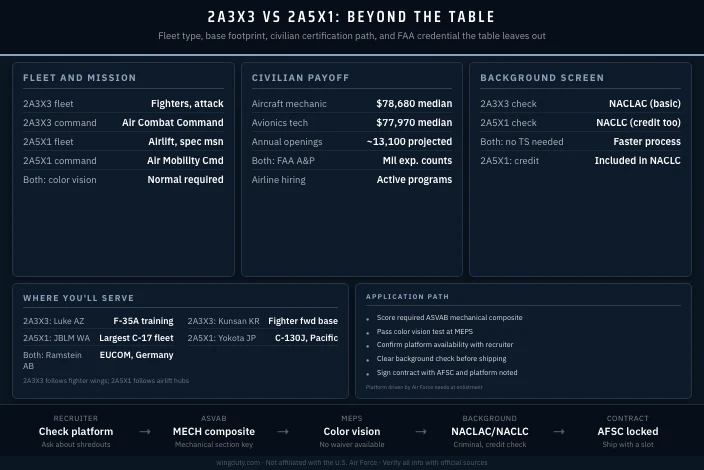
Quick Comparison
| Decision point | 2A3X3 | 2A5X1 |
|---|---|---|
| Core role | Performs all ground-level maintenance on tactical military aircraft, conducting pre-flight, through-flight, and post-flight inspections and certifying fighter and attack aircraft airworthy before every sortie. Platforms include the F-16, F-22, and A-10. | Performs organizational-level maintenance on airlift and special mission aircraft, conducting pre-flight and post-flight inspections and certifying C-17, C-130, and other mobility platforms airworthy before every mission. |
| Test gate | ASVAB, MECH 47 minimum | ASVAB, MECH 47 minimum |
| Score summary | Requires a MECH composite of 47 and AFQT 36. | Requires a MECH composite of 47 and AFQT 36. |
| Training path | BMT at JBSA-Lackland (7.5 weeks), then Tech School at Sheppard AFB, TX (approximately 13 weeks, varies by platform), followed by 12 to 18 months of upgrade training at the first duty station to earn the 5-skill-level journeyman designation. | BMT at JBSA-Lackland (7.5 weeks), then common core course at Sheppard AFB, TX (approximately 20 to 32 days) followed by platform-specific qualification training. Upgrade to 5-skill-level journeyman at first duty station requires additional months of supervised OJT. |
| Work setting | Outdoor flight line at fighter wings. Shift schedules follow the flying schedule, including early mornings and swing shifts. | Outdoor flight line at Air Mobility Command airlift and mobility wings. |
| Deployment pattern | Regular deployments supporting tactical aircraft at forward operating locations. Typical rotation lengths run 90 to 120 days. Fighter units with Theater Security Package commitments may deploy a significant percentage of maintainers annually. | Frequent deployments tied to airlift missions. AMC units run Aerospace Expeditionary Force cycles with typical rotation lengths of 90 to 120 days. Active-duty baseline is approximately 1 to 2 deployments every 3 to 4 years, varying by installation. |
| Best fit | Best for people who want hands-on work directly tied to fighter jet operations, have mechanical aptitude, can follow detailed technical procedures without shortcuts, and want a clear post-service A&P certification path. | Best for people who want broad exposure to large airlift and mobility platforms, value a direct path to an FAA A&P certificate, and can handle the physical and schedule demands of a 24/7 flight-line career. |
| Less ideal if | Less ideal if you need predictable schedules, prefer indoor work, cannot tolerate extreme outdoor conditions year-round, or have a color vision deficiency. | Less ideal if you want fighter-specific work, cannot tolerate outdoor shift work across extreme climates, have a color vision deficiency, or need a highly predictable schedule. |
If working directly on tactical fighter and attack aircraft interests you, start with the 2A3X3 Tactical Aircraft Maintenance profile. If maintaining the airlift and mobility fleet that moves troops and equipment worldwide is the draw, start with the 2A5X1 Aerospace Maintenance profile.
Qualification Gates
Both careers run through the ASVAB and share the same composite requirement.
- 2A3X3 needs a MECH composite of 47. Normal color vision is required, and no waiver is available for color deficiency. A National Agency Check is required.
- 2A5X1 needs a MECH composite of 47. Normal color vision is required, and no waiver is available. A National Agency Check with Local Agency Checks and Credit (NACLC) is required.
Both require AFQT 36 with a high school diploma, or AFQT 65 with a GED. Neither requires a security clearance at the full Top Secret level, which means the application timeline is shorter than intelligence or cyber AFSCs.
The MECH composite draws from the General Science, Auto/Shop Information, Mathematics Knowledge, and Mechanical Comprehension subtests. Our ASVAB study guide covers how to target the Mechanical Comprehension and Auto/Shop subtests that drive the MECH score.
Work Environment
Both careers are outdoor, shift-based, and physically demanding. The platform type and base footprint separate them.
2A3X3 Tactical Aircraft Maintenance specialists work on fighter and attack aircraft at tactical aircraft installations: Luke AFB, Nellis AFB, Shaw AFB, Langley-Eustis AFB, Spangdahlem AB in Germany, and Kunsan and Osan AB in South Korea. The flight line tempo follows the flying schedule, with early starts on day shift and late nights on swing. Heat at Arizona and Nevada bases, cold at Alaskan and European installations, and jet noise at every location are standard conditions. The assignment pool concentrates at a smaller set of fighter bases than the mobility fleet.
2A5X1 Aerospace Maintenance specialists work on airlift and special mission aircraft at Air Mobility Command installations: Joint Base Lewis-McChord, Travis AFB, Dover AFB, Joint Base Charleston, Dyess AFB, Little Rock AFB, and OCONUS locations including Ramstein AB and Yokota AB. The fleet is larger and the base footprint broader, which gives more assignment variety over a 20-year career. Shift schedules run days, swings, and nights, including 12-hour crew schedules during exercises and deployments.
Both careers expose Airmen to jet noise, hazardous fluids, and outdoor work in extreme temperatures year-round. Hearing conservation enrollment is standard for both.
Training Path
Both pipelines start at BMT at JBSA-Lackland, then move to Sheppard AFB, TX.
- 2A3X3 attends Tech School at Sheppard AFB for approximately 13 weeks, with course length varying by aircraft platform. F-16 and F-15 tracks are well-established at Sheppard; newer platforms may have supplemental training at other locations. After Tech School, 12 to 18 months of upgrade training at the first duty station is required before earning the 5-skill-level journeyman designation.
- 2A5X1 attends a common core course at Sheppard AFB (approximately 20 to 32 days) followed by platform-specific qualification training for the assigned shredout: C-17, C-130, C-5, or executive/special mission aircraft. Upgrade to 5-skill-level at the first duty station requires additional supervised OJT.
The 2A5X1 common core is shorter than the 2A3X3 tactical course because the platform qualification training comes after. Both AFSCs require significant on-the-job development before Airmen independently sign off maintenance documentation.
Which One Fits You
Choose 2A3X3 if you want to work on tactical fighter and attack aircraft, prefer the faster-paced environment of a fighter wing, and are drawn to the concentrated ownership of being the last person to sign off a jet before a combat sortie.
Go with 2A5X1 if you prefer working on large airlift platforms, want broader geographic variety across AMC installations, or are specifically interested in the C-17 or C-130 fleets that move the joint force globally.
Both careers lead to the FAA Airframe and Powerplant (A&P) certificate after service, which is one of the most direct post-military credentials in civilian aviation. The A&P opens doors at commercial airlines, defense contractors, and maintenance repair and overhaul shops. Both career fields also have strong Air National Guard and Reserve components, allowing continued service alongside a civilian aviation career.
Next Step
The MECH composite is the ASVAB gate for both careers. A score of 47 is the floor, and applicants who prepare specifically on the Mechanical Comprehension and Auto and Shop Information subtests position themselves for a wider range of maintenance options at MEPS.
- Build your mechanical composite before testing. Use the ASVAB study guide to focus on the Mechanical Comprehension and Auto/Shop subtests that drive the MECH score.
- Confirm color vision before your MEPS appointment. Both careers require normal color vision, and no waiver is available. A color deficiency disqualifies you from both AFSCs before you reach the MEPS color vision test.
- Ask your recruiter about current platform availability. Shredout assignments for 2A5X1 and platform assignments for 2A3X3 are driven by Air Force needs at the time you enlist. C-17 and C-130J slots for 2A5X1 are among the most common.