Air Force 1N0X1 vs 1N4X1 Intelligence
Both 1N0X1 and 1N4X1 are Air Force intelligence careers that require a Top Secret clearance and operate inside classified facilities, but they work different sides of the analytical mission. All Source Intelligence Analysts fuse reporting across all collection disciplines to brief commanders, while Fusion Analysts specialize in network communications intelligence and cyber threat analysis.
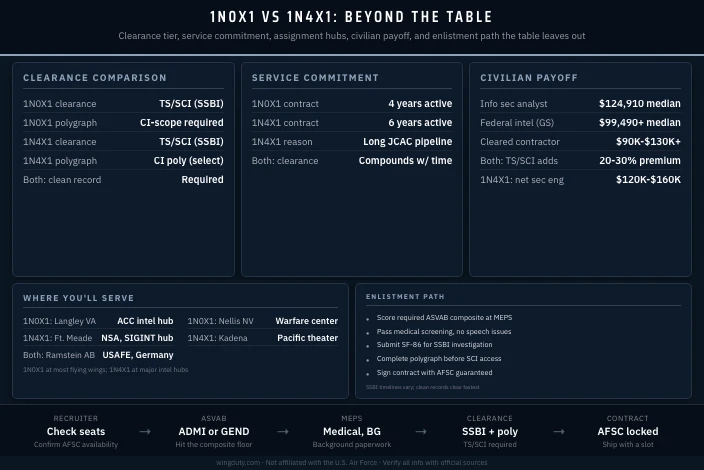
Quick Comparison
| Decision point | 1N0X1 | 1N4X1 |
|---|---|---|
| Core role | Fuses reporting from human, imagery, signals, and open-source collection to produce finished intelligence assessments that guide Air Force commanders and joint warfighters. | Collects and analyzes intelligence from target network communications, integrating signals, cyber, and human sources to produce finished intelligence products for operations planning, targeting, and threat assessment. |
| Test gate | ASVAB, ADMI 60 minimum | ASVAB, GEND 62 minimum |
| Score summary | Requires an ADMI composite of 60 plus AFQT 36. GED requires AFQT 65. A TS/SCI clearance with an SSBI and counterintelligence-scope polygraph is also required. | Requires a General (GEND) composite of 62 and AFQT 36 (high school diploma) or AFQT 65 (GED). A TS/SCI clearance with SSBI is required. A CI polygraph may be required for specific assignments. |
| Training path | BMT at JBSA-Lackland (7.5 weeks), then Technical School at Goodfellow AFB, TX (approximately 90.5 days, about 13 weeks) covering all-source analytical methods, the intelligence cycle, threat systems, and classified tools. | BMT at JBSA-Lackland (7.5 weeks), then the 1N4X1 Initial Skills Course at Goodfellow AFB, TX (approximately 110 days), followed by the Joint Cyber Analysis Course at NAS Pensacola, FL (approximately 6 months). Total pipeline: 12 to 15 months. |
| Work setting | Classified SCIFs inside secure facilities at Air Force wings and major commands, with shift work common at operational units tied to flying schedules. | Classified SCIFs at installations with major intelligence missions. Rotating shift schedules are common at operational intelligence squadrons. |
| Deployment pattern | Generally lower tempo than combat support AFSCs. Most Airmen in a standard enlistment can expect at least one 90 to 180 day deployment supporting theater intelligence cells or joint intelligence support elements. | Lower tempo than combat AFSCs. Deployments typically run 90 to 180 days supporting Air Operations Centers or combined intelligence fusion elements. Shredout can influence frequency. |
| Best fit | Best for people who enjoy analytical problem-solving, read and write clearly, and want a clearance that compounds into high post-service earning potential. | Best for analytically oriented people who enjoy pattern recognition in complex data, can handle shift work, and want one of the strongest TS/SCI clearance premiums available to an enlisted Airman. |
| Less ideal if | Less ideal if you want physical work or outdoor assignments, cannot maintain financial and personal conduct standards for a TS/SCI clearance, or need to discuss your work openly. | Less ideal if you cannot commit to a 6-year contract, need an early cross-training option, find the SCIF environment restrictive, or have a background that complicates a TS/SCI investigation. |
If all-source analytical work feeding Air Force flying and ground missions interests you, start with the 1N0X1 All Source Intelligence Analyst profile. If network communications intelligence and cyber threat analysis is the draw, start with the 1N4X1 Fusion Analyst profile.
Qualification Gates
Both careers run through the ASVAB and require a TS/SCI clearance. The composite scores differ.
- 1N0X1 needs an ADMI composite of 60. The Administrative composite draws from General Science, Paragraph Comprehension, Word Knowledge, and Arithmetic Reasoning. A counterintelligence-scope polygraph is required before SCI access is granted.
- 1N4X1 needs a General (GEND) composite of 62. The General composite combines Word Knowledge, Paragraph Comprehension, Arithmetic Reasoning, and Mathematics Knowledge. A CI polygraph may be required for specific assignments.
Both require AFQT 36 with a high school diploma, or AFQT 65 with a GED. Both require a Single Scope Background Investigation covering finances, foreign contacts, and personal conduct going back ten or more years. Neither career tolerates significant debt, foreign entanglements, or a history of drug use.
The ASVAB verbal and reasoning subtests drive both composites. Our ASVAB study guide covers how to target the ADMI and GEND composites specifically.
Work Environment
Both careers are sedentary and entirely indoors inside SCIFs. The operational context and analytical focus differ.
1N0X1 All Source Intelligence Analysts work across a wide range of Air Force assignments, from Operations Support Squadrons at fighter wings where the work runs close to the flying schedule, to major command headquarters where the scope covers theater-wide analysis. At fighter wings, shift work tied to the flying schedule is common. At headquarters assignments, the pace runs closer to standard business hours with surge periods around exercises and real-world events.
1N4X1 Fusion Analysts work at installations concentrated around major intelligence missions: Fort Meade, Beale AFB, Buckley Space Force Base, Kadena AB, and Ramstein AB. Panama schedules covering two-day and two-night rotations are common at operational intelligence squadrons. The analytical environment is technically intensive, and the range of assignment locations is narrower than 1N0X1.
Training Path
Both pipelines start at BMT, then diverge at Tech School.
- 1N0X1 attends the intelligence analyst course at Goodfellow AFB, TX, covering all-source analytical methods, the intelligence cycle, threat systems, and classified tools. The course runs approximately 90.5 days (about 13 weeks). Clearance processing and polygraph examination occur during this phase.
- 1N4X1 attends the 1N4X1 Initial Skills Course at Goodfellow AFB, TX (approximately 110 days), then the Joint Cyber Analysis Course at NAS Pensacola, FL (approximately 6 months). The full pipeline from BMT to a qualified, cleared analyst at a first duty station typically runs 12 to 15 months.
The 1N4X1 pipeline is substantially longer and requires a 6-year enlistment contract. The 1N0X1 standard obligation is four years.
Which One Fits You
Choose 1N0X1 if you want to produce all-source intelligence assessments that directly support Air Force flying and joint operations, prefer assignment variety across a broader range of bases, and want to enter service on a four-year contract.
Go with 1N4X1 if you are drawn to network communications intelligence and cyber threat analysis, want to work alongside joint intelligence community personnel at major SIGINT hubs, and can commit to a six-year enlistment.
Both careers build clearance assets that compound significantly in the civilian market. A 1N0X1 Airman separating with an active TS/SCI clearance and documented analytical experience steps into federal analyst positions and defense contractor roles at a meaningful salary premium. A 1N4X1 Airman with clearance, JCAC training, and two or more years at a national-level intelligence organization is among the most marketable veterans in the cleared workforce.
Next Step
Your ASVAB verbal and reasoning scores are the first gate for both careers. Both require composites above the average enlisted floor, and the clearance investigation is unforgiving of financial or personal conduct problems.
- Target the right composite. Use the ASVAB study guide to focus on the Paragraph Comprehension, Word Knowledge, and Arithmetic Reasoning subtests that drive both the ADMI and GEND scores.
- Audit your background honestly. Foreign contacts, recent drug use, and unresolved financial problems slow or disqualify both clearance applications. Recruiters will screen for these early.
- Ask about seat availability. Both career fields have training pipelines with limited capacity. The timing of your MEPS scores and clearance eligibility affects access to your preferred AFSC.