Air Force 1N0X1 vs 1N2X1 Intelligence
Both 1N0X1 and 1N2X1 are Air Force intelligence careers that require a Top Secret clearance and a polygraph, but they answer different questions. All Source Intelligence Analysts fuse reporting from multiple collection disciplines to build the full intelligence picture, while Signals Intelligence Analysts collect and decode electronic emissions from radar and communications systems.
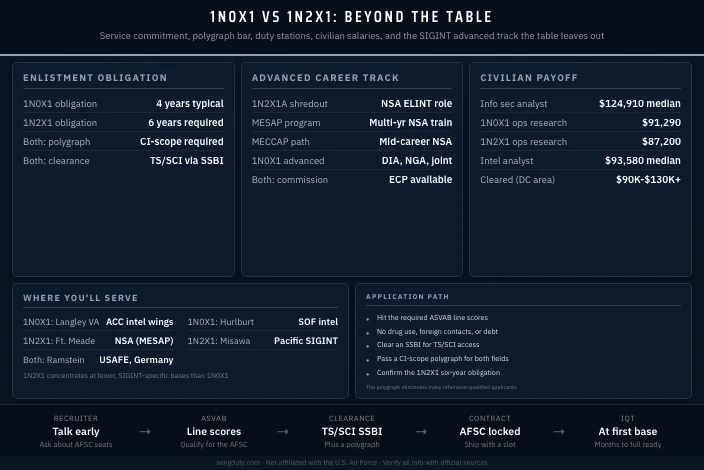
Quick Comparison
| Decision point | 1N0X1 | 1N2X1 |
|---|---|---|
| Core role | Fuses reporting from human, imagery, signals, and open-source collection to produce finished intelligence assessments that guide Air Force commanders and joint warfighters. | Collects, processes, and analyzes electronic emissions from radar and communication systems to characterize adversary capabilities and feed targeting, electronic warfare, and strategic assessments. |
| Test gate | ASVAB, ADMI 60 minimum | ASVAB, GEND 72 minimum |
| Score summary | Requires an ADMI composite of 60 plus AFQT 36. GED requires AFQT 65. A TS/SCI clearance with an SSBI and counterintelligence-scope polygraph is also required. | Requires a GEND composite of 72, AFQT 36 (high school diploma) or AFQT 65 (GED), and no history of temporomandibular joint pain. A TS/SCI clearance with SSBI and counterintelligence-scope polygraph is required. |
| Training path | BMT at JBSA-Lackland (7.5 weeks), then Technical School at Goodfellow AFB, TX (approximately 90.5 days, about 13 weeks) covering all-source analytical methods, the intelligence cycle, threat systems, and classified tools. | BMT at JBSA-Lackland (7.5 weeks), then the Electronic Signals Intelligence course at Goodfellow AFB, TX (74 to 84 days, approximately 11 to 12 weeks), followed by Initial Qualification Training at the first duty station. |
| Work setting | Classified SCIFs inside secure facilities at Air Force wings and major commands, with shift work common at operational units tied to flying schedules. | Fixed ground stations with shift-based 24/7 collection operations, or airborne intelligence platforms with mission-based scheduling, primarily in secure, technically intensive environments. |
| Deployment pattern | Generally lower tempo than combat support AFSCs. Most Airmen in a standard enlistment can expect at least one 90 to 180 day deployment supporting theater intelligence cells or joint intelligence support elements. | Fixed-site Airmen may deploy 3 to 6 months every 18 to 24 months. Airborne units can operate at higher tempos. Deployments include established bases in the Pacific, Europe, and the Middle East. |
| Best fit | Best for people who enjoy analytical problem-solving, read and write clearly, and want a clearance that compounds into high post-service earning potential. | Best for technically focused people who enjoy pattern recognition and signal analysis, can handle strict security requirements, and want one of the strongest post-service clearance premiums in the enlisted force. |
| Less ideal if | Less ideal if you want physical work or outdoor assignments, cannot maintain financial and personal conduct standards for a TS/SCI clearance, or need to discuss your work openly. | Less ideal if you cannot pass a counterintelligence-scope polygraph, have foreign national entanglements, or want a career with physical challenge or geographic variety. |
If broad analytical work drawing from all collection types interests you, start with the 1N0X1 All Source Intelligence Analyst profile. If technically focused signals collection and characterizing adversary electronic systems is the draw, start with the 1N2X1 Signals Intelligence Analyst profile.
Qualification Gates
Both careers require the ASVAB, a TS/SCI clearance through an SSBI, and a counterintelligence-scope polygraph. The ASVAB composites differ by discipline.
- 1N0X1 needs an ADMI composite of 60. The Administrative composite draws from General Science, Paragraph Comprehension, Word Knowledge, and Arithmetic Reasoning. It rewards verbal and reading aptitude.
- 1N2X1 needs a GEND composite of 72, above average for enlisted AFSCs. The General composite pulls from Word Knowledge, Paragraph Comprehension, and Arithmetic Reasoning. A GED holder also needs AFQT 65 rather than the standard 36.
Both careers add a medical note: 1N0X1 requires no speech disorders, and 1N2X1 requires no history of temporomandibular joint (TMJ) pain. The 1N2X1 enlistment commitment is six years, one year longer than the standard four-year contract typical for 1N0X1.
The ADMI and GEND composites both emphasize verbal reasoning and reading comprehension. Our ASVAB study guide covers the specific subtests that drive both scores.
Work Environment
Both careers take place primarily inside SCIFs, but the day-to-day texture differs.
1N0X1 All Source Analysts work at the intersection of multiple intelligence disciplines. At a fighter wing, the work runs close to the flight schedule, with analysts preparing pre-mission threat briefings and debriefing aircrew afterward. At a major command or joint intelligence support element, the tempo is steadier and the scope covers theater-wide analysis. Shift work is common at operational units running around the clock.
1N2X1 Signals Intelligence Analysts often work at fixed ground stations running 24/7 collection operations on rotating shifts, or aboard airborne intelligence platforms on mission-based schedules. The work is highly technical and methodical: monitoring collection equipment, cataloging signal parameters, and building technical reports on adversary emitters. Many 1N2X1 Airmen describe the environment as quiet and focused, long periods of analysis between reporting cycles.
Training Path
Both pipelines start with BMT at JBSA-Lackland, then proceed to Goodfellow AFB, TX, which is the Air Force’s primary intelligence training hub.
- 1N0X1 attends approximately 90.5 days (about 13 weeks) of Technical School covering all-source analytical methods, the intelligence cycle, order of battle analysis, and classified briefing production. Clearance processing and the polygraph are completed during this phase.
- 1N2X1 attends the Electronic Signals Intelligence course for 74 to 84 days (approximately 11 to 12 weeks), covering signal theory, emitter analysis, collection system operation, and intelligence report writing. Initial Qualification Training at the first duty station adds additional months before full mission readiness.
Both programs earn college credits toward an Intelligence Studies and Technology associate degree through the Community College of the Air Force.
Which One Fits You
Choose 1N0X1 if you want to pull from every intelligence discipline to answer commanders’ questions, write finished assessments, and brief senior leaders, and you have strong verbal reasoning and reading skills to drive the ADMI score.
Go with 1N2X1 if you are drawn to the technical side of intelligence, enjoy working with electronic systems and signal analysis, and can meet the higher GEND 72 composite and the polygraph requirements that eliminate a meaningful share of otherwise-qualified applicants.
Both careers leave service with a TS/SCI clearance that pays a significant premium in defense contracting and federal agency hiring. The longer you hold it, the more it compounds.
Next Step
Your ASVAB verbal and reasoning scores are the entry gate for both careers.
- Target the right composite. Use the ASVAB study guide to focus on Word Knowledge, Paragraph Comprehension, and Arithmetic Reasoning, the subtests that drive both ADMI and GEND.
- Audit your background before applying. Both careers require a TS/SCI clearance with a polygraph, and foreign contacts, financial problems, or prior drug use complicate or end the process.
- Talk to an Air Force recruiter about the current enlistment obligation length. 1N2X1 carries a six-year active-duty commitment; confirm the current terms before signing.