Air Force 1B4X1 vs 3D0X2 Cyber
Both 1B4X1 and 3D0X2 are Air Force cyber careers that live inside classified facilities and require a Top Secret clearance, but they operate on opposite sides of the mission. Cyber Warfare Operators attack and exploit adversary networks, while Cyber Systems Operations specialists build and defend the Air Force’s own networks.
Quick Comparison
| Decision point | 1B4X1 | 3D0X2 |
|---|---|---|
| Core role | Plans and executes offensive and defensive cyberspace operations against adversary networks, exploiting digital targets and defending Air Force systems under the 16th Air Force. | Installs, configures, and defends Air Force computer systems and networks, managing servers, monitoring for threats, and responding to cyber incidents to protect mission-critical Air Force infrastructure. |
| Test gate | ASVAB, ELEC 70 minimum | ASVAB, MECH 45 and ELEC 60 (or alternate: MECH 45, ELEC 55, and Cyber Test 60) |
| Score summary | Requires an ELEC composite of 70 and AFQT 36. A high school diploma or equivalent is required. ELEC 70 is among the highest ASVAB requirements in the enlisted Air Force. | Primary path requires MECH 45 and ELEC 60 plus AFQT 36. An alternate path substitutes MECH 45, ELEC 55, and a Cyber Test score of 60. GED accepted with AFQT 36. |
| Training path | BMT at JBSA-Lackland (7.5 weeks), then the Cyber Warfare Operator Apprentice Course at Keesler AFB, MS (approximately 6 months), followed by 12 or more months of OJT and, for USCYBERCOM team members, a 9-week Intermediate Network Warfare Training course at Hurlburt Field. | BMT at JBSA-Lackland (7.5 weeks), then Technical School at Keesler AFB, MS (66 days, approximately 9.5 weeks) covering systems administration, network security, and server management. |
| Work setting | Classified SCIFs and secure facilities at installations with cyber mission units, working on small teams in a sedentary, screen-intensive environment. | Server rooms, network operations centers, and classified office spaces at installations with network infrastructure or cyber missions, with rotating shifts common at 24/7 operations units. |
| Deployment pattern | Moderate tempo, 90 to 180 day rotations. Some missions are conducted remotely from CONUS bases. Operators at the 16th Air Force or USCYBERCOM teams deploy more frequently than support roles. | Deploys less frequently than combat support AFSCs. Typical deployments run 4 to 6 months supporting Air Operations Centers and joint task forces. Some Airmen complete a four-year contract without deploying. |
| Best fit | Best for technically curious people who want to work against real adversaries in classified environments and are prepared for a demanding clearance process. | Best for technically minded people who want a clear post-service path into civilian cybersecurity and can handle shift work and a Top Secret clearance process. |
| Less ideal if | Less ideal if you have significant financial problems or foreign contacts that complicate a TS/SCI clearance, or if you want physical variety in your work environment. | Less ideal if you need a standard day shift schedule or want physical variety; the work is desk-based and often involves rotating night shifts at network operations centers. |
If offensive operations against real adversaries is what draws you, start with the 1B4X1 Cyber Warfare Operations profile. If building and defending Air Force network infrastructure interests you more, start with the 3D0X2 Cyber Systems Operations profile.
Qualification Gates
Both careers run through the ASVAB and require a Top Secret clearance based on a Single Scope Background Investigation. The ASVAB split is the key difference.
- 1B4X1 needs an ELEC composite of 70, one of the highest ASVAB requirements in the enlisted Air Force. The Electronics composite draws from General Science, Arithmetic Reasoning, Mathematics Knowledge, and Electronics subtests.
- 3D0X2 needs MECH 45 and ELEC 60 on the primary path, or MECH 45, ELEC 55, and a Cyber Test score of 60 on the alternate path. The lower electronics floor makes 3D0X2 accessible to more applicants.
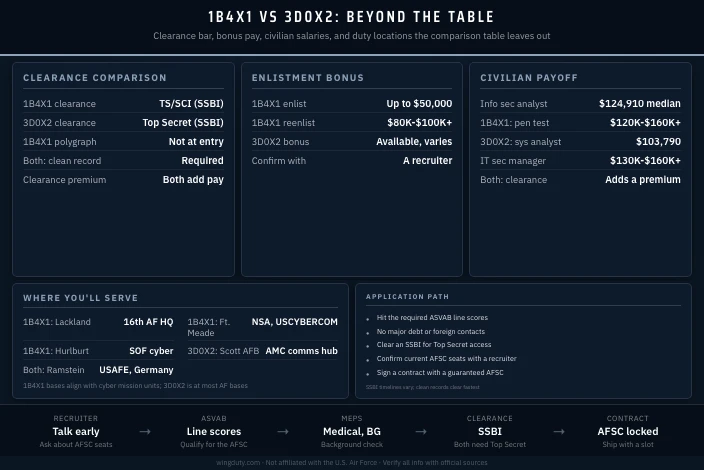
Both require AFQT 36, and both require a clean financial and personal record for the TS/SCI clearance. The 1B4X1 clearance is a TS/SCI with SCI access through an SSBI; 3D0X2 requires Top Secret with SSBI. Neither tolerates significant debt, foreign contacts, or recent drug use.
Your ASVAB electronics and mechanical scores are the first gates to clear. Our ASVAB study guide covers how to target both the ELEC and MECH composites.
Work Environment
The physical setting for both jobs is similar: indoor, classified facilities with screen-intensive work. The mission tempo and team structure differ.
1B4X1 Cyber Warfare Operators work in small, tightly integrated teams inside SCIFs, executing missions that are planned through a formal authorization process. The work is methodical and analysis-driven, but the stakes are direct: operators work against real adversary systems in real time. Some positions involve rotating shifts; others support mission cycles with extended hours during exercises.
3D0X2 Cyber Systems Operations specialists often work in Network Operations and Security Centers running 24/7 operations with rotating shifts covering nights, weekends, and holidays. The day-to-day tempo is more procedural: monitoring dashboards, responding to incidents, patching systems, and maintaining server infrastructure. The environment is collaborative, with teams passing responsibilities across shifts in formal handoffs.
Training Path
Both pipelines start at JBSA-Lackland for BMT, then diverge at Tech School.
- 1B4X1 attends the Cyber Warfare Operator Apprentice Course at Keesler AFB, MS, which runs approximately 6 months. Airmen joining USCYBERCOM teams complete an additional 9-week Intermediate Network Warfare Training course at Hurlburt Field before their first operational assignment.
- 3D0X2 attends Technical School at Keesler AFB, MS, for 66 days (about 9.5 weeks), covering systems administration, network fundamentals, and the foundational concepts behind the Information Assurance Technical Level II certification required to hold the AFSC.
The 1B4X1 pipeline is roughly three to four times longer. That investment reflects the classified and offensive nature of the training content.
Which One Fits You
Choose 1B4X1 if you are genuinely curious about how networks can be broken, want to work directly against adversary systems in classified environments, and are willing to meet one of the highest ASVAB electronics requirements in the enlisted force.
Go with 3D0X2 if you want to build and defend Air Force networks, are more interested in systems administration and defensive security than offensive operations, and find the lower ASVAB electronics floor more achievable.
Both careers deliver strong post-service value. A 1B4X1 operator with a TS/SCI clearance and offensive cyber experience commands significant salary in the defense contracting market.
A 3D0X2 Airman with an active clearance, security certifications, and documented network defense work steps into civilian information security roles at competitive pay. The clearance is the compounding asset in both cases.
Next Step
Start with your ASVAB electronics scores. Both careers live or die on ELEC, and 1B4X1’s ELEC 70 floor eliminates candidates who do not prepare.
- Target the right composite. Use the ASVAB study guide to work specifically on the Mathematics Knowledge and Electronics Information subtests that drive the ELEC score.
- Audit your background honestly before you apply. Both careers require a Top Secret clearance, and unresolved debts or foreign contacts slow the process significantly.
- Talk to an Air Force recruiter about current seat availability. 1B4X1 seats are limited; the timing of your MEPS scores and clearance eligibility affects access to the contract.