Air Force 17D vs 17S Cyber Officers
Both 17D and 17S officers work in classified cyber environments and commission through the same paths, but they operate on opposite sides of the mission. The 17D builds and defends the Air Force’s communications and network infrastructure. The 17S plans and executes offensive operations against adversary systems.
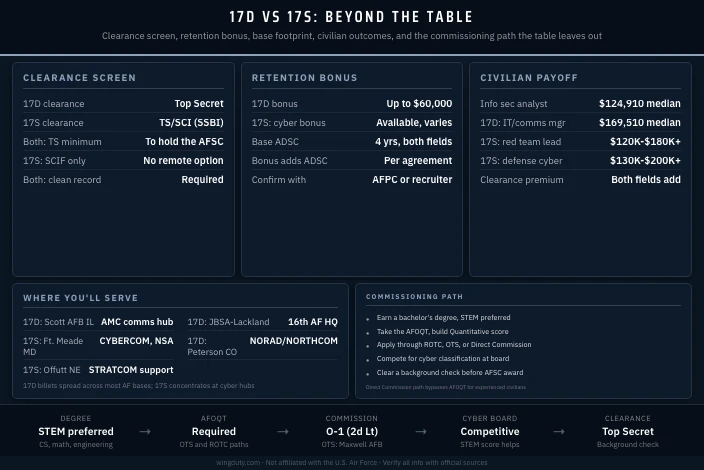
Quick Comparison
| Decision point | 17D | 17S |
|---|---|---|
| Core role | Plans, designs, and operates the information networks and cyberspace systems Air Force operations depend on, leading flights and squadrons responsible for network defense, communications architecture, and cyberspace infrastructure. | Plans, directs, and executes cyberspace operations against adversary systems and networks, leading cyberspace operations flights and squadrons executing offensive and defensive cyber missions under 16th Air Force. |
| Test gate | AFOQT, Verbal 15 and Quantitative 10 minimum | AFOQT, Verbal 15 and Quantitative 10 minimum |
| Score summary | Published minimums are Verbal 15 and Quantitative 10, but competitive 17D candidates score significantly higher. A Cyber Direct Commission path is also available without AFOQT for qualified civilians with demonstrated cyber experience. | Published minimums are Verbal 15 and Quantitative 10, though competitive candidates for technical fields score well above. A Cyber Direct Commission path is available for qualified civilian cyber professionals without AFOQT. |
| Training path | Commission through OTS (9.5 weeks at Maxwell AFB), then Undergraduate Cyberspace Warfare Training at Keesler AFB, MS, followed by Mission Qualification Training at the first duty station (6 to 12 or more months). | Commission through OTS (approximately 8.5 to 9.5 weeks at Maxwell AFB), then Undergraduate Cyberspace Training at Keesler AFB (approximately 6 months at the 329th Training Squadron), followed by Mission Qualification Training at the assigned unit. |
| Work setting | Operations centers, network operations centers, server rooms, and classified facilities at Air Force installations. Work is primarily indoors with on-call requirements common for network incidents and exercises. | Sensitive Compartmented Information Facilities (SCIFs) and specially accredited cyber operations centers, with 24/7 operational postures at cyber mission units. Remote work is not an option for most billets. |
| Deployment pattern | Generally lower tempo than rated or special warfare fields. Deployments typically run 60 to 180 days supporting expeditionary communications and tactical networks at forward locations. | Many missions executed from CONUS reach-back facilities. Deployments typically run 90 to 180 days supporting forward-deployed joint forces. Officers in joint billets travel more frequently on shorter TDY trips. |
| Best fit | Best for technically minded officers who want to build and defend the communications backbone that enables Air Force operations, and who are comfortable leading people in a technically demanding environment. | Best for technically strong officers with genuine interest in offensive security and vulnerability research who want to operate at a national security scale and are willing to lead people as they advance past O-3. |
| Less ideal if | Less ideal if you want primarily hands-on technical work without management responsibilities, or if private-sector cyber compensation is your primary motivation and you are unwilling to accept the pay differential. | Less ideal if financial parity with the private sector is essential, you cannot accept the SCIF-based work environment, or you want purely hands-on technical work without organizational leadership responsibilities. |
If managing the communications backbone that enables Air Force operations interests you, start with the 17D Cyberspace Warfare Operations Officer profile. If offensive cyber operations and working against adversary systems at the national security level is the draw, start with the 17S Cyberspace Effects Operations Officer profile.
Qualification Gates
Both careers require the AFOQT for officers commissioning through OTS, ROTC, or the Air Force Academy. The published minimums are Verbal 15 and Quantitative 10 for both fields, but these are floors, not targets. Both career fields favor STEM backgrounds, and competitive classification boards score well above the published minimums.
Both 17D and 17S also offer a Cyber Direct Commission path, which allows qualified civilian cyber professionals to commission directly without attending OTS. That path has no AFOQT requirement but demands documented operational cyber experience.
Both career fields require a Top Secret clearance. The 17S profile specifically calls out a Single Scope Background Investigation for TS/SCI access. Both fields require a clean financial and personal record.
Your AFOQT scores are the first academic gate. Our AFOQT study guide covers the six composite breakdown and how to prepare for the Quantitative subtest that matters most for technical fields.
Work Environment
Both fields are SCIF-based. The mission direction and operational tempo differ.
17D Cyberspace Warfare Operations Officers work in network operations centers, server rooms, and classified communications facilities. Most garrison assignments follow a regular duty week with on-call requirements for network incidents. Deployed environments involve standing up tactical networks at forward locations. The work is infrastructure-focused and support-intensive.
17S Cyberspace Effects Operations Officers work in specially accredited cyber operations centers that run around the clock. Junior officers in operational billets work shift rotations and surge periods tied to real-world missions. The work is mission-execution focused, with legal review integrated into every operational planning cycle.
Both careers are in-person only. No remote work option exists in most billets for either field.
Training Path
Both paths start at commissioning, then diverge at the career-field qualification course.
- 17D completes Undergraduate Cyberspace Warfare Training at Keesler AFB, MS, covering network architecture, communications systems, and cyberspace operations doctrine. Officers who complete Expeditionary Communications Training earn the 17DXB designation for deployed operations.
- 17S completes Undergraduate Cyberspace Training at Keesler AFB (approximately 6 months at the 329th Training Squadron), covering electronics theory, network exploitation, cryptography, and offensive and defensive cyber operations, followed by Mission Qualification Training at the assigned unit.
Both pipelines run through Keesler AFB before separating into mission-specific qualification. The 17S pipeline is explicitly framed in the source profile as approximately 6 months for UCT plus additional months of Mission Qualification Training.
Which One Fits You
Choose 17D if you want to build and defend the communications infrastructure that Air Force operations depend on, prefer a more distributed base footprint with assignments across many installations, and want to lead people in a technically demanding but support-oriented mission set.
Go with 17S if you have genuine technical depth in offensive security or vulnerability research, want to execute cyberspace effects against adversary systems at a national security scale, and are prepared for the operational tempo of a 24/7 mission environment at a concentrated set of bases.
Both fields compete with the private sector for talent, and both offer retention bonuses at certain career points. Both fields impose a TS/SCI clearance requirement that adds significant value after separation.
Next Step
Both tracks require the AFOQT for OTS and ROTC commissioning. Two preparation moves matter most.
- Build your AFOQT Quantitative score. Technical cyber fields reward strong quantitative performance at classification boards. Use the AFOQT study guide to target the subtest that drives that composite.
- Assemble a technical background. Computer science, mathematics, engineering, or management information systems degrees are the stated degree preferences for both 17D and 17S. Prior cyber certifications or documented hands-on experience strengthen classification applications for both fields.
Then talk to an Air Force recruiter or your ROTC detachment about current classification timelines and what a competitive candidate profile looks like for each field.