Air Force 14N vs 14F Intelligence Officers
Both 14N and 14F officers work at the edge of Air Force operations, but one produces intelligence for commanders and aircrew, while the other uses information to shape what adversaries think and do. They share a clearance level and a SCIF-based work environment, but the analytical focus and career paths are meaningfully different.
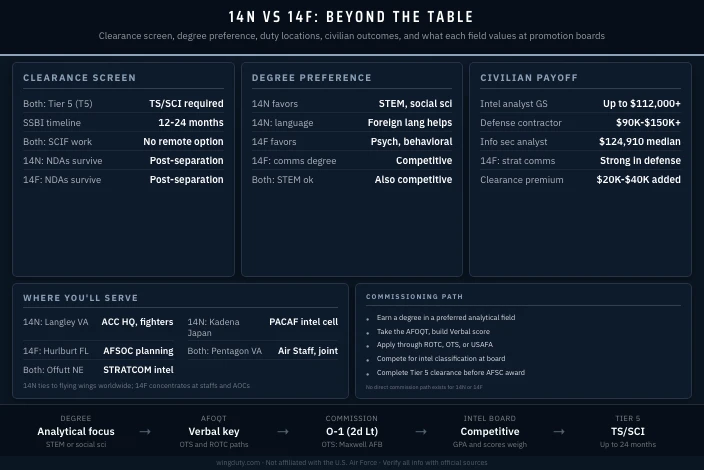
Quick Comparison
| Decision point | 14N | 14F |
|---|---|---|
| Core role | Directs all-source intelligence operations for Air Force flying and joint units, analyzing and presenting intelligence products that support targeting, mission planning, and force protection. | Plans, integrates, and assesses information-related capabilities that shape adversary decision-making, combining analysis, signature management, and synchronized non-kinetic effects to support Air Force and joint operations. |
| Test gate | AFOQT, Verbal 15 and Quantitative 10 minimum | AFOQT (no 14F-specific floor published) |
| Score summary | Published minimums are Verbal 15 and Quantitative 10. Competitive 14N candidates typically score well above both floors. A Tier 5 (T5) federal background investigation is required before the AFSC is formally awarded. | The 14F source profile publishes no career-field-specific AFOQT composite floor. Classification is competitive and favors behavioral sciences, psychology, linguistics, or social science backgrounds. A Tier 5 investigation is required before the AFSC is awarded. |
| Training path | Commission through OTS (9.5 weeks at Maxwell AFB), then the Intelligence Officer Initial Skills Course at Goodfellow AFB, TX (approximately 8 weeks), followed by 12 weeks of home station qualification training and a 3-week specialized intelligence course. | Commission through OTS (approximately 8.5 weeks at Maxwell AFB), then the Information Operations Professionals Course (length varies by location and year), followed by follow-on approved IO courses and 12 to 24 months of first-assignment OJT. |
| Work setting | Classified SCIFs at Air Force wings and major commands, working inside secure operations rooms with classified workstations and network access. At flying wings, the intel section works to the flying schedule. | Planning environments, operations center staffs, and secure collaborative facilities rather than flight lines or conventional offices. Significant time in SCIFs coordinating with joint, interagency, and coalition partners. |
| Deployment pattern | Frequent at flying wings. Deployment lengths typically run 90 to 180 days supporting theater intelligence and targeting operations. Officers at MAJCOM or national-level staffs deploy less often but travel more for TDY. | Can support deployed headquarters from CONUS SCIF environments via reach-back, reducing physical forward deployment. When deploying, embeds with command planning staffs or combined joint task force headquarters. Standard cycles run 90 to 179 days. |
| Best fit | Best for analytical officers who read and write clearly, can tolerate and assess ambiguous information, and want to brief senior leaders and aircrew in an operational environment. | Best for officers who think across psychology, planning, and operations simultaneously, are comfortable with ambiguous effects measurement, and find intellectual satisfaction in coordinated influence campaigns. |
| Less ideal if | Less ideal if you prefer solitary technical work over briefing and managing people, cannot handle frequent PCS moves, or need remote work flexibility that classified facilities cannot provide. | Less ideal if you need immediate visible operational effects to stay motivated, want a simple technical lane with clear performance metrics, or find ambiguity in influence assessment frustrating rather than stimulating. |
If directing intelligence operations and briefing aircrew before combat missions is the draw, start with the 14N Intelligence Officer profile. If planning influence campaigns and integrating information-related capabilities against adversary decision-making interests you more, start with the 14F Information Operations Officer profile.
Qualification Gates
Both careers require the AFOQT for OTS, ROTC, and Air Force Academy commissioning. The 14N profile publishes the non-rated officer minimums of Verbal 15 and Quantitative 10; the 14F profile lists no career-field-specific floor. Neither field requires the TBAS.
Both require a high-level federal background investigation before the AFSC is formally awarded.
- 14N requires a Tier 5 (T5) Investigation for Top Secret/SCI access, which is the most intensive federal background investigation level. The 14N source profile states the process can take 12 to 24 months.
- 14F also requires a Tier 5 Investigation for TS/SCI clearance plus Sensitive Compartmented Information access based on the source profile’s explicit mention of a Tier 5 polygraph-level process.
Degree preferences differ in emphasis. The 14N source page lists science, humanities, social sciences, engineering, and mathematics as preferred fields. The 14F source page specifically names behavioral sciences, psychology, linguistics, social sciences, communications, and public relations as the strongest backgrounds.
Use the AFOQT study guide to prepare for the Verbal and Quantitative sections that matter most for both career fields.
Work Environment
Both officers work in SCIFs on classified networks. The type of work and the organizational setting differ.
14N Intelligence Officers are attached to the Operations Group at flying wings and work to the flying schedule. The day involves pre-mission threat briefs, all-source analysis, and managing intelligence production for the unit. Staff assignments at MAJCOMs, combatant commands, or national agencies like the Defense Intelligence Agency shift the work to more deliberate analytical products.
14F Information Operations Officers work inside planning cells, joint staffs, and operations centers. The source profile describes the field as staff-heavy by design, because information effects are generated through planning quality and organizational coordination. Officers may support deployed headquarters from home-station SCIF environments through reach-back infrastructure.
Both fields prohibit remote work from outside cleared facilities.
Training Path
Both officers commission through OTS, ROTC, or the Air Force Academy before career-field-specific training. The qualification courses are different in content and location.
- 14N attends the Intelligence Officer Initial Skills Course at Goodfellow AFB, TX, approximately 8 weeks. The 315th Training Squadron at Goodfellow is the primary Air Force intelligence training organization. After the initial course, 12 weeks of home station qualification and a 3-week specialized intelligence course complete the pipeline.
- 14F attends the Information Operations Professionals Course, the primary Air Force qualification course for IO officers, after commissioning. Follow-on approved IO courses and 12 to 24 months of first-assignment OJT follow.
The 14N training location is fixed: Goodfellow AFB, TX. The 14F source profile notes that IOPC location and length vary; the Air Force’s public-facing page confirms the course as a hard qualification requirement.
Which One Fits You
Choose 14N if you want to produce finished intelligence products, brief aircrew before combat missions, and work in a career field with a clear operational tie to flying units throughout your assignments.
Go with 14F if you think across psychology, planning, and operations simultaneously, are drawn to influence and decision-making analysis over traditional intelligence production, and are prepared for a staff-heavy career where effects are measured diffusely rather than immediately.
Both fields offer strong post-service transitions. A 14N officer with TS/SCI carries direct market value to the Defense Intelligence Agency, National Geospatial-Intelligence Agency, and defense contractors. A 14F officer’s combination of cleared analyst status and information-influence planning experience is sought by defense contractors, think tanks, and interagency organizations.
Next Step
The AFOQT Verbal and Quantitative scores carry the most weight for both career fields at the classification board. Two preparation moves matter most.
- Build a strong AFOQT Verbal score. Both 14N and 14F analytical work depends on reading comprehension and writing quality. The AFOQT study guide covers each subtest and explains how to target the Verbal composite.
- Build your application background before you apply. For 14N, analytical coursework in history, political science, economics, or a STEM field strengthens your package. For 14F, behavioral science, psychology, or linguistics backgrounds directly align with the career field’s stated degree preferences.
Then contact your nearest Air Force recruiter or AFROTC detachment to get current information on classification timelines and what a competitive candidate looks like right now.