Air Force TACP Officer: Selection, Training, and Career
A TACP officer leads Airmen who help ground troops use airpower, and the work blends field skills with plans, briefs and team training. A strong fitness score is not enough; the team needs a leader who can help it get ready. Before you apply, know the three steps. First, the Air Force must select you for the field, and you also need a commission if you do not have one yet. Full job qualification comes later, after schools and work with a unit. These steps are not the same gate.
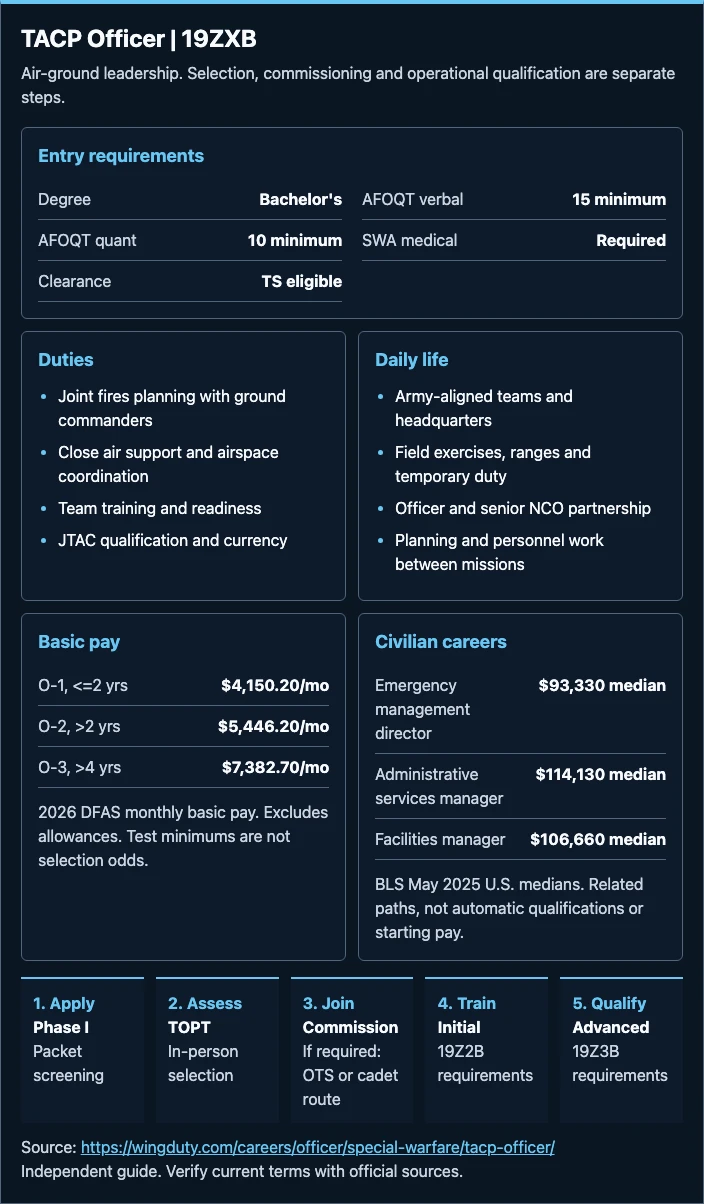
Entry requirements
- Degree
- Bachelor's
- AFOQT verbal
- 15 minimum
- AFOQT quant
- 10 minimum
- SWA medical
- Required
- Clearance
- TS eligible
Duties
- Joint fires planning with ground commanders
- Close air support and airspace coordination
- Team training and readiness
- JTAC qualification and currency
Daily life
- Army-aligned teams and headquarters
- Field exercises, ranges and temporary duty
- Officer and senior NCO partnership
- Planning and personnel work between missions
Basic pay
- O-1, <=2 yrs
- $4,150.20/mo
- O-2, >2 yrs
- $5,446.20/mo
- O-3, >4 yrs
- $7,382.70/mo
2026 DFAS monthly basic pay. Excludes allowances. Test minimums are not selection odds.
Civilian careers
- Emergency management director
- $93,330 median
- Administrative services manager
- $114,130 median
- Facilities manager
- $106,660 median
BLS May 2025 U.S. medians. Related paths, not automatic qualifications or starting pay.
- ApplyPhase IPacket screening
- AssessTOPTIn-person selection
- JoinCommissionIf required: OTS or cadet route
- TrainInitial19Z2B requirements
- QualifyAdvanced19Z3B requirements
Source: Air Force TACP Officer: Selection, Training, and Career
Independent guide. Verify current terms with official sources.
On this page
Wing Duty is supported by purchases through our links, which may earn us a commission.
Job Role and Responsibilities
Air Force Tactical Air Control Party officers lead teams that bring air support to ground forces. They help ground commanders plan joint fires and qualify to control close air support. They also train the team for work in the field.
Close air support is air action against hostile targets near friendly troops, and it needs a clear plan agreed with those troops. A Joint Terminal Attack Controller, or JTAC, directs the final part of an air attack. The role needs its own training, so rank alone does not give an officer the skill or the right to do it.
TACP teams plan fire missions and use radios, digital networks and targeting gear, and the officer helps a ground commander weigh the air support options. The team must know where friendly troops are, and it also needs clear limits. Good gear cannot fix a plan built on the wrong facts.
The work starts before a mission and goes on after it, and it runs across four areas.
- Air support plans with the ground force.
- Team goals and checks on progress.
- Work with senior NCOs on skills, gear and people.
- Field training and lessons from the debrief.
| Code | Meaning |
|---|---|
| 19Z1B | Entry TACP officer |
| 19Z2B | Intermediate level, after initial training requirements |
| 19Z3B | Qualified level, after advanced training and experience |
| 19Z4B | Staff level |
| 19ZXA / 19ZXC | Separate Special Tactics / Combat Rescue specialties |
The 19Z parent profile shows how the three fields fit together.
A new lieutenant first learns the job and may lead a flight or a team training task, while later posts can include squadron command and higher staff work. Team size depends on the post, so a new officer should not expect to lead a large unit from day one.
Salary and Benefits
Base pay depends on rank and years of service, and TACP has no separate base-pay scale. This table shows DFAS pay, rounded to whole dollars, and the source line gives the year. The rows show pay at chosen service points, so they do not promise when a rank will be reached.
| Rank | Pay Grade | Years of Service | Monthly Base Pay | Annual Base Pay |
|---|---|---|---|---|
| Second Lieutenant (2d Lt) | O-1 | 2 or less | $4,150 | $49,802 |
| First Lieutenant (1st Lt) | O-2 | Over 2 | $5,446 | $65,354 |
| Captain (Capt) | O-3 | Over 4 | $7,383 | $88,592 |
| Major (Maj) | O-4 | Over 10 | $9,420 | $113,040 |
Source: DFAS 2026 pay tables. Figures reflect the 2026 pay raise.
Prior enlisted service can change the pay category, and housing allowance depends on rank, place of duty and dependent status, so there is no one rate for the whole field. The shared officer BAS rate is $328.48 a month. BAS is the food allowance, and it helps pay for the member’s meals rather than food for the whole household.
Other benefits and pay have their own rules.
- Healthcare follows active-duty TRICARE rules.
- Parachute and other special pays need the right orders. The duty must meet the rules for that pay.
- Work with aircraft from the ground does not earn aviation pay on its own.
- Active-duty members earn 30 days of paid leave each year. Mission needs still affect when leave can be taken.
No current bonus for all TACP officers was verified, so get the terms of any offer in writing, because a bonus may add time to the service owed.
The Blended Retirement System has a pension and savings plan. For active-duty members who meet the rules, the pension at 20 years is 40% of the highest 36-month average base pay, and housing and special pays are not part of that base. The Thrift Savings Plan, or TSP, is its own savings account. Once matching starts, a member who puts in 5% of base pay can get a 4% match, and the government also adds 1% under its own rules. Some funds must vest before they belong to the member, and service rules apply too.
To compare pay with a job at home, start with base pay and then check which costs the service covers. Rent, tax and care costs can change the result, so a larger monthly sum is not the same as more cash left to spend.
Life at home station may have a steadier pace, while field work can mean long days and time away. Earning leave does not mean it can be used at any time, so weigh that cost along with the pay.
Qualifications and Eligibility
Find the right entry route
You need a bachelor’s degree, but no one major is required, and you do not have to serve in the enlisted ranks first. ROTC and the Air Force Academy train cadets before they earn a commission. For those who meet its rules, OTS offers a path from civilian life or enlisted service.
| Route | Degree and GPA | Age and medical rules | TACP entry step |
|---|---|---|---|
| Civilian SWAP and OTS | Degree or eligible senior within 12 months of graduation; published minimum GPA 2.5 | Published civilian SWAP age 18–39 at commissioning; commissioning and Special Warfare medical rules | Work through a Special Warfare recruiter, then obtain separate OTS approval after selection |
| ROTC | Degree and the program’s academic standards | ROTC commissioning and Special Warfare medical rules; confirm the route’s age limit | Complete Field Training and apply through detachment leadership |
| Air Force Academy | Academy degree and commissioning program | Academy entry rules and Special Warfare medical standards | Apply through cadet leadership and coordinate career-field classification |
| Serving Air Force member | Existing commission or degree-qualified enlisted OTS route | Service, release and medical rules for that route | Apply for TACP; obtain release or OTS approval as needed |
| Interservice transfer | Existing commission and transfer eligibility | Losing-service release and Air Force medical/transfer rules | TOPT selection and transfer approval are separate |
The GPA and age in the civilian row apply to that route, while ROTC and the Academy have their own rules. The table also cannot decide a serving officer’s waiver request, and no direct-commission TACP shortcut based on a civilian job was found.
The recruiting page still linked FY2025 forms with old board dates when checked in October 2026, and a newer FY2027 packet was on a site outside the Air Force. Ask the accessions team for the right forms before filing, because a date in an old file does not mean a job is open now.
Study for the AFOQT
For the civilian route, AFOQT scores must meet two floors: verbal must be at least 15, and quantitative must be at least 10. These scores let a file meet the test floor, but they do not show what score makes a strong TACP bid, and no winning score or board cutoff was found. TBAS tests pilot candidates, so it is not a listed TACP entry test.
A study plan should show where marks are being lost.
- Take a timed sample and keep the result.
- Sort errors by topic and by cause. A math gap needs a different fix from a rushed answer.
- Review the method behind each missed answer.
- Try fresh questions to check whether the skill has improved.
If you want lessons and practice in a planned order, an AFOQT study course is one paid choice, and this is an affiliate link. A course cannot promise a place in TACP, because the entry rules still apply. If it does not fit your budget, start with free practice, and a guide is another choice for self-study. Check the price and what each format includes.
Keep the selection steps separate
Phase I is the file review, and Phase II, called TOPT, takes place in person. Staff assess how candidates think, brief and work as a team, and they also look at how each person handles strain. A strong fitness score is only part of that picture.
A clear file helps the board see what you have done, so show how you led people and solved problems. Claims about drive or grit add little without facts to back them up.
Cadets need to work with their unit before job fields are assigned, and serving members may need release from their present field. A move from another service needs its own approval. A civilian can pass TOPT and still fail to gain a place at OTS.
New officers normally start as second lieutenants. The TACP service commitment is tied to formal training and runs for six years after the required milestone. Where a follow-on FTU applies, the clock is reset to its graduation date rather than starting on the day of commissioning. Read the form with the recruiter or unit before signing.
Work Environment
TACP work moves between offices, classrooms, ranges and field sites. At home station, the team needs plans, working gear and time to build skills, while field training tests those plans in rain, cold and darkness. Plans also have to change as the mission shifts. TDY means duty travel away from home station, and it can happen even when the unit is not deployed.
The officer works with senior NCOs who know the people and the craft, and a flight chief may have far more time in the field than a new lieutenant. Good leaders draw on that knowledge, make clear choices and follow up. Rank is no reason to ignore sound advice.
A 2026 ground evaluation at Fort Campbell tested planning, field work and debriefing. The team used drones and tools to work in the radio spectrum, so the test went well beyond a single call for air support.
Some posts have more staff work, because a larger headquarters needs plans and advice rather than just small-team skills. No current rate for officers staying in TACP was found, nor was a broad survey of how they feel about the job. To judge fit, weigh the full mix of duties, since one exciting mission clip cannot show the whole job.
Training and Skill Development
ROTC and Academy cadets finish the work to earn a commission first. For OTS, the course at Maxwell AFB is 8.5 weeks, and it teaches general officer skills. A graduate still needs TACP training to do the job.
The April 2026 classification directory lists initial and advanced training. The date inside is April 2026, but its filename still says 2025.
| Stage | Place | Length | Focus |
|---|---|---|---|
| TOPT | Assigned assessment site | About one week in published instructions | Selection, judgment and physical readiness |
| OTS, if needed | Maxwell AFB, Alabama | 8.5 weeks | Commissioning and general officer skills |
| Special Warfare Assessment and Selection; Zulu Course | Joint Base San Antonio, Texas | Confirm course lengths with the TACP recruiting team | Common field skills and assessment |
| Basic Airborne | Fort Benning, Georgia | Confirm the assigned course dates | Parachute skills |
| Survival, water and egress courses | Fairchild AFB, Washington, and assigned sites | Course dependent | Survival and emergency skills |
| TACP Officer Apprentice/Basic course | Chapman Training Annex, JBSA | Confirm the current syllabus | TACP technical and field skills |
| FTU and advanced TACP/air liaison training | Camp Bullis, Texas; Nellis AFB, Nevada; assigned sites | Course and schedule dependent | Certification and joint fires skills |
| Unit training | Assigned unit | Depends on proficiency and evaluations | Apply skills and reach mission readiness |
The table maps the path but does not give a fixed end date. Ask the accessions team to confirm the course order. A wait for a seat or an injury can add time, and so can a course that must be done again, so leave room for delays when planning a move or a large expense.
The first schools lead toward 19Z2B, and the 19Z3B level adds more training along with proof of skills on the job. Those at this level must keep JTAC and parachute skills current, and they must also meet the operator fitness standard. A school pass is not enough for a whole career.
Later schools help officers lead at a wider scale.
| School | Audience and purpose |
|---|---|
| Squadron Officer School, Maxwell | Captains building broader leadership skills |
| Air Command and Staff College | Intermediate officers studying plans and joint operations |
| Air War College | Senior officers studying strategy |
Check the class dates and format before making plans. An officer needs approval to teach a course, and funded graduate study needs approval too, so each must fit service needs rather than just a wish to attend.
The AFOQT is an entry test, not a field course in this pipeline. Before applying, use timed practice to find weak areas. The AFOQT course offers guided study for that written test, but it does not teach JTAC skills or replace military training.

Career Progression and Advancement
Early work builds job skills and trust within a team, and later posts may include larger teams or joint staff work. Finishing the pipeline does not promise command, and it does not promise a higher rank either.
| Rank | Time in grade | Possible development and duties |
|---|---|---|
| O-1, second lieutenant | Initial grade; school timing varies | Finish the pipeline and learn the unit’s work |
| O-2, first lieutenant | Selected active-duty officers normally reach captain after two years in grade, subject to approval rules | Build mission skills and lead small-team work |
| O-3, captain | No single verified TACP tour length | Flight, training or operations roles; SOS |
| O-4, major | Board-selected; no verified TACP-specific timeline | Operations or higher staff work; intermediate education |
| O-5, lieutenant colonel | Board-selected; command has a separate selection | Possible squadron command or senior staff work |
| O-6, colonel | Board-selected; limited senior posts | Possible group/wing-level leadership or senior staff work |
The two-year active-duty rule for selected first lieutenants still needs approval, and rules on the date of rank still apply. Later boards judge the service record. No current TACP-only O-4 or O-5 selection rate was found, and a broad Air Force rate would not give this field’s odds.
A strong record shows the work done and the people helped. Keep job skills sharp, train others well, and meet the needs of the present post first; chasing a school for its name alone will not do that. Teaching and staff tours can build new skills. A move to a new field still needs approval, and it also needs an open job and release from service still owed.
Physical Demands and Medical Evaluations
TACP work can mean long moves with a load, poor weather and little rest, so a general Air Force test pass does not prove fitness for that work. Three sets of rules do not serve the same need.
| Standard | What it measures |
|---|---|
| General Air Force test | Service fitness under current age/sex scoring rules |
| TACP entry test | Fitness to enter the selection process |
| Operator standard | Fitness that qualified Special Warfare members must maintain |
The new general fitness program took effect July 1, 2026. It includes a two-mile run or approved shuttle run, and strength, core and waist-to-height measures also count. The old 1.5-mile chart does not fit this test.
| General test, under age 25 | Male | Female |
|---|---|---|
| Minimum satisfactory total | 75 points | 75 points |
| Event minimums | Meet each chosen event’s male chart minimum | Meet each chosen event’s female chart minimum |
| Failure despite 75 total | A missed event minimum can make the result unsatisfactory | A missed event minimum can make the result unsatisfactory |
The manual requires both the total score and a pass at each event minimum. The current age/sex score sheets could not be checked for this update, so this page does not guess the run times or rep cutoffs. Use the current sheets linked from the official fitness page.
| Published TACP entry benchmark | Minimum |
|---|---|
| Pull-ups | 12 |
| Sit-ups | 75 in two minutes |
| Push-ups | 64 in two minutes |
| Three-mile run | 22 minutes |
| 500-meter swim | 12 minutes 30 seconds |
| Underwater events | Pass/fail under the prescribed test protocol |
Ask the assessment staff which entry-test rules apply now, because a pass at that floor does not promise a place. Never do breath-hold or water-confidence work alone, and work with staff trained to supervise it.
The Special Warfare Airman medical exam is its own step, so a sports physical alone is not final approval, and general clearance to earn a commission is not enough either. Medical staff must review the records, and past surgery, eye issues and injuries need their own review. A guide cannot grant a waiver or promise that one exists.
Deployment and Duty Stations
TACP teams train and serve with ground forces, so an officer may live at an Army post rather than an Air Force flying base. Work with the ground unit can mean time away even between deployments.
Unit locations are not a list of open jobs. A June 2026 exercise at Volk Field included the Kansas Guard’s 284th ASOS, and the Guard also trains away from home.
No fixed deployment rate or tour length covers all the units in the sources checked, because the mission and ground force matter. Officers may travel with enlisted teammates, though their roles still differ.
The service weighs its needs, skills, open posts and each officer’s choices, and join-spouse efforts cannot create jobs at every base. Compare a unit’s mission and time away with the needs at home: a base near home may still mean long trips away. Ask about the unit’s travel, not just where it is based.
Risk, Safety, and Legal Considerations
The hazards include weapons and aircraft, and loads, weather and moving vehicles add risks too. An air-ground error can harm friendly troops or civilians. Leaders must know if the team has what it needs, which means the right people, skills and gear.
A team can lack enough people with current skills for a planned event, and then its leader must change the plan or raise the shortfall. Calling that a paperwork issue would hide the real problem. The case is hypothetical, but the risk it shows is real.
Safe work starts well before a range opens. The officer checks the plan, gear and staff skills, sets clear limits and uses the proper risk review, and stops unsafe training so the cause can be reported.
Formal command adds duties for conduct. Fair treatment is part of that work, and the commander must also address unit climate. UCMJ authority depends on the command role and its rules. Relief from command can end a post and harm a career, but it is not proof of a crime on its own. Rules of engagement and legal limits govern the use of force, and this guide does not teach strike tactics or grant strike approval.
Impact on Family and Personal Life
The first years can be hard to plan. Course dates may shift, and an injury or a wait for a school can delay a move. Later field training and deployments add time away, so a budget needs room for those changes and must cover more than the first move.
Discuss the parts of daily life that need backup.
- School pickup and childcare during field weeks.
- A spouse’s work and licensing needs after a move.
- Bills and home tasks during long absences.
- Help when a short trip becomes longer.
Military and Family Readiness Centers help with moves and plans for time away, and they also offer job resources. Unit staff can help with local needs. Check childcare space early, and do not assume a place will be open.
Couples who both serve need to plan their posts together, and some cases require a family care plan. The same base can help with daily life, but it cannot keep both spouses home for every trip. No sound TACP-wide move rate was found to compare with other fields, so weigh the needs of the unit and look at likely next posts and the strain on life at home.
Before you apply, plan study time around work and home needs too, and online lessons may fit that plan. Compare the AFOQT course with free practice and your own study plan before paying.

Reserve and Air National Guard
TACP is listed in all three parts of the Air Force, but that does not mean a job is open near home. Ask the recruiter about the unit and its open post, and find out how to apply.
If you do not have a commission, ask about unit-backed OTS. This path needs the right approvals, and an active-duty commitment or an ROTC contract does not turn into a Guard contract on request. A serving officer needs a release and the new unit’s approval. No direct-commission shortcut was found for TACP.
| Factor | Active duty | Reserve | Air National Guard |
|---|---|---|---|
| Work pattern | Full-time | Traditional part-time or specific full-time post | Traditional part-time or specific full-time post |
| 2026 O-3 pay example, over four years | $7,382.70 monthly base pay | $984.36 for four paid drill periods | $984.36 for four paid drill periods |
| Healthcare | Active-duty TRICARE rules | Eligible members may buy Reserve Select; orders can change coverage | Eligible members may buy Reserve Select; orders can change coverage |
| Education | Federal programs with service conditions | Component programs; GI Bill depends on qualifying service | Federal and eligible state programs; GI Bill service rules apply |
| Deployment | Unit tasking; no fixed ratio verified | Mobilization and operational tasking; no fixed interval verified | Federal and other applicable duty; no fixed interval verified |
| Command | Active-duty posts and selection | Unit posts and selection | Unit posts and selection |
| Retirement | Qualifying active service and BRS/TSP rules | Qualifying years, points and age rules | Qualifying years, points and age rules |
A drill weekend is not a full month’s pay. An O-3 with over four years earns $246.09 for one paid drill period in 2026, so four periods pay $984.36 before tax and other deductions. Annual training and active orders use their own rules, and a drill check does not come with all the same allowances as full-time duty.
Part-time service still needs large blocks of time, and the pipeline cannot fit into spare weekends. Later schools and field work may take more days than the usual drill schedule. Ask for a real calendar, and check it against work, home and travel needs before choosing a unit.
Members who meet the rules can buy TRICARE Reserve Select for $57.88 a month alone or $286.66 with family in 2026. These are premiums, and care can have extra costs. Guard school benefits vary by state, and GI Bill rules depend on the type and length of service.
Reserve retirement uses qualifying years and points. Most members need 20 qualifying years, and pay tends to start at 60, though some service can lower that age. It is not the same as an active-duty pension paid straight away, because twenty years on a calendar may not be 20 qualifying years. Schools and command posts have their own entry rules, and rank also depends on the record and open posts. No current TACP-only board rates were found for these parts of the force.
USERRA protects job and reemployment rights for covered service, subject to its rules, but it does not promise full civilian pay during duty. Discuss time away with the people who hire you, because a part-time label still needs a sound work plan.
Post-Service Opportunities
The field can build skill in plans, training and leading people, so to get hired, show how those skills fit a job. Explain the work done, who was trained and what improved. Keep protected mission details out of a resume.
| Civilian field | U.S. median annual pay, May 2025 | Job growth, 2025–2035 |
|---|---|---|
| Emergency management director | $93,330 | 4% |
| Administrative services manager | $114,130 | 5% for the combined administrative services/facilities group |
| Facilities manager | $106,660 | 5% for the combined administrative services/facilities group |
These paths are not job offers. The pay figures cover all workers in each field rather than starting pay for former TACP officers.
Emergency planning may need skill with local response plans, so a degree alone may not be enough. Facilities work needs skills that TACP schools do not teach, while defense training jobs may use more of the field skills. Check the needs of each post and clearance rules.
JTAC status does not grant a civilian pilot certificate, nor does it grant an air traffic control license. Choose further study to fill a real skills gap. The Transition Assistance Program can help plan the move out of service, and GI Bill access depends on qualifying service and program rules. Rank alone does not decide the benefit.
Is This a Good Job for You? The Right (and Wrong) Fit
Weigh this path if you want field work and the duty to help others do it well. It calls for clear speech and sound judgment, and it also takes the will to learn from senior NCOs. Strength helps, but it cannot replace those traits.
Compare two tasks. One is taking part in a hard field event, and the other is fixing a training gap so the team can take part at all. If only the first sounds worthwhile, look more closely at the officer workload.
It is a weaker fit if the goal is to avoid office work, since the job will not mean field work all day. Plans, reports, gear needs and people issues stay part of the job. Compare the enlisted TACP path if the main draw is the craft rather than officer leadership.
Do not plan on a short first tour. The service owed reaches well past selection week. Guard or Reserve service changes the long-term work pattern, but it still needs the full first phase of training, and the team must stay ready for its mission. If a fixed home base and set hours are firm needs, compare civilian work too.
More Information
Ask a Special Warfare recruiter or your ROTC unit for the right packet. Find out which route fits, and check the medical steps, service owed and school dates. Build the AFOQT study plan with the rest of the file; a test score alone is not a plan to get chosen.
For lessons and practice, the AFOQT course is the first paid option here, and this is an affiliate link. A study guide is another choice if it better fits your budget and study habits. Check the price before choosing.

Compare the Special Warfare officer group and 19Z parent profile. The Special Tactics Officer and Combat Rescue Officer pages explain the other two specialties.