19Z Special Warfare Officer
Most Air Force officer career fields start with a degree, a commission, and a training pipeline you can plan around. The 19Z Special Warfare Officer path is different. It starts years earlier, in enlisted special operations units, and ends with one of the most demanding officer roles in the U.S. military. These are the officers who lead Combat Controllers, Pararescuemen, and Tactical Air Control Party specialists in environments where the mission rarely goes according to plan.
The 19Z is not an entry-level commission for a new college graduate. It is the career field designation for officers who lead Air Force Special Warfare forces across three distinct shredouts: Special Tactics, Tactical Air Control Party, and Combat Rescue. Whether you are a prior-enlisted special operator eyeing a commission or a ROTC cadet drawn to the most physically demanding officer path in the Air Force, this guide covers every stage of the career.
OTS candidates need competitive ASVAB scores. Our AFOQT study guide covers exactly how to prepare.
Job Role
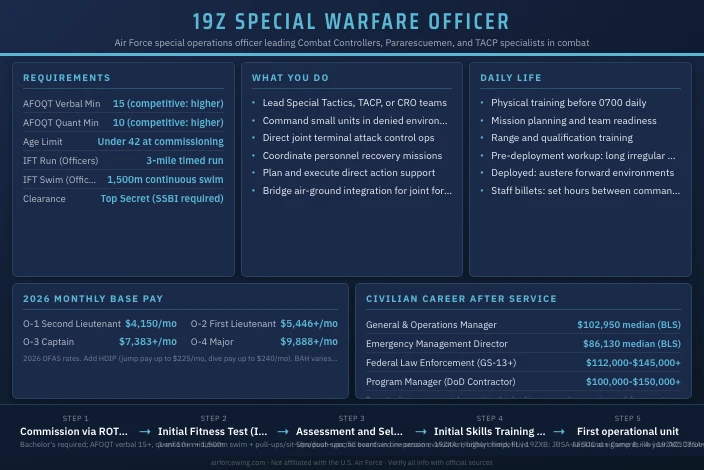
19Z Special Warfare Officers lead Air Force special operations forces across three mission sets: direct action support, personnel recovery, and joint terminal attack control. They command small teams in denied and contested environments, coordinate with joint and special operations forces worldwide, and serve as the bridge between ground teams and the air component. These officers hold command authority over some of the most highly trained enlisted specialists in the Air Force.
Command and Leadership Scope
A 19Z officer leads at every level from small team to squadron. As a junior officer, you command a flight of specialized Airmen, typically 10-30 personnel depending on the shredout. By O-4 and O-5, you move into operations officer and squadron command roles overseeing 50-200 Airmen across multiple teams. Group and wing command positions at O-6 carry responsibility for hundreds of personnel and multiple operational squadrons.
At every stage, administrative and operational decisions belong to you. You set training standards, manage deployment readiness, and hold final accountability for your unit’s performance in the field.
Specific Roles and Designations
The 19Z career field uses three shredouts, each tied to a distinct enlisted community and mission set.
| AFSC | Title | Enlisted Community Led | Primary Mission |
|---|---|---|---|
| 19ZXA | Special Tactics Officer | Combat Controllers (1C2X1), Special Reconnaissance (1Z1X1), SOWT (1W0X2) | Global access, direct action support, air traffic control in austere environments |
| 19ZXB | Tactical Air Control Party Officer | TACP (1C4X1) | Joint terminal attack control, close air support, air-ground integration |
| 19ZXC | Combat Rescue Officer | Pararescue (1T2X1) | Personnel recovery, combat search and rescue, medical care under fire |
The Air Force created the 19Z designator in May 2020, consolidating Special Tactics Officers, TACP Officers, and Combat Rescue Officers out of the 13XX career field into a unified special warfare designation. The consolidation aimed to improve talent management, increase resourcing, and enhance deployment capabilities for these communities.
Mission Contribution
19Z officers support the joint force commander by providing capabilities that conventional forces cannot. Special Tactics teams infiltrate denied areas to seize airfields and direct precision fires. TACP officers integrate ground maneuver units with air power, calling in strikes that save the lives of allied ground troops. Combat Rescue Officers lead the teams that go in to recover downed aircrew and isolated personnel when no one else can reach them.
These missions run through Air Force Special Operations Command (AFSOC) and feed into theater special operations commands worldwide. In joint operations, 19Z officers often work directly with Army Special Forces, Navy SEALs, and allied special operations forces, making air-ground integration their defining professional skill.
Technology, Equipment, and Systems
The specific systems depend on your shredout. Special Tactics Officers operate with laser designators, precision navigation equipment, and tactical radios that allow them to call in precision fires from aircraft miles away. TACP officers use the full suite of joint terminal attack controller equipment, including laser rangefinders, joint fires observer tools, and digital targeting systems. Combat Rescue Officers manage personnel recovery equipment, medical gear, and rotary and fixed-wing helicopter coordination.
All 19Z officers rely on command and control systems that link ground teams to the air operations center and to fire support elements across the battlespace.
Salary
Officer Base Pay
Base pay follows the standard DFAS military pay table, which applies to all services. Special Warfare Officers routinely receive additional pays on top of base pay that add significant income.
| Rank | Grade | Typical Years of Service | Monthly Base Pay |
|---|---|---|---|
| Second Lieutenant | O-1 | Under 2 | $4,150 |
| First Lieutenant | O-2 | 2-3 years | $5,446 |
| Captain | O-3 | 4-6 years | $7,383 |
| Major | O-4 | 10-12 years | $9,888 |
Figures from DFAS 2026 military pay tables.
Special and Incentive Pay
Special Warfare Officers qualify for Hazardous Duty Incentive Pay (HDIP) for parachuting, diving, and other high-risk duties. Jump pay runs up to $225 monthly. Dive pay adds up to $240 monthly. Officers in Combat Rescue also qualify for flight pay if they fly on rescue missions, adding up to $1,000 monthly for rated or flight-attached personnel.
Retention bonuses for special operations officers have varied over recent years. Check with your recruiter or AFPC for current Special Warfare Officer bonus programs, as these change based on retention needs.
Additional Benefits and Allowances
Officers receive the same core benefits as all Airmen: TRICARE Prime health coverage at no cost to active-duty members, 30 days of leave per year, and access to base housing or a Basic Allowance for Housing (BAH) that varies by duty location and dependency status. Officers’ BAH rates are typically higher than enlisted rates at the same installation.
The Basic Allowance for Subsistence (BAS) for officers is $328.48 per month in 2026, a flat national rate.
The Blended Retirement System (BRS) provides a pension at 20 years at 40% of your highest 36-month average basic pay, plus Thrift Savings Plan matching of up to 5% of basic pay. Officers eligible for the legacy High-3 system were grandfathered in; BRS applies to those who entered service after January 1, 2018.
The Post-9/11 GI Bill covers full in-state tuition at public universities after you leave active duty, or up to $29,920.95 per academic year at private schools. Officers can transfer benefits to dependents after six years of service.
Work-Life Balance
Special Warfare is one of the most demanding career fields in the Air Force for work-life balance, and that is not marketing language, it is a realistic expectation to set before you apply. Training cycles, pre-deployment workups, and actual deployments create long stretches away from home. Between deployments, garrison life at AFSOC installations tends to involve intense physical training schedules, team-level readiness events, and recurring certification requirements.
Officers in staff positions between command assignments typically work more predictable hours. The transition from an operational flying or ground role to an Air Staff or MAJCOM staff job changes the tempo significantly.
Qualifications
Commissioning Sources
19Z officer candidates commission through the same sources as other Air Force officers, with one significant distinction: prior-enlisted special warfare Airmen who commission are the most common pathway into the 19ZXA and 19ZXC shredouts. Direct accession officers (those with no prior service) can also apply, but the selection process favors candidates who can demonstrate exceptional physical and leadership preparation.
| Commissioning Source | GPA Minimum | Degree Requirement | Age Limit | Notes |
|---|---|---|---|---|
| ROTC | Varies by detachment; typically 2.5+ | Bachelor’s, any field | Under 42 at commissioning | Most common path for non-prior-service candidates |
| OTS | No fixed minimum; competitive applicants typically 3.0+ | Bachelor’s, any field | Under 42 at entry | Primary path for prior-enlisted 1Z/1T/1C Airmen commissioning into 19Z |
| USAFA | Competitive admission | Bachelor’s conferred at graduation | N/A (4-year program) | Cadets select career field post-graduation; special warfare slots are limited |
| Direct Commission | Not typically applicable to 19Z | N/A | Under 42 | 19Z does not use direct commission pathways |
Prior-enlisted Airmen in 1ZXX (Special Tactics), 1C4X1 (TACP), and 1T2X1 (Pararescue) who earn a bachelor’s degree and receive a commission are the most direct pipeline into the 19Z career field. Former 1ZX personnel transitioning through OTS should coordinate with the AFPC 19Z Officer Assignment Team, as their training pipeline may differ from direct-accession officers based on skills already held.
Test Requirements
All Air Force officer candidates must take the Air Force Officer Qualifying Test (AFOQT). For Special Warfare Officer applicants, the minimum AFOQT verbal score is 15 and the minimum quantitative score is 10. These are floor scores, selection is highly competitive, and candidates with scores near the minimum are at a disadvantage. Aim for verbal and quantitative scores well above the minimum to strengthen your package.
The TBAS (Test of Basic Aviation Skills) is required for rated officer positions (pilot, CSO, RPA) but is not a standard requirement for 19Z Special Warfare Officers. If you are pursuing the pilot-adjacent path or a broadening assignment that involves rated duties, verify current requirements with your recruiter.
Preparing for the AFOQT takes structured study. A solid AFOQT study guide is worth the investment before you submit your application package.
Career Field Assignment and Selection
Selection into a 19Z shredout is competitive and conducted through a formal application and assessment process. Each shredout runs its own selection cycle. The Special Tactics Officer process includes an in-person assessment and selection event. TACP Officer and Combat Rescue Officer selection similarly require physical assessments and board review of your full application package.
Officers who do not match to a Special Warfare shredout during their initial assignment cycle may be assigned to other career fields. Cross-training into 19Z from another officer career field later is possible but uncommon and requires a formal application with AFPC.
Upon Commissioning
New officers enter at O-1 (Second Lieutenant). The Active Duty Service Commitment (ADSC) for the 19Z Initial Skills Training pipeline is typically four years from training completion, though specific ADSC lengths can vary. Prior-enlisted officers should clarify their ADSC with AFPC since prior training may affect the commitment calculation.
Work Environment
Setting and Schedule
19Z officers work across a wide range of environments depending on career stage and current assignment. In an operational billet, you spend significant time at your unit’s home installation conducting physical training, mission planning, team-level readiness events, and range work. On deployment, you are operating in austere locations that may be forward operating bases, joint special operations task force camps, or austere field environments with limited support infrastructure.
Garrison schedules typically start early, physical training before 0700 is standard across special operations units. Work days in the field or pre-deployment workup period run long and irregular. Staff billets between command assignments follow more conventional schedules, generally Monday through Friday with predictable hours.
Leadership and Chain of Command
As a flight commander, you work directly above your flight chief (a senior NCO who handles day-to-day troop management) and report to the squadron operations officer and commander. The officer-NCO dynamic in special warfare is particularly close. Your senior enlisted Airmen often have more operational experience than you do when you first arrive. The best 19Z officers use that experience rather than treating it as a threat to their authority.
At higher grades, you move into squadron and group command roles where your NCO senior leaders become your most important advisors on unit readiness, training standards, and personnel issues.
Staff vs. Command Roles
Developmental assignments between command tours take officers to MAJCOM staffs, joint headquarters, AFSOC headquarters at Hurlburt Field, and occasionally to the Pentagon. These staff positions build understanding of the bigger enterprise, how resources are allocated, how policy gets made, how joint operations are coordinated, all of which makes you a more effective commander when you return to a line unit.
Most officers in special warfare spend roughly half their career in operational assignments and half in staff and broadening roles. The balance shifts as you progress toward O-5 and O-6.
Job Satisfaction and Retention
Retention in Air Force Special Warfare officer ranks tends to be relatively high among those who successfully complete training, largely because the work is difficult to replicate in any other career. Officers who leave before their ADSC expires usually cite family strain from deployment tempo, the difficulty of the sustained physical demands, or opportunities in the defense contracting sector where special operations experience commands a premium.
Training
Pre-Commissioning Training
ROTC and OTS pathways include standard pre-commissioning curricula that cover Air Force officership, military customs, and basic leadership concepts. These programs do not provide special warfare-specific skills. Physical preparation before OTS or ROTC commissioning is the candidate’s responsibility, and the single most important variable in whether you survive the training pipeline that follows.
Officers commissioning from the enlisted special warfare community bring operational skills from their enlisted service, which may reduce or modify certain training requirements in the pipeline.
Initial Skills Training
After commissioning, 19Z officers enter the Initial Skills Training (IST) pipeline, which consists of multiple courses at several installations. The pipeline is among the longest for any Air Force officer career field.
| Phase | Location | Focus |
|---|---|---|
| Officer Training School | Maxwell AFB, AL | Commissioning (if not yet commissioned) |
| Advanced Skills Training (AST) Preparation | PCS to training unit (typically Jul/Aug) | Administrative processing, clearance initiation |
| Combat Survival Training | Fairchild AFB, WA | SERE, escape and evasion |
| Shredout-Specific Pipeline | 19ZXA: Hurlburt Field, FL / 19ZXB: JBSA-Lackland, TX & Camp Bullis, TX / 19ZXC: JBSA-Lackland, TX & Kirtland AFB, NM | Mission-specific qualifications |
| Assessment and Selection | Varies by shredout | Physical and leadership evaluation |
The Special Tactics Officer pipeline runs through the Special Tactics Training Squadron at Hurlburt Field. The TACP Officer pipeline runs through the 350th Spectrum Warfare Wing training elements at JBSA-Lackland and the 6th Combat Training Squadron at Camp Bullis. The Combat Rescue Officer pipeline runs through the 350th and 351st Special Warfare Training Squadrons at JBSA-Lackland and Kirtland AFB.
Prior-enlisted 1ZX personnel who commission may have a modified pipeline. The AFPC 19Z Officer Assignment Team makes those determinations case by case.
Before starting any Special Warfare training pipeline, all candidates must pass the Initial Fitness Test (IFT). Officers face a more demanding version than enlisted candidates: a 3-mile run instead of 1.5 miles, and a 1,500-meter surface swim instead of 500 meters. The IFT also includes pull-ups (1 minute), sit-ups, and push-ups. Begin physical preparation months before you apply.
Professional Military Education
Professional Military Education (PME) follows a standard Air Force officer timeline:
- Squadron Officer School (SOS): Typically completed as a Captain at Maxwell AFB, AL. Covers officer leadership, joint warfighting, and communication skills. In-residence attendance is typical for officers on competitive career tracks.
- Air Command and Staff College (ACSC): For Majors. Covers operational and joint planning. Completion is expected for promotion to O-5.
- Air War College (AWC): For senior officers selected for O-6 and beyond. Covers national security strategy and senior leader development.
Special Warfare Officers compete for in-residence PME slots. Selection signals you’re on a competitive career track.
Additional Schools and Training
19Z officers can attend several specialized courses that build combat and leadership capability:
- Joint Special Operations University programs: Strategic and operational-level special operations education
- Joint Terminal Attack Controller (JTAC) certification courses: Required for TACP Officers; also available as a broadening qualification
- Underwater Egress and Combat Diver courses: Required for certain shredouts; water competency is central to the special warfare officer identity
- Air Force Institute of Technology (AFIT): Fully funded graduate degree programs; typically pursued between operational tours
Before OTS, you need qualifying scores. See our AFOQT study guide.
Career Progression
Career Path
The 19Z career path mirrors the standard Air Force officer progression model, with additional emphasis on key developmental positions within special operations units.
| Grade | Typical Years in Service | Key Developmental Position |
|---|---|---|
| O-1 (2d Lt) | 0-2 | Pipeline training |
| O-2 (1st Lt) | 2-4 | Qualified operator; team-level duties |
| O-3 (Capt) | 4-10 | Flight commander (primary KD position) |
| O-4 (Maj) | 10-16 | Ops officer / squadron-level staff |
| O-5 (Lt Col) | 16-22 | Squadron commander (primary KD for O-6 selection) |
| O-6 (Col) | 22+ | Group commander; AFSOC staff |
The two positions that most determine promotion competitiveness are the flight commander tour (O-3 level) and the squadron commander tour (O-5 level). Officers who complete both in-community command jobs are in the strongest position for continued advancement.
Promotion System
O-1 through O-3 promotions are essentially time-based, assuming satisfactory performance. O-4 and above require selection by a centralized board. Promotion rates for special operations officers at O-4 historically track close to or above Air Force-wide averages due to the size of the community and operational demand, but O-5 and O-6 selection rates tighten considerably.
Evaluation reports, joint duty experience, advanced degrees, and in-community command are the primary levers. Officers who spend too many years in staff assignments without completing key developmental positions in a special operations unit face a structural disadvantage at promotion boards.
Cross-Training and Broadening
Cross-training from 19Z to another career field is uncommon but possible through the assignment process. More relevant for most officers is the opportunity to take broadening assignments that expand leadership skills: ROTC instructor tours, joint staff positions (including SOCOM and theater special operations commands), Pentagon Air Staff billets, and fellowships at defense think tanks or interagency assignments.
Special duty assignments as ROTC detachment commanders or officer accession staff members are available to 19Z officers and count positively toward a competitive file.
Physical Demands
Air Force Fitness Assessment
All Air Force officers take the same Air Force Fitness Assessment as enlisted Airmen. The assessment is scored on a 100-point scale with a minimum passing composite of 75. Scores must meet minimums on each individual component.
| Component | Max Points | Notes |
|---|---|---|
| 1.5-Mile Run | 60 | Primary aerobic component |
| Waist Circumference / Body Composition | 20 | Age- and gender-normed |
| Push-Ups (1 minute) | 10 | Muscular endurance |
| Sit-Ups (1 minute) | 10 | Core endurance |
Standards are age- and gender-normed. The Fitness Assessment is conducted annually for most Airmen. See af.mil for current component standards and scoring tables.
The standard Air Force Fitness Assessment is a minimum standard. Special Warfare Officers operate far above that baseline. The IFT required for pipeline entry includes a 3-mile run, a 1,500-meter swim, pull-ups, sit-ups, and push-ups at standards that exceed the Fitness Assessment significantly. Passing the FA is not preparation for the IFT.
Career Field-Specific Physical Standards
The Initial Fitness Test is the gating event for all Special Warfare training pipelines. For officers:
- Run: 3 miles (timed)
- Swim: 1,500 meters surface swim using freestyle, breaststroke, or sidestroke (continuous; stopping or pushing off the bottom terminates the test as a failure)
- Pull-Ups: 1-minute timed event from dead-hang position
- Sit-Ups: 2-minute timed event
- Push-Ups: 2-minute timed event
Specific minimum values for each event are published by the Special Warfare Training Wing. Candidates must pass all components in one uninterrupted session. The IFT cannot be retaken immediately on failure.
Beyond initial training, 19Z officers maintain water confidence qualifications, parachutist currency, and other specialty-specific physical standards throughout their career.
Medical Evaluations
A flight physical equivalent and a full Single Scope Background Investigation (SSBI) are required. Candidates must initiate a Top Secret clearance investigation before their assignment to the training pipeline is finalized. Medical conditions that disqualify candidates from parachute, diving, or high-altitude operations are disqualifying for this career field.
Deployment
Deployment Details
19Z officers deploy regularly. Special Warfare units operate at high tempo by design, these are the forces the combatant commanders call on when conventional forces aren’t the right tool. Deployment cycles vary by shredout and unit, but 180-day deployments with comparable dwell time is a reasonable expectation. Some units run shorter rotational cycles with more frequent trips; others deploy for longer periods to support sustained operations.
Officers typically carry more command responsibility during deployments than enlisted Airmen in the same unit, you own the mission planning, the risk assessment, and the accountability for your team’s actions.
Primary Duty Stations
Air Force Special Warfare Officers are concentrated at AFSOC installations. Primary assignment locations include:
- Hurlburt Field, FL: AFSOC headquarters; home of the 1st Special Operations Wing and Special Tactics Training Squadron
- Cannon AFB, NM: 27th Special Operations Wing
- JBSA-Lackland, TX: Special Warfare Training Wing; initial training billets
- Kirtland AFB, NM: 58th Special Operations Wing; Combat Rescue Officer training
- Davis-Monthan AFB, AZ: 355th Wing with AFSOC elements
- Various OCONUS locations: forward-assigned and rotational billets through theater special operations commands
Assignment preferences are submitted through the Air Force Personnel Center (AFPC). Officers are given a preference worksheet, but operational requirements drive final assignments more than individual preference.
Risk/Safety
Job Hazards
Special Warfare is one of the most physically hazardous occupations in the Air Force. Parachuting injuries, dive-related risks, and combat exposure are all real parts of the job. Combat Rescue Officers operate in active threat environments to recover isolated personnel; Special Tactics Officers operate in environments where enemy contact is a planned-for variable, not a contingency.
Officers carry a different layer of risk than enlisted Airmen: command responsibility. When something goes wrong in your unit, you are accountable. Poor decision-making under pressure can result in relief for cause, which ends a military career quickly.
Safety Protocols
Operational Risk Management (ORM) is a standard framework across all Air Force operations, and special operations units apply it rigorously. Pre-mission briefings, Go/No-Go criteria, and post-mission debriefs are foundational to how 19Z officers manage risk. Crew Resource Management (CRM) principles apply to joint terminal attack control and personnel recovery operations, where communication failures can have fatal consequences.
Legal and Command Responsibility
As a commissioned officer, you hold command authority under the Uniform Code of Military Justice (UCMJ). You are responsible for the welfare, conduct, and actions of every Airman in your unit. Command climate surveys, Equal Opportunity requirements, and sexual assault prevention programs are not administrative extras, they are command responsibilities. Relief for cause removes an officer from a command position immediately and typically ends promotion eligibility.
Impact on Family
Family Considerations
The deployment and training tempo in Air Force Special Warfare is demanding on families. Expect extended absences during training workups, deployments, and TDY events. Officers rarely have full control over when they leave or return. The Air Force provides support infrastructure through the Airman and Family Readiness Center (A&FRC), the Key Spouse Program, and spouse employment assistance programs at installations like Hurlburt Field and Cannon AFB.
PCS moves happen roughly every two to three years in a normal career, occasionally more frequently during development-heavy early years. Spousal employment can be challenging in the smaller towns that surround AFSOC bases, which is worth factoring into your decision if your partner has a career-dependent profession.
AFSOC Base Communities
Hurlburt Field sits in the Fort Walton Beach area on Florida’s Emerald Coast. It is the most desirable assignment from a quality-of-life standpoint among AFSOC bases, beach access, a large military community, and an active outdoor culture make it popular. The cost of living is above average for a non-metro area, and housing waitlists for on-base units can run 6 to 12 months. Spousal employment options locally are limited outside military support sectors, but Fort Walton Beach has grown with the military population.
Cannon AFB near Clovis, New Mexico is the most geographically isolated assignment in Air Force Special Warfare. The Albuquerque metro is approximately 3 hours away. Clovis itself has a small economy built around agriculture and the base. On-base housing is more available than at Hurlburt, and cost of living is lower, but families with career-dependent spouses should have a realistic conversation about what remote employment options exist before accepting orders.
JBSA-Lackland, where the training pipeline runs, places families in the San Antonio metro. San Antonio is a large, military-friendly city with strong spouse employment options, diverse schooling, and a well-developed veteran and military support community. Officers in training billets are often at JBSA for 12 to 18 months, which makes San Antonio a longer temporary assignment than the typical TDY.
Deployment Frequency and Family Planning
Special Warfare units operate on rotation cycles that keep Airmen deployed or in pre-deployment status for a significant portion of each year. Family care plans are mandatory for officers with sole caregiving responsibility for dependents, the Air Force requires a documented plan specifying who cares for children or other dependents in the event of a no-notice deployment. Get this documentation in place before arriving at your first operational unit.
Military OneSource provides confidential counseling for 19Z officers and families at no cost, including support for high-deployment-tempo career fields. The service includes financial counseling, referrals, and telephonic or video counseling that can be accessed from anywhere, including deployed locations for non-classified issues.
Dual-Military Families
The Air Force attempts to co-locate dual-military couples through the join spouse program, but special operations units at geographically isolated bases complicate these requests. Dual-military Special Warfare officers should plan early and work with AFPC well before PCS windows open. Deployment synchronization for dual-military couples with children requires active coordination with unit leadership and formal family care plans.
Reserve and Air National Guard
Component Availability
The 19Z career field exists in both the Air Force Reserve and the Air National Guard, though the depth of billets is significantly smaller than in the active component. The Air Force Reserve’s special operations units include the 919th Special Operations Wing at Duke Field, FL. Air National Guard units with special operations missions exist in several states, though availability varies.
Prior active-duty 19Z officers transitioning out of active service can often find Reserve or Guard billets in special warfare units, though competition for those slots is high and not all states have units.
Commissioning Paths for Reserve and Guard
Reserve and Guard officers commission through ROTC with a Reserve component contract, OTS sponsored by a Guard or Reserve unit, or by transferring from active duty. Prior active-duty 19Z officers moving to the Reserve or Guard retain their designator and typically enter at the rank and years-of-service bracket they left active duty at.
Drill and Training Commitment
Standard Reserve commitment is one Unit Training Assembly (UTA) weekend per month and two weeks of Annual Tour per year. Special Warfare Reserve units almost universally require additional training days, exercises, and certification events beyond that standard commitment. Expect a minimum of 60-80 additional training days per year in an active special operations Reserve unit, not counting deployments.
Part-Time Pay
An O-3 Captain drilling in a Reserve or Guard unit earns approximately $494 per drill day (four drill periods per UTA weekend), based on 2026 DFAS rates with four or more years of service. A standard UTA weekend generates about four drill periods and pays roughly $1,976 before taxes.
Benefits Comparison
| Category | Active Duty | Air Force Reserve | Air National Guard |
|---|---|---|---|
| Commitment | Full-time | 1 weekend/mo + 2 weeks/yr (minimum) | 1 weekend/mo + 2 weeks/yr (minimum) |
| Monthly Pay (O-3, 4-6 yr) | $7,383 base | ~$1,976/UTA weekend | ~$1,976/UTA weekend |
| Healthcare | TRICARE Prime (free) | TRICARE Reserve Select (premiums apply) | TRICARE Reserve Select; state programs vary |
| Education | Tuition Assistance + GI Bill | Federal TA + GI Bill (eligibility varies) | Federal TA + state tuition waivers (ANG) |
| Retirement | 20-year pension (BRS) | Points-based Reserve retirement | Points-based Reserve retirement |
| Deployment Tempo | High (routine) | Variable; mobilizations possible | Variable; mobilizations possible |
| Command Opportunities | Squadron, group, wing | Squadron-level billets in unit | Squadron-level billets in unit |
Civilian Career Integration
Special Warfare Reserve and Guard officers commonly work in federal law enforcement, defense contracting, intelligence community positions, and emergency management. The combination of a security clearance, leadership experience, and special operations skills is unusually marketable in those sectors. USERRA protections require employers to provide leave for military training and deployments and to restore returning service members to their civilian positions.
Post-Service
Transition to Civilian Life
19Z officers leave the Air Force with a skill set that is rare and in demand. Small-team leadership, operational planning, working in austere environments with minimal support, and managing life-safety risk under pressure are all capabilities that translate to high-value civilian roles. The Transition Assistance Program (TAP) provides career counseling, resume workshops, and networking support before separation. Hiring Our Heroes runs corporate fellowship programs specifically designed for transitioning military officers.
Civilian Career Prospects
| Civilian Role | Median Annual Salary | Job Outlook |
|---|---|---|
| General and Operations Manager | $102,950 | +4% through 2034 |
| Emergency Management Director | $86,130 | +3% through 2034 |
| Federal Law Enforcement (GS-13+) | $112,000-$145,000+ (GS scale varies) | Stable; high demand for cleared candidates |
| Defense Intelligence Analyst | $90,000-$130,000+ | Strong; contractor and GS demand |
| Program Manager (DoD Contractor) | $100,000-$150,000+ | High; SOCOM-adjacent industry |
Salary data from bls.gov. Federal law enforcement and defense contractor figures vary by agency, contractor, and clearance level.
Graduate Education and Credentials
The Post-9/11 GI Bill covers tuition for veterans pursuing graduate degrees after separation. Officers who stayed active long enough to transfer benefits to dependents may have already exhausted their GI Bill; verify eligibility before banking on it for your own education. AFIT-funded graduate education taken during active service does not consume GI Bill entitlement.
Special Warfare service generates few portable civilian certifications directly, but the JTAC qualification is recognized by the joint force and has value in defense contractor roles. EMT or paramedic credentials earned during pararescue training (for officers with that background) are state-licensable and add a concrete civilian credential.
Is This a Good Job
Ideal Candidate Profile
The candidates who do well in this career field tend to share a few traits that matter more than physical ability. They perform under genuine uncertainty, the kind where the right answer isn’t obvious and the consequences of error are serious. They are competitive but not fragile, because the training pipeline will require them to fail and try again. They lead by earning respect rather than citing rank, because the enlisted Airmen they will lead have often seen more than they have.
Academically, candidates do not need a specific degree field. Leadership experience from ROTC, team sports, or prior enlisted service matters more to selection boards than your GPA.
Potential Challenges
This career field is genuinely hard on families. The deployment tempo is real, the training schedules are demanding even between deployments, and the geographic concentration of AFSOC bases limits your choices. Officers who come in expecting the operational thrill without the sustained physical and family cost often leave at their first retention point.
The training pipeline attrition rate is high. Not everyone who gets selected passes. Candidates who go in without months of dedicated physical preparation, specifically swim conditioning and running endurance beyond what the standard Air Force Fitness Assessment requires: fail at a predictable rate.
The staff grind at O-4 and beyond surprises many officers who came from the field. Years of budget work, PowerPoint briefings, and headquarters staff meetings are part of this career, not a departure from it. Officers who cannot find meaning in the institutional side of the Air Force struggle in the back half of their career.
Career and Lifestyle Alignment
If you want the most physically demanding officer career in the Air Force with direct involvement in special operations missions, 19Z is the closest match. If your priority is family stability, geographic flexibility, or a career that does not require sustained elite physical performance, this field will cost you in ways that are worth knowing before you commit.
For officers who serve one or two terms and leave, the civilian transition is excellent. The special operations background opens doors in defense, federal law enforcement, and private security leadership that are difficult to enter from other career fields. For those who stay to O-6 and beyond, the career offers rare command opportunities at the most operationally relevant units in the Air Force.
More Information
Talk to an Air Force recruiter or your nearest ROTC detachment to start the application process. If you’re preparing for OTS, get your AFOQT study materials in order well before your application window opens, board scores matter, and the AFOQT is a testable exam. Physical preparation should begin months before any selection event; use the Special Warfare Training Wing’s pre-accession training manual as your baseline program.
When you contact a recruiter or ROTC commander, be specific about which 19Z shredout interests you. The Special Tactics Officer, TACP Officer, and Combat Rescue Officer tracks have different application and assessment processes, different physical requirements, and different post-training assignment patterns. A recruiter who knows you are interested in 19ZXC (Combat Rescue) rather than 19ZXA (Special Tactics) can direct you to the right resources and assessment timelines immediately.
Physical preparation specifics: The officer IFT for Special Warfare is more demanding than the enlisted version. The 3-mile run and 1,500-meter swim are the two events that cut the most candidates. Do not approach the IFT having only prepared to pass the Air Force Fitness Assessment, those standards are the floor, not the target. Most candidates who successfully complete the full training pipeline arrive at the IFT exceeding every standard by 20 percent or more.
Swimming is the highest-risk physical gap for candidates from non-swimming backgrounds. Pool access and structured swim coaching are available at most Air Force installations and YMCA facilities. Begin swim conditioning at least 3 to 6 months before any selection event. Comfort in the water under physical and psychological stress is a skill that takes time to build; it cannot be compressed.
Prior-enlisted transition: Former enlisted special warfare Airmen (1ZXX, 1C4X1, 1T2X1) who earn a commission are the most direct pipeline into the 19Z career field. If you are an enlisted Airman considering this path, contact the AFPC 19Z Officer Assignment Team directly to understand how your prior qualifications affect your pipeline requirements. Your training history is an asset in the selection process.
This site is not affiliated with the U.S. Air Force or any government agency. Verify all information with official Air Force sources before making enlistment or career decisions.
Explore more Air Force Special Warfare officer careers alongside other high-intensity paths in the field.