13SX Space Access and Sustainment Officer
Every GPS fix, every satellite contact, every launch that puts a national security payload into orbit, none of it happens without someone managing the infrastructure underneath it. Space Access and Sustainment (S&AS) officers are those people. The 13SX shredout puts Air Force officers in charge of launch ranges, the Air Force Satellite Control Network, and the downlink sites that keep military satellites operational. It’s a career field where your job is keeping the architecture alive so that everything else in space can function.
The 13S career field covers the full range of space operations. S&AS is one of the functional specialties within it, focused specifically on space access architecture: spacelift operations at Vandenberg and Cape Canaveral, satellite network management through the AFSCN, and the sustainment of ground systems that communicate with on-orbit assets. If you’re drawn to space infrastructure rather than operations center crew duty, this shredout is worth understanding in detail before you commission.
OTS candidates need competitive ASVAB scores. Our AFOQT study guide covers exactly how to prepare.
Job Role
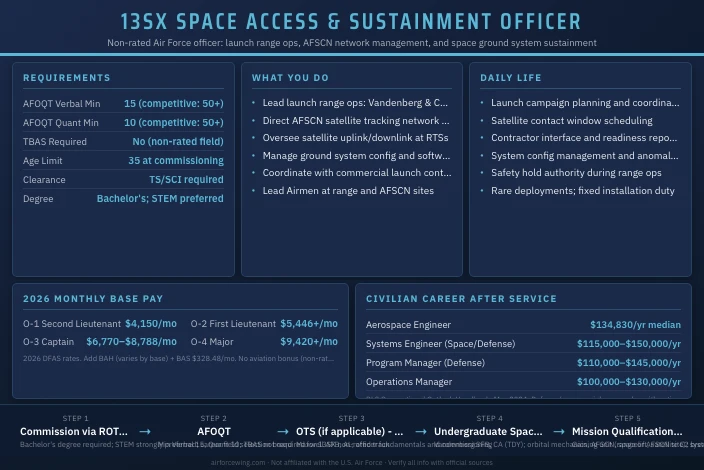
Space Access and Sustainment Officers plan, direct, and execute operations and maintenance of the space access architecture that enables every military satellite mission. They manage launch range operations, the Air Force Satellite Control Network (AFSCN), and downlink sites that provide command and control links to satellites across all orbits. As a 13SX officer in the S&AS functional area, you lead Airmen maintaining the ground-based infrastructure that connects terrestrial commanders to space assets, if that network degrades, the satellites it supports degrade with it.
Command and Leadership Scope
At the flight level, S&AS officers typically supervise 10 to 25 Airmen operating launch range facilities, satellite tracking stations, or AFSCN ground terminals. A Flight Commander at the O-3 or O-4 level may own a single facility’s operations, including maintenance crew coordination, safety oversight, and mission scheduling.
At the squadron level, Operations Officers and Squadron Commanders manage entire functional areas across multiple sites. Group and Wing command at O-5 and O-6 can span geographically separated units, since AFSCN detachment sites are distributed across the continental United States and at overseas locations.
Administrative decisions this officer owns include facility readiness reporting, contractor interface management, configuration control for ground systems, and cyber surety compliance for networked space architecture. On the operational side, you hold mission execution authority during launch range operations and satellite contact windows.
Specific Roles and Designations
The 13S career field uses a shredout system where the alpha suffix is awarded after assignment based on your assigned system. The “X” in 13SX denotes the base qualification level before shredout assignment. Officers working in Space Access and Sustainment functions are typically designated with shreds tied to spacelift and network management missions.
| Designation | Mission Focus |
|---|---|
| 13SX (base) | Space Operations, general qualifier pending system assignment |
| 13SXB | Spacelift, launch range operations at Vandenberg and Cape Canaveral |
| 13S3E (functional) | Space Access and Sustainment, AFSCN, downlink sites, system configuration |
Special Experience Identifiers (SEIs) are available for joint operations experience, acquisition functions, and cyber-related qualifications that align with S&AS system management responsibilities.
Mission Contribution
S&AS officers enable every other space mission. Satellite command and control is only possible because AFSCN ground stations and downlink sites maintain reliable uplink and downlink connectivity. Spacelift, launching the satellites in the first place, requires trained officers overseeing range safety, flight control coordination, and launch processing activities alongside contractor launch teams.
In joint and combined operations, S&AS officers ensure the ground architecture remains resilient and available. As space becomes a contested domain, the ability to sustain satellite network connectivity and recover degraded ground systems has direct operational value to joint force commanders who depend on those satellites for GPS, communications, and intelligence data.
Technology, Equipment, and Systems
S&AS officers work with a specific set of ground infrastructure systems:
- Air Force Satellite Control Network (AFSCN): A global network of Remote Tracking Stations (RTSs) and ground terminals providing uplink/downlink capability to military satellites in multiple orbits. Managed from Schriever Space Force Base with distributed detachment sites.
- Launch Ranges: Eastern Range at Cape Canaveral Space Force Station (Florida) and Western Range at Vandenberg Space Force Base (California). Range control, safety, and flight termination systems are officer responsibilities.
- Mission Control Stations: Ground systems managing satellite command and telemetry across GPS, AEHF, WGS, and other constellations, with S&AS officers managing system configuration and anomaly resolution.
- Ground System Software and Cyber Surety: Configuration management, software updates, and cyber compliance for ground segment systems that interface with on-orbit assets.
Salary
Base Pay
13SX officers enter at O-1 (Second Lieutenant) and progress through the grade structure with time in service. Pay figures below are 2026 DFAS rates.
| Rank | Grade | Typical Years of Service | Monthly Base Pay |
|---|---|---|---|
| 2d Lt | O-1 | Less than 2 years | $4,150 |
| 1st Lt | O-2 | 2 to 4 years | $5,446 |
| Capt | O-3 | 4 to 10 years | $6,770 to $8,788 |
| Maj | O-4 | 10 to 16 years | $9,420 to $10,402 |
Base pay is taxable. Officers receive Basic Allowance for Housing (BAH), which varies by duty location and dependency status. Officers also receive Basic Allowance for Subsistence (BAS) of $328.48 per month (2026 rate). A Captain with dependents at a Colorado Springs installation or Vandenberg-area assignment typically exceeds $90,000 in total annual compensation before tax advantages.
Special Pay
13SX is a non-rated career field, no aviation bonus or flight pay applies. Officers may receive special duty assignment pay for specific billets and hostile fire/imminent danger pay when deployed to qualifying locations. Space operations retention bonuses have been offered periodically; confirm current availability with your assignment officer at AFPC.
Additional Benefits
Active-duty officers receive full TRICARE Prime health coverage at no cost, no enrollment fee, no deductible, no copay. Medical, dental, vision, mental health, and prescriptions are covered.
The Blended Retirement System (BRS) delivers a 20-year pension at 40% of high-36 average basic pay, plus Thrift Savings Plan matching: automatic 1% government contribution beginning after 60 days, then matching up to 4% on member contributions. Officers who leave before 20 years keep their TSP balance.
Education benefits include:
- Tuition Assistance: Up to $4,500 per year, $250 per semester hour, while on active duty
- Post-9/11 GI Bill: Full in-state tuition at public universities; up to $29,920.95 per academic year at private schools (2025-2026 cap)
- AFIT Programs: Competitive, fully funded graduate school through the Air Force Institute of Technology
Work-Life Balance
Officers accrue 30 days of paid leave per year. In garrison, S&AS assignments at launch range sites and AFSCN stations tend to follow more predictable schedules than 24-hour crew operations in missile warning or satellite C2. That said, some facilities operate continuously, and launch operations schedules are driven by contractor and mission timelines that don’t always align with standard duty hours.
Deployments are rare in the S&AS functional area. Most work happens at fixed installations. TDY travel for training exercises, inspections, and coordination visits is moderate.
Qualifications
Commissioning Sources
Three paths lead to a 13SX commission. Each carries different timelines and eligibility rules.
| Source | Degree Requirement | GPA Minimum | Age Limit | 13SX-Specific Prerequisites |
|---|---|---|---|---|
| AFROTC | Bachelor’s degree; STEM strongly preferred | 2.5 cumulative GPA | 35 at commissioning | AFOQT qualifying scores; career field selection board |
| OTS | Bachelor’s degree; STEM strongly preferred | 3.0 preferred | 35 at commissioning | AFOQT qualifying scores; career field selection board |
| USAFA | Bachelor’s; built-in engineering/science curriculum | Class standing-based | Entering class: 17-22 | AFSC assignment through USAFA placement process |
A STEM bachelor’s degree, engineering, computer science, physics, or mathematics, is strongly preferred and improves selection odds significantly. Non-STEM degrees are eligible but less competitive on career field selection boards. All candidates must be U.S. citizens. Normal color vision may be required for certain system operator roles.
Test Requirements
All officer candidates must complete the Air Force Officer Qualifying Test (AFOQT) before commissioning. The minimum scores for non-rated officer consideration are Verbal 15 and Quantitative 10. Competitive 13SX candidates typically score above 50 on both composites.
The TBAS (Test of Basic Aviation Skills) is not required for 13SX, this is a non-rated, non-flying career field. If you’re preparing for commissioning, AFOQT study resources cover test structure, timing, and scoring strategies before you submit a package.
Career Field Assignment and Classification
ROTC cadets are classified through the AFROTC Field Training and Career Field Selection process. Academic performance, AFOQT scores, physical fitness scores, and field training rankings combine to determine available slots. The broader 13S career field is moderately competitive among ROTC cadets, it draws technically oriented candidates, but space officer demand has grown since the Space Force stood up.
OTS applicants compete through a board package review. A STEM degree, strong AFOQT scores, and a clear interest in space operations infrastructure strengthen a package for S&AS-focused positions.
USAFA graduates enter the career field assignment process based on class standing, AFOQT performance, and supply-and-demand factors. Space operations has increased in priority as national security space missions have expanded.
Upon Commissioning
New officers enter at O-1 (2d Lt). The standard Active Duty Service Commitment (ADSC) for commissioning is four years. Officers selected for AFIT graduate school programs or other advanced education incur additional ADSCs. The 13SX training pipeline does not add a rated flying ADSC on top of the commissioning commitment.
A Top Secret/SCI clearance investigation begins at or immediately before commissioning. Eligibility for and eventual award of TS/SCI access is mandatory for the 13S AFSC.
Officers with financial instability, foreign contacts, or certain medical conditions may face delays or denials during the TS/SCI adjudication process. Discuss any concerns with a recruiter before submitting a commissioning package.
Work Environment
Setting and Schedule
S&AS officers work in a mix of environments depending on assignment. Launch range positions at Cape Canaveral and Vandenberg involve facility-based operations centers, outdoor range equipment, and coordination with contractor launch teams. AFSCN remote tracking station positions are typically smaller, geographically dispersed facilities where officers manage a compact team and direct satellite contact operations.
Work schedules at launch range sites vary based on launch manifest. A SpaceX or United Launch Alliance launch window drives activity cycles, long preparation periods followed by concentrated launch operations. At AFSCN detachment sites, contact windows with satellites create scheduling rhythms distinct from standard Air Force duty hours.
Staff positions at Schriever Space Force Base follow more conventional schedules during garrison, with meetings, planning, and contractor interface filling the day.
Leadership and Chain of Command
Junior 13SX officers work under Operations Officer supervision within a flight or detachment. The relationship with senior NCOs is especially important at smaller AFSCN and range sites, where an experienced Technical Sergeant or Master Sergeant carries significant institutional knowledge about systems, procedures, and local relationships. A new 2d Lt arriving at a remote tracking station needs to listen actively and build trust with the team before asserting decisions.
At field grade, the shift is to larger-scale operations leadership, contractor oversight, and staff coordination. The 13SX officer who spent a first tour at a range site or AFSCN detachment has direct operational credibility that transfers to those senior roles.
Staff vs. Command Roles
Between command assignments, 13SX officers fill staff billets at Space Operations Command, Air Force Space Command staff elements, AFPC, and joint organizations at U.S. Space Command. These tours cover requirements development, acquisition support, policy analysis, and program management for space infrastructure.
A typical 20-year career includes two to three operational tours (range, AFSCN, or staff), at least one major HQ staff assignment, a PME residence school, and a broadening assignment. The variety across those tours is wider than career fields confined to a single installation type.
Job Satisfaction and Retention
S&AS officers report satisfaction from the variety of mission areas and the tangible nature of the work, you can see the launch vehicle lift off, and you know the AFSCN contact worked. The career field’s retention challenges mirror those across all space specialties at the O-4 level: aerospace and defense contractors actively recruit cleared, technically experienced officers with launch and satellite network backgrounds.
The Air Force has periodically offered retention incentives for space operations officers. Verify current bonus availability before making career decisions based on financial projections.
Training
Pre-Commissioning Training
ROTC cadets complete a multi-year curriculum combining Air Force leadership courses, the AFOQT, and Field Training (a summer leadership assessment). OTS candidates complete 9.5 weeks at Maxwell AFB, Alabama, focused on Air Force officership, leadership principles, and military skills. USAFA graduates complete a four-year program with an engineering-heavy curriculum and intensive military training throughout.
Initial Skills Training
After commissioning, all 13S officers, including those destined for S&AS billets, attend Undergraduate Space Training at Vandenberg Space Force Base before reporting to their first operational unit.
| Phase | Location | Duration | Focus |
|---|---|---|---|
| Commissioning (OTS/ROTC/USAFA) | Various | 9.5 weeks (OTS) / 4 years (USAFA) | Officership, leadership, Air Force fundamentals |
| Undergraduate Space Training (UST) | Vandenberg Space Force Base, CA | ~12 weeks (TDY) | Orbital mechanics, space domain awareness, spacelift, AFSCN, satellite C2 fundamentals |
| Mission Qualification Training (MQT) | Gaining unit | 3 to 9 months | System-specific qualification, operator certification |
UST is conducted as a TDY from your first duty station. You PCS to your assigned base, then travel to Vandenberg for the course before returning to begin MQT. The curriculum covers approximately 14 training blocks: orbital mechanics, space domain awareness, spacelift operations, AFSCN architecture, satellite communications, missile warning, and space control fundamentals. UST gives breadth across all 13S mission areas; MQT at your gaining unit delivers depth on the specific system you’ll operate.
For S&AS-focused officers, MQT typically occurs at a launch range facility or AFSCN ground station and covers that system’s specific operations procedures, safety requirements, and certification standards.
The Space Force established its own Officer Training Course in 2025 for Space Force Guardians. Air Force 13SX officers continue through the Air Force training pipeline described here unless they transfer to the Space Force.
Professional Military Education
| School | Timing | Location | Duration |
|---|---|---|---|
| Squadron Officer School (SOS) | O-3 (in-residence) or earlier (correspondence) | Maxwell AFB, AL | 5.5 weeks (in-residence) |
| Air Command and Staff College (ACSC) | O-4 board selection | Maxwell AFB, AL | 1 year (in-residence) or correspondence |
| Air War College (AWC) | O-5/O-6 selection | Maxwell AFB, AL | 1 year (in-residence) or correspondence |
PME completion, particularly SOS in-residence, is a competitive differentiator for promotion boards. Correspondence completion is noted but carries less weight than in-residence attendance.
Advanced Space Education and Additional Training
The space professional development track continues throughout a 13SX career:
- Space 200: Intermediate space operations course at Peterson Space Force Base, CO. Required for development before Major.
- Space 300: Advanced space operations, also at Peterson. Required for senior career progression.
- Air Force Institute of Technology (AFIT): Fully funded master’s and doctoral programs in astronautical engineering, space systems engineering, computer science, and related fields. AFIT graduates bring technical depth valued in S&AS acquisition and senior staff roles.
Exchange programs with allied space organizations including Australia’s Defence Space Command and UK Space Command offer international exposure for mid-career officers interested in broadening beyond domestic S&AS assignments.
Before OTS, you need qualifying scores. See our AFOQT study guide.
Career Progression
Career Path
| Rank | Grade | Typical Time in Grade | Key Developmental Positions |
|---|---|---|---|
| 2d Lt | O-1 | 1.5 years | Launch range or AFSCN operator, system certification |
| 1st Lt | O-2 | 2 years | Evaluator qualification, crew lead responsibilities |
| Capt | O-3 | 4 years | Flight Commander, Assistant Operations Officer, instructor or evaluator |
| Maj | O-4 | 4 years | Operations Officer, HQ staff action officer, joint staff billet |
| Lt Col | O-5 | 4 years | Squadron Commander (key developmental), Group Deputy, major program manager |
| Col | O-6 | 4 years | Group Commander, Wing Commander, senior joint or acquisition staff |
Key Developmental (KD) positions driving promotion competitiveness are Flight Commander at the O-3/O-4 level and Squadron Commander at the O-5 level. Missing a KD assignment at the appropriate career point is difficult to recover from at O-5 and O-6 promotion boards.
S&AS officers have an advantage compared to some other 13S shredouts: the mix of launch range, AFSCN, and staff tour options creates genuine variety in developmental assignments. An officer who serves at a range, an AFSCN detachment, and a HQ staff arrives at the O-4 level with a broad operational foundation.
Promotion System
O-1 through O-3 promotions are automatic with time in grade and satisfactory performance. O-4 and above are board-selected. Air Force promotion rates to O-4 typically run 80 to 90 percent for eligible candidates; O-5 rates fall to roughly 70 to 75 percent. O-6 is competitive at approximately 50 percent or less for a given year group.
Board factors include consistent strong Officer Performance Reports (OPRs), completion of KD positions on schedule, in-residence PME, joint or broadening experience, and advanced academic degrees. Officers who serve exclusively in operational crew roles without staff or leadership diversity tend not to be competitive above O-4.
Officers can cross-train to different career fields through the Career Broadening Officer program or voluntary retraining boards, subject to Air Force needs.
Building a Competitive Record
Early career actions that compound over time:
- Earn evaluator or instructor certification in the first tour
- Seek Flight Commander positions at the O-3 level before the primary window closes
- Complete SOS in-residence rather than by correspondence
- Pursue an advanced degree through AFIT or part-time programs during garrison assignments
- Request a joint staff or combatant command tour before the O-4 promotion board
Physical Demands
Physical Fitness Standards
All Air Force officers take the Air Force Fitness Assessment, which applies the same standards regardless of career field. The test is age- and gender-normed. There are no S&AS-specific physical requirements beyond the Air Force standard.
| Component | Maximum Points | Minimum Score (Male, Under 30) | Minimum Score (Female, Under 30) |
|---|---|---|---|
| 1.5-Mile Run | 60 | 9:12 (satisfactory) | 10:47 (satisfactory) |
| Waist Circumference | 20 | Varies by height | Varies by height |
| Push-Ups (1 minute) | 10 | 33 reps (minimum threshold) | 18 reps (minimum threshold) |
| Sit-Ups (1 minute) | 10 | 38 reps (minimum threshold) | 34 reps (minimum threshold) |
| Total | 100 | 75 composite minimum | 75 composite minimum |
Standards are age- and gender-normed. Minimum passing composite score is 75. Officers must also meet minimum thresholds on each individual component, scoring well above average in one area cannot compensate for falling below the component minimum in another. Scoring standards are published by the Air Force Personnel Center.
Fitness assessments are administered annually. Officers who fail must retest within a specified window. An unsatisfactory FA has direct consequences for deployment eligibility, promotion, and professional standing in the unit. S&AS officers working in operations center or staff environments face the same FA standards as operational flying officers, the physical demands of the duty position do not affect the assessment requirements.
Day-to-Day Physical Activity
The daily physical demands of S&AS duty are modest. Launch range operations involve walking the range, operating outdoor facilities, and occasional equipment handling, but sustained heavy labor is not part of the job. AFSCN detachment positions are primarily indoor console and staff work. Officers assigned to S&AS positions should maintain fitness independently through personal routines rather than expecting the duty position to provide physical activity.
Air Force installations provide on-base fitness facilities that are available to officers at no cost. Most units conduct unit physical training sessions several days per week, typically during the early morning hours before the duty day begins. Participation in unit PT builds team cohesion and helps maintain FA standards for officers who prefer structured group training.
Medical and Clearance Requirements
13SX is a non-rated career field. No flight physical or aviation medical certification is required. Standard officer commissioning physical standards apply.
The significant medical requirement is security eligibility. Officers must qualify for and hold a Top Secret/SCI clearance. Medical conditions affecting cognitive function, substance use history, or financial instability can affect clearance adjudication. Discuss any medical or background concerns with a recruiter before commissioning.
Some AFSCN ground system roles require normal color vision for specific operator functions. Confirm vision requirements for your assigned system when you receive your unit assignment.
Deployment
Deployment Details
Deployments for 13SX officers are infrequent compared to operational flying or combat support fields. The S&AS mission runs from fixed ground installations. When deployments occur, they typically involve:
- Theater space support assignments (4 to 6 months)
- Active Duty Operational Support (ADOS) tours for Reserve officers
- Exercise and contingency support TDYs to allied launch ranges or AFSCN partner stations
It is realistic to serve a full 13SX career with one or two deployments. That said, some remote AFSCN tracking station assignments involve locations with limited nearby amenities, and launch range duty at Cape Canaveral or Vandenberg can require extended periods of irregular hours around active launch campaigns.
Duty Station Options
S&AS assignments are concentrated in California and Florida for launch range operations, with Colorado-based assignments for AFSCN management, staff, and school positions. A small number of remote AFSCN remote tracking station sites exist domestically and at overseas locations.
| Installation | Location | Mission Focus |
|---|---|---|
| Vandenberg Space Force Base | Lompoc, CA | Western Range, UST schoolhouse, AFSCN |
| Cape Canaveral Space Force Station | Titusville, FL | Eastern Range, launch operations |
| Schriever Space Force Base | Colorado Springs, CO | AFSCN management, Space Operations Command |
| Peterson Space Force Base | Colorado Springs, CO | Space 200/300 schoolhouse, HQ staff |
| AFSCN Remote Tracking Stations | Various CONUS and overseas | Satellite contact and uplink/downlink operations |
Assignment preferences are submitted through AFPC worksheets. Officers interested in California or Florida assignments should engage AFPC early, particularly for launch range billets, which are in high demand. Join spouse coordination is available through AFPC’s join spouse preference tools, though the geographic diversity of S&AS assignments makes co-location more complex than in career fields concentrated in one region.
Risk/Safety
Job Hazards
The primary physical risks in S&AS operations are at launch range facilities. Range operations involve proximity to launch vehicles, propellant systems, and high-energy equipment that requires strict safety compliance. Officers overseeing range operations hold direct authority over safety hold decisions and flight termination authorization.
At AFSCN sites, physical risk is minimal. The operational risks center on decision-making: a missed satellite contact or an improperly executed software update can affect a multi-hundred-million-dollar asset. Those consequences trace directly to officer judgment and supervision.
As in all 13S positions, shift work and extended campaign operations at launch ranges create fatigue risk. Units use fatigue management protocols, but the officer in charge sets the tone for whether those protocols are followed.
Safety Protocols
Launch range operations use formalized Operational Risk Management (ORM) frameworks with preflight safety reviews, hold authority for weather and range conflicts, and flight termination systems that require officer authorization. Range Safety Officer qualification is a distinct training track for officers who will hold those authority positions.
AFSCN operations use systems configuration management and change control processes that require officer sign-off. Crew Resource Management (CRM) principles apply in multi-operator environments.
Legal and Command Responsibility
Commissioned officers exercise command authority under the Uniform Code of Military Justice (UCMJ). You are legally responsible for the actions of the Airmen under your command. Command climate surveys, Equal Opportunity compliance, and misconduct response are officer responsibilities, not administrative functions.
Relief for cause, removal from command for misconduct or poor leadership, ends career progression and is documented permanently. For range-qualified officers, it can also carry implications beyond the personnel record if a safety decision is involved.
Impact on Family
Family Considerations
S&AS duty stations span three distinct geographic regions. The Colorado Springs area, home to Schriever and Peterson, has a mature military community infrastructure: Airman and Family Readiness Centers (A&FRC), child development centers, Key Spouse Program support, and a large population of defense contractor employers for military spouses. Cost of living is moderate for a major metro area.
Vandenberg-area assignments place officers in the Lompoc/Santa Maria corridor on California’s central coast. The area is smaller and more rural than Colorado Springs, with fewer spouse employment options outside the base. Cape Canaveral-area assignments put officers in the Space Coast region near Brevard County, Florida, a growing technology employment market with reasonable cost of living.
PCS moves happen roughly every 3 years. Unlike career fields with most billets in a single metro area, S&AS officers may PCS between California, Florida, and Colorado during a career, which means families relocate across multiple regions.
Dual-Military and Family Planning
The Air Force manages dual-military couples through join spouse assignment coordination. Two S&AS officers can potentially co-locate in the Colorado Springs area, where multiple billets exist at Schriever and Peterson. Different career fields or different S&AS specialty areas create more complexity, engage AFPC early about join spouse preferences before any assignment cycle.
The Key Spouse Program and A&FRC provide deployment and TDY family support. Units at remote AFSCN sites tend to have tight internal community networks because the teams are small and geographically isolated.
Reserve and Air National Guard
Component Availability
The 13S career field exists in both the Air Force Reserve Command (AFRC) and the Air National Guard (ANG). S&AS-focused Reserve and Guard units support launch range and AFSCN operations, primarily at bases in California, Colorado, and Florida. Some ANG units have converted to Space Force-aligned missions as the transfer of space missions from Air Force to Space Force has continued. Clarify whether a unit you’re considering is an Air Force Reserve, Air National Guard, or Space Force Reserve billet before committing.
Commissioning Paths
Reserve and Guard officers commission through the same sources as active duty. ROTC with a Reserve component contract, OTS through Air National Guard officer programs, or USAFA with a Guard or Reserve follow-on commitment. Active-duty 13SX officers completing their ADSC can transfer to Reserve or Guard components through unit vacancy applications and AFPC release processes.
Drill and Training Commitment
Standard Reserve and Guard commitment is one Unit Training Assembly (UTA) weekend per month and two weeks of Annual Tour per year. S&AS Reserve units supporting launch operations and AFSCN missions often require additional training days for system currency, annual certifications, and exercises tied to real-world launch manifests. Confirm the specific training requirement for any unit before accepting a position.
Part-Time Pay
A Captain (O-3) with 6 years of service earns approximately $7,737 per month on active duty. The same officer drilling in the Reserve or Guard earns roughly $450 to $560 per drill period (two periods per UTA day), or approximately $900 to $1,200 for a full UTA weekend.
Benefits Differences
| Feature | Active Duty | Air Force Reserve | Air National Guard |
|---|---|---|---|
| Commitment | Full-time | 1 UTA/month + 2 weeks/year | 1 UTA/month + 2 weeks/year |
| Monthly Pay (O-3, 6 YOS) | ~$7,737 | Drill pay only (~$900-1,200/mo UTA month) | Same as Reserve |
| Healthcare | TRICARE Prime (free) | TRICARE Reserve Select (premiums apply) | State-dependent + TRICARE Reserve Select |
| Education Benefits | Tuition Assistance ($4,500/yr) + GI Bill eligible | Federal Tuition Assistance + GI Bill eligibility varies | State tuition waivers (varies by state) + Federal TA |
| Retirement | 20-year pension (BRS) | Points-based Reserve retirement (age 60 draw) | Points-based Guard retirement (age 60 draw) |
| Deployment Tempo | Low for 13SX S&AS | Mobilization-dependent | Mobilization-dependent |
| Command Opportunities | Squadron, Group, Wing | Squadron command billets available | Squadron command billets available |
Reserve retirement accumulates points for drill periods, annual tours, and active-duty service. Benefits draw at age 60, earlier if you deployed to a qualifying combat zone.
Civilian Career Integration
S&AS skills pair directly with the commercial space and defense sectors. Launch range experience transfers to contractor roles at SpaceX, United Launch Alliance, and Rocket Lab operations teams. AFSCN satellite network management experience is directly applicable to commercial satellite operations companies and ground system contractors. Colorado Springs has concentrated defense industry presence for officers who prefer to stay in that region.
USERRA protections guarantee civilian job protection and benefit continuation during mobilizations. Defense contractors and commercial space companies actively value employees with active security clearances and operational space infrastructure experience.
Post-Service
Transition to Civilian Life
13SX officers leave the Air Force with a combination of technical operations experience, security clearance eligibility, and leadership background that is in demand. Launch range officers bring specific expertise that commercial launch providers cannot easily replicate from civilian hiring pools. AFSCN officers understand satellite ground network architecture that applies directly to commercial satellite operations.
Transition programs, the Transition Assistance Program (TAP) and Hiring Our Heroes fellowships, provide structured support. The defense contractor market, particularly in Colorado Springs, Cape Canaveral, and Vandenberg-adjacent markets, actively recruits cleared space operations officers without much outbound effort required.
Industries that recruit former S&AS officers include:
- Commercial launch providers: SpaceX, United Launch Alliance, Rocket Lab, and others need range-qualified operations professionals and systems engineers
- Commercial satellite operators: Planet, SES, Viasat, and others operate satellite ground networks with requirements that directly match AFSCN management experience
- Defense contractors: Northrop Grumman, Raytheon, L3Harris, and Leidos staff space infrastructure programs with former military operators
- Intelligence community: NRO, NSA, and DIA value cleared professionals with ground system and launch architecture backgrounds
- Federal civil service: GS-12 through SES positions at Space Force, Space Command, and acquisition program offices
Civilian Career Prospects
| Job Title | Estimated Median Salary | Outlook |
|---|---|---|
| Aerospace Engineer | ~$134,830/year | 6% growth (faster than average) |
| General and Operations Manager | ~$100,000 to $130,000/year | Stable demand across industries |
| Systems Engineer (Space/Defense) | ~$115,000 to $150,000/year | Strong growth in commercial space sector |
| Program Manager (Defense) | ~$110,000 to $145,000/year | Consistent DoD contractor demand |
Salary figures reflect available industry data; actual compensation varies by employer, location, and clearance level. Officers with TS/SCI clearances and launch range or AFSCN experience typically earn above median figures in commercial and defense roles.
Graduate Education and Credentials
AFIT remains the primary path to funded graduate education for Air Force officers. S&AS officers are competitive for AFIT programs in astronautical engineering, space systems engineering, and computer science, disciplines that map directly to system sustainment and network management responsibilities.
The Post-9/11 GI Bill covers tuition up to $29,920.95 per academic year at private schools (2025-2026 cap), with full in-state coverage at public universities, for officers who have served the required time.
Project management credentials (PMP), systems engineering certifications, and cybersecurity credentials translate well to defense industry and federal civil service roles that involve space ground system management.
Is This a Good Job
Ideal Candidate Profile
The 13SX officer who thrives in S&AS likes systems-level thinking, is comfortable with infrastructure management rather than direct kinetic operations, and finds satisfaction in keeping complex architecture reliable. The work is less dramatic than missile warning or satellite command and control, you are maintaining and sustaining the pipeline, not executing the mission that runs through it. That suits engineers and technically rigorous problem-solvers well.
Strong candidates typically have:
- Engineering, computer science, or physics academic background
- Interest in launch vehicle operations, satellite networks, or ground system engineering
- Preference for varied operational environments over a single installation type
- Comfort with contractor interface and joint operations coordination
Potential Challenges
S&AS has real friction points. The geographic spread of assignments means more PCS moves across more regions than career fields concentrated in one metro area. Launch range duty involves irregular hours tied to launch campaigns, which disrupts family routines in ways that predictable operations center shifts do not.
Officers who want visible, immediate, or kinetic military service find S&AS unsatisfying. The mission effect is real but indirect, you keep the infrastructure running so that GPS works and communications satellites respond. If you want to be in the operations center when the satellite contact happens, a satellite C2 or missile warning shred is a better fit. If you want to be at the range when the rocket launches, S&AS is your career.
Career and Lifestyle Alignment
For officers who want diverse operational experience, reasonable deployment tempo, and strong post-service marketability in both commercial space and defense sectors, 13SX in the S&AS functional area is a compelling option. The career field sits at the intersection of military space operations and the commercial launch and satellite industry, which means post-service options are broader than for more specialized military space roles.
Officers considering a four-year commitment only should factor in that the clearance process and training pipeline make the first tour short. You’ll have operational experience and a clearance by year four, both valuable. The career field tends to deliver its most interesting work in command and staff roles after year 8 or 10.
More Information
Contact an Air Force recruiter or your nearest ROTC detachment to discuss current 13S commissioning board dates, field selection timelines, and scholarship availability. If you are preparing for OTS selection or ROTC classification, your AFOQT scores are the most controllable variable in a competitive package, AFOQT preparation resources are a good starting point before you submit.
When you connect with a recruiter, ask specifically about the S&AS functional area within the 13S career field. General recruiters and ROTC cadre are familiar with the 13S designation but may not have current details about S&AS-specific billet availability or the distinction between S&AS, missile warning, and satellite C2 assignments. The career field’s growth under Space Force expansion means assignment options have shifted in recent years.
STEM degree priority: Applicants with engineering, physics, computer science, or mathematics degrees score more competitively on 13S selection boards than non-STEM graduates. If you are still in school, a STEM degree or a double major combining a non-STEM interest with a technical field strengthens your package. If you already hold a non-STEM degree, your AFOQT scores and relevant work or project experience can partially offset that gap on an OTS package.
TS/SCI clearance timeline: The Single Scope Background Investigation for a TS/SCI clearance can take 6 to 18 months, depending on your background. The investigation begins before commissioning or immediately after, and it must complete before you can be formally assigned to a classified S&AS position. Being prepared for that wait, and not assuming it will be fast, helps candidates set realistic timelines for when they will actually arrive at a first duty station ready to work.
Space Force transfer considerations: Some 13S officers elect to transfer to the U.S. Space Force after their initial Air Force service, serving as Guardians in similar mission roles. If this interests you, ask your recruiter about the current transfer process and timeline. The Space Force has been refining its transfer policies since standing up in 2019, and current procedures may differ from what was reported in earlier news coverage.
This site is not affiliated with the U.S. Air Force or any government agency. Verify all information with official Air Force sources before making enlistment or career decisions.
Explore more Air Force Space Operations officer careers alongside the 13S Space Operations Officer profile to compare shredout missions and career paths across the space career field.