13S3D Space Battle Management Officer
Every satellite in orbit exists in a catalog. Someone tracks it, updates its position, and flags it when it moves in ways it shouldn’t. Space Battle Management officers are the people who run that operation. The 13S3D shredout puts Air Force officers in charge of space surveillance, space domain awareness, and the battle management functions that tell national commanders what is happening in orbit at any given moment.
The 13S3D designation is one of four functional shredouts within the 13S Space Operations officer career field. While the 13S base qualification covers all space operations broadly, the D shredout is awarded after assignment to a space surveillance or space warning unit and at least 12 months of operational experience there. Officers working space surveillance at the Combined Space Operations Center, the 20th Space Control Squadron, or missile warning radar sites carry this designation. If you want to commission into the most operationally demanding corner of the space mission, the part that watches everything in orbit and tells commanders when something is wrong, this shredout is the one to understand before you commission.
Preparing for an officer commissioning board starts with the AFOQT. Strong Pilot and Quantitative scores matter for any 13S specialty, and early preparation gives you the most options when boards convene.
Job Role
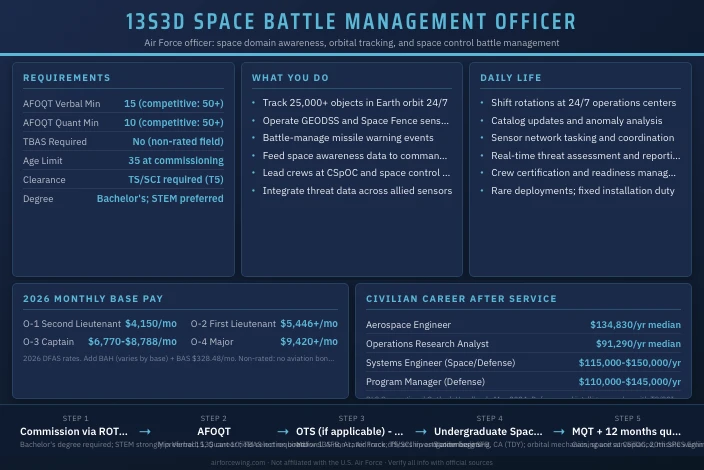
Space Battle Management Officers conduct space surveillance, space domain awareness, and battle management operations that defend U.S. and allied interests in orbit. They operate ground-based sensor networks to track more than 25,000 objects in Earth’s orbit, identify missile launches in real time, and provide space situational awareness data to combatant commanders and national decision-makers. As a 13S3D officer, you lead the Airmen and Guardians running the sensors, the software, and the operations that every other space mission depends on for situational awareness.
Command and Leadership Scope
At the flight level, a 13S3D officer typically leads a crew or operations team of 5 to 20 personnel at a sensor site, operations center, or space control squadron. Flight Commanders at the O-3 and O-4 level own the operational readiness of their crew, mission scheduling, and execution authority during real-time space events.
At the squadron level, Operations Officers and Squadron Commanders oversee entire sensor networks or space control mission sets. The 20th Space Control Squadron at Eglin AFB, for example, manages ground-based electro-optical sensors across multiple geographically separated detachment sites, a scope that requires significant coordination across locations and time zones.
The operational and administrative decisions this officer owns include crew readiness certification, sensor tasking prioritization, real-time battle management decisions during active events, and reporting to higher command during space anomalies or adversary activities.
Specific Roles and Designations
The 13S shredout structure works differently than most people expect. The assignment drives the shred, you don’t choose 13S3D specifically; you receive it after serving in a qualifying space surveillance or space warning unit.
| Designation | Mission Focus | Notes |
|---|---|---|
| 13S3A | Satellite Command and Control | GPS, WGS, AEHF satellite operations |
| 13S3B | Spacelift | Launch range operations at Vandenberg and Cape Canaveral |
| 13S3D | Space Battle Management / Space Surveillance | Space domain awareness, orbital tracking, missile warning battle management |
| 13S3E | Missile Warning | SBIRS ground stations, UEWR radar operations |
Special Experience Identifiers (SEIs) recognize additional qualifications in joint operations, intelligence, acquisition, and cyber functions. Officers can accumulate multiple SEIs across a career.
Mission Contribution
The 20th Space Control Squadron at Eglin AFB tracks thousands of near-Earth and deep-space objects around the clock. That catalog, who is in orbit, where, on what trajectory, is the foundation for every other space operation. Without current, accurate space domain awareness data, operators commanding satellites cannot distinguish a normal orbital drift from an adversary maneuver.
In joint and combined operations, 13S3D officers serve as space advisors and battle managers who integrate threat data, sensor tasking, and decision support into what combatant commanders see and act on. The Combined Space Operations Center at Vandenberg SFB is the hub for that function, bringing together U.S. and allied space operators under a single operational picture.
Technology, Equipment, and Systems
13S3D officers work across a specific set of ground-based and networked sensors:
- Space Surveillance Network: A global network of radars and optical sensors tracking objects in low, medium, and geosynchronous orbit. Ground-based electro-optical deep space surveillance (GEODSS) sensors at multiple sites provide optical coverage of deep-space objects.
- Ground-Based Electro-Optical Deep Space Surveillance (GEODSS): Operated by detachments of the 20th Space Control Squadron. Tracks deep-space objects using telescopic sensors at sites in New Mexico, Diego Garcia, and Maui.
- Combined Space Operations Center (CSpOC): Located at Vandenberg SFB, this is the multinational C2 hub for space domain awareness and space control operations.
- Space Fence: A high-power S-band radar at Kwajalein Atoll capable of tracking objects as small as a marble in low Earth orbit. Officers in this shredout work directly with data from this system.
- Missile Warning Integration: Battle management functions at missile warning units where 13S3D officers may also support SBIRS and UEWR early warning data flows.
Salary
Base Pay
13S3D officers enter at O-1 (Second Lieutenant) and advance through the grade structure with time in service. The figures below are 2026 DFAS rates. Before these figures apply, you need to commission, and solid AFOQT study guide is the first step in a competitive 13S package.
| Rank | Grade | Typical Years of Service | Monthly Base Pay |
|---|---|---|---|
| 2d Lt | O-1 | Less than 2 years | $4,150 |
| 1st Lt | O-2 | 2 to 4 years | $5,446 |
| Capt | O-3 | 4 to 10 years | $6,770 to $8,788 |
| Maj | O-4 | 10 to 16 years | $9,420 to $10,402 |
Base pay is taxable. Officers also receive Basic Allowance for Housing (BAH), which varies by duty location and dependency status. Basic Allowance for Subsistence (BAS) adds $328.48 per month at the current rate. A Captain with dependents at a Colorado Springs or Vandenberg-area installation typically clears $90,000 or more in total annual compensation before the tax advantages of tax-free allowances factor in.
Special Pay
The 13S3D shredout is non-rated, no aviation bonus or flight pay applies. Officers may receive special duty assignment pay for certain billets and hostile fire/imminent danger pay for qualifying deployed locations. Space operations retention bonuses have been offered at various points in recent years; confirm current availability with your assignment officer at AFPC before making financial plans.
Additional Benefits
Active-duty officers receive full TRICARE Prime health coverage at no cost, no enrollment fee, no deductible, no copay. The package covers medical, mental health, prescriptions, dental at military treatment facilities, and vision care.
The Blended Retirement System (BRS) delivers a 20-year pension at 40% of high-36 average basic pay, plus Thrift Savings Plan matching: automatic 1% government contribution after 60 days, then matching up to 4% on member contributions. Officers who leave before 20 years keep their TSP balance.
Education benefits include:
- Tuition Assistance: Up to $4,500 per year, $250 per semester hour, while on active duty
- Post-9/11 GI Bill: Full in-state tuition at public universities; up to $29,920.95 per academic year at private schools (2025-2026 cap)
- AFIT Programs: Fully funded graduate school through the Air Force Institute of Technology for competitive applicants
Work-Life Balance
Officers accrue 30 days of paid leave per year. Space surveillance operations run continuously, the catalog never pauses, which means shift rotations for junior officers at sensor sites and operations centers. Garrison assignments at Vandenberg and Eglin follow more predictable scheduling than some other space specialties, though 24-hour operations create irregular hours at times.
Deployments in this shredout are infrequent. Most work happens at fixed U.S. installations. TDY travel for exercises, sensor site visits, and coordination events is moderate.
Qualifications
Commissioning Sources
Officers don’t commission directly into the 13S3D shredout, they commission into the broader 13S career field and receive the D shredout after assignment to a qualifying space surveillance or space warning unit. Three commissioning paths lead to the 13S career field.
| Source | Degree Requirement | GPA Minimum | Age Limit | 13S Prerequisites |
|---|---|---|---|---|
| AFROTC | Bachelor’s degree; STEM strongly preferred | 2.5 cumulative GPA | 35 at commissioning | AFOQT qualifying scores; field selection board |
| OTS | Bachelor’s degree; STEM strongly preferred | 3.0 preferred | 35 at commissioning | AFOQT qualifying scores; career field selection board |
| USAFA | Bachelor’s; built-in engineering/science curriculum | Class standing-based | Entering class: 17 to 22 | AFSC assignment through USAFA placement process |
A STEM bachelor’s degree, engineering, computer science, physics, or mathematics, is strongly preferred. Non-STEM applicants are eligible but less competitive on 13S career field selection boards. All candidates must be U.S. citizens. Normal color vision may be required for certain sensor operator roles at the gaining unit.
The TS/SCI clearance investigation begins at or before commissioning. Award of any 13S AFSC requires eligibility for TS/SCI access, completed through a T5 (Tier 5 Single Scope Background Investigation).
Test Requirements
All officer candidates must pass the Air Force Officer Qualifying Test (AFOQT) before commissioning. Minimum scores for non-rated officer consideration are Verbal 15 and Quantitative 10. Competitive 13S candidates typically score above 50 on both composites. The TBAS (Test of Basic Aviation Skills) is not required for the 13S career field.
Strong quantitative AFOQT performance matters for this shredout specifically: space domain awareness work involves orbital mechanics, data analysis, and sensor modeling that benefit from a solid math foundation. Starting your AFOQT study guide early gives you the best shot at scores that stand out on a competitive career field board.
Career Field Assignment and Shredout Award
ROTC cadets are classified through the AFROTC Field Training and Career Field Selection process. Academic performance, AFOQT scores, physical fitness scores, and field training rankings determine available slots. The 13S career field is moderately competitive.
After commissioning and Undergraduate Space Training, officers PCS to their first operational unit. The shredout is awarded by MAJCOM after the officer completes at least 12 months of operational experience in space surveillance or space warning units. Officers cannot self-select the D shredout; the assignment drives it.
Upon Commissioning
New officers enter at O-1 (2d Lt). The standard Active Duty Service Commitment (ADSC) for commissioning is four years. Officers selected for AFIT graduate programs incur additional ADSCs. The 13S pipeline does not add a rated flying ADSC.
Clearance timeline: TS/SCI investigations can take 6 to 18 months depending on your background. Officers who have significant foreign travel, foreign contacts, or complex financial history should discuss their situation with a recruiter before submitting a commissioning package. The investigation must complete before you can work in a classified 13S3D position.
Work Environment
Setting and Schedule
13S3D officers work primarily in classified operations centers, sensor facilities, and mission control rooms. The work environment varies by assignment type:
| Assignment Type | Setting | Schedule | Team Size |
|---|---|---|---|
| Combined Space Operations Center (CSpOC) | Large ops center, Vandenberg SFB | 24/7 rotating shifts | Multi-crew, 15-50+ per shift |
| GEODSS sensor sites (Maui, NM, Diego Garcia) | Remote optical sensor facilities | Nighttime operations (optical sensors need dark skies) | Small teams, 5-15 per detachment |
| 20th SPCS detachments | Ground radar and tracking facilities | 24/7 shift rotations | Compact teams, 10-20 per site |
| Staff billets (Schriever, Peterson SFB) | Office environment, HQ buildings | Standard weekday schedule | Section-dependent |
Shift work is the norm at continuous-operations units. A typical junior officer tour at a space surveillance or missile warning unit involves rotating shifts, crew qualifications, and real-time operations where the unexpected happens regularly. Staff assignments at Schriever SFB and Peterson SFB follow more conventional schedules.
Leadership and Chain of Command
New 13S3D officers work under Operations Officer supervision within a flight or crew section. The relationship with senior NCOs is especially important at sensor detachment sites, where an experienced Technical Sergeant or Master Sergeant brings deep system-specific knowledge that a newly arrived Second Lieutenant doesn’t have yet. Listening actively in the first year matters.
At field grade, the shift moves toward operations leadership, cross-unit coordination, and contributions to space domain awareness policy and strategy. The credibility built in an early crew tour, knowing the system, knowing the catalog, knowing what anomalous behavior actually looks like, carries forward into those senior roles.
Staff vs. Command Roles
Between crew and command assignments, 13S3D officers fill staff billets at Space Operations Command, U.S. Space Command at Peterson SFB, AFPC, and joint organizations. These tours cover intelligence fusion, requirements development for sensor networks, acquisition support for space surveillance systems, and joint doctrine work.
A realistic 20-year career includes two to three operational tours (sensor site, CSpOC, or missile warning), one or two major staff assignments, in-residence PME, and a broadening assignment. The variety is wider than career fields confined to a single installation type or mission.
Job Satisfaction and Retention
The 13S3D mission has grown in strategic attention as adversaries have demonstrated on-orbit capabilities, jamming, spoofing, rendezvous operations, and direct-ascent tests. Officers working space domain awareness know they’re watching a problem that’s getting more complicated every year. That tends to drive high engagement for technically minded officers who like analytical, high-stakes work.
Retention pressure at O-4 is the common friction point across all 13S specialties. The cleared aerospace and intelligence sectors pay well for officers with operational space surveillance backgrounds.
Training
Pre-Commissioning Training
ROTC cadets complete a multi-year curriculum combining Air Force leadership courses, the AFOQT, and Field Training, a summer leadership assessment at Maxwell AFB, Alabama. OTS candidates complete 9.5 weeks at Maxwell AFB, covering Air Force officership, leadership principles, and military fundamentals. USAFA graduates complete a four-year program with a built-in engineering-heavy academic program and intensive military training. Across all paths, the AFOQT is a mandatory early milestone, AFOQT preparation resources help candidates arrive prepared.
Initial Skills Training
After commissioning, all 13S officers, including those who will eventually earn the D shredout, attend Undergraduate Space Training (UST) at Vandenberg Space Force Base before reporting to their first unit.
| Phase | Location | Duration | Focus |
|---|---|---|---|
| Commissioning (OTS/ROTC/USAFA) | Various | 9.5 weeks (OTS) / 4 years (USAFA) | Officership, Air Force fundamentals |
| Undergraduate Space Training (UST) | Vandenberg Space Force Base, CA | ~12 weeks (TDY) | Orbital mechanics, space domain awareness, missile warning, AFSCN, spacelift breadth |
| Mission Qualification Training (MQT) | Gaining unit | 3 to 9 months | System-specific certification; shredout qualification begins |
| Shredout Award (13S3D) | Gaining unit | After 12 months at qualifying unit | MAJCOM-awarded after operational experience threshold |
UST is conducted as a TDY from your first duty station. You PCS to your assigned base, travel to Vandenberg for the course, then return to begin MQT. The curriculum covers approximately 14 training blocks including orbital mechanics, space domain awareness, missile warning systems, space surveillance network architecture, and spacelift operations. UST delivers breadth across all 13S mission areas; MQT and the first operational year deliver the depth that eventually earns the 13S3D designation.
Professional Military Education
| School | Timing | Location | Duration |
|---|---|---|---|
| Squadron Officer School (SOS) | O-3, in-residence or correspondence | Maxwell AFB, AL | 5.5 weeks (in-residence) |
| Air Command and Staff College (ACSC) | O-4 board selection | Maxwell AFB, AL | 1 year (in-residence) or correspondence |
| Air War College (AWC) | O-5/O-6 selection | Maxwell AFB, AL | 1 year (in-residence) or correspondence |
In-residence PME matters more than correspondence for promotion boards. Officers who complete SOS in-residence rather than by correspondence distinguish themselves in a competitive file.
Advanced Space Education and Additional Training
The space professional development track includes:
- Space 200: Intermediate space operations course at Peterson Space Force Base, CO. Required before Major.
- Space 300: Advanced space operations, also at Peterson. Required for senior career development.
- Air Force Institute of Technology (AFIT): Fully funded master’s and doctoral programs in astronautical engineering, space systems engineering, physics, and computer science. AFIT graduates bring technical depth directly applicable to sensor network analysis and advanced space domain awareness work.
Exchange programs with allied space organizations. Australia’s Defence Space Command, UK Space Command, and others, provide international experience for mid-career officers looking to broaden beyond domestic assignments.
Career Progression
Career Path
| Rank | Grade | Typical Time in Grade | Key Developmental Positions |
|---|---|---|---|
| 2d Lt | O-1 | 1.5 years | Crew member, sensor operator, space surveillance qualification |
| 1st Lt | O-2 | 2 years | Crew Commander qualification, evaluator track begins |
| Capt | O-3 | 4 years | Flight Commander, Assistant Operations Officer, instructor or evaluator |
| Maj | O-4 | 4 years | Operations Officer, HQ staff action officer, joint staff billet |
| Lt Col | O-5 | 4 years | Squadron Commander (key developmental), senior staff or program director |
| Col | O-6 | 4 years | Group Commander, Wing Commander, senior joint or combined staff |
Key Developmental positions at O-3/O-4 (Flight Commander) and O-5 (Squadron Commander) drive promotion competitiveness. Missing a KD assignment at the right career point is difficult to recover from at O-5 and O-6 boards.
Promotion System
O-1 through O-3 promotions are automatic with time in grade and satisfactory performance. O-4 and above are board-selected. Air Force promotion rates to O-4 typically run 80 to 90 percent for eligible candidates; O-5 rates fall to roughly 70 to 75 percent. O-6 selection is competitive at approximately 50 percent or below for a given year group.
Strong Officer Performance Reports (OPRs), KD completion, in-residence PME, joint experience, and advanced academic degrees drive board selection. Officers who serve exclusively in crew or sensor roles without staff or broadening experience tend not to be competitive above O-4.
Building a Competitive Record
Early career moves that compound over time:
- Earn evaluator or instructor certification in the first operational tour
- Pursue Flight Commander positions at the O-3 level before the primary window closes
- Complete SOS in-residence when selected, not by correspondence
- Pursue an advanced degree through AFIT or part-time programs during garrison assignments
- Request joint staff or combatant command experience before the O-4 promotion board
- Seek Space 200 completion before the Major promotion cycle
Physical Demands
Physical Fitness Standards
All Air Force officers take the Air Force Fitness Assessment regardless of career field. The test is the same for all Airmen, standards are age- and gender-normed. There are no additional physical requirements specific to the 13S3D shredout.
| Component | Maximum Points |
|---|---|
| 1.5-Mile Run | 60 |
| Waist Circumference | 20 |
| Push-Ups (1 minute) | 10 |
| Sit-Ups (1 minute) | 10 |
| Total | 100 |
Minimum passing composite score is 75. Officers must also meet minimum thresholds on each individual component. Scoring above average in one area cannot compensate for falling below the component floor in another. Current standards are published by Air Force Personnel Center.
Day-to-Day Physical Activity
The daily physical demands of 13S3D duty are minimal. Operations center and sensor site work is sedentary. Officers working shift rotations can find it difficult to maintain consistent fitness routines, particularly during night shifts, so personal discipline with off-duty fitness is necessary to meet FA standards year to year.
Most Air Force installations provide fitness facilities at no cost. Unit physical training sessions, typically held several mornings per week before the duty day, provide structured group exercise that helps officers stay current.
Medical and Clearance Requirements
13S3D is non-rated. No flight physical or aviation medical certification is required. Standard officer commissioning physical standards apply.
The significant requirement is security eligibility. Officers must qualify for and hold a TS/SCI clearance through a T5 investigation. Medical conditions affecting cognition, substance use history, and financial instability can affect clearance adjudication. Discuss any concerns with a recruiter before committing to a commissioning application.
Deployment
Deployment Details
Space surveillance and battle management missions run from fixed U.S. installations. Deployments for 13S3D officers are infrequent: many officers complete an entire career with one or two. When deployments occur, they involve:
- Theater space support assignments (typically 4 to 6 months)
- Active Duty Operational Support (ADOS) tours for Reserve component officers
- Exercise and contingency support TDYs to allied operations centers or sensor sites
The GEODSS detachment sites at locations like Maui, New Mexico, and Diego Garcia involve remote or geographically isolated assignments that don’t rise to the level of combat deployment but do require living in locations with limited nearby amenities.
Duty Station Options
The 13S3D shredout concentrates around a specific set of installations tied to space surveillance, space control, and missile warning missions.
| Installation | Location | Mission Focus |
|---|---|---|
| Vandenberg Space Force Base | Lompoc, CA | Combined Space Operations Center (CSpOC), UST schoolhouse |
| Eglin AFB | Valparaiso, FL | 20th Space Control Squadron, GEODSS operations |
| Schriever Space Force Base | Colorado Springs, CO | Space Operations Command HQ, Space Deltas |
| Peterson Space Force Base | Colorado Springs, CO | Space 200/300 schoolhouse, U.S. Space Command |
| Buckley Space Force Base | Aurora, CO | Missile warning, Space Delta 4 |
| Dahlgren, VA | King George County, VA | 20th SPCS Det 1, space surveillance network management |
Assignment preferences are submitted through AFPC worksheets. Officers interested in California assignments should engage AFPC early, as CSpOC billets at Vandenberg are in demand. Colorado Springs recurring assignments are possible, and the area has a well-developed military community for families.
Risk/Safety
Job Hazards
13S3D is primarily an indoor, operations center and sensor facility career. Physical hazards are minimal. The real risks are operational and cognitive:
- Decision-making consequences: Space domain awareness decisions affect national assets worth hundreds of millions of dollars and inform decisions made at the highest levels of government. An incorrect threat assessment or a missed anomaly can have serious strategic consequences.
- Shift work fatigue: Continuous-operations units require night shifts and rotating schedules. Fatigue degrades decision quality, and commanders in this shredout set the tone for whether fatigue management protocols are actually followed.
Officer accountability differs from enlisted in that command responsibility for crew execution traces to the officer on watch. Errors trace back to your judgment and your supervision of the team.
Safety Protocols
Space operations units use Operational Risk Management (ORM) frameworks for crew operations, mission planning, and sensor tasking. Crew Resource Management (CRM) principles, adapted from aviation, apply in multi-operator control environments where coordination failures can produce execution errors.
Annual procedure reviews, red team exercises, and mission rehearsals are standard at space surveillance and missile warning units. Officers lead those review processes, not just participate in them.
Legal and Command Responsibility
Commissioned officers exercise command authority under the Uniform Code of Military Justice (UCMJ). You are legally responsible for the conduct of the Airmen under your command. Command climate surveys, Equal Opportunity compliance, and misconduct response are officer responsibilities, not HR functions.
Relief for cause ends career progression and is documented permanently. Officers approaching command positions should understand that command responsibility is legal and binding, not nominal.
Impact on Family
Family Considerations
The two primary regional hubs for 13S3D assignments are Colorado Springs (Schriever, Peterson, Buckley) and the California coast (Vandenberg). The family experience differs significantly by location:
- Colorado Springs: Extensive military support infrastructure, including Airman and Family Readiness Centers, child development centers, Key Spouse Program support, and dense defense contractor employment for spouses. Multiple installations in the area mean recurring assignments are common, reducing PCS disruption.
- Vandenberg SFB area: Lompoc/Santa Maria corridor is smaller and more rural. Fewer spouse employment options outside the installation, but the coastal location appeals to families who prefer smaller communities.
- Remote detachment sites (Diego Garcia, Maui, GEODSS): Shorter tours, typically unaccompanied or with limited family accompaniment. Additional pay or preference points toward subsequent assignments partially offset the isolation.
PCS moves happen roughly every three years. Colorado Springs recurring assignments are common for 13S3D officers, which reduces family disruption compared to career fields with more diverse basing. Shift work at continuous-operations units is the main family impact unique to this shredout, affecting evenings, weekends, and holidays during crew tours.
Dual-Military and Family Planning
The Air Force manages dual-military couples through join spouse coordination. Two officers both serving in the 13S career field can often co-locate in Colorado Springs, where multiple billets exist across three installations. Different career fields or different shredouts require earlier engagement with AFPC, particularly if one partner is in a career field with limited Colorado Springs presence.
The Key Spouse Program and A&FRC provide support during extended TDYs and the occasional deployment.
Reserve and Air National Guard
Component Availability
The 13S career field exists in both the Air Force Reserve Command (AFRC) and the Air National Guard (ANG). Reserve and Guard units supporting space surveillance and missile warning missions are concentrated primarily at Colorado and California installations, mirroring the active-duty assignment pattern. Some ANG units have converted to Space Force-aligned missions as the Space Force has assumed ownership of many 13S missions. Clarify whether a unit you’re considering is an Air Force Reserve, Air National Guard, or Space Force Reserve billet before applying.
Commissioning Paths
Reserve and Guard officers commission through the same sources as active duty. ROTC with a Reserve component contract, OTS through Air National Guard officer programs, or USAFA with a Guard or Reserve follow-on commitment. Active-duty 13S officers completing their ADSC can transfer to Reserve or Guard components through unit vacancy applications.
Drill and Training Commitment
Standard Reserve and Guard commitment is one Unit Training Assembly (UTA) weekend per month and two weeks of Annual Tour per year. Space surveillance and missile warning Reserve units often require additional training days to maintain mission currency on continuous-operations systems. Confirm the specific training load for any unit before accepting a position.
Part-Time Pay
A Captain (O-3) with 6 years of service earns approximately $7,737 per month on active duty. The same officer drilling in the Reserve or Guard earns roughly $450 to $560 per drill period (two periods per UTA day), or approximately $900 to $1,200 for a full UTA weekend.
Benefits Comparison
| Feature | Active Duty | Air Force Reserve | Air National Guard |
|---|---|---|---|
| Commitment | Full-time | 1 UTA/month + 2 weeks/year | 1 UTA/month + 2 weeks/year |
| Monthly Pay (O-3, 6 YOS) | ~$7,737 | Drill pay (~$900-1,200/mo UTA month) | Same as Reserve |
| Healthcare | TRICARE Prime (free) | TRICARE Reserve Select (premiums apply) | State-dependent + TRICARE Reserve Select |
| Education Benefits | Tuition Assistance ($4,500/yr) + GI Bill eligible | Federal Tuition Assistance + GI Bill varies | State tuition waivers (varies) + Federal TA |
| Retirement | 20-year BRS pension | Points-based Reserve retirement (draw at 60) | Points-based Guard retirement (draw at 60) |
| Deployment Tempo | Low for 13S3D | Mobilization-dependent | Mobilization-dependent |
| Command Opportunities | Squadron, Group, Wing | Squadron command billets exist | Squadron command billets exist |
Reserve retirement accumulates points for drill periods, annual tours, and active-duty service. Benefits begin drawing at age 60, earlier if you deployed to a qualifying combat zone.
Civilian Career Integration
The 13S3D skill set pairs directly with commercial space and intelligence community employers. Colorado Springs, the primary hub for space surveillance assignments, has concentrated defense industry presence. Northrop Grumman, Raytheon, L3Harris, Leidos, and dozens of smaller contractors operate in the area and actively recruit cleared space operators. Reserve service with an active 13S3D connection accelerates hiring in that market significantly.
USERRA protections guarantee civilian job protection and benefit continuation during mobilizations. Most defense contractors in the Colorado Springs and Vandenberg corridors support employee military service because cleared, operationally experienced space professionals are genuinely difficult to hire.
Post-Service
Transition to Civilian Life
Officers leaving the Air Force after a 13S3D tour carry three things that are in high demand: operational space domain awareness experience, Top Secret/SCI clearance eligibility, and leadership experience managing technical teams. That combination recruits itself. Transition programs, the Transition Assistance Program (TAP) and Hiring Our Heroes fellowships, provide structure, but most officers in this shredout find the cleared defense and intelligence market reaches them before they formally start a job search.
Industries that actively recruit former 13S3D officers:
- Defense contractors: Northrop Grumman, Raytheon, L3Harris, Leidos, and Booz Allen Hamilton staff space domain awareness and intelligence programs with former operators
- Intelligence community: NSA, NRO, DIA, and CIA value cleared professionals with operational space surveillance and threat analysis backgrounds
- Commercial space: Planet Labs, Maxar, Palantir, and others need people who understand orbital mechanics and space situational awareness operations
- Federal civil service: GS-12 through SES positions at Space Force, Space Command, and space acquisition program offices
Civilian Career Prospects
| Job Title | Estimated Median Salary | Outlook |
|---|---|---|
| Aerospace Engineer | $134,830/year | 6% growth (faster than average) |
| Operations Research Analyst | $91,290/year | 21% growth (much faster than average) |
| Systems Engineer (Space/Defense) | $115,000 to $150,000/year | Strong growth in commercial and defense space sectors |
| Program Manager (Defense) | $110,000 to $145,000/year | Consistent DoD contractor demand |
Figures for aerospace engineer and operations research analyst are from BLS Occupational Outlook Handbook, May 2024 data. Systems engineer and program manager figures reflect available industry data. Officers with TS/SCI clearances and operational space surveillance experience typically earn above median in defense and intelligence roles.
Graduate Education and Credentials
AFIT is the primary path to funded graduate education for Air Force officers. 13S3D officers are competitive for AFIT programs in astronautical engineering, space systems engineering, physics, and computer science, disciplines directly applicable to the sensor, catalog, and battle management functions of this shredout.
The Post-9/11 GI Bill covers full in-state tuition at public universities and up to $29,920.95 per academic year at private schools (2025-2026 cap) for officers who have served the required time.
No specific civilian certifications are required, but project management credentials (PMP) and systems engineering certifications translate well to defense and federal program management roles that rely on space surveillance architecture.
Is This a Good Job
Ideal Candidate Profile
The officer who fits 13S3D is analytically oriented, comfortable with abstract data, and satisfied by work where the mission effect is strategic rather than visible in the field. You’re not watching missiles explode or aircraft land, you’re watching a catalog of thousands of objects and catching the ones that shouldn’t be where they are. That appeals to people who like hard problems with national security consequences.
Strong candidates typically have:
- Engineering, physics, computer science, or mathematics academic background
- Interest in orbital mechanics, space situational awareness, or intelligence analysis
- Preference for operationally demanding but low-physical-hazard work
- High personal discipline around classified information and security practices
Potential Challenges
Shift work is the most common friction point. Continuous-operations units mean night shifts, rotating schedules, and irregular family time that doesn’t improve until you move off crew duty. Officers who want predictable weekday schedules early in their careers will find the first tour disruptive.
The mission is consequential but not dramatic. You won’t see a direct kinetic effect from your work in most assignments. Officers drawn to flying, special operations, or direct combat support roles typically find 13S3D unsatisfying for exactly that reason.
Staff assignments at O-4 and above require time in bureaucratic environments, requirements documents, acquisition coordination, policy development, that suit some officers well and frustrate others. The career field’s technical depth means the most interesting senior roles are those that combine operational experience with advanced education or acquisition background.
Career and Lifestyle Alignment
For an officer who wants to serve a full career with geographic stability, low deployment frequency, and strong post-service options in a growing sector, 13S3D is a practical choice. Colorado Springs is military-friendly, affordable relative to coastal cities, and surrounded by outdoor recreation. The mission has gotten more important as the space domain has gotten more contested.
Officers considering a four-year commitment only should account for the clearance process and training pipeline. By year four, you’ll have operational experience, a TS/SCI clearance, and a specific understanding of space domain awareness that defense contractors and the intelligence community pay well for. That’s a real return on four years of service.
More Information
Contact an Air Force recruiter or your nearest ROTC detachment to learn about current 13S commissioning board dates, available scholarship opportunities, and the career field selection process. The AFOQT is the single most controllable factor in your package, AFOQT study resources are the best starting point before you submit a commissioning application. The test can only be retaken once, so arriving prepared for the first attempt is the most important thing you can do.
When you talk to a recruiter, ask specifically about the 13S career field and how shredout assignments work. General recruiters know the 13S designation but may not know the current operational demand for space surveillance positions versus other shredouts. Ask about UST class availability and the typical timeline from commissioning to first operational unit.
Candidates interested in space domain awareness specifically should look for opportunities before commissioning to demonstrate relevant background: internships with defense contractors, physics or astronomy coursework, AFROTC Field Training performance, and any exposure to orbital mechanics or intelligence analysis. None of these are required, but they signal genuine interest to a career field board.
This site is not affiliated with the U.S. Air Force or any government agency. Verify all information with official Air Force sources before making enlistment or career decisions.
Explore more Air Force Space Operations officer careers alongside the 13S Space Operations Officer and 13SX Space Access and Sustainment Officer profiles to compare space career field missions and shredout paths.