35P Public Affairs Officer
The Air Force can execute the mission perfectly and still lose the information fight if nobody explains what happened, why it mattered, or how to respond when the story turns hostile. That is where the 35P Public Affairs Officer sits. This is the officer who counsels commanders before a press conference, manages crisis communication after an incident, and decides how the Air Force presents itself to the public, Congress, and its own people. It is part communications strategy, part leadership, part pressure management.
If you are coming through OTS, build your package early with the AFOQT study guide.
Job Role and Responsibilities
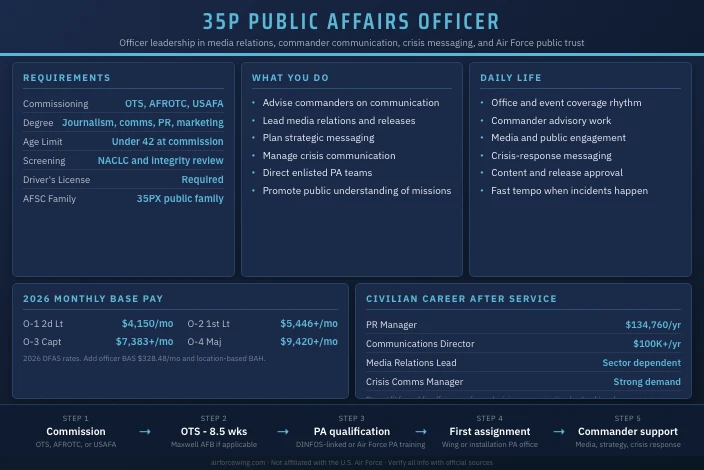
35P Public Affairs Officers advise commanders on communication strategy, media engagement, internal communication, and public information. They lead public affairs teams that prepare news releases, coordinate interviews, manage digital and broadcast communication, and protect the Air Force’s credibility during both normal operations and crises.
Leadership Scope
A new PA officer usually leads a small team of enlisted public affairs specialists, often inside a wing-level public affairs office. Even as a lieutenant or captain, the role is visible. The job can put you next to the wing commander, local media, civic leaders, and installation crisis response teams early in your career.
Day-to-day duties include reviewing news releases before publication, briefing the commander on local or national media interest, approving social media content, managing interview requests, and coaching leaders before speaking engagements. During exercises or real-world events, the PA officer is in the emergency operations center alongside security forces, civil engineering, and medical leaders, controlling the information flow and making sure the official account does not fall behind what is already spreading publicly.
At higher grades, the officer shifts from direct production work to shaping communication policy, advising senior leaders on reputational risk, and managing larger staff efforts across multiple channels.
Family Code Context
The public recruiting site lists this field as 35PX Public Affairs Officer. This guide shortens the code label to 35P while discussing the same career field.
| Designation | Meaning |
|---|---|
| 35P | Hub label used in this site |
| 35PX | Public recruiting family code |
Mission Contribution
Public affairs shapes trust. That includes public understanding of Air Force missions, crisis response after accidents or controversies, and internal communication that keeps Airmen informed. In practice, the field protects both mission legitimacy and commander credibility.
Systems And Tools
PA officers work around media plans, social channels, broadcast support, photo and video teams, and the commander’s message architecture. The officer job is not just writing. It is deciding what gets said, when it gets said, and how risk is controlled.
Salary and Benefits
Officer Base Pay
2026 pay follows the DFAS military pay tables.
| Rank | Grade | Typical YOS | Monthly Base Pay |
|---|---|---|---|
| Second Lieutenant | O-1 | Under 2 | $4,150 |
| First Lieutenant | O-2 | 2-4 years | $5,446-$6,485 |
| Captain | O-3 | 4-10 years | $7,383-$8,376 |
| Major | O-4 | 10-16 years | $9,420-$10,402 |
Allowances
- BAH: location based, varies by zip code and dependency status
- BAS: $328.48 per month for officers
- TRICARE Prime: comprehensive health and dental coverage for the officer and eligible dependents
- BRS and TSP matching: government contributes up to 5% of base pay into the Thrift Savings Plan after initial vesting period
Additional Benefits
Total compensation extends beyond base pay. Officers also receive 30 days paid leave per year, access to commissary and exchange shopping at military prices, legal assistance services, and professional development funding for continuing education and public affairs certifications. Communication-related professional memberships and training through organizations like the Public Relations Society of America or journalism associations can supplement career growth at no personal cost.
Civilian Value
This field translates directly into media relations, public affairs, crisis communications, strategic communications, and corporate communications roles after service. Military PA experience is specifically valued by defense contractors, federal agencies, and major corporations because the work involves high-stakes communication under conditions most civilian professionals never encounter.
Qualifications and Eligibility
Commissioning Requirements
The public Air Force Public Affairs Officer page provides the clearest baseline.
| Commissioning Source | Degree Requirement | Age Limit | Key Prerequisites |
|---|---|---|---|
| OTS | Bachelor’s degree | Must commission before 42 | Competitive officer selection |
| AFROTC | Bachelor’s degree | Must commission before 42 | Career-field assignment at commissioning |
| USAFA | Degree on graduation | Standard academy limits | Assignment at graduation |
Competitive majors include communication, journalism, public relations, broadcasting, advertising, marketing, management, political science, foreign area studies, and other behavioral or social sciences.
Screening
The public page also calls out:
- No record of disciplinary action that questions integrity or professionalism
- Completion of a current National Agency Check, Local Agency Checks and Credit
- No unresolved substance abuse or major mental health issues
- Valid state driver’s license
A Top Secret security clearance is common for this field, particularly for officers assigned to sensitive communication roles or headquarters positions. The National Agency Check and background investigation process begins during the commissioning cycle, so candidates should resolve any financial, legal, or character concerns before applying. Integrity is not just a preferred trait in public affairs. It is a professional requirement, because the field depends on the public’s ability to trust what the Air Force says.
Use the AFOQT study guide if you are preparing for the officer-accession side of the process.
Upon Commissioning
New accessions enter as O-1 and move into a public affairs office after commissioning. The field rewards officers who can write clearly, brief calmly, and handle pressure without improvising recklessly.
Work Environment
Setting And Schedule
Public affairs is a mix of office work, event coverage, commander support, and crisis response. Most days look like staff work. The hard days look like live media pressure, emergency response coordination, or a fast-moving information problem.
A typical week includes internal coordination meetings with wing staff sections, drafting or reviewing external news releases, supporting the commander’s social media presence, checking in with the enlisted team on ongoing projects, and reviewing the local and national news cycle for items that affect the installation. When an incident occurs, the pace accelerates sharply. PA officers are expected to have prepared holding statements, draft news releases, and media response frameworks ready before the phone rings.
Officer-NCO Dynamic
35P officers rely heavily on enlisted PA specialists for production, photography, writing, and local media execution. The officer lane is broader: counsel, approval, strategy, and leadership under pressure. A strong PA officer recognizes that the enlisted team carries the technical execution load and invests in developing their skills rather than micromanaging the output.
Staff And Command Balance
This field is usually tied closely to senior leaders. That makes it very staff-facing even early. Later assignments can include MAJCOM, Pentagon, or specialized strategic communication jobs.
Training and Skill Development
Training Pipeline
| Phase | Location | Length | Focus |
|---|---|---|---|
| Commissioning source or OTS | Maxwell AFB, AL or source dependent | OTS 8.5 weeks | Officership basics |
| Public affairs qualification | DINFOS / Air Force PA training path | Verify current length | Media relations, command communication, public affairs fundamentals |
| First assignment OJT | Wing or installation PA office | 12-24 months | Commander support and real-world communication ops |
The Defense Information School at Fort George G. Meade, Maryland is the primary military professional education venue for public affairs. DINFOS courses cover broadcast journalism, visual information, print journalism, and strategic communication, with some courses available to both officers and enlisted personnel. Air Force PA officers may attend DINFOS courses, joint training, or Air Force-specific professional development programs based on assignment needs and career timing.
The AFOQT study guide is still the first prep step for OTS applicants.
Additional Development
The best growth paths include crisis communication, strategic communication planning, senior leader support, and joint or headquarters PA assignments. Officers who pursue advanced study in journalism, communication, or organizational leadership build a stronger record for senior positions. Joint assignments at combatant commands or the Pentagon expose PA officers to the interagency communication environment that shapes how the U.S. government manages information at the highest levels.
Career Progression and Advancement
Timeline
| Rank | Grade | Typical Timeline | Development Focus |
|---|---|---|---|
| Second Lieutenant | O-1 | Entry to 2 years | Learn PA execution and commander support |
| First Lieutenant | O-2 | 2-4 years | Lead small PA teams and projects |
| Captain | O-3 | 4-10 years | Chief of PA or flight-level leadership |
| Major | O-4 | 10-16 years | Wing, MAJCOM, or staff communication roles |
| Lieutenant Colonel | O-5 | 16-22 years | Senior PA leadership and command-adjacent roles |
Promotion Drivers
Strong records in this field come from trusted commander support, calm crisis performance, and clear evidence that your communication plans helped leadership rather than creating extra risk. Officers who build relationships with senior leaders and demonstrate sound judgment during high-visibility situations tend to advance faster than those who focus only on production quality.
Command And Specialized Tracks
The public affairs field does not typically lead to flying command, but it does offer a credible track toward leadership of PA organizations and direct advisory roles to senior commanders. Officers who move into strategic communication can reach positions that advise flag-level leaders and support interagency information efforts. Some officers pursue education in law, international relations, or communication strategy through the Air Force’s graduate program or civilian institutions, which opens paths to senior advisory and policy positions.
Physical Demands and Medical Evaluations
Fitness Standards
35P officers take the standard Air Force Fitness Assessment.
| Component | Max Points |
|---|---|
| 1.5-mile run | 60 |
| Push-ups | 10 |
| Sit-ups | 10 |
| Waist or body composition | 20 |
No special field-specific physical requirement is emphasized publicly beyond normal commissioning fitness.
Physical Reality Of The Role
Public affairs is not a physically demanding operational job on most days. The work is primarily cognitive and interpersonal. That said, officers who deploy to support operational units may operate in environments with physical demands similar to other staff officers in the field. The standard fitness test applies regardless of assignment, and officers are expected to meet passing scores for their age and gender at all times.
Deployed PA officers may also need to travel to forward locations, cover events on flight lines or in field conditions, and operate equipment in non-office environments. General officer fitness standards are the practical floor, not the ceiling.
Deployment and Duty Stations
Deployment Tempo
Public affairs officers do deploy, especially with wings, expeditionary units, and crisis-response elements. Deployed PA work can be busy because the information environment gets more contested as operations intensify.
Deployment lengths vary by mission type but typically run 4 to 6 months for most Air Force officer positions, with some shorter or longer depending on the unit and theater. PA officers at combat air forces bases tend to see more deployment opportunity than those at training or administrative installations. Deployed assignments often involve joint media operations, host-nation engagement, and coordination with strategic communication teams at the combatant command level.
Duty Stations
Any installation with a public affairs office can host this field. That gives 35P officers broad stateside and overseas options, with especially visible assignments at larger or more operational bases. High-profile assignments include the Pentagon, Air Force headquarters, major air forces commands, and joint combatant commands. Overseas duty stations include USAFE-AFAFRICA in Europe, PACAF in the Pacific theater, and installations in the Middle East and Central Command area of operations.
Risk, Safety, and Legal Considerations
Main Risks
The biggest risk is reputational and leadership risk:
- Bad communication in a crisis
- Poor media handling
- Slow or inaccurate command advice
- Credibility damage from avoidable mistakes
Legal Framework
PA officers operate inside a defined legal framework that includes Department of Defense Instruction 5120.04, which governs military public affairs policy, and the First Amendment restrictions on what the military can and cannot do in domestic information operations. Officers must understand the distinction between external public communication and prohibited influence operations targeting domestic audiences. Releasing classified information, even accidentally, can create significant legal and career consequences. The field also intersects with Freedom of Information Act requests, Privacy Act considerations, and Congressional inquiry procedures, all of which require precision and legal awareness.
Control Measures
This field lives on preparation, approval discipline, and honest commander counsel. Good PA officers tell leaders what they need to hear, not what is easiest to say.
Impact on Family and Personal Life
The daily schedule is often manageable, but crisis response can erase predictability fast. That is the tradeoff. Most of the time it is staff work. When something big happens, family plans can change immediately.
PA officers typically PCS every 2 to 4 years, which is consistent with the broader officer population. Families can expect frequent relocation across a diverse set of duty stations, including some overseas tours. The field’s broad base coverage means families have relatively good access to quality-of-life programs, schools, and support services at most assignments. The unpredictability of crisis response is the main quality-of-life concern. An evening that starts as a routine Wednesday can turn into a 14-hour day when an incident breaks. Families who can tolerate occasional unpredictability adapt well. Families who need rigid daily schedules may find the operational tempo harder to manage. Spousal employment can be affected by PCS moves, and the installation’s Family Readiness Center and Airman and Family Readiness Center offer transition support.
Reserve and Air National Guard
Component Availability
The public page lists Active Duty, Air Force Reserve, and Air National Guard. That makes 35PX one of the officer communication fields with real component flexibility.
Reserve and ANG PA officers perform the same core functions as their active-duty counterparts: advising commanders, managing media relationships, overseeing internal communication, and supporting crisis response when called up. The main difference is that Reserve and ANG officers integrate their military PA role with civilian careers, which often makes them more effective because many bring real-world journalism, PR, or marketing experience into the unit.
Civilian Integration
This field pairs exceptionally well with civilian journalism, public relations, corporate communications, government affairs, and crisis communication work. Reserve PA officers who work in civilian media or PR bring current industry knowledge that benefits their military unit, and their military experience often accelerates advancement in their civilian organization.
Post-Service Opportunities
Civilian Career Paths
| Civilian Role | Median Pay | Outlook |
|---|---|---|
| Public Relations Manager | $134,760 median field | Strong |
| Communications Director | Often $100K+ | Strong |
| Media Relations Manager | Varies by sector | Strong |
| Crisis Communications Lead | High demand in gov and corporate sectors | Strong |
The civilian translation is direct and strong. PA officers leave the Air Force with verifiable experience advising senior leaders, managing communication under pressure, and directing teams through complex information environments. Those are skills that senior corporate communicators, federal agencies, and defense contractors actively recruit for. Federal agencies including the Department of Defense, State Department, and Department of Homeland Security maintain active public affairs functions that specifically value military PA backgrounds. Large defense contractors, media organizations, and corporate crisis firms also recruit from this pipeline because of the high-stakes communication experience the role provides.
Is This a Good Job for You? The Right (and Wrong) Fit
35P is a strong fit if you write well, think fast, and can stay calm when the information pressure turns ugly. It is not a strong fit if you dislike ambiguity, live interaction with senior leaders, or accountability for public messaging.
The field rewards officers who are comfortable operating in the gray zone between what the Air Force wants to say and what the media wants to know. That tension requires judgment, not just skill. Officers who prefer technical clarity and defined procedures over communication judgment may find the field more stressful than satisfying.
The right fit is someone who is curious about how institutions manage reputation, genuinely enjoys writing and presenting, and can give a commander honest advice even when that advice is not what the commander wants to hear. The wrong fit is someone who sees the job as a creative outlet rather than a leadership responsibility.
More Information
- Review the Air Force Public Affairs Officer page
- Compare the enlisted side at 3N0X6 Public Affairs
- Build your OTS prep plan with the AFOQT study guide
Explore more Air Force officer career paths to compare this field with other options.