Air Force Reconnaissance and Electronic Warfare Pilot: Missions and Crew Roles
A reconnaissance and electronic warfare pilot flies the aircraft that collects information or interferes with an enemy’s ability to use radios, radar and networks. The pilot’s primary responsibility is flying and aircraft command. The division of sensor, intelligence, and electronic-warfare tasks depends on the platform and crew; it should not be reduced to one seating arrangement for every aircraft.
The distinction matters more here than in most flying jobs. People who want the sensor picture should look at the combat systems officer field. People who want to fly the aircraft that carries the sensors should keep reading.
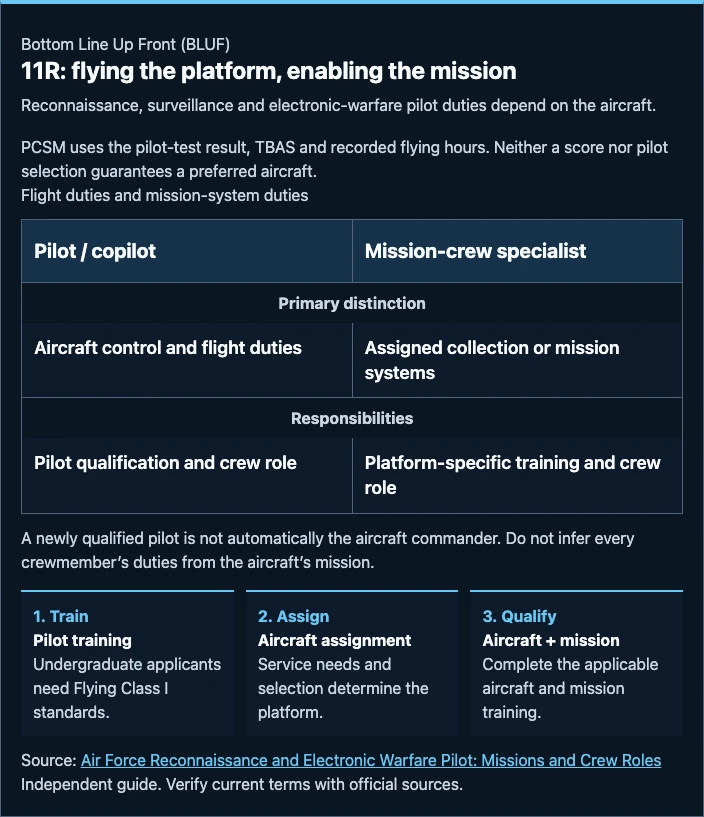
PCSM uses the pilot-test result, TBAS and recorded flying hours. Neither a score nor pilot selection guarantees a preferred aircraft.
| Pilot / copilot | Mission-crew specialist |
|---|---|
| Primary distinction | |
| Aircraft control and flight duties | Assigned collection or mission systems |
| Responsibilities | |
| Pilot qualification and crew role | Platform-specific training and crew role |
A newly qualified pilot is not automatically the aircraft commander. Do not infer every crewmember’s duties from the aircraft’s mission.
- TrainPilot trainingUndergraduate applicants need Flying Class I standards.
- AssignAircraft assignmentService needs and selection determine the platform.
- QualifyAircraft + missionComplete the applicable aircraft and mission training.
Source: Air Force Reconnaissance and Electronic Warfare Pilot: Missions and Crew Roles
Independent guide. Verify current terms with official sources.
On this page
Wing Duty is supported by purchases through our links, which may earn us a commission.
Job Role and Responsibilities
Reconnaissance and electronic warfare pilots plan and fly intelligence, surveillance and electronic attack missions. They command the aircraft and its crew, manage fuel, altitude and routing so the mission systems can work, and bring everyone home. The officer classification directory identifies 11R for reconnaissance, surveillance, and electronic-warfare pilots within the wider pilot field.
Aircraft qualification follows pilot training; a civilian applicant is not promised a particular aircraft by the career title.
Command scope grows the way it does in any flying squadron. A newly qualified pilot may serve as a copilot before earning aircraft-commander qualification. A flight commander leads several crews and owns training and scheduling.
An operations officer runs the flying program, and a squadron commander owns the unit. Selection for those posts depends on qualifications, performance, and available positions; fleet size alone does not establish an earlier command timeline.
Mission contribution runs through the intelligence and electromagnetic spectrum. These aircraft find things, listen to things and disrupt things. They support joint and combined operations by feeding what they collect into the same picture the rest of the force is using.
The crew split is the part applicants get wrong most often.
| Crew position | What the job is |
|---|---|
| Pilot (11X) | Flies the aircraft, commands the crew, manages the mission profile |
| Combat systems officer (12X) | Runs sensors, electronic attack systems or mission equipment |
| Airborne cryptologic linguist (1A8) | Works language and signals collection in the air |
| Intelligence officer (14N) | Turns collection into analysis and reporting |
Aircraft types change. The RC-135 family has flown signals and electronic intelligence work for decades, and the EA-37B is replacing the EC-130H in the electronic attack role. Older types leave service and new ones arrive.
Treat any aircraft list as a snapshot and confirm the current fleet with a recruiter or a unit before you plan around it.
The Career Code and the Aircraft Are Different Choices
The 11R entry in the officer classification directory distinguishes an entry/student level, a qualified pilot/copilot level, aircraft commander, and staff duty. Qualification in the suffix-specific aircraft is a separate step after pilot training. The directory therefore describes a progression in responsibility, not a promise that a new pilot immediately commands a reconnaissance crew.
This matters when reading an aircraft list. Some designations describe a platform, while others describe a general mission or a staff use of the specialty. A classification list is not a current inventory of open seats, and the presence of a code does not tell an applicant which aircraft a particular training class will receive.
An applicant should distinguish four milestones:
- Selection for pilot training.
- Assignment to an aircraft.
- Completion of that aircraft’s formal course.
- Local mission qualification.
If the aircraft itself is essential to the decision, establish whether a specific unit is hiring against that platform before treating a preference as an offer.
Pilot Work Versus Mission-Crew Work
Reconnaissance collects information; electronic warfare uses or contests the electromagnetic environment. The aircraft and crew determine how those missions are combined. A pilot can help position the aircraft for collection or electronic attack while another crew specialist manages the mission equipment, but the precise division must be described for the actual platform.
If you want to operate mission sensors or work directly with electronic-warfare equipment, compare the combat systems officer route as well as the pilot route. If you want aircraft control, flight planning, and eventual aircraft-command responsibility, pilot training is the relevant starting point. Interest in intelligence alone does not decide between the two.
That comparison should include training rather than only the aircraft name. A pilot qualification and a CSO qualification are not interchangeable, even if both officers later serve on the same mission. Ask which duties require the qualification you would earn and how the first operational tour develops that skill.
Prepare for the Actual Selection Gates
The Air Force testing manual describes how the pilot-test result, TBAS, and updated flying hours feed the PCSM score. Record flight experience accurately and use the current testing instructions; do not treat a practice-test result as an official score. AFOQT preparation addresses that examination, not the separate TBAS, medical review, or aircraft training.
Medical screening also has a defined role. DAFI 36-2137 requires Flying Class I standards for undergraduate pilot applicants entering medical flight screening. A generic Class III statement is not an adequate substitute, and an online guide cannot decide whether a particular condition is disqualifying or waiverable.
Before choosing a route, compare the point at which each commitment becomes binding. Ask what happens if medical screening, pilot training, or a requested aircraft assignment does not work out. Those are practical planning questions, not predictions that a particular candidate will fail.
Finally, separate eligibility from competitiveness. Meeting a minimum lets an application proceed under the relevant rules; it does not establish how a board will rank it. Current official application instructions and a unit’s actual vacancy should carry more weight than a score quoted from an older selection cycle or an anecdote about another aircraft community.
Salary and Benefits
Basic pay follows rank and years of service, and rated officers also earn aviation incentive pay. The 11X Pilot profile explains the shared pay, allowance and bonus rules in full.
| Rank | Pay Grade | Years of Service | Monthly Base Pay | Annual Base Pay |
|---|---|---|---|---|
| Second Lieutenant (2d Lt) | O-1 | 2 or less | $4,150 | $49,802 |
| First Lieutenant (1st Lt) | O-2 | Over 2 | $5,446 | $65,354 |
| Captain (Capt) | O-3 | Over 4 | $7,383 | $88,592 |
| Major (Maj) | O-4 | Over 10 | $9,420 | $113,040 |
Source: DFAS 2026 pay tables. Figures reflect the 2026 pay raise.
The officer food allowance is $328.48 a month. Housing allowance depends on rank, location and family status. Aviation incentive pay has separate aviation-service eligibility and service-gate rules; a rating alone does not establish continued entitlement.
No standing reconnaissance or electronic warfare bonus was verified for this page. Bonuses follow the needs of the force and change between budget cycles, so ask a recruiter for current terms rather than planning around an old announcement.
Qualifications and Eligibility
In the active-duty route, officers commission and compete for aircraft assignments through pilot training. Reserve and Guard unit hiring can identify the aircraft before training, subject to the actual vacancy and selection terms.
| Path | Degree | Notes |
|---|---|---|
| ROTC | Bachelor’s, any major | Class rank and commander ranking drive the pilot slot |
| Officer Training School | Bachelor’s | Competitive selection, aviation physical required |
| Air Force Academy | Bachelor’s | Assignment happens near graduation |
| Reserve or Guard | Bachelor’s | Hires against a specific unit and aircraft |
The AFOQT and the TBAS are both required for a pilot slot. The Pilot Candidate Selection Method score uses the applicable pilot-test result, TBAS performance, and recorded flying hours. It is one selection input, not a guarantee of an aircraft or training place.
Medical qualification is a separate gate.
Undergraduate pilot applicants must meet Flying Class I medical standards, subject to the applicable qualification and waiver process. A test score does not waive that medical decision.
An AFOQT study course covers the composites in a set order and includes practice tests. This is an affiliate link. A study guide costs less if you plan to study on your own.
No course can promise a slot in this career field.

After pilot training, aircraft assignment depends on class ranking, instructor assessment and the needs of the Air Force. An officer who wants reconnaissance aircraft states a preference and then competes. The needs of the force can override the preference.
The active duty service commitment for pilot training is long. Plan for a decade or more of obligated service from the date training ends, and confirm the current term with a recruiter.
Work Environment
Most days are spent in a squadron building rather than in the air. Crews plan missions, study the operating area, brief with intelligence and weather, then fly. Simulator periods fill the gaps.
Flying frequency depends on the unit, qualification, and mission schedule.
Mission-planning time varies with the sortie and its coordination requirements. The crew studies the operating area, agrees on what the aircraft is looking for, and works out how the sensors will be pointed. Weather, tanker support and the political boundaries of the airspace all shape the plan before anyone steps to the aircraft.
The flying itself is mostly steady work with bursts of attention. A pilot holds the aircraft on a track so the sensors can collect, adjusts when the crew asks, and manages fuel against a plan that rarely survives contact with reality. Boring is the goal.
Boring means the collection worked.
Sorties are long. An intelligence aircraft can stay airborne for many hours, and the crew rotates through rest periods in flight. That rhythm suits people who can stay alert during a long, quiet stretch and then act quickly when something appears.
The officer and noncommissioned officer relationship works the same way it does across the Air Force. Senior enlisted members run the maintenance and operations support side, and the pilot relies on their judgment about whether the aircraft is ready. New officers who treat that experience as a resource do better than ones who treat it as an obstacle.
Training and Skill Development
Pilot training comes first for every 11X officer, regardless of the aircraft they eventually fly.
| Phase | Location | Length | Focus |
|---|---|---|---|
| Undergraduate Pilot Training | Several bases | About a year | Fundamentals, instruments, formation, navigation |
| Aircraft assignment | UPT graduation | Days | Track and aircraft selection |
| Formal training unit | Aircraft specific | Weeks to months | Mission qualification in the assigned type |
| Mission qualification | Home unit | Months | Local area, crew certification, deployment readiness |
After qualification, the community offers instructor pilot duty, weapons and tactics courses, and test work. Graduate education through the Air Force Institute of Technology is available on a competitive basis and is not part of the normal flying path.
Professional military education follows the standard officer timeline. Squadron Officer School comes early, then Air Command and Staff College and Air War College for officers who stay.
Career Progression and Advancement
| Rank | Career context, not a promotion date | Responsibility examples |
|---|---|---|
| O-1 to O-2 | Assignment and qualification dependent | Student, then mission-qualified copilot or aircraft commander |
| O-3 | Assignment and qualification dependent | Aircraft commander, instructor, flight scheduler |
| O-4 | Assignment and qualification dependent | Flight commander, assistant operations officer |
| O-5 | Assignment and qualification dependent | Operations officer, squadron command |
| O-6 | Assignment and qualification dependent | Group or wing command, senior staff |
Commissioning grade and subsequent promotion follow their applicable eligibility and performance rules; neither is guaranteed by entering a flying field. O-4 and above are board selections. Flying communities weigh operational performance heavily, and a strong record shows progressive responsibility in the aircraft as well as in staff jobs.
Broadening assignments include instructor duty, test and evaluation, joint staff work, and exchange tours. Some officers leave the cockpit for staff work and return to flying later.
Physical Demands and Medical Evaluations
Every officer takes the standard Air Force fitness assessment. Flying duty adds a flight physical, which reviews vision, hearing, heart, lungs, and any condition that could affect consciousness or judgment in the air.
The flight physical is the harder gate. Conditions that are manageable on the ground can still disqualify a pilot. Medications, surgeries and mental health treatment all have rules, and waivers exist for some cases.
Start the medical conversation early, because a waiver takes time and the medical authority must explain any applicable review or waiver process.
Deployment and Duty Stations
Reconnaissance crews deploy to forward operating bases and to partner locations. Some missions fly from home station and some require a rotation. The tempo depends on the aircraft and the combatant command asking for coverage.
Main operating bases cluster around a small number of installations tied to specific aircraft. Assignment works through the officer assignment process, with a preference list and a needs-of-the-force overlay. Compared with enlisted assignments, officers typically see fewer but larger sets of options.
Risk, Safety, and Legal Considerations
Long sorties carry fatigue risk, and crew rest rules exist because fatigue has caused accidents. Crews use operational risk management before every mission and after any change to the plan.
Command authority carries legal weight. An aircraft commander is responsible for the crew, the aircraft and the mission, and can be held accountable for decisions made in flight. That responsibility is the reason the training pipeline is long and the standards are strict.
Impact on Family and Personal Life
The schedule is irregular. Some weeks are heavy with flying and some are heavy with ground duties. Deployments remove the officer for months at a time, and short notice taskings happen.
Ask the installation support center and unit about current family readiness and deployment support services. Permanent change of station moves are part of the career; timing depends on assignments and component.
Reserve and Air National Guard
Reconnaissance and electronic warfare aircraft exist in the Reserve and the Air National Guard, and some units hire directly into a cockpit. A unit hire means the aircraft is known before training starts, which is the opposite of the active duty path.
| Item | Active duty | Reserve | Air National Guard |
|---|---|---|---|
| Commitment | Full time | Drill plus annual tour | Drill plus annual tour, state mission added |
| Aircraft | Assigned by needs of the force | Hired against a unit | Hired against a unit |
| Pay | Monthly basic pay plus allowances | Drill pay plus active duty periods | Drill pay plus active duty periods |
| Retirement | Pension at 20 years | Points based | Points based |
Post-Service Opportunities
Flying hours are the main currency after service. Airlines hire military pilots, and the hours flown on long intelligence sorties count toward hiring minimums. Defense contractors hire pilots for test, training and advisory work, often because of the clearance and the mission background.
| Civilian field | US median annual pay, May 2025 | Job growth, 2025 to 2035 |
|---|---|---|
| Airline pilots, copilots and flight engineers | $232,140 | 7% for airline and commercial pilots together |
| Commercial pilots | $123,220 | 7% for airline and commercial pilots together |
The Transition Assistance Program helps with the move. Airline pay varies with the employer, aircraft, position, and seniority. These occupation-wide medians are not starting-pay offers to separating officers.
Is This a Good Job for You? The Right (and Wrong) Fit
This job suits someone who wants to fly but does not need to be the person shooting or bombing. The satisfaction comes from a long mission that produces information someone else can act on.
It fits poorly if you want to be at the center of the action in a cockpit built for combat. It also fits poorly if you dislike long periods of monitoring. Patience is the core skill, and the people who thrive here tend to be steady rather than aggressive.
More Information
Ask a recruiter which aircraft are currently accepting new pilots, and ask a squadron what a new pilot actually does in the first year. Then work the parts you control: the degree, the AFOQT and TBAS scores, the flight physical and the fitness standard.
The 11X Pilot profile covers the shared training and medical rules for every pilot. The Combat Systems Officer page covers the sensor and electronic attack side of the same aircraft, and the Special Operations Pilot page covers the other flying branch that works closely with intelligence crews. The Operations officer group shows the wider career options.