Air Force Mobility Pilot: Airlift and Tanker Career Paths
Mobility pilots move the people, the gear and the fuel that other missions need, flying everything from small transports to the largest tankers. A recruit who wants to fly without the combat side faces one question: airlift or tanker? Few sources explain how the two paths differ, so this page does.
It covers the mission, the 11M plane codes, the aircraft commander ladder, what decides your aircraft, and what the job costs in time and family life. Pay, entry routes and the training pipeline are shared with every pilot field, so they appear here in brief with links to the parent profile.
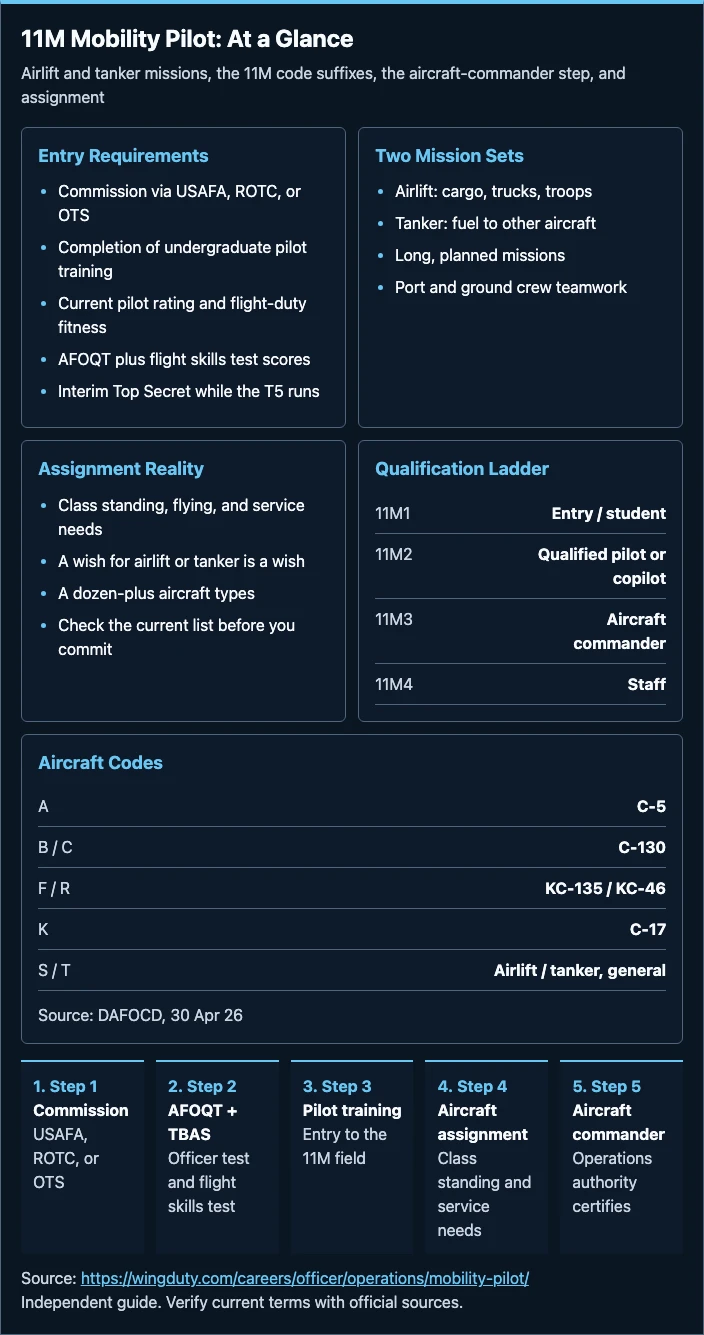
Entry Requirements
- Commission via USAFA, ROTC, or OTS
- Completion of undergraduate pilot training
- Current pilot rating and flight-duty fitness
- AFOQT plus flight skills test scores
- Interim Top Secret while the T5 runs
Two Mission Sets
- Airlift: cargo, trucks, troops
- Tanker: fuel to other aircraft
- Long, planned missions
- Port and ground crew teamwork
Assignment Reality
- Class standing, flying, and service needs
- A wish for airlift or tanker is a wish
- A dozen-plus aircraft types
- Check the current list before you commit
Qualification Ladder
- 11M1
- Entry / student
- 11M2
- Qualified pilot or copilot
- 11M3
- Aircraft commander
- 11M4
- Staff
Aircraft Codes
- A
- C-5
- B / C
- C-130
- F / R
- KC-135 / KC-46
- K
- C-17
- S / T
- Airlift / tanker, general
Source: DAFOCD, 30 Apr 26
- Step 1CommissionUSAFA, ROTC, or OTS
- Step 2AFOQT + TBASOfficer test and flight skills test
- Step 3Pilot trainingEntry to the 11M field
- Step 4Aircraft assignmentClass standing and service needs
- Step 5Aircraft commanderOperations authority certifies
Source: Air Force Mobility Pilot: Airlift and Tanker Career Paths
Independent guide. Verify current terms with official sources.
On this page
Wing Duty is supported by purchases through our links, which may earn us a commission.
Job Role and Responsibilities
11M mobility pilots fly airlift and tanker aircraft such as the C-17, C-5, C-130, KC-135 and KC-46. They plan the mission, lead a crew, deliver cargo, troops or fuel, and bring the plane home. The field belongs to 11X, and a pilot earns the code after pilot training and a course in the assigned aircraft.
The April 2026 officer classification directory lists the job as flying mobility aircraft and leading the crew. That covers planning, loading, flying and the paperwork that follows a mission.
Command and Leadership Scope
A mobility crew is small. A C-17 or C-130 carries two pilots and a loadmaster crew, and a tanker carries a boom operator as well. The aircraft commander owns the plane, the crew and the call.
Duty grows with certification. A new pilot flies as copilot, becomes an aircraft commander when the unit certifies it, and may later take instructor, evaluator or flight commander jobs. A squadron commander can lead a dozen or more crews, plus the maintainers, loadmasters and staff who keep the schedule.
Specific Roles and Designations
The field has four levels, and each plane family has its own letter.
| Code | Plane or scope |
|---|---|
| 11M1 | Entry level and student |
| 11M2 | Qualified pilot or copilot |
| 11M3 | Aircraft commander |
| 11M4 | Staff |
| A | C-5 |
| B, C | C-130E/H, C-130J |
| D | C-27J |
| E | VC-25 |
| F, G, R | KC-135, KC-10, KC-46 |
| J, K, L, M, N, P, Q | C-12, C-17, C-20/C-37, C-21, C-26, C-32, C-40 |
| S, T | Airlift, general; tanker, general |
| U | Air mobility liaison officer |
| V, W | Inter theater airlift, general; intra theater airlift, general |
| Y, Z | Other; general |
The parent field also holds fighters (11F), bombers (11B), rescue helicopters (11H) and special operations aircraft (11S), and the 11X Pilot profile shows how those branches differ. Special Experience Identifiers record extra skills, such as airdrop or test qualification, apart from the code.
Airlift or Tanker: What Differs
Airlift and tanker flying share one field, one school and one ladder, though the daily work differs. Know that before you state a wish.
Airlift crews move cargo, trucks and troops, which means load plans and weight checks. Some planes use short or rough runways, and some crews drop cargo by parachute. The pace can be calm or rushed when a crisis hits, and the payoff is plain: the gear you hauled is the gear the ground team needed.
Tanker crews move fuel. A KC-135 or KC-46 crew flies a track or joins a package to refuel other planes. That calls for tight timing, and the crew must match both the receiver and the command cell on the ground. The work is steady and exact, and crews drill the same steps until they hold up under stress.
Two facts follow. The plane you fly shapes your day more than the word mobility does. Both paths also lead to the same leadership steps, so picking one is not picking a good career over a bad one.
Mission Contribution
Mobility gives the joint force reach. Airlift moves troops, vehicles, fuel bladders and medical patients between theaters, and it can put a runway in use that no airliner would touch. Airdrop delivers cargo where no runway exists.
Tankers keep other aircraft in the air. A single refueling track can extend a fighter patrol, a bomber mission or a surveillance orbit, and the effect is larger than the tanker crew’s own flight plan. Mobility crews also fly aeromedical evacuation support, embassy and command transport, and humanitarian missions after a disaster.
Technology, Equipment, and Systems
The pilot works with flight controls, navigation and communication systems, weather radar and traffic awareness. Cargo work adds load planning software, winches, rollers and tie down gear, and airdrop adds rigging and a computed release point. Tanker work adds the boom or drogue system and the receiver’s own limits.
Planning happens on the ground. Crews build the route, the fuel plan, the cargo manifest and the threat picture, then brief before the engines start. After landing, the crew closes out the paperwork that proves what moved and where it went.
Salary and Benefits
Base pay depends on rank and years of service. Mobility pilots use the same officer scale as every other officer, and rated officers also earn aviation incentive pay. The 11X parent profile explains that pay in full.
| Rank | Pay Grade | Years of Service | Monthly Base Pay | Annual Base Pay |
|---|---|---|---|---|
| Second Lieutenant (2d Lt) | O-1 | 2 or less | $4,150 | $49,802 |
| First Lieutenant (1st Lt) | O-2 | Over 2 | $5,446 | $65,354 |
| Captain (Capt) | O-3 | Over 4 | $7,383 | $88,592 |
| Major (Maj) | O-4 | Over 10 | $9,420 | $113,040 |
Source: DFAS 2026 pay tables. Figures reflect the 2026 pay raise.
The officer food allowance is $328.48 a month. Housing allowance depends on rank, base and family, so there is no single figure for the field. Other pay has its own rules.
- Healthcare follows active duty TRICARE rules. The member pays no fee or copay.
- Aviation incentive pay continues while the officer keeps a rating and flies.
- No standing mobility bonus was verified for this page. Bonuses change with the needs of the force, so ask a recruiter for the current terms.
- Active duty members earn 30 days of paid leave a year. Rotations and exercises can shape when it is used.
The Blended Retirement System pairs a pension with a savings plan. Members who meet the rules get 40% of the highest 36 month average base pay at 20 years. Allowances are not part of that base. The Thrift Savings Plan adds 1% of base pay, and it matches up to 4% when the member puts in 5%.
Work life mixes office days with flying days. A crew studies, flies the simulator and trains between missions, and a mission can run across several days with crew rest built in. Rotations take the crew away for months, and the schedule at home fills with training and ground duties.
Qualifications and Eligibility
Find the right entry route
You need a bachelor’s degree to commission, and the degree can be in any major. The Air Force pilot requirements page asks for a grade point average of 2.5 or better, though a degree within 365 days also counts. You must start pilot training after age 18 and before your 33rd birthday. There is no direct commission path for pilots.
| Route | Degree | Age | How the field is assigned |
|---|---|---|---|
| Air Force ROTC | Bachelor’s, any major, GPA 2.5 or better | Start pilot training before age 33 | Rated board in the cadet years |
| Officer Training School | Bachelor’s, any major, GPA 2.5 or better | Start pilot training before age 33 | Rated pick through the OTS board |
| Air Force Academy | Academy degree | Academy rules and the same age window | Assigned in the senior year |
Every route needs the Air Force Officer Qualifying Test. A medical exam and a flying class physical come next. A board weighs the scores, the record and the needs of the Air Force. A pilot slot is not the same as a C-17 or a KC-46, because the plane comes later.
Study for the AFOQT
The published minimums for officer accessions are verbal 15 and quantitative 10. Those are floors, not targets. Pilot candidates also take the Test of Basic Aviation Skills, and the pilot score combines both results. A strong file needs more than the floor.
A study plan should show where points are lost.
- Take a timed sample test and keep the score.
- Sort the errors by topic and by cause.
- Review the method behind each missed answer.
- Try fresh questions to see if the skill improved.
An AFOQT study course offers lessons and practice in a set order. This is an affiliate link. No course can promise a pilot slot or a plane, and a study guide costs less if you study on your own. Check what each format includes before you buy.

Security Clearance
The mobility field needs routine access to Tier 5 data and systems. The Q code, the C-40, is the one exception, while the F and R codes, the KC-135 and the KC-46, call for a current Tier 5 investigation. The entry level can be awarded before the check ends, as long as an interim Top Secret clearance is in place. Plan for a long review if you have foreign contacts or travel.
Career Field Assignment and Classification
A pilot gets an aircraft at the end of pilot training. Class rank, instructor input, student choice and the needs of the Air Force decide which one. Students bound for mobility and tankers fly the T-1A track, while those bound for fighters and bombers fly the T-38C. The 11X parent profile covers the pipeline.
Mobility flies more than a dozen plane types, so a student is less likely to get one exact plane and more likely to fly something they did not ask for. That is not a flaw. It is how a field with so many airframes spreads its crews.
Upon Commissioning
New officers enter at O-1, a second lieutenant. The commissioning route sets its own service term, and pilot training adds a much larger one. The pilot career page states a 10 year active duty commitment after pilot training. That is the term to weigh before you apply. The course in the assigned aircraft follows, and it can add time or reset the clock.
Work Environment
Setting and Schedule
The job moves between a squadron, a flight line, a simulator bay and a planning room. A normal week holds classes, simulator rides, training flights and ground duties. A mission week looks different. The crew plans, rests, loads, flies and closes out the paperwork, often across a long day or a night.
Squadrons keep a training rhythm. Crews need currency in the plane and in the mission, and instructors and evaluators check that standard. Paperwork and scheduling sit beside the flying.
Leadership and Chain of Command
A pilot works inside a squadron. The commander, instructors and schedulers set the pace, and senior NCOs run much of the ground support. Loadmasters, maintainers, aerial port teams and command post staff all shape whether the mission leaves on time.
The officer and NCO partnership matters here. A loadmaster knows the cargo limits, and a maintenance chief knows the jet’s condition. A good aircraft commander asks before deciding, because the crew’s judgment is part of the aircraft’s margin.
Staff vs. Command Roles
Careers alternate between flying jobs and staff work. Staff tours at a major command, a numbered air force or the Pentagon build a wider view, and boards look for that above O-4. Instructor and evaluator tours build skill and trust, and some officers return to the schoolhouse.
Command comes later, and it is a selective assignment. A mobility squadron command mixes flying standards, people, money and a heavy scheduling load.
Job Satisfaction and Retention
Pilots who stay talk about the mission, the crew and the variety of places the job goes. Pilots who leave point to time away from home and the pull of airline pay. The service manages retention with bonuses and job choices.
No current retention rate for this field was verified for this page. Ask about manning and bonus terms before you plan around one plane.
Training and Skill Development
Pre-Commissioning Training
ROTC cadets finish a four year program with field training and leadership labs. Academy cadets finish the military and academic program. Officer Training School serves the rest, and the official OTS page describes an 8.5 week course at Maxwell Air Force Base in Alabama.
Initial Skills Training
Pilot training is the gate to every flying career. It starts with the T-6 and moves to a track plane. Mobility students fly the T-1A, then take the formal course in the assigned aircraft.
| Stage | Where | Length | Focus |
|---|---|---|---|
| Officer Training School, if needed | Maxwell AFB, Alabama | 8.5 weeks | Officership and leadership |
| Undergraduate pilot training | Columbus AFB, Laughlin AFB, Vance AFB or Sheppard AFB | About a year | Basic flying, instruments, formation and navigation |
| Formal course in the assigned aircraft | The training base for that fleet | Six months to over a year | Aircraft systems, cargo or tanker work, tactics and crew duties |
| Mission training | The squadron | Months of flights | Mission ready status |
The parent profile explains the pipeline in more detail. A student who wants one specific plane should know that the track is set by the needs of the Air Force, not by a wish.
Professional Military Education
Squadron Officer School comes in the captain years, and it is required for promotion to major. Air Command and Staff College serves majors who compete for lieutenant colonel, and Air War College serves senior officers. Class dates change, so check them before you plan.
Additional Schools and Training
The weapons school teaches advanced tactics for mobility and tanker crews. Test pilot school takes skilled pilots into flight test, and graduate study through the Air Force Institute of Technology is another route. Each program needs an application and a strong record, and it also needs the nod of the career field.
Career Progression and Advancement
Career Path
The field moves from flying the plane to leading the crew and then the squadron.
| Rank | Time in grade | Possible development and duties |
|---|---|---|
| O-1, second lieutenant | Initial grade | Learn the plane, fly as copilot |
| O-2, first lieutenant | Selected active duty officers normally reach captain after two years in grade, subject to approval rules | Build mission skills and aircraft commander progress |
| O-3, captain | No verified mobility tour length | Aircraft commander, instructor or flight commander, Squadron Officer School |
| O-4, major | Board selected | Operations officer, evaluator or staff |
| O-5, lieutenant colonel | Board selected; command has a separate pick | Squadron command or senior staff |
| O-6, colonel | Board selected; few senior posts | Group or wing leadership |
The two year active duty rule for selected first lieutenants still needs approval, and date of rank rules apply too. No mobility promotion rate was verified for this page.
Promotion System
Promotion to O-2 and O-3 is mostly time and a clean record. O-4 and above are board picks. Boards weigh reports, schooling, awards and the range of a career. A pilot who only flies can stall below O-5, so broadening matters.
Cross-Training and Broadening
Pilots can move between aircraft through boards and training seats. Instructor, evaluator, weapons school and staff tours all widen a record. Some officers take exchange or fellowship tours outside the Air Force, and a few move into test, acquisition or attaché work. Each one needs a release from the current job.
Experience develops through more than flying hours. A mobility pilot has to coordinate a crew, understand the mission’s logistics and make decisions when destinations, weather or cargo requirements change. Later responsibilities may include evaluating other crews, planning missions and leading a flying unit. Applicants should distinguish the flight experience they want from the management responsibilities that can occupy a growing share of a long officer career.
Physical Demands and Medical Evaluations
Physical Requirements
Pilots take the general fitness test like every other member. The current test uses a two mile run or an approved shuttle run. It adds strength and core events and a waist to height measure. The pass mark is 75 points, and each chosen event also has a minimum. The Air Force fitness page and DAFMAN 36-2905 own the rules and the charts.
| General test, under age 25 | Male | Female |
|---|---|---|
| Minimum satisfactory total | 75 points | 75 points |
| Event minimums | Meet each chosen event’s chart minimum | Meet each chosen event’s chart minimum |
| Failure despite 75 total | A missed event minimum can make the result unsatisfactory | A missed event minimum can make the result unsatisfactory |
The current age and sex score sheets were not checked for this page. Use the official charts.
Flight Physicals and Career Field-Specific Medical
Flying has its own medical standard, and it is strict. Rated candidates meet a flying class physical, and the 11X parent profile sets out the vision and general standards. Mobility adds its own load. Long duty days, night flying and cargo work in austere places all raise the demand on the body.
Nothing here grants a waiver. Medical staff review each case, and a flight surgeon decides what is safe for flying. Start the medical work early, because a slow review can cost a training seat.
Deployment and Duty Stations
Deployment Details
Mobility crews deploy on air expeditionary force rotations, and a typical tour runs about 90 to 120 days. The work is steady rather than sudden, with a schedule of missions flown from a forward base. Exercises and humanitarian taskings add shorter trips.
A deployed crew flies the same missions with less support. Maintenance and aerial port teams work long days, and the crew may fly into airfields with limited approaches. Families should plan for the rotation, not for a steady weekly routine.
Duty Station Options
Mobility wings sit at large bases in the United States and at hubs overseas. The 11X parent profile lists examples such as Travis, McChord, Scott and Fairchild, and the list shifts as fleets move.
Officers state choices through the Air Force Personnel Center, but jobs follow the needs of the force. Some mobility bases sit near large cities and others sit in quieter places, where a spouse’s job options and school choices matter. Join spouse rules exist but cannot create a flying job at every base.
Risk, Safety, and Legal Considerations
Job Hazards
Mobility flying carries risk in the air and on the ground. Weather, night operations, short runways, heavy cargo and refueling in close formation all add to it. Ground crews face moving vehicles, machinery and cargo that can shift if it is loaded wrong.
The professional risk sits with the aircraft commander. That officer signs for the load, the fuel and the plan, and answers for the calls made in the air.
Safety Protocols
Risk management applies to every flight. Crews use checklists, load checks, briefs and debriefs, and they set limits before launch. A crew that calls off a mission for a sound reason is doing the job, not failing it. Mishap investigation and reporting rules apply after any incident.
Legal and Command Responsibility
Officers work under the Uniform Code of Military Justice. Cargo and passenger rules, customs law and the rules of engagement govern what a crew may carry and where. Commanders also answer for the climate of their units. Relief from command goes in an officer’s file, and it ends most promotion prospects above O-4.
Impact on Family and Personal Life
Family Considerations
The rotation schedule shapes family life. A 90 to 120 day deployment is long enough to change a school year, and the crew knows the dates well ahead. A family that plans around the rotation does better than one that expects a set weekly routine.
Airman and Family Readiness Centers help with moves, spouse jobs and money. The Key Spouse Program links families during deployments. Check childcare and school options before you accept an assignment.
Dual-Military and Family Planning
Join spouse requests are considered, not promised. Flying jobs sit at set bases, so a couple in two flying fields may struggle to live together. Plan the plane and the timing as a pair, and expect at least one hard choice.
Mobility missions can involve repeated trips and changing departure or return times rather than one predictable rotation. A crew may be away from home for shorter stretches that still disrupt routines, while other assignments can involve longer absences. Ask a squadron what a typical month looks like for a junior pilot, how trips are scheduled and how often training or other duties change that pattern. An aircraft type alone cannot answer those questions.
Reserve and Air National Guard
Component Availability
Mobility units exist in the Air Force Reserve and the Air National Guard. They share planes and missions with active duty wings, and a part time pilot keeps a rating and a mission. The standards do not change.
Commissioning Paths
Reserve and Guard pilots have three routes in: ROTC with a reserve contract, unit sponsored OTS, or a transfer from active duty. A transfer needs a release and a flying job. A rated officer with a strong record is a credible candidate, but the unit still has to have the seat.
Drill and Training Commitment
The standard drill schedule is one weekend a month plus a two week annual tour. Flying adds much more. A part time pilot must keep currency in the plane and the mission, so the real time commitment is larger than a monthly drill.
Part-Time Pay
A drill period pays one thirtieth of monthly basic pay. An O-3 with more than four years of service earns $246.09 for one paid drill period in 2026. Four periods pay $984.36 before tax. Flying days and active orders pay under their own rules, and they also carry allowances that a drill weekend does not.
Benefits Differences
Members who meet the rules can buy TRICARE Reserve Select, which costs $57.88 a month alone or $286.66 with family cover in 2026. Those are premiums, and care can cost more. Federal tuition help is open to drilling members, though Guard school benefits vary by state. Post 9/11 GI Bill eligibility depends on qualifying service.
Command and Career Progression
Reserve and Guard squadrons have their own command and instructor jobs. Officers can attend PME when a seat allows. Promotion timing and board rates differ from active duty, and no current field figures were verified for this page.
Deployment and Mobilization
Part time crews mobilize for rotations and contingency work. The tasking follows the same mission as the active duty wing. No fixed gap was verified, so ask a unit about its recent cycle.
Civilian Career Integration
Flying pairs well with airline and defense industry work. Many part time pilots fly for an airline during the week and keep a military rating on drill weekends. USERRA protects job and reemployment rights for covered service, within its rules.
| Factor | Active duty | Air Force Reserve | Air National Guard |
|---|---|---|---|
| Commitment | Full time | Part time plus flying days and mobilization | Part time plus flying days and mobilization |
| 2026 O-3 pay example, over four years | $7,382.70 monthly base pay | $984.36 for four paid drill periods | $984.36 for four paid drill periods |
| Healthcare | Active duty TRICARE rules | Eligible members may buy Reserve Select | Eligible members may buy Reserve Select |
| Education | Federal programs with service terms | Component programs; GI Bill depends on service | Federal and state programs as offered |
| Deployment | Wing tasking and rotations | Mobilization and operational support | Federal and state duty as applicable |
| Command | Squadron to wing level | Squadron level | Squadron level |
| Retirement | Qualifying active service under the Blended Retirement System | Points based, paid from age 60 with qualifying years | Points based, paid from age 60 with qualifying years |
Post-Service Opportunities
Transition to Civilian Life
A mobility pilot leaves with thousands of flying hours, heavy jet experience and often a clearance. Airlines hire military pilots, and cargo carriers value crews who have flown long sectors and managed loads. The Transition Assistance Program can help plan the move.
Civilian Career Prospects
| Civilian field | US median annual pay, May 2025 | Job growth, 2025 to 2035 |
|---|---|---|
| Airline pilots, copilots and flight engineers | $232,140 | 7% for airline and commercial pilots together |
| Commercial pilots | $123,220 | 7% for airline and commercial pilots together |
Airline pay is set by seniority and plane type, not by military rank. The route usually starts at a regional airline, and the first years pay far less than the long term average. Ask a current airline pilot about the timeline before you plan around it. Other paths include cargo carriers, defense contract flying and operations management.
Graduate Education and Credentials
Pilots can use tuition help and the GI Bill for more study. Flight hours and instructor time count toward airline hiring. Some states accept military check rides toward civilian certificates. Check the current rules with the airline and the Federal Aviation Administration, and do not rely on older ones.
Is This a Good Job for You? The Right (and Wrong) Fit
Ideal Candidate Profile
This path suits someone who likes a steady crew, a long flight and a job that delivers something real. The work rewards planning and patience. It also requires comfort with check rides, since a pilot is tested for a whole career.
Potential Challenges
The rotation is the hard part. A 90 to 120 day deployment takes a crew away for a season, and training fills the time at home. Someone who wants short trips and a fixed weekly schedule will find the job hard.
Career and Lifestyle Alignment
Compare the branches before you commit. A fighter pilot flies short, fast missions, and a bomber crew flies long missions into a fight. The 11X parent profile explains the field, and the Fighter Pilot and Bomber Pilot pages explain the other two.
If the flying is the goal rather than the plane, any of these paths can work. If the goal is one jet, remember that the Air Force decides, not the student.
More Information
Ask a recruiter or an ROTC detachment which boards are open, and what the current bonus terms look like. Ask a mobility squadron what a new pilot does in the first year. Then plan the parts you control: the degree, the test scores, the medical review and the fitness standard.
The AFOQT study course is the first paid option on this page. This is an affiliate link. A study guide costs less if it fits your budget. The free AFOQT guide on this site explains the composites and what each one measures.
Compare the Operations officer group to see how this field fits the wider community. The Bomber Pilot and Special Operations Pilot pages cover two other branches that share the same sky. The 11X Pilot profile covers the shared pay and training, and it also covers the medical details.