Ground-Based Air Battle Manager: CRC and Fixed Battle Management Careers
An Air Battle Manager can work from the ground. The career field trains officers to run air operations, and the work happens wherever the control equipment sits. Some ABMs fly.
Others spend a career in a control center, watching the same air picture on a console.
The ground jobs split into two kinds. A deployable control center moves with the mission. A fixed site stays where it is and covers a permanent area.
Both direct aircraft. Neither one is a lesser version of the flying job.
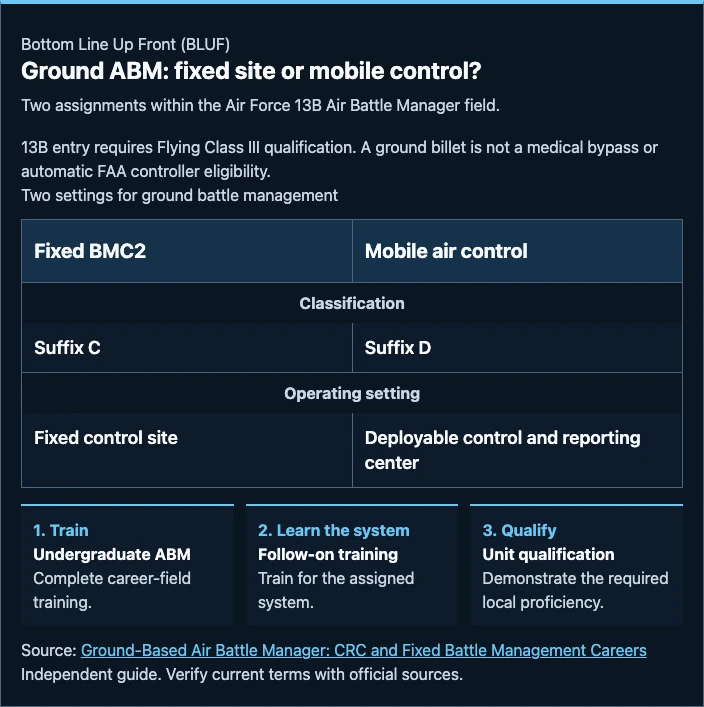
13B entry requires Flying Class III qualification. A ground billet is not a medical bypass or automatic FAA controller eligibility.
| Fixed BMC2 | Mobile air control |
|---|---|
| Classification | |
| Suffix C | Suffix D |
| Operating setting | |
| Fixed control site | Deployable control and reporting center |
- TrainUndergraduate ABMComplete career-field training.
- Learn the systemFollow-on trainingTrain for the assigned system.
- QualifyUnit qualificationDemonstrate the required local proficiency.
Source: Ground-Based Air Battle Manager: CRC and Fixed Battle Management Careers
Independent guide. Verify current terms with official sources.
On this page
Wing Duty is supported by purchases through our links, which may earn us a commission.
Job Role and Responsibilities
Ground-based Air Battle Managers direct fighters, tankers and other aircraft from a control center. They build the air picture from radar and data links, identify what is in the airspace, and issue the instructions that keep a mission coordinated. The job belongs to the 13B career field, and ground duty is an assignment within it rather than a separate specialty.
Scope grows with experience. A new controller works a position under supervision. A certified controller runs a sector alone.
More senior officers run the crew, then the operations shift, then the unit. In a deployable control center the senior controller may be the officer who decides what the radar picture means for the entire theater.
Mission contribution is airspace control. Somebody has to decide which aircraft goes where, which one gets fuel first, and which one is cleared to engage. In joint operations that decision often crosses service lines, and the ABM is the person on the radio who makes the plan work.
The equipment is a console, radios and a data link picture. A control and reporting center brings its own radar and communications gear. A fixed site ties into permanent infrastructure.
The systems differ, but the job on the headset is the same.
The difference between airborne and ground duty is worth stating plainly.
| Duty | Where the officer works | What changes |
|---|---|---|
| Airborne | Inside an aircraft with a crew | Flying duty, flight physical, aircrew schedule |
| Deployable ground | Control and reporting center | Packs and moves with the mission |
| Fixed ground | Permanent battle management site | Stable location, continuous shift coverage |
Fixed and Mobile Are Different Assignments
The officer classification directory identifies fixed battle management under 13B suffix C and mobile air control under suffix D. Both belong to the ABM field, and both require the relevant training and qualification. Those designations make the comparison more useful than dividing the field into officers who fly and officers who do not.
A control and reporting center (CRC) is designed to bring tactical control capability to a location. Its work depends on establishing communications and an air picture, then integrating with the forces it supports. A fixed battle management site instead works from an established location and infrastructure, although a fixed location does not imply ordinary office hours.
The distinction changes what to ask about an assignment:
- Mobile unit: How much time goes to exercises, equipment setup, and operations away from the home installation?
- Fixed site: Which shifts does the crew cover, how is certification maintained, and does the billet include travel or exercises elsewhere?
An official Western Air Defense Sector exercise account describes integration with the 116th Air Control Squadron. It illustrates that deployable and fixed organizations can work together; the categories are not isolated careers that never share a mission. One exercise is an example, not a deployment forecast for a prospective officer.
Qualification Follows the Mission System
Undergraduate ABM training establishes the foundation, but qualification for a particular weapon system is a further requirement. An officer moving between systems should not assume that a previous certification transfers without additional training. The unit determines proficiency against the applicable performance, experience, and training requirements.
For an applicant, this means that a career-field selection and a particular ground job are different outcomes. Ask which part of an offer is fixed, which assignment decisions occur later, and whether a unit-specific hiring process applies. A preference for a ground location should not be described as an assurance that all later assignments will stay there.
For a serving officer considering a move, ask how the new system differs from the current one and what training time is planned. Find out which qualifications are required on arrival and which will be completed at the gaining unit. That information is more useful than a generic statement that ground work is easier than flying work.
Compare the Crew’s Work Before Choosing the Location
The basic attraction is responsibility for a coordinated air picture and the decisions that follow from it. A reader who enjoys that work may find both a CRC and a fixed sector appealing, while someone seeking an aircraft cockpit is comparing the wrong occupation. The meaningful choice is the mission and working environment, followed by the actual assignment terms.
Ask a unit to describe the responsibilities of a new officer, how a controller is evaluated, and how the crew coordinates with other organizations. Also ask how frequently officers move between positions within the unit. Those questions help distinguish a concrete job from a recruiting description without assuming that every ground ABM performs identical duties.
Location stability should be assessed in the same way. A fixed facility may offer a consistent duty location, but certification, shift coverage, and mobilization requirements still shape time at home. Compare the unit’s actual expectations with your civilian work or family commitments before treating a Guard vacancy as a conventional part-time office job.
Salary and Benefits
Pay follows rank and years of service, and the 13B Air Battle Manager profile explains the shared rules, including how flying status affects pay.
| Rank | Pay Grade | Years of Service | Monthly Base Pay | Annual Base Pay |
|---|---|---|---|---|
| Second Lieutenant (2d Lt) | O-1 | 2 or less | $4,150 | $49,802 |
| First Lieutenant (1st Lt) | O-2 | Over 2 | $5,446 | $65,354 |
| Captain (Capt) | O-3 | Over 4 | $7,383 | $88,592 |
| Major (Maj) | O-4 | Over 10 | $9,420 | $113,040 |
Source: DFAS 2026 pay tables. Figures reflect the 2026 pay raise.
The officer food allowance is $328.48 a month. Housing allowance varies by rank, location and family status.
One honest caution about pay. Officers in flying positions may receive aviation incentive pay. A ground assignment alone does not settle entitlement.
Aviation incentive eligibility depends on the applicable service rules and the officer’s aviation history; it should not be inferred solely from whether the current console is on the ground. Ask about the specific billet rather than assuming the flying rate applies.
Qualifications and Eligibility
You commission first, then train as an ABM, then learn whether the follow-on assignment is airborne or ground.
| Path | Degree | Notes |
|---|---|---|
| ROTC | Bachelor’s, any major | Class rank and commander ranking matter |
| Officer Training School | Bachelor’s | Competitive selection |
| Air Force Academy | Bachelor’s | Assignment near graduation |
| Reserve or Guard | Bachelor’s | Hired against a specific unit |
The AFOQT is required. Air battle management does not use the TBAS, because the job is not piloting. Medical standards depend on the assignment.
Entry into 13B requires qualification for a Flying Class III physical, and award and retention require the applicable aviation qualification. A ground assignment is not an established medical bypass; discuss any condition or waiver with the authorized medical and accessions staff.
An AFOQT study course covers the composites in a set order and includes practice tests. This is an affiliate link. A study guide offers another study format to compare.
No course can promise a slot in this career field.

Competition for the career field varies by year and by commissioning source. The honest answer is that no fixed score guarantees it. Ask a recruiter what recent selects looked like rather than trusting a number from an older cycle.
Work Environment
The work happens on an operations floor. Screens, radios and a headset, with a crew around you. A control center runs continuously, so shifts cover nights, weekends and holidays.
A fixed site may run a steady rotation. A deployed center runs whenever the mission runs.
The pace swings. Long stretches of monitoring give way to intense minutes when something enters the airspace. Controllers who do well here can hold attention through the quiet parts and then act without hesitation.
A shift starts before the console does. The crew reviews the air tasking order, checks the radar and communications status, and takes a handover from the team coming off duty. During the shift the controller talks to aircraft, watches the picture and updates the plan as the mission changes.
At the end, the crew hands the picture to the next team in a briefing that leaves nothing ambiguous.
The hardest part is rarely the radio call. It is knowing which of several competing requests matters most when fuel, weather and timing all press at once. That judgment is what separates a certified controller from a competent one, and it takes years of shift work to build.
Officer and enlisted roles interlock closely. Enlisted radar and weapons technicians run the equipment, and the officer directs the fight. A new lieutenant who learns what the technicians know becomes useful much faster than one who does not.
Training and Skill Development
Initial training is the same undergraduate course that airborne ABMs attend. The split happens at the follow-on assignment.
| Phase | Location | Length | Focus |
|---|---|---|---|
| Undergraduate ABM training | Tyndall Air Force Base | Months | Airspace, radar theory, control procedures |
| Follow-on assignment | Airborne or ground unit | Assignment-dependent | Track and unit selection |
| Mission qualification | Home unit | Months | Position certification under supervision |
| Upgrade | Home unit | Years | Sector, crew and instructor certification |
Further training includes instructor duty, weapons and tactics courses, and joint air operations courses. Graduate education is available on a competitive basis and is not required for the ground path.
Professional military education follows the standard timeline, with Squadron Officer School early and the staff colleges later for officers who stay.
Career Progression and Advancement
| Rank | Career context, not a promotion date | Responsibility examples |
|---|---|---|
| O-1 to O-2 | Assignment and qualification dependent | Trainee, then certified controller |
| O-3 | Assignment and qualification dependent | Sector controller, instructor, scheduler |
| O-4 | Assignment and qualification dependent | Flight commander, assistant operations officer |
| O-5 | Assignment and qualification dependent | Operations officer, squadron command |
| O-6 | Assignment and qualification dependent | Group or wing command, staff |
Early promotion still depends on applicable eligibility and performance rules; it is not guaranteed. O-4 and above are board selections that weigh operational performance, professional education and progressive responsibility.
Broadening includes instructor billets, joint staff work, and assignments to air operations centers. Ground ABMs often build unusually deep joint experience, because airspace control crosses service boundaries every day.
Physical Demands and Medical Evaluations
Ground control work involves sustained attention at a console rather than piloting an aircraft. Officers still take the standard fitness assessment, and 13B entry requires Flying Class III qualification; a ground billet does not establish a lower career-field entry standard.
If you want the airborne path later, say so early. The applicable medical authority decides qualification and any waiver. Passing an examination earlier does not guarantee qualification for a later assignment, and this page cannot predict an individual medical outcome.
Deployment and Duty Stations
A deployable control center goes where the fight is. Teams rotate through forward locations, set up the equipment, run the air picture and hand off. A fixed site stays home and covers its permanent area, which can include homeland air defense.
Fixed sites are concentrated at a small number of locations, some of them in the Air National Guard. Deployable units rotate more. The assignment process uses a preference list with a needs-of-the-force overlay, so the location you want and the location you get are not the same conversation.
Risk, Safety, and Legal Considerations
The risk profile is lower than flying, and it is not zero. Controllers make decisions that put aircraft in the same piece of sky, and a mistake can kill people. That is why certification takes months and why procedures exist for every routine action.
The legal side is command authority. An officer on the operations floor may be directing aircraft from another service or another country, and the orders carry weight. Accountability for those decisions is part of the job.
Impact on Family and Personal Life
Shift work is the main family consideration. A rotating schedule is harder to plan around than a daytime job, and it takes a household that can adapt. Fixed sites with stable rotations are easier than deployable units that leave on short notice.
Family support runs through the Airman and Family Readiness Center and unit programs. Permanent change of station moves are part of the career, though fixed-site assignments can be longer than average.
Reserve and Air National Guard
Ground battle management is one of the career fields where the Guard carries real weight. Air defense sectors and control squadrons exist in the Air National Guard, and some units hire directly into them.
| Item | Active duty | Reserve | Air National Guard |
|---|---|---|---|
| Commitment | Full time | Drill plus annual tour | Drill plus annual tour, state mission added |
| Location | Rotates | Tied to unit | Tied to unit |
| Pay | Monthly basic pay plus allowances | Drill pay plus active duty periods | Drill pay plus active duty periods |
| Retirement | Pension at 20 years | Points based | Points based |
A Guard hire often means a stable location and a civilian career alongside the military one, which suits people who want the work without the moving.
Post-Service Opportunities
The civilian destination is airspace work. Air traffic control is a possible career to investigate, but battle management is not the same qualification as civilian air traffic control. The FAA experienced-controller route requires qualifying ATC experience and ratings; ABM service alone does not establish eligibility or reduced training.
| Civilian field | US median annual pay, May 2025 | Outlook, 2025 to 2035 |
|---|---|---|
| Air traffic controllers | $148,080 | 2 percent growth |
| Management analysts | $101,860 | 10 percent growth |
| Operations research analysts | $88,940 | 12 percent growth |
These are occupation-wide medians, not offers to former ABMs. Each civilian role has its own entry and education requirements.
Defense contractors also hire former ABMs for simulation, training and air operations support. The Transition Assistance Program covers the mechanics of the move.
Is This a Good Job for You? The Right (and Wrong) Fit
This job suits someone who likes systems, procedures and real consequences without needing to be in the aircraft. It rewards people who can stay calm on a headset while several aircraft need attention at once.
It fits poorly if you need variety or daylight. The work is repetitive by design, because repetition is what makes the response reliable. It also fits poorly if you want to fly.
Ground ABMs are not pilots, and no amount of ground experience converts into a cockpit.
More Information
Ask a recruiter whether current openings are airborne or ground, and ask a control squadron what a new controller’s first year looks like. Then work the parts you control: the degree, the AFOQT score, the medical review and the fitness standard.
The 13B Air Battle Manager profile covers the airborne side and the shared training. The Nuclear and Missile Operations page covers the other command and control field in the same family, and the Operations officer group shows how the whole community fits together.