Air Force Experimental Test Pilot: The 11E Path
An Air Force experimental test pilot plans and flies tests that help determine whether an aircraft or system meets its requirements. The 11E qualification follows pilot training and the required test-pilot schooling; it is not a civilian entry slot.
For a serving pilot, the useful questions are whether the degree fits, how school selection works, and what is required for qualified 11E duty. A test program also depends on engineers and other crew specialists whose qualifications differ from the pilot’s.
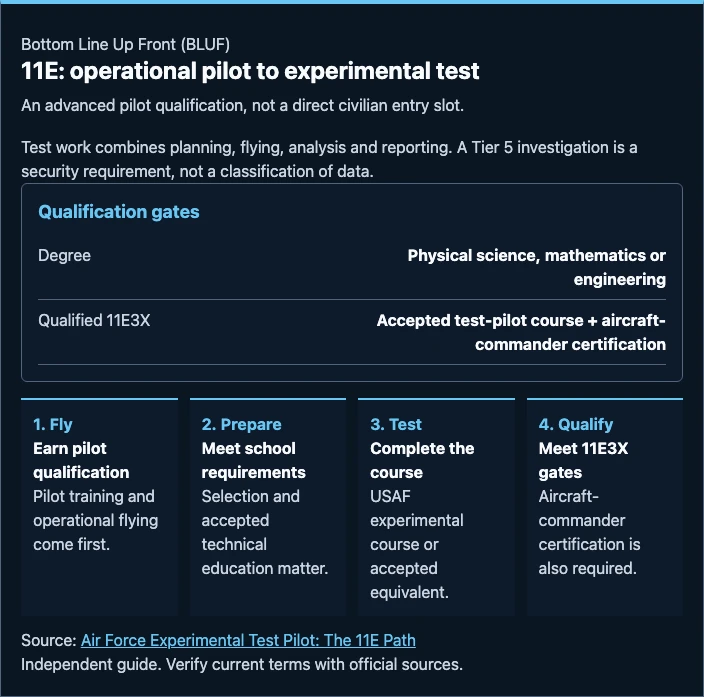
Test work combines planning, flying, analysis and reporting. A Tier 5 investigation is a security requirement, not a classification of data.
Qualification gates
- Degree
- Physical science, mathematics or engineering
- Qualified 11E3X
- Accepted test-pilot course + aircraft-commander certification
- FlyEarn pilot qualificationPilot training and operational flying come first.
- PrepareMeet school requirementsSelection and accepted technical education matter.
- TestComplete the courseUSAF experimental course or accepted equivalent.
- QualifyMeet 11E3X gatesAircraft-commander certification is also required.
Source: Air Force Experimental Test Pilot: The 11E Path
Independent guide. Verify current terms with official sources.
On this page
Wing Duty is supported by purchases through our links, which may earn us a commission.
Job Role and Responsibilities
An 11E plans, flies, and reports on flight test programs covering planes, space vehicles, simulators, and the systems that go with them. The pilot flies the test, leads the team, and writes the answer that shapes the design.
The rule book lists four duties, and they are easy to state. The first covers the test itself, where the pilot writes the test steps and then flies them. That work tests strength, speed, handling, and how well the plane holds up.
It is the heart of the job, because a new plane is not one question but thousands.
The pilot also runs the project and ties the goals together, which means leading the test team. Running flight ops is part of that, and it is a leadership job rather than a flying one. The pilot also identifies flaws and recommends fixes.
The findings go into a report that changes hardware, because a flaw found early saves lives. Staff work closes the loop, and it means writing policy, watching the program, and briefing the boss.
The Designations
Once a pilot is rated, a letter after the code says what kind of test work the officer is qualified for. The April 2026 officer classification directory lists the field.
| Shredout | Covers |
|---|---|
| A | Airlift, tanker, and bomber |
| B | Fighter |
| C | Helicopter and V/STOL |
| D | Airlift |
| E | Tanker |
| F | Bomber |
| G | Remotely piloted aircraft |
| Q | Mission support aircraft |
| Y | General |
| Z | Other |
Suffix A covers the three heavy categories together, while D, E and F split the same work by aircraft type. The directory keeps both forms, so a record may show either.
What a Test Sortie Is
A test sortie is scripted before anyone walks to the jet. The crew already knows the points it needs, the order it will fly them, and the limit it must not cross. Gear on board records far more than a crew could feel.
The flying is strict and repetitive: the crew performs the same maneuver at slightly different settings. That is how a flight envelope grows, one small step at a time.
Test Pilot or Flight Test Engineer
Two officers often share one test cockpit, and they are not the same job. We cover the other one on the 62E flight test engineer role. The engineer comes from an acquisition or engineering field, so an engineer can reach flight test without ever flying solo.
Engineers often fly to run gear and sort data. The 11E is a pilot specialty, so wings come first and the school follows. The test pilot owns the plane and the move, while the engineer owns the numbers, and a good test program needs both.
Test Flying Versus Combat Flying
The distinction is the question the test needs to answer:
- Design testing: Does the system work as designed? This comes early, near the builder and often at a test base.
- Combat testing: Does it work for the troops? This comes later, with operational crews and tactics.
An 11E can do either, depending on the assignment.
Salary and Benefits
| Rank | Pay Grade | Years of Service | Monthly Base Pay | Annual Base Pay |
|---|---|---|---|---|
| Second Lieutenant (2d Lt) | O-1 | 2 or less | $4,150 | $49,802 |
| First Lieutenant (1st Lt) | O-2 | Over 2 | $5,446 | $65,354 |
| Captain (Capt) | O-3 | Over 4 | $7,383 | $88,592 |
| Major (Maj) | O-4 | Over 10 | $9,420 | $113,040 |
Source: DFAS 2026 pay tables. Figures reflect the 2026 pay raise.
Base pay depends on rank and years and is the same for every officer. Flying pay is the main difference. Flying officers get Aviation Incentive Pay, which the Air Force shortens to AVIP.
Eligibility and rates depend on aviation service, applicable career requirements, and current pay authority. Ask the finance office to verify the actual entitlement; currency alone does not establish continuing payment.
Food and housing allowances work the same way as anywhere else. The housing rate depends on the base and on whether you have family, and health care comes through TRICARE Prime. Place matters more here than in most jobs, because Edwards sits in the high desert.
Home prices in the Antelope Valley are not the same as a base on the coast, so run the numbers for the base and not for the field. Bonus programs for rated officers change each year, so ask an assignment officer for the current one. Do not trust a figure from an old page.
Qualifications and Eligibility
Pilot Wings Come First
Entry needs completion of Specialized Undergraduate Pilot Training, and that is gate one. There is no way around it. Award and retention also require the current pilot rating and qualification for aviation service specified by the directory.
That is why this is a later-career qualification. A pilot commissions, learns to fly, and flies for real before trying for test.
| Path to the pilot seat | Degree | What decides it |
|---|---|---|
| ROTC | Bachelor’s, any major | Class rank and commander ranking drive the pilot slot |
| Officer Training School | Bachelor’s | Competitive selection, aviation physical required |
| Air Force Academy | Bachelor’s | Assignment happens near graduation |
| Reserve or Guard | Bachelor’s | Hires against a specific unit and aircraft |
None of those paths leads to 11E directly. Each one leads to pilot training, and this qualification comes after operational flying. Class standing and the needs of the force decide the aircraft, and no commissioning source promises a test slot.
The AFOQT and the TBAS belong to the pilot application rather than to this qualification. If that test is still ahead of you, the AFOQT study course is the first paid option on this page. This is an affiliate link.
A study guide is another format to compare if structured self-study suits you. The free AFOQT guide on this site explains the composites and what each one measures. No course can promise a school slot.

The Degree Rule
The rule book is firm here, because entry needs a degree in physical science, math, or engineering. It says mandatory. That word does work, since most fields call a tech degree nice to have while this one does not.
Test work is full of numbers, and the school assumes a candidate can handle them. If you are still picking a major, that line should shape the choice.
Test Pilot School Is Mandatory
The 11E3X stamp requires the Test Pilot School experimental course. The rule also accepts an equivalent course from the Navy or an allied test pilot school. The school sits at Edwards AFB in California, where the 412th Test Wing runs it.
The Air Force Test Center calls it the place where top pilots, navigators, and engineers learn to run tests and pull the data out.
Aircraft Commander Sign-Off
Before the stamp, an operations authority must certify the officer as an aircraft commander. That is a second gate rather than a formality, and it says the officer can lead a crew. The record has to show it before the 11E3X follows.
Clearance
The specialty requires a Tier 5 background investigation for award and retention. Tier 5 describes the investigation, not a classification assigned to data or equipment. The entry level can be awarded before that check finishes when an interim Top Secret clearance is in place, and the full check still has to follow.
What Does Not Exist
There is no direct commission, no civilian path, and no route that skips real flying. Any page saying otherwise contradicts the rule book.
Work Environment
The Test Center
Most of this work sits at a test base rather than a combat wing. Edwards is the big one, and the 412th Test Wing is the host unit. That wing plans, flies, studies, and reports all air and ground tests of planes, weapons, software, and parts, and it also runs models and sims.
The chain above it is the Air Force Test Center, which sits under Air Force Materiel Command. The Center runs early and follow-on tests of crewed and uncrewed planes, plus avionics, flight controls, bombs, and weapons.
Inside a Test Wing
Test wings group by what they test, and the Edwards units show the pattern. The 411th works the F-22, the 416th takes fighters, and the 419th takes bombers. The 418th takes airlift and tankers, the 461st handles the F-35, and the 452nd takes uncrewed aircraft.
That grouping matters at assignment, because test pilots do not test planes in the abstract. They join a unit that owns one program.
A Week on the Ground
Flying is the part people see, and it is not the whole job. The week fills with plan reviews, safety boards, data checks, and meetings. Test plans get fought over line by line, and engineers, maintainers, and safety staff all get a say.
If you want to fly more and plan less, the split will annoy you.
Other Bases
Edwards is not the only spot, because Eglin AFB hosts the 96th Test Wing. That wing runs tests of bombs, navigation, guidance, and command and control gear. Some work happens at Wright-Patterson AFB under Air Force Materiel Command.
Navy test units also take Air Force pilots on exchange, which is one reason the rule takes a Navy school.
Training and Skill Development
The Long Path
The path runs in steps, and each one gates the next. It starts with pilot training, where a pilot earns wings, then a real flying post where skill grows. A pilot without operational flying experience has no foundation for test work.
Then comes Test Pilot School, where entry is a contest and the school picks from the whole rated force.
| Phase | Where | Length | Focus |
|---|---|---|---|
| Pilot training | Several bases | About a year | Wings, instruments, formation, navigation |
| Operational flying | Assigned unit | Several years | Mission qualification, aircraft commander, crew leadership |
| Test Pilot School | Edwards AFB, CA | About a year | Test planning, execution, data analysis |
| First test tour | A test wing | Months | Flying programs as a crew member |
What the School Teaches
The core skill is not hard flying but asking a clean question and trusting the data. Students learn to write a plan that answers one thing, and to fly it so the data means something. They also learn to sort the results and defend them to engineers who will push back.
The degree rule starts to make sense here, because the output is a tech report and not a war story.
After the School
The first post is usually a test unit, where new test pilots fly as part of a crew under a skilled hand. It is like any first tour. More courses come with time, including safety training and classes on the airframe.
The learning does not stop at one school.
Career Progression and Advancement
The field has three levels, and they track duty rather than time alone. The 11E1 is the entry and student level, the 11E3 is the rated aircraft commander, and the 11E4 is the staff level. Upgrade to 11E3 rests on the unit commander’s call, where skill, time, and the minimum courses all count.
| Rank | Career context, not a promotion date | Responsibility examples |
|---|---|---|
| O-1 to O-2 | Assignment and qualification dependent | Student pilot, then mission qualification in an operational unit |
| O-3 | Assignment and qualification dependent | Aircraft commander, instructor, then a first test tour |
| O-4 | Assignment and qualification dependent | Flight commander, test program lead |
| O-5 | Assignment and qualification dependent | Operations officer, squadron command |
| O-6 | Assignment and qualification dependent | Group or wing command, senior staff |
The qualification usually arrives in the middle of that ladder rather than at the start, which is why the O-3 and O-4 rows matter most to a pilot planning the move.
The Path Up
Early years go to flying and earning ratings. A new test pilot usually builds experience on one program before moving to another for breadth. Mid-career brings flight command and program lead, since running a whole program rather than one sortie is a normal step.
Senior officers move to division and wing lead, or to a program office. Test time is worth a lot there, because the officer has seen how a plan meets real hardware.
Promotion
Promotion past O-4 is picked by a board, and the board reads the whole file. Test tours are demanding and visible, which can help at promotion time. Staff work is still expected, so skip it and the path narrows.
An officer who flies well and writes nothing will stall, because the job wants both.
Physical Demands and Medical Evaluations
Test flying is harder on the body than most flying jobs, and the medical bar shows it. The officer must hold a current flying physical for the whole career, with vision, heart, hearing, and nerves checked on a set cycle. A problem that ends flying ends the field.
The Fitness Test
Every officer takes the general fitness test, and test pilots are no exception. The current assessment scores a run or shuttle run, strength and core events, and a waist to height measure. The pass mark is 75 points, and each chosen event also has a minimum.
| General test, under age 25 | Male | Female |
|---|---|---|
| Minimum satisfactory total | 75 points | 75 points |
| Event minimums | Meet each chosen event’s chart minimum | Meet each chosen event’s chart minimum |
| Failure despite 75 total | A missed event minimum can make the result unsatisfactory | A missed event minimum can make the result unsatisfactory |
Use the current age- and sex-specific official charts on the Air Force fitness page.
G and the Seat
Fighters and trainers pull hard G, and test work often pushes to the edge of what a crew can take. That edge is part of what gets measured. An ejection seat is a live system, and crews train in a chamber for high altitude and sudden pressure loss.
They train for spatial disorientation too.
The Honest Part
Test flying is safer than it once was, and it is still dangerous. Growing the envelope means flying where the answers are not known. The people who do it say the prep is what makes it bearable, not the risk.
Deployment and Duty Stations
Test posts are mostly at home base, which is a real change from a combat flying tour and one reason pilots want the job.
Where the Work Sits
Edwards AFB in California is the center of Air Force flight test. Eglin AFB in Florida hosts bomb and command-and-control tests, and Wright-Patterson AFB in Ohio hosts Air Force Materiel Command. Test pilots also serve in program offices and at staff, where the flying is rare and the study is constant.
Trips
Test units do deploy, though less predictably than a combat unit. A test pilot may fly to a forward base to check a system in the environment it was designed for. Short trips are common, so expect runs to builder sites, other service ranges, and the units that will get the hardware.
Risk, Safety, and Legal Considerations
The Safety Culture
Flight test depends on risk reviews, and the paperwork matters. Each plan gets a review before flight, and crews brief the bad cases, the stop points, and the limit that ends the sortie. Crew resource training is mandatory and recurring.
The goal is to make it normal for the junior person to call a stop. When something goes wrong, the investigation looks for systemic causes rather than blaming one person. That approach is deliberate: a team punished for bad news stops reporting it.
Command and Law
A test pilot is an officer first, which means command over assigned Airmen and a duty under military law. Test pilots also sit near buying choices, so rules on fair dealing and conflicts of interest apply. The military also monitors contact with contractors and enforces the rules.
If you plan to work for a contractor later, read the post-job limits while you still serve.
Impact on Family and Personal Life
Place Sets the Tone
Edwards AFB sits in the Mojave Desert, about an hour and a half from Los Angeles with traffic permitting. The nearest real towns are Lancaster and Palmdale. Location matters more than the job description: spouse employment is the common complaint, commutes are long, and summers are hot.
The trade is space, low home costs for California, and a tight base where everyone does the same work.
Schedule
Test hours are steadier than combat hours, and they still slip. One milestone can pull a crew into six-day weeks for a month. Short trips add up, and so does study, because a test pilot is often in a course or getting ready for one.
Moves
Test posts usually run a few years, and then the officer moves. The next stop may be another test unit, a staff job, or a flying post to keep the hours up. Expect to move on the normal officer cycle, though the list of places is shorter and easier to guess.
Reserve and Air National Guard
This is where the honest answer matters more than a hopeful one. The 11E depends on full-time requirements: pilot training, a current pilot rating, a commander’s sign-off, and Test Pilot School. Those cannot be completed in a drill weekend.
Test flying itself sits in full-time units under Air Force Materiel Command, and the units that run programs are staffed by full-time crews.
| Item | Active duty | Air Force Reserve | Air National Guard |
|---|---|---|---|
| Test flying | Full-time test wing | Only if the unit holds a test task | Only if the unit holds a test task |
| School | Test Pilot School through the command | Same school, nominated by the unit | Same school, nominated by the unit |
| Commitment | Full time | Drill plus annual tour | Drill plus annual tour, state mission added |
| Pay | Monthly basic pay plus allowances | Drill pay plus active duty periods | Drill pay plus active duty periods |
| Retirement | Pension at 20 years | Points based | Points based |
That does not shut the door, because a Reserve or Guard pilot can still chase test work. Ask a recruiter or rated assignment officer about your unit rather than the career field. Ask two things: does the unit you would join have a test task, and does it send people to Test Pilot School?
The answers settle it faster than any page.
Post-Service Opportunities
A test pilot leaves with a rare mix: a flying record, a technical degree, and direct experience judging weapons systems. That background fits flight-test firms and program offices that need someone who knows the cockpit and the plan.
| Civilian Role | Median Annual Salary | Job Outlook (2025-2035) |
|---|---|---|
| Aerospace engineer | $134,960 | +8% |
| Operations research analyst | $88,940 | +12% |
| Management analyst | $101,860 | +10% |
Salary data comes from the Bureau of Labor Statistics, May 2025. These are occupation-wide medians, not test-pilot salaries or offers to former officers; each role has separate education and hiring requirements. Contractors, test support firms, and air safety bodies are employers to investigate.
The Transition Assistance Program covers the move out, and Hiring Our Heroes runs fellowships for officers. One caution: post-job rules limit what a leaving officer can do for a contractor on programs the officer ran. Read them while you still serve.
Is This a Good Job for You? The Right (and Wrong) Fit
Who Does Well
People who do well in test are patient with the process and stubborn about proof. They like the fight over the plan as much as the flight. They also tend to teach, because a test pilot spends hours explaining results to engineers, commanders, and crews who were not there.
If you liked the tech side of flying and wanted more of it, this is the job that gives you more.
Who Struggles
If you measure a career by the number of sorties, test will feel slow, because the planning and reporting workload may be a poor fit. If you hate writing, this is the wrong field, since the report is the product. A great sortie with a weak write-up gives the program nothing.
If you need to be the only voice that decides, the test culture will chafe, because every number gets checked, including yours.
How It Compares
A test assignment has a different workload from an operational fighter assignment; neither title establishes a predictable schedule. Next to a staff job, it keeps you in the plane. Next to the 62E flight test engineer route, the gap is the start, because the engineer can enter with a tech degree while the pilot needs wings and real flying time first.
A Fair Summary
This is a small, hard, and much sought field for pilots who want to shape hardware rather than just fly it. It is no shortcut, and it is not for everyone. The fit depends on whether the officer wants the planning, analysis, and reporting responsibilities as well as the flying.
More Information
Ask a recruiter or an ROTC detachment which boards are open, and ask a test squadron what a new test pilot does in the first year. Then work the parts you control: the degree, the test scores, the flight physical and the fitness standard.
Questions to put to a recruiter or an assignment officer:
- Which units at your target base run the programs you care about? The unit, not the base, sets what you test.
- How does your command pick people for the school? It runs through the command, and the timing shifts by year.
- Does your degree meet the rule? Physical science, math, or engineering. Ask before you plan.
- What happens if you are not picked? The answer should be a good flying post, not a dead end.
Browse the rest of the operations career group for the rated fields this one builds on.
The 11X Pilot profile covers the commission, the AFOQT and the flying physical, and all of that comes before this page. The Fighter Pilot and Bomber Pilot pages cover the operational tours that usually come first.