Airborne Missileer: The Airborne Launch Control System Officer Role
A missile officer can serve aboard an aircraft. The job exists because the land based missile force needs a way to operate if a ground control center is destroyed or degraded. A small number of qualified missileers fly with that mission.
This is not an entry level flying job and it is not a separate career field. You become a missile officer first, serve on crew, and later compete for the airborne assignment. Nobody commissions into it directly.
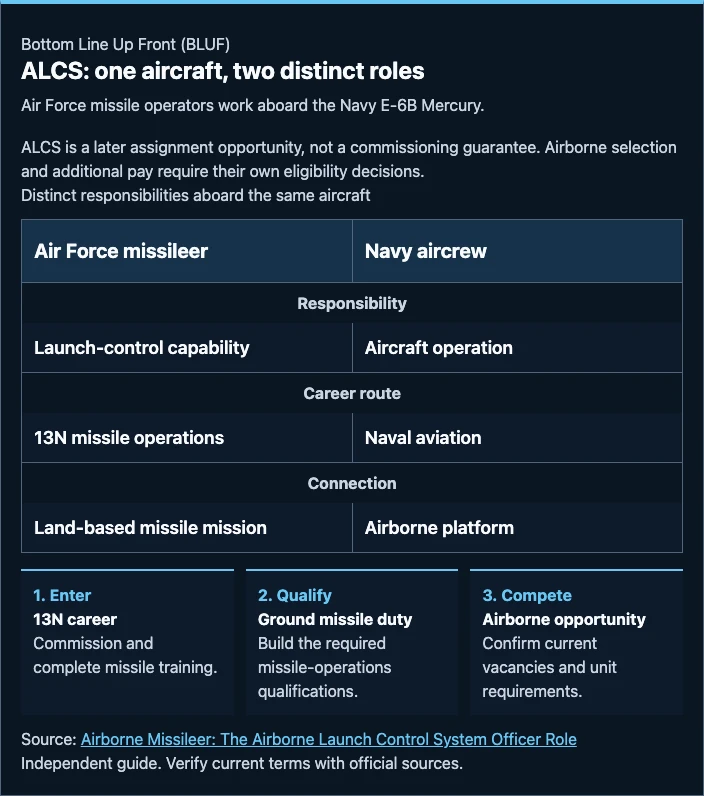
ALCS is a later assignment opportunity, not a commissioning guarantee. Airborne selection and additional pay require their own eligibility decisions.
| Air Force missileer | Navy aircrew |
|---|---|
| Responsibility | |
| Launch-control capability | Aircraft operation |
| Career route | |
| 13N missile operations | Naval aviation |
| Connection | |
| Land-based missile mission | Airborne platform |
- Enter13N careerCommission and complete missile training.
- QualifyGround missile dutyBuild the required missile-operations qualifications.
- CompeteAirborne opportunityConfirm current vacancies and unit requirements.
Source: Airborne Missileer: The Airborne Launch Control System Officer Role
Independent guide. Verify current terms with official sources.
On this page
Wing Duty is supported by purchases through our links, which may earn us a commission.
Job Role and Responsibilities
An airborne missileer serves aboard an airborne command post as part of a crew that can control land based missiles from the air. The officer is a qualified nuclear and missile operations officer who has moved into a flying assignment. The work supports the same deterrent mission as a ground launch crew, from a different platform.
The unit at the center of this mission is the 625th Strategic Operations Squadron at Offutt Air Force Base in Nebraska. It falls under Air Force Global Strike Command and works alongside the Navy crews that fly the aircraft. Air Force officers serve aboard a Navy platform, which makes the crew arrangement unusual and worth understanding before you apply.
Command scope follows the missile career field rather than a flying squadron. A new airborne officer works a crew position. More senior officers lead the airborne element, then move into operations and staff roles.
Because the community is small, seniority arrives quickly for the officers who stay.
Mission contribution is continuity. The ground based missile force depends on launch control centers, and those centers are fixed targets. Putting the same capability in the air removes a single point of failure.
That is the whole reason the mission exists.
Specific designations matter here. The officer specialty is 13N, nuclear and missile operations. The airborne duty is an assignment and a qualification within that specialty, not a separate suffix that a recruit can request.
Two limits belong in this article. First, the sources establish the role, not current billet availability, selection odds or a guaranteed first assignment. Second, the mission involves procedures that are not described here and should not be.
The Aircraft and the Joint Mission
The airborne platform in the official accounts is the Navy E-6B Mercury. Air Force missileers bring the land-based missile mission aboard that aircraft, while the Navy provides the flying platform and aircrew. The service that owns the aircraft and the service that qualifies its missile operators are different, which is why an applicant should not treat this as either Navy pilot training or an ordinary Air Force flying assignment.
An official account of a 625th STOS test mission describes ALCS employment aboard the E-6B as part of an unarmed ICBM launch test. That is evidence of a real airborne launch-control mission, not evidence that new officers can select the tour at commissioning. A test event also does not establish the crew roster or schedule for every operational mission.
For someone comparing careers, the important distinction is the object being controlled. The missileer supports the land-based missile force from an airborne command post; the pilot flies the aircraft carrying that capability. If the appeal is primarily flying an airplane, a pilot career is the comparison to make before committing to the missile field.
How to Investigate a Later Airborne Tour
Start with the ground career because that is the work an applicant must be willing to do without an airborne offer. Ask a missile officer to describe the qualification process, crew evaluations, and the responsibilities of a normal ground assignment. A plan that is acceptable only if a later competitive assignment appears is a fragile basis for choosing the field.
For a serving missileer, ask the assignment office:
- Which qualifications are required when applying?
- Is there a current opening?
- Which medical review must be completed?
- How does the tour fit the officer’s development, and what return assignments are possible?
No published selection percentage or guaranteed date is established here, so those details should come from the current vacancy and assignment process.
Keep selection separate from mission qualification. Being chosen for a tour does not mean the officer can immediately perform every crew duty, just as completing initial missile training does not remove the need for local qualification. Before accepting a plan, identify which office owns selection, which unit owns training, and which authority records the final qualification.
What a Public Mission Account Cannot Tell You
Public reporting can explain why the airborne capability exists and show that units exercise it. It should not be used to reconstruct operational procedures, infer readiness, or predict a specific officer’s assignments. A career guide needs the publicly supported job distinction and application boundaries, not technical launch instructions.
That limit also affects lifestyle comparisons. A report about one test flight cannot establish a normal month’s flying frequency, time away from home, or a predictable family schedule. When speaking with the unit, ask about the routine training cycle and recent temporary-duty demands without requesting protected operational details.
The same caution applies to post-service work. Experience in a nuclear mission may be relevant to defense programs, but it does not confer an engineering degree or a civilian professional license. Compare the educational and technical requirements of an actual vacancy before interpreting the civilian salary table as a likely personal outcome.
Salary and Benefits
Basic pay follows rank and years of service. The Nuclear and Missile Operations profile covers the shared pay and allowance rules for the career field.
| Rank | Pay Grade | Years of Service | Monthly Base Pay | Annual Base Pay |
|---|---|---|---|---|
| Second Lieutenant (2d Lt) | O-1 | 2 or less | $4,150 | $49,802 |
| First Lieutenant (1st Lt) | O-2 | Over 2 | $5,446 | $65,354 |
| Captain (Capt) | O-3 | Over 4 | $7,383 | $88,592 |
| Major (Maj) | O-4 | Over 10 | $9,420 | $113,040 |
Source: DFAS 2026 pay tables. Figures reflect the 2026 pay raise.
The officer food allowance is $328.48 a month. Housing allowance depends on rank, location and family status.
An airborne billet can carry flying-duty requirements and potentially additional pay, but this page does not establish a particular incentive entitlement. Ask the personnel and finance offices which authority applies to the actual billet; being aboard an aircraft does not make a missile officer a rated pilot.
Qualifications and Eligibility
The path starts like any other missile officer path. You commission, train as a 13N, and serve on a ground crew.
| Path | Degree | Notes |
|---|---|---|
| ROTC | Bachelor’s, any major | Class rank drives the selection |
| Officer Training School | Bachelor’s | Competitive, technical background helps |
| Air Force Academy | Bachelor’s | Assignment near graduation |
| Reserve or Guard | Confirm the actual vacancy | Do not assume a part-time ALCS entry route exists |
The AFOQT is required. A technical degree is not mandatory but it helps, because the coursework covers nuclear systems, physics and engineering fundamentals. Medical standards for the airborne tour are stricter than for ground duty, since flying status requires an aircrew physical.
An AFOQT study course covers the composites in a set order and includes practice tests. This is an affiliate link. A study guide offers another study format to compare.
No course can promise a slot in this career field.

Selection for the airborne assignment happens later, from within the qualified community. No published board score guarantees it. The practical answer is to do well on crew, stay medically qualified and apply when the opening appears.
Work Environment
Ground duty comes first and it looks nothing like flying. A missile crew works shifts in a hardened launch control center, often far from a main base, with long periods of monitoring and strict procedures.
The airborne tour changes the setting and keeps the discipline. Crews fly long missions, sometimes very long, and the work alternates between checks, drills and waiting. The people who do well are the ones who can hold a standard through hours of quiet.
A ground crew tour comes first, and it is not a formality. Alert duty builds the habits the airborne mission depends on, because the airborne crew is doing the same job with fewer people and no second chance. Officers who arrive at the airborne unit without that grounding struggle with the pace.
The airborne crew is small and the roles are fixed. Air Force missileers operate the ALCS as part of a joint crew, while Navy aircrew operate the aircraft and its other mission systems. The specific crew positions and qualifications must be confirmed with the unit, rather than inferred from a generic officer-versus-enlisted division.
That intimacy is the appeal for some officers and the difficulty for others, since there is nowhere to hide on a bad day.
Officer and enlisted roles are tightly coupled. Enlisted operators work the equipment alongside the officer, and the crew functions as a single unit. There is little room for hierarchy games in a capsule or a cabin.
Training and Skill Development
| Phase | Location | Length | Focus |
|---|---|---|---|
| Undergraduate missile training | Vandenberg Space Force Base | Months | Nuclear systems, procedures, crew fundamentals |
| Mission qualification | Home unit | Months | Crew certification under evaluation |
| Ground crew duty | Missile wing | Years | Alert tours, evaluations, instructor upgrades |
| Airborne qualification | Confirm with the gaining unit | Current course and unit requirements | Flying duty, airborne systems, crew integration |
Further training includes instructor and evaluator duty, weapons and tactics work, and joint nuclear planning courses. Graduate education is available on a competitive basis through the Air Force Institute of Technology and is not part of the normal path.
Professional military education follows the standard officer timeline, with Squadron Officer School early and the staff colleges later.
Career Progression and Advancement
| Rank | Career context, not a promotion date | Responsibility examples |
|---|---|---|
| O-1 to O-2 | Assignment and qualification dependent | Student, then crew member on alert |
| O-3 | Assignment and qualification dependent | Crew commander, instructor, evaluator |
| O-4 | Assignment and qualification dependent | Flight commander, operations staff |
| O-5 | Assignment and qualification dependent | Operations officer, squadron command |
| O-6 | Assignment and qualification dependent | Group or wing command, joint nuclear staff |
Early promotion still depends on applicable eligibility and performance rules; it is not guaranteed. O-4 and above are board selections. Nuclear communities weigh evaluation performance and procedural discipline heavily, because the mission tolerates no shortcuts.
Broadening includes staff work in nuclear policy and plans, joint assignments, and exchange tours. The community is small enough that a well regarded officer can move between operational and policy work several times.
Physical Demands and Medical Evaluations
Ground crew duty is mentally demanding and physically static. Officers take the standard fitness assessment and hold a medical clearance for nuclear duty.
The airborne tour adds an aircrew physical, which reviews vision, hearing, heart and any condition that could affect judgment in flight. Because the airborne opportunity arrives years into a career, a condition that appears in the meantime can close it. That is worth knowing before you build a plan around flying.
Deployment and Duty Stations
Missile wings sit at three active duty bases, and the airborne unit sits at Offutt. Ground crew duty means rotating through alert tours at a missile complex. The airborne tour means flying from Nebraska with detachments elsewhere.
A continuous home-station mission does not establish how frequently an individual officer will travel or deploy. Ask the unit about its current alert, exercise, and temporary-duty schedule, especially when comparing an airborne tour with a ground crew assignment.
Risk, Safety, and Legal Considerations
The obvious risk is nuclear. The controls are procedural, layered and evaluated constantly, and the culture treats any deviation as serious. Officers who cannot accept that level of scrutiny should choose a different field.
Flying adds ordinary aviation risk and the fatigue that comes with long missions. Crew rest rules exist for that reason.
Legal responsibility is unusually direct. A missile officer holds authority that most officers never touch, and the accountability that comes with it is explicit in training, evaluation and the Uniform Code of Military Justice.
Impact on Family and Personal Life
Missile duty has a reputation for a difficult schedule and it is earned. Alert tours mean days away from home on a rotation, and the bases are often in rural areas with long commutes.
The airborne tour changes the rhythm rather than removing the absences. Family support runs through the Airman and Family Readiness Center and unit programs, and the small community tends to look after its own.
Reserve and Air National Guard
Missile operations exist almost entirely on active duty. The Air National Guard does not operate intercontinental ballistic missiles, and Reserve missile billets are limited.
| Item | Active duty | Reserve | Air National Guard |
|---|---|---|---|
| Missile crew | Yes | Very limited | No |
| Airborne tour | Yes | No | No |
| Retirement | Pension at 20 years | Points based | Points based |
An officer who wants this work part time should plan on a different career field rather than counting on a Guard missile squadron.
Post-Service Opportunities
Nuclear and defense program work are civilian fields to investigate. A military clearance and operational experience do not replace the education, technical skills, and hiring requirements of a particular vacancy.
| Civilian field | US median annual pay, May 2025 | Outlook, 2025 to 2035 |
|---|---|---|
| Nuclear engineers | $133,970 | Little or no change |
| Operations research analysts | $88,940 | 12 percent growth |
| Management analysts | $101,860 | 10 percent growth |
These are occupation-wide medians, not predicted starting salaries or offers to former missile officers.
The Transition Assistance Program covers the mechanics. The technical depth is real, though a civilian nuclear engineering role usually expects an engineering degree, so the transition is easier for officers who already hold one.
Is This a Good Job for You? The Right (and Wrong) Fit
This job suits people who take procedure seriously and do not need visible excitement. The satisfaction comes from holding a standard that almost nobody sees.
It fits poorly if you want variety, daylight or a big community. It also fits poorly if you want to fly. Flying here is a tour inside a ground career, not the career itself, and treating it as the goal leads to disappointment.
More Information
Before choosing the ground career in hopes of an airborne tour, ask:
- Entry: Which commissioning and testing requirements apply to your route?
- Ground duty: What does the unit’s normal alert and evaluation cycle require?
- Later selection: What qualifications and current openings does the airborne unit have?
- Medical review: Which authority determines eligibility for the specific billet?
These are separate decisions. Prepare for the ground career on its own terms rather than treating a later airborne assignment as assured.
The Nuclear and Missile Operations profile covers the ground crew career in full. The Air Battle Manager page covers the other command and control field that works the same airspace problems, and the Operations officer group shows where both sit in the wider community.