Air Force Advanced Weather Officer: The 15W3A Graduate Path
Weather officers forecast for aircraft, convoys and commanders. The Advanced Weather Activities suffix records additional graduate education within that field; a completed degree is one qualifying route, not the only one.
The Air Force marks those officers with a suffix that sits after the core code: 15W3A. It is not a job you apply for at commissioning. It is a qualification that says an officer has gone deeper into the science than the operational course requires.
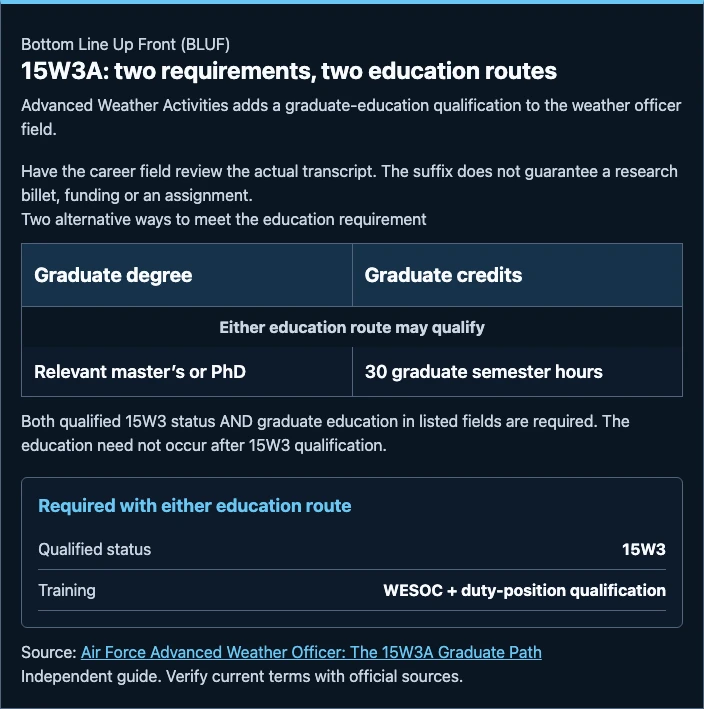
Have the career field review the actual transcript. The suffix does not guarantee a research billet, funding or an assignment.
| Graduate degree | Graduate credits |
|---|---|
| Either education route may qualify | |
| Relevant master’s or PhD | 30 graduate semester hours |
Both qualified 15W3 status AND graduate education in listed fields are required. The education need not occur after 15W3 qualification.
Required with either education route
- Qualified status
- 15W3
- Training
- WESOC + duty-position qualification
Source: Air Force Advanced Weather Officer: The 15W3A Graduate Path
Independent guide. Verify current terms with official sources.
On this page
Wing Duty is supported by purchases through our links, which may earn us a commission.
Job Role and Responsibilities
The 15W3A Advanced Weather Activities suffix requires qualified 15W3 status and qualifying graduate education. A relevant master’s or PhD can meet the education requirement, as can 30 semester hours of graduate work in the fields the classification directory lists. The suffix does not guarantee a research assignment.
The suffix is a marker, and understanding that matters before planning a career around it. The Air Force does not publish a separate list of duties that only 15W3A officers perform. What it publishes is the qualification itself.
What the Suffix Certifies
The April 2026 officer classification directory permits a master’s, a PhD, or 30 graduate semester hours in specified subjects. The list includes meteorology and space sciences, but also hydrology, computer science, software engineering, operations research, statistics, and mathematics.
A course’s subject and graduate level matter more than the department’s name. Before enrolling, ask the career field to review the transcript and proposed coursework against the actual requirement; do not assume either that every technical program qualifies or that a graduate certificate is automatically excluded.
Where Advanced Weather Work Shows Up
The work that follows the suffix looks like the rest of the field, done at a higher level of technical depth. An officer with the credential is the person a squadron asks when a model disagrees with the atmosphere.
That can mean research liaison with agencies that build the models, or technical review of a forecasting process that keeps producing bad guidance. It can also mean teaching, because the field has to train its own replacements.
The honest answer is that the assignment decides the work. The suffix opens the door to technical billets. It does not assign anyone to one.
Three Things This Is Not
- Not a civilian accession program: An applicant first needs a route into 15W and the qualified 15W3 level.
- Not a promised billet: Advanced study may be useful in forecasting, applied research, instruction, or staff work, but the assignment determines the work.
- Not a different career field: Studying space weather does not turn a weather officer into a space operations officer. The subject of the degree and the officer’s career field are separate decisions.
Specific Roles and Designations
The weather field uses codes for skill, staff level and specialization.
| Code | Meaning |
|---|---|
| 15W1 | Entry weather and environmental sciences officer |
| 15W3 | Qualified level, requiring WESOC and a duty-position qualification |
| 15W3A | Advanced Weather Activities, requiring additional qualifying graduate education |
| 15W4 | Staff-level weather officer, above wing level |
The letter adds the advanced-education qualification to the qualified 15W3 code. It is not a higher military rank.
The 15W Weather Officer page covers the career field itself, including commissioning and the operational forecasting mission.
Mission Contribution
Forecasting accuracy is a readiness issue. A wrong forecast grounds aircraft that could have flown, or launches them into weather that damages them.
Advanced study does not make an officer a better forecaster on its own. It does give the field people who can question a model, explain why it failed, and translate a research result into an operating procedure. That is the contribution, and it is why the Air Force keeps the suffix in its classification structure.
Technology, Equipment, and Systems
The tools are the ones the whole field uses: numerical weather prediction models, radar and satellite data, upper-air soundings and the systems that fuse them into a product for a commander.
Graduate study can help an officer examine model assumptions and investigate a recurring forecast problem. The suffix records an education qualification, however; it does not establish that every qualified forecaster without it lacks those skills.
Salary and Benefits
The suffix does not change pay. An advanced weather officer is paid as a 15W officer at the same grade and years of service as any peer.
| Rank | Pay Grade | Years of Service | Monthly Base Pay | Annual Base Pay |
|---|---|---|---|---|
| Second Lieutenant (2d Lt) | O-1 | 2 or less | $4,150 | $49,802 |
| First Lieutenant (1st Lt) | O-2 | Over 2 | $5,446 | $65,354 |
| Captain (Capt) | O-3 | Over 4 | $7,383 | $88,592 |
| Major (Maj) | O-4 | Over 10 | $9,420 | $113,040 |
Source: DFAS 2026 pay tables. Figures reflect the 2026 pay raise.
Base pay follows rank and years. The food allowance for officers is $328.48 a month, and housing pay varies by base, rank and family status.
Special Pays
Weather officers do not receive aviation incentive pay or the medical special pays. Their compensation is base pay, allowances and the standard officer benefits.
That makes the graduate degree a career investment rather than a financial one. Its professional value depends on how the officer uses the education; it does not establish an assignment or promotion outcome.
What the Degree Costs
If the Air Force pays for the program, the cost is time and an additional service commitment. If the officer pays, the cost is tuition on top of a full-time job.
Either way the officer should ask what the commitment is before starting. A funded graduate program usually carries a service obligation, and the terms differ between programs and years.
Qualifications and Eligibility
The Two Conditions
Both parts of the qualification matter: possession of 15W3 and the specified graduate education. A graduate degree alone does not award an operational qualification, while operational experience alone does not satisfy the graduate requirement.
The 15W3 Gate
The April 2026 directory requires the Weather and Environmental Sciences Officer Course (WESOC) and completion of a 15W duty-position qualification for 15W3. It does not express that qualification as a universal 12-month tour.
Ask the gaining unit how its qualification is documented and which duties the officer must demonstrate. Course completion, assignment to a weather unit, and recorded qualification are distinct milestones.
What Counts as the Right Degree
Read the specified graduate subjects alongside the course descriptions, not just the degree title. An atmospheric-science program may be straightforward to map, while an interdisciplinary program may require a closer transcript review.
The 30-semester-hour route is particularly relevant to an officer whose graduate work spans several listed subjects. Keep transcripts and syllabi so the personnel and career-field authorities can decide whether the work meets the requirement before a suffix award is requested.
The Undergraduate Route Still Applies
Accession into 15W has a separate education matrix in Appendix A of the directory. Meeting the advanced suffix requirement does not waive that entry decision.
If you are still choosing a degree, ask an officer-accessions recruiter to assess the undergraduate program before building a plan around later graduate study. If you are already a 15W officer, use the career-field education process rather than treating a civilian admissions offer as Air Force approval.
Security screening
The April 2026 officer classification directory requires a current Tier 5 background investigation for award and retention of 15W AFSCs. Its note permits entry-level award before the investigation is complete once the initial investigation paperwork has been submitted. That exception concerns entry-level award; it does not establish that an officer has completed all requirements for 15W3A.
Ask the recruiter or servicing personnel office to confirm the current investigation and clearance requirements for the intended entry route and assignment. A background-investigation tier and a security-clearance determination are different parts of the screening process.
Test Requirements
AFOQT preparation is relevant to an applicant whose commissioning route requires that test, including standard OTS and AFROTC applications. It does not satisfy the graduate-education requirement for suffix A; confirm the requirements of your actual commissioning route.
An AFOQT course covers the book work, and the free AFOQT guide on this site explains what each section measures.

Work Environment
Two Kinds of Day
An operational weather officer works shifts in a forecast center or a wing weather flight. The day is built around products: briefings, warnings and forecasts that someone else acts on.
An officer in a technical or staff billet works a different day. The schedule follows projects and meetings rather than a flying schedule, and the output is a procedure, a review or a recommendation.
Where Advanced Officers Work
The 557th Weather Wing at Offutt AFB produces the Air Force’s central weather products. Operational weather squadrons under it serve each combatant command.
Staff billets sit at major commands, at Headquarters Air Force and on joint staffs. Those are the assignments where policy and requirements work happens, and they suit an officer who can read research and turn it into a decision.
The Team
Weather flights are small. A wing weather flight may run with a handful of officers and a larger group of enlisted forecasters, and the officer leads people who know the tools better than they do.
That relationship rewards humility. A new lieutenant who treats the senior forecaster as a source of expertise learns the job faster than one who does not.
Research-Adjacent Work
Some billets put an officer next to the organizations that build the models. The Air Force does not run a large atmospheric research enterprise of its own, so the interface is usually with other agencies, laboratories or contractors.
An officer with graduate training can hold that conversation as a peer. That is the practical value of the suffix in a meeting where a model’s behavior is being explained.
Training and Skill Development
Training and Education Requirements
| Stage | Where | Length | Focus |
|---|---|---|---|
| Commissioning | OTS, ROTC or USAFA | Varies | Officer foundation |
| WESOC | Confirm the current course allocation | Course schedule | Weather and environmental sciences officer training |
| Duty-position qualification | Assigned weather unit | Competency-based | Required qualification toward 15W3 |
| Graduate education | An accepted graduate program | Degree or qualifying 30 semester hours | Subjects specified in the directory |
| Suffix award | Personnel process | After both requirements | 15W3A recorded |
This table groups requirements rather than imposing a fixed order on graduate study and operational qualification. Both conditions must be met for suffix award; graduate education may already be complete when an officer enters the field.
How Officers Get the Degree
Funding and qualification are separate questions:
- Funded study: Ask which programs currently offer tuition funding or full-time attendance, how selection works, and what service obligation applies.
- Self-funded study: Ask the career field to assess the proposed coursework before paying. Meeting a civilian university admission requirement does not establish eligibility for the suffix.
The accepted education requirement can be met through a qualifying degree or qualifying graduate credits; who pays does not replace the classification requirements.
What the Program Involves
A graduate program in meteorology or atmospheric science is quantitative. It assumes fluid dynamics, thermodynamics and statistics, and it moves quickly into numerical modeling and data analysis.
A space weather program adds plasma physics and solar-terrestrial interaction to that base. Those are examples of graduate study, not the only education routes to the suffix. The classification directory also accepts 30 qualifying graduate semester hours without a completed graduate degree; qualified 15W3 status remains a separate requirement.
Professional Military Education
Squadron Officer School comes early, usually as a captain. Air Command and Staff College follows for majors selected for it, and Air War College serves lieutenant colonels and colonels.
PME and graduate education are separate tracks. Neither substitutes for the other, and a board reads them differently.
Keeping Current
The field has a certification requirement that does not lapse quietly. Weather officers maintain aeronautical meteorological forecaster certification through documented operational hours and a written examination.
An officer in a staff or research billet has to work at that currency rather than assuming it. Losing certification affects the ability to serve in an operational billet later.
Career Progression and Advancement
Promotion Timeline
| Rank | Career context, not a promotion date | Typical duties |
|---|---|---|
| O-1, second lieutenant | Entry | Weather Officer Course and first operational tour |
| O-2, first lieutenant | Assignment and qualification dependent | Operational forecasting, flight leadership |
| O-3, captain | Assignment and qualification dependent | Flight command, graduate program, Squadron Officer School |
| O-4, major | Board selected | Staff work, technical billets, squadron leadership |
| O-5, lieutenant colonel | Board selected | Squadron or division leadership, major command staff |
| O-6, colonel | Board selected, few positions | Wing or headquarters leadership |
What the Suffix Does for a Board
It does not replace performance. A board reads the whole file, and a graduate degree does not rescue a weak record.
What it does is support a specific story. An officer who wants to be the field’s technical authority, or to work in requirements and policy, can show the credential that backs the claim.
The Staff Track
The weather field is small, and its senior billets cluster at headquarters and at the wing that produces the products. An officer aiming for those positions needs both operational credibility and something distinctive.
Graduate study is one of the few distinctions available inside a field this size. That is a practical argument for it, separate from any interest in the science.
Broadening
Officers can serve in joint billets, on exchange, or as instructors. Some move into requirements or acquisition roles where a technical background matters.
Each of those moves takes an officer further from the forecast desk. The suffix helps there, because it certifies depth that a billet outside operations can use.
Physical Demands and Medical Evaluations
Fitness Assessment
Officers take the general fitness test. The current assessment scores a run or shuttle run, strength and core events, and a waist-to-height measure, with 75 points as the passing total and a minimum on each event chosen.
| General test, under age 25 | Male | Female |
|---|---|---|
| Minimum satisfactory total | 75 points | 75 points |
| Event minimums | Meet each chosen event’s chart minimum | Meet each chosen event’s chart minimum |
| Failure despite 75 total | A missed event minimum can make the result unsatisfactory | A missed event minimum can make the result unsatisfactory |
Use the current age- and sex-specific official charts on the Air Force fitness page.
A Desk Job With Shift Work
Forecasting is sedentary work done under time pressure. The physical demand is low, and the strain is in sustained attention across a shift that may run at night.
Operational weather squadrons run around the clock. Shift rotation is the part of the job that people underestimate, because it affects sleep in a way that a normal office schedule does not.
Medical Standards
A weather officer does not need a flying physical. Entry requires the standard commissioning medical standards, and the specialty adds no physical qualification of its own.
A particular assignment can impose additional requirements. Do not use descriptions of historical weather specialties as evidence that suffix A carries an additional physical standard.
Deployment and Duty Stations
Deployed Weather Support
Weather officers deploy to support air operations, and the work is compressed. A deployed forecaster produces the same products with less data and less time.
Advanced weather officers deploy like any other weather officer. The suffix does not create a separate deployment role, and it does not exempt anyone from a rotation.
Tempo
Deployment tempo follows the unit and the combatant command. A weather officer supporting a flying wing deploys with it, while one in a staff billet travels for exercises and conferences.
The Air Force does not publish deployment rates by specialty. Any figure quoted for this field is an estimate rather than a record.
Duty Stations
Weather billets exist at most major bases with a flying mission, at the 557th Weather Wing, at operational weather squadrons and at headquarters.
The graduate program itself can put an officer at a civilian university for a year or more. That is a posting like any other, and it counts toward the career.
Risk, Safety, and Legal Considerations
The Consequence of a Bad Forecast
A weather officer’s product shapes decisions that involve aircraft, people and money. A forecast that misses a thunderstorm can put a crew in the wrong place, and the investigation afterwards reads the product.
That is the professional risk in this field. It is managed through standard procedures, forecast verification and a culture where a forecaster can say the confidence is low.
Security
The April 2026 directory’s investigation requirement and entry-level exception are explained under Security screening. Confirm the current standard with the personnel office rather than assuming that a pending investigation establishes clearance eligibility or qualification for an operational assignment.
Officer Accountability
A weather officer is an officer first. That carries command responsibility over assigned personnel, duties under military law, and the standards that apply to equal opportunity and climate.
Operational performance and administrative responsibilities have their own standards; avoid assuming that every adverse event leads to the same career outcome.
Impact on Family and Personal Life
Shift Work at Home
Operational weather runs continuously, so the schedule includes nights, weekends and holidays on rotation. That rhythm is harder on a household than a Monday-to-Friday job.
A graduate program changes the rhythm again. Full-time study with a family in a university town is a different life from a base, and it usually lasts a year or more.
Moves
Permanent change of station timing varies by assignment and component. Weather billets cluster at flying bases and at a small number of headquarters, so the list of possible locations is narrower than in a large career field.
A graduate program adds one move that is not a normal posting. The officer should plan for it as a relocation, not as a course.
Deployment and Absence
A deployed weather officer is gone for months, and the flight at home is short while the officer is away. Family support centers, key spouse programs and military family life counselors exist on every base.
The practical advice is to use them before a deployment rather than during one.
Reserve and Air National Guard
Availability
Weather officers serve in the Air Force Reserve and the Air National Guard, mostly in weather flights supporting flying units. The advanced weather suffix is not tied to the active component.
A Reserve or Guard officer who completes a qualifying graduate program can hold the suffix on the same terms as an active-duty peer.
What the Suffix Requires There
The two conditions do not change. The officer must hold qualified 15W3 status and meet the accepted graduate-education requirement, through a qualifying degree or qualifying graduate credits.
A part-time officer still needs the required course and duty-position qualification. Ask the unit which training periods and duties provide a realistic route to qualification alongside civilian employment.
Commitment and Pay
The standard commitment is one unit training assembly a month plus two weeks of annual tour, with additional days for exercises and currency.
| Component | Grade | Approximate monthly drill pay, four periods |
|---|---|---|
| Air Force Reserve or Air National Guard | O-3, over four years | $984.36 for four drill periods |
The 2026 DFAS officer drill pay table lists $246.09 for one paid drill period at that grade and service point. Four periods total $984.36 before deductions.
Benefits Compared
| Feature | Active duty | Air Force Reserve | Air National Guard |
|---|---|---|---|
| Pay | Full base pay and allowances | Drill pay unless mobilized | Drill pay unless mobilized |
| Healthcare | TRICARE Prime at no cost | TRICARE Reserve Select with premiums | TRICARE Reserve Select or state coverage |
| Education | GI Bill and tuition assistance | Partial GI Bill eligibility and tuition assistance | State tuition waivers vary, and tuition assistance is available |
| Retirement | Defined benefit after qualifying service, plus TSP under BRS | Qualifying service and points determine reserve retired pay | Qualifying service and points determine reserve retired pay |
| Currency | Full-time operational access | Depends on the unit’s forecast workload | Depends on the unit’s forecast workload |
| Graduate study | Funded programs available | Civilian benefits and tuition assistance | State waivers may apply |
For new accessions, the Blended Retirement System combines a defined benefit with Thrift Savings Plan contributions; retirement eligibility and payment timing depend on the applicable service rules.
The currency row is another consideration for a weather officer. Forecasting skill decays without practice, and a unit that produces few products makes it hard to keep certification.
Post-Service Opportunities
What the Experience Is Worth
A weather officer may leave with an operational forecasting record, a security clearance and qualifying graduate education. The suffix can reflect a completed graduate degree or 30 qualifying graduate semester hours; it does not establish that every holder has a graduate degree.
Federal agencies, contractors and research organizations hire people who can forecast and who can also read the literature. That combination is not common in the civilian market.
Civilian Pay
| Civilian role | US median annual pay, May 2025 | Outlook, 2025 to 2035 |
|---|---|---|
| Atmospheric scientist | $99,070 | 3 percent, about average |
| Environmental scientist | $82,220 | 6 percent, faster than average |
The federal figures come from the Bureau of Labor Statistics. These occupation-wide medians are not offers to former officers. Compare an actual vacancy’s education, experience, and eligibility requirements before using a civilian salary in a service decision.
Credentials and Further Study
Officers who completed a master’s or doctorate can present that degree to civilian employers. Officers who qualified through graduate credits should document the coursework accurately rather than present the suffix as a completed degree.
A weather officer who wants to teach or to move into research can use the Post-9/11 GI Bill for further study. The Air Force also funds some graduate education through the Air Force Institute of Technology while the officer is serving.
Is This a Good Job for You? The Right (and Wrong) Fit
Who Thrives
This path suits an officer who genuinely likes the science and is willing to spend years on it. If you want to understand why a model failed rather than only what it predicted, the graduate route fits.
It also suits someone who can handle a small field. Weather is a narrow community, and the people who advance in it tend to be known by the people who assign them.
Who Should Choose Something Else
If you want to fly, this is not the route. Weather officers support aviation rather than practicing it.
If you want a research career with research as the main job, the military is an awkward home for it. The Air Force needs forecasters who can read research, not researchers who occasionally forecast.
If your goal is a particular operational assignment, investigate its current requirements separately from the graduate suffix.
The Comparison That Matters
Against the operational weather officer, the difference is depth rather than status. Both serve in the same billets, and the suffix marks additional academic training rather than a separate ladder.
Against a space operations officer, the difference is the field. A 13S officer commissions into space operations. A weather officer who studies space weather stays in weather and applies that knowledge to the environment rather than to a satellite system.
More Information
Ask a weather officer at the nearest operational squadron what graduate study looked like in their field, and whether it changed the billets they were offered. Then ask a recruiter what the current funded-program terms are.
The 15W Weather Officer page covers the career field, commissioning and the operational mission. The Operations officer group shows where weather sits among the rated and non-rated fields.