18X Remotely Piloted Aircraft Pilot
An 18X pilot never leaves the ground, yet flies real combat missions in real time against real targets. From a ground control station at Creech Air Force Base in Nevada, an RPA pilot can orbit a target in Afghanistan for 14 hours, coordinate with special operations teams on the ground, and employ weapons when the order comes. No other aircraft in the Air Force fleet delivers that combination of persistence and precision. The career field has grown from a niche experiment into one of the most operationally active flying assignments in the Air Force.
OTS candidates need competitive ASVAB scores. Our AFOQT study guide covers exactly how to prepare.
Job Role
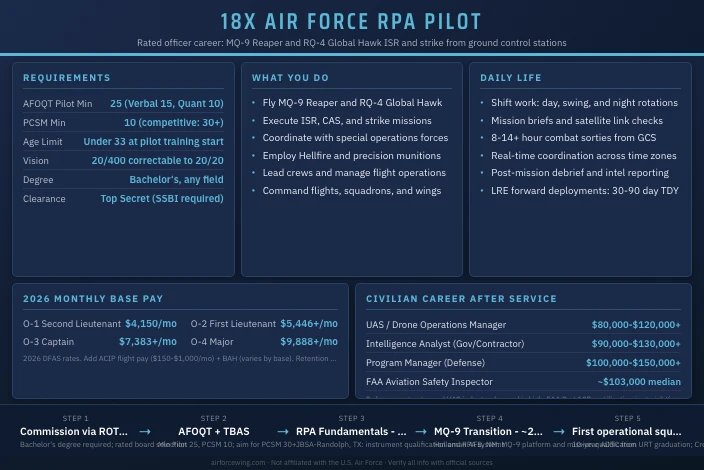
Remotely Piloted Aircraft Pilots are rated Air Force officers who fly MQ-9 Reapers and RQ-4 Global Hawks from ground control stations. They plan and execute intelligence, surveillance, and reconnaissance missions, conduct close air support, and employ precision weapons against time-sensitive targets. As officers, 18X pilots lead Airmen, manage flight operations, and are accountable for mission outcomes and the safety of ground forces who depend on their overhead coverage.
Command and Leadership Scope
New RPA pilots enter at O-1 (2d Lt) and spend their initial years qualifying on the MQ-9 and building combat hours as aircraft commanders. By O-3 (Capt), most are flight commanders responsible for 15 to 25 Airmen and managing the training currency and mission readiness of their flight. Crew coordination is different from manned aviation but no less demanding: an MQ-9 crew of pilot and sensor operator must maintain situational awareness across time zones, communicate with multiple agencies simultaneously, and make weapons employment decisions in minutes.
At O-4 (Maj) and above, RPA pilots move into operations officer and squadron commander roles. The 432d Wing at Creech AFB is the Air Force’s primary RPA wing, and its squadron commanders manage full flying programs including combat sorties around the clock.
Specific Roles and Designations
The 18X designator covers two primary platforms, with distinct mission profiles.
| AFSC | Designation | Primary Platform | Mission Focus |
|---|---|---|---|
| 18X | RPA Pilot (MQ-9) | MQ-9 Reaper | Strike, close air support, ISR |
| 18X | RPA Pilot (RQ-4) | RQ-4 Global Hawk | Strategic ISR, long-endurance surveillance |
| 11U | RPA Pilot (transitioned) | MQ-9, RQ-4 | Pilots who transitioned from manned aircraft |
The 18X designation specifically identifies officers whose first airframe is a remotely piloted aircraft. Officers who transition to RPAs from manned aircraft carry the 11U designation. Both categories fly the same missions but follow different training pipelines.
Mission Contribution
The MQ-9 Reaper has logged more combat flight hours than any other aircraft in Air Force history. RPA pilots support every combatant command that needs persistent surveillance or precision strike capability. A single MQ-9 can orbit a target for 14 or more hours, something no manned tactical aircraft can approach. That persistence makes RPA pilots a first call for special operations support, personnel recovery coordination, and time-sensitive targeting missions.
In joint and combined operations, 18X pilots integrate with CIA operations, Army special forces, Marine Corps ground units, and allied forces. The sensor feed from an MQ-9 is often the common operating picture that ties a joint task force together on a complex mission.
Technology and Systems
The MQ-9 Reaper is a medium-altitude, long-endurance platform capable of carrying 3,800 pounds of weapons and sensors. It employs Hellfire missiles, GBU-12 Paveway II laser-guided bombs, and GBU-38 Joint Direct Attack Munitions. Its sensor suite includes a multi-spectral targeting system with electro-optical, infrared, laser designator, and laser illuminator capabilities. The RQ-4 Global Hawk operates at high altitude and carries advanced synthetic aperture radar and electro-optical sensors for wide-area strategic surveillance.
Pilots fly from ground control stations equipped with aircraft-style control interfaces, communications systems connecting to satellite links worldwide, and data networks that feed the mission picture to commanders and intelligence analysts in real time.
Salary
Officer Base Pay
All Air Force officer pay is set by DFAS and applies across the service regardless of career field. The table below shows 2026 pay rates.
| Rank | Grade | Typical Years of Service | Monthly Base Pay |
|---|---|---|---|
| Second Lieutenant | O-1 | Under 2 | $4,150 |
| First Lieutenant | O-2 | 2-3 years | $5,446 |
| Captain | O-3 | 4-6 years | $7,383 |
| Major | O-4 | 10-12 years | $9,888 |
| Lieutenant Colonel | O-5 | 16-18 years | $11,714 |
| Colonel | O-6 | 20-22 years | $13,751 |
Pay rates are published annually by DFAS and reflect the 2026 military pay schedule.
Aviation Incentive Pay
RPA pilots receive Aviation Career Incentive Pay (ACIP) as rated officers. Rates increase with years of aviation service:
| Years of Aviation Service | Monthly ACIP |
|---|---|
| 2 or less | $150 |
| Over 2 | $250 |
| Over 6 | $700 |
| Over 12 | $1,000 |
| Over 14 | $1,000 (sustained through 22 years for RPA pilots) |
| Over 22 | $700 |
| Over 24 | $450 |
The Air Force has extended the $1,000 monthly rate for RPA pilots with over 14 years of aviation service through the 22-year mark, longer than the standard aviator schedule, reflecting the demand for experienced RPA operators.
Retention Bonuses
The Air Force has offered critical skills retention bonuses to address RPA manning requirements. Programs have included retention packages in the range of $75,000 to $135,000 total value for eligible pilots with at least six years of aviation service. Bonus amounts and eligibility windows are set annually based on manning needs. Verify current offers with the Air Force Personnel Center or an officer recruiter before making retention decisions.
Additional Benefits
Officers receive Basic Allowance for Housing (BAH) that varies by duty location, pay grade, and dependent status. At Joint Base San Antonio, an O-1 without dependents receives approximately $1,584 per month in BAH. Basic Allowance for Subsistence (BAS) for officers is $328.48 per month.
TRICARE Prime covers all active-duty members at no cost: no enrollment fee, no deductible, no copays for medical, dental, vision, mental health, prescriptions, and hospitalization. The Blended Retirement System provides a 20-year pension equal to 40% of high-36 basic pay, plus government TSP matching up to 5% of base pay. Tuition Assistance covers up to $4,500 per year toward degree coursework while on active duty.
Work-Life Balance
RPA missions run around the clock. Pilots work rotating shifts that include nights, weekends, and holidays because the MQ-9 doesn’t land just because it’s 3 a.m. at the home station. That shift schedule is a significant lifestyle factor that many pilots describe as the hardest adjustment from civilian life. At the same time, 18X pilots are largely home-station based. Unlike manned aviation, most combat flying happens from the continental United States, which means more stability for families compared to frequent overseas deployments. Annual leave accrues at 30 days per year.
Qualifications
Every 18X pilot must first commission as an Air Force officer. The same three paths that lead to manned aviation apply here.
Commissioning Sources
| Source | GPA Minimum | Degree Requirement | Age Limit | Key Prerequisite |
|---|---|---|---|---|
| Air Force Academy (USAFA) | N/A (competitive) | Awarded at graduation | 17-22 at entry | Congressional nomination |
| Air Force ROTC | 2.5 cumulative | Bachelor’s from host school | Under 33 at start of pilot training | ROTC scholarship or contract |
| Officer Training School (OTS) | 3.0+ competitive | Bachelor’s in any field | Under 33 at start of pilot training | Degree in hand at application |
No specific degree major is required. The Air Force has commissioned 18X pilots with degrees in fields ranging from history to engineering. Science, technology, engineering, and math backgrounds tend to be competitive but are not mandatory.
Test Requirements
All 18X candidates must complete the Air Force Officer Qualifying Test (AFOQT). Minimum scores for the RPA pilot track are a Pilot composite of 25, with Verbal at 15 and Quantitative at 10. Competitive applicants score higher; AFOQT preparation pays off.
Candidates must also complete the Test of Basic Aviation Skills (TBAS), which feeds the Pilot Candidate Selection Method (PCSM) score. The minimum PCSM required to list for an RPA slot is 10. The bar is lower than for manned pilot tracks (which require a minimum of 25), but selection boards still weigh the score. Logging civilian flight hours before taking the TBAS raises the PCSM score and signals genuine aviation interest.
The PCSM minimum of 10 is a floor, not a target. Boards still compare candidates against each other. A PCSM in the 30s or 40s puts you in a more competitive position than a 10 or 15. Treat TBAS preparation seriously even for the RPA track.
Medical and Vision Requirements
18X pilots complete an aviation flight physical, but the vision standards are less restrictive than for manned pilots. Distant visual acuity of 20/400 is acceptable, as long as it corrects to 20/20. Candidates who have been disqualified from manned pilot training on vision grounds are sometimes still eligible for the RPA track. Verify your specific situation with a flight surgeon before withdrawing from the rated selection process.
Career Field Assignment and Competition
ROTC cadets list rated preferences in their junior year. USAFA graduates compete for rated slots during their senior year. OTS applicants apply specifically for rated positions through a separate board. RPA slots are separate from manned pilot slots and have their own selection board. Competition has been variable over the years: the Air Force has had periods of significant RPA pilot shortages and periods of more selective entry. Current board competitiveness should be confirmed with an officer recruiter or career field manager.
Upon Commissioning
New 18X pilots enter at O-1 (2d Lt). The Active Duty Service Commitment for the RPA training pipeline is 10 years from the completion of Undergraduate RPA Training. This mirrors the commitment for Undergraduate Pilot Training, reflecting the Air Force’s investment in the training pipeline.
OTS candidates can find a focused study plan in our AFOQT study guide.
Work Environment
RPA pilots work primarily in ground control stations, which are climate-controlled trailers or hardened facilities equipped with flight control interfaces, communications terminals, and sensor displays. The environment looks more like a high-end operations center than a cockpit, but the operational demands are equivalent. An aircraft commander is responsible for the aircraft, the mission, the crew, and the safety of ground forces below.
Shift work defines the daily experience. Many units operate around the clock, and pilots rotate through day, swing, and night shifts on a regular schedule. A pilot on a night shift in Nevada may be flying combat in support of operations 7,000 miles away at the same time their family is asleep a few miles from the base.
Officer-NCO Dynamic
Senior NCOs manage the day-to-day mechanics of crew scheduling, equipment maintenance, and administrative functions. RPA sensor operators are frequently enlisted personnel, and the pilot-sensor operator crew relationship is the foundation of mission effectiveness. Pilots who build strong working relationships with their enlisted crew members perform better operationally and lead more cohesive flights. As in all Air Force units, experienced NCOs often know more about platform specifics and base processes than a newly arrived officer.
Staff vs. Command Roles
RPA pilots follow the same staff and command rotation pattern as other rated officers. After initial operational assignments, many move into staff roles at major commands, AFPC, or joint headquarters. Staff work in the RPA community often involves acquisitions support, operational policy, or ISR program management, reflecting the technical depth of the career field. Command assignments at flight, squadron, and group level are available and required for senior promotion.
Retention
The Air Force has faced RPA pilot retention challenges for over a decade. Sustained combat operations tempo, shift work, and geographic concentration of bases create friction. Retention bonuses have been a recurring tool. The career field is also relatively small, which means officers can move into key developmental positions faster than in larger career fields.
Training
Pre-Commissioning Training
ROTC cadets complete a four-year curriculum alongside their degree. USAFA graduates complete four years of academic and military training at Colorado Springs. OTS candidates attend a 9.5-week commissioning course at Maxwell AFB, AL, covering leadership, military law, Air Force culture, and officership fundamentals.
Undergraduate RPA Training Pipeline
The 18X training pipeline runs approximately 59 weeks total. Initial flight fundamentals training is conducted at Joint Base San Antonio-Randolph, followed by MQ-9 mission qualification training at Holloman AFB, NM.
| Phase | Location | Duration | Content |
|---|---|---|---|
| RPA Instrument Qualification and Fundamentals | JBSA-Randolph, TX | ~20 weeks | Instrument flying fundamentals, RPA systems |
| MQ-9 Transition Training | Holloman AFB, NM | ~21 weeks | MQ-9 platform qualification, mission systems |
| Mission Qualification Training | Operational unit | Weeks to months | Unit-specific tactics, weapons, mission qualification |
Air National Guard 18X pilots complete the same Randolph and Holloman pipeline before arriving at their unit. Reserve component training runs through Hancock Field ANGB, NY and March ARB, CA for the MQ-9 training phase.
The 18X pipeline does not include Undergraduate Pilot Training on the T-6 or T-38. That is deliberate: 18X officers are trained from day one as RPA specialists, not manned pilots who transitioned. The fundamentals course builds instrument flying competency through RPA-specific ground and simulator training.
Professional Military Education
| Course | Rank | Location | Duration |
|---|---|---|---|
| Squadron Officer School (SOS) | Capt (O-3) | Maxwell AFB, AL | 6 weeks in residence (or correspondence) |
| Air Command and Staff College (ACSC) | Maj (O-4) | Maxwell AFB, AL | 10 months (residence) or distance |
| Air War College (AWC) | Lt Col/Col | Maxwell AFB, AL | 10 months (senior officers only) |
PME is mandatory for promotion consideration above O-3. Completing SOS and ACSC in residence is viewed favorably on officer performance reports in the RPA community as in any other career field.
Additional Schools and Opportunities
The Air Force Institute of Technology (AFIT) provides fully funded graduate education for selected officers. RPA pilots have moved into program management, acquisitions, and systems engineering roles that benefit from advanced technical degrees. Exchange assignments with joint agencies, combatant commands, and intelligence community organizations are available and common given the ISR-heavy nature of the career field. The career field is too specialized for Weapons School, but senior RPA pilots often move into training and standards roles that serve a similar function within the community.
Before OTS, you need qualifying scores. See our AFOQT study guide.
Career Progression
Officer Career Timeline
| Rank | Grade | Typical Time in Grade | Key Developmental Positions |
|---|---|---|---|
| Second Lieutenant | O-1 | 18 months | URT student, initial MQ-9 qualification |
| First Lieutenant | O-2 | 2 years | Aircraft commander, combat missions |
| Captain | O-3 | 4-5 years | Flight commander, assistant ops officer (KD) |
| Major | O-4 | 4-5 years | Operations officer, staff tour (KD) |
| Lieutenant Colonel | O-5 | 4-5 years | Squadron commander (most competitive KD) |
| Colonel | O-6 | 4-5 years | Group or wing commander, major command staff |
Key developmental positions for the RPA career field follow the same structure as manned aviation: flight commander at O-3, operations officer at O-4, and squadron command at O-5. Officers who skip or delay KD positions tend not to be competitive at the O-5 board.
Promotion System
O-1 through O-3 promotions are time-in-grade for officers meeting standards. Promotion to O-4 (Maj) and above is board-selected and competitive. Board selection rates vary by career field and fiscal year. Stratified officer performance reports, documented leadership in KD positions, and completion of PME in residence drive board outcomes.
Building a Competitive Record
Officers who compete well for promotion and command in the 18X career field share the same characteristics as other rated officers: consistent top-third performance ratings, KD positions with documented results, PME in residence, and broadening assignments that show versatility. Given the career field’s concentration at a small number of bases, officers who pursue joint assignments or staff tours outside the RPA community often build more competitive files. The RPA community is also small enough that individual reputations travel fast, which cuts both ways.
Physical Demands
Air Force Fitness Assessment
All Air Force officers take the Fitness Assessment annually. The FA uses a 100-point scale across four components. Passing requires a minimum composite score of 75 and meeting the minimum threshold on each component.
| Component | Max Points | Notes |
|---|---|---|
| 1.5-Mile Run | 60 | Primary aerobic component |
| Waist Circumference | 20 | Body composition measure |
| Push-Ups (1 minute) | 10 | Muscular fitness |
| Sit-Ups (1 minute) | 10 | Core fitness |
Standards are age- and gender-normed. For current scoring standards, check official Air Force sources.
Flight Physical Requirements
18X pilots complete an aviation flight physical before entering training and periodically throughout their career. Vision requirements are less restrictive than for manned pilots: distant visual acuity of 20/400 correcting to 20/20 is acceptable. No cockpit height restrictions apply. The physical still screens for cardiovascular, neurological, and orthopedic conditions that could affect safe aircraft operation.
Candidates disqualified from manned pilot training on vision grounds may still qualify for the 18X track. Do not assume a prior medical disqualification closes the RPA door. Have a flight surgeon review your records against 18X-specific standards before withdrawing from the rated process.
RPA pilot duty involves extended periods of sustained attention at ground control stations, sometimes for 8 to 12 hours per shift. The mental demands are significant even though the physical environment is sedentary. Fatigue management and crew rest standards exist for a reason.
Deployment
Deployment Tempo
Most MQ-9 combat missions are flown from U.S. bases to overseas airspace via satellite link. That means many 18X pilots never deploy in the traditional sense, yet fly combat missions regularly from home station. The shift schedule at units like Creech AFB can be as demanding as any deployment rotation in terms of operational intensity. Some RPA missions require forward-deployed personnel at the launch-and-recovery element (LRE), which handles takeoffs and landings from austere airfields closer to the operational area. Officers may rotate through LRE assignments for 30 to 90 days.
Duty Station Options
MQ-9 operations are concentrated at a smaller set of bases than manned aviation. Primary assignments include:
- Creech AFB, Nevada: home of the 432d Wing, the Air Force’s primary RPA wing and largest MQ-9 operator
- Holloman AFB, New Mexico: houses the 49th Wing, RPA training, and operational MQ-9 squadrons
- Cannon AFB, New Mexico: 27th Special Operations Wing, MQ-9 operations supporting AFSOC missions
Reserve and Guard units operate from Hancock Field ANGB, NY and March ARB, CA, among other locations. Geographic concentration is a real lifestyle factor. Officers assigned to the RPA community spend most of their career in Nevada or New Mexico. AFPC manages assignments through preference worksheets, but options are more limited than in manned aviation career fields.
Risk/Safety
Operational Hazards
18X pilots face a different risk profile than manned aviation. Physical danger from aircraft mishaps is minimal since the pilot is on the ground. The operational risks are different: link loss, satellite communication failures, and cyber vulnerabilities affect RPA operations in ways that don’t exist in manned platforms. Weapons employment decisions carry the same legal and moral weight as any other combat strike. Pilots are accountable for Rules of Engagement compliance and positive target identification under the same standards as any attack aircraft.
Extended shift work and sustained high-intensity operations create fatigue risks that the Air Force manages through crew rest requirements and operational scheduling standards.
Safety Protocols
Operational Risk Management (ORM) and Crew Resource Management (CRM) apply to RPA operations the same as manned aviation. The pilot and sensor operator crew model is designed around cross-checking and communication. Safety officer is a common additional duty, and the Air Force Safety Center tracks RPA mishap data as part of its broader aviation safety program.
Command Responsibility and Legal
18X pilots hold the same command authority and legal accountability as manned pilots. Weapons employment must comply with Rules of Engagement, Law of Armed Conflict, and applicable theater directives. Decisions made from a ground control station have the same legal weight as decisions made in a cockpit. Command climate requirements, equal opportunity obligations, and UCMJ authorities apply to all officers with supervisory responsibility.
Impact on Family
RPA duty is unusual in the rated world: most combat flying happens from home station. That’s a genuine benefit for families. No six-month overseas deployment to the desert, no advance party movements, no extended separation for the bulk of operational tours. Children stay in the same schools and spouses build more stable careers than is typical in the manned aviation community.
The shift schedule complicates that picture. Night shifts, weekend duties, and holiday operations affect family routines in ways that a standard Monday-through-Friday schedule does not. The psychological weight of flying combat operations from the United States and then driving home to suburban Nevada is a documented challenge specific to the RPA community. The Air Force has invested in mental health resources and peer support programs at RPA bases in response.
The Airman and Family Readiness Center (A&FRC) at Creech and Holloman provides counseling, employment support for spouses, and financial planning resources. The Key Spouse Program connects new families with experienced RPA families who understand the specific lifestyle factors of the community.
Dual-Military Couples
Geographic concentration at a small set of bases simplifies join-spouse assignments compared to manned aviation in some respects. If both officers are in RPA career fields, Creech and Holloman are both active. Cross-career-field dual-military couples face the standard challenge of different assignment pools, and AFPC manages join-spouse requests when operationally feasible.
Reserve and Air National Guard
The Air National Guard and Air Force Reserve operate MQ-9 Reapers with their own squadrons. Guard and Reserve RPA pilots fly the same missions as active-duty crews and participate in combat operations through activation and mobilization.
Commissioning Paths
Officers can commission directly into Guard or Reserve RPA units through OTS with a Reserve component contract, through ROTC with a Reserve scholarship, or by transferring from active duty after completing their ADSC. Many active-duty 18X pilots transition to Guard units flying the same MQ-9 platform, maintaining currency and combat readiness on a part-time basis.
Drill and Training Commitment
Standard commitment is one Unit Training Assembly (UTA) weekend per month and 15 days of Annual Tour per year. RPA pilots must maintain flying currency beyond the standard schedule, which typically adds flying days each month. The New York Air National Guard 174th Attack Wing, one of the Guard’s MQ-9 units, requires members to complete the full 41-week Randolph-plus-Holloman training pipeline before joining their operational squadron.
Component Comparison
| Feature | Active Duty | Air Force Reserve | Air National Guard |
|---|---|---|---|
| Commitment Model | Full-time | 1 UTA/month + 15 days/yr | 1 UTA/month + 15 days/yr |
| Monthly Pay (O-3) | ~$7,383 base | Drill pay only (~$590/UTA) | Drill pay only (~$590/UTA) |
| Healthcare | TRICARE Prime (free) | TRICARE Reserve Select (premium) | State-specific + TRICARE RS |
| Education Benefits | TA + full GI Bill eligibility | TA + GI Bill (qualifying service) | State tuition waivers + TA |
| Deployment Tempo | Rotational shifts, some LRE TDY | Mobilizations | Mobilizations |
| Command Opportunities | Full progression to wing | Squadron and group billets | Squadron and group billets |
| Retirement System | 20-year pension (BRS) | Points-based Reserve retirement | Points-based Reserve retirement |
Part-Time Pay
An O-3 Captain earns approximately $493 per drill day. A standard UTA weekend involves four drill days, so monthly drill pay runs roughly $1,972 before taxes. ACIP flight pay applies during active-duty periods but not during standard drill.
Civilian Career Integration
Guard and Reserve RPA pilots work in aviation, defense contracting, technology, and intelligence roles in their civilian careers. The MQ-9 operator skill set translates directly to civilian UAS programs, defense contractor support roles, and government intelligence agency positions. USERRA protections ensure civilian employers cannot penalize members for military service obligations.
Post-Service
Civilian Transition
18X pilots leave the Air Force with a skill set that civilian employers want. UAS operations are the fastest-growing segment of the aviation industry, and most civilian UAS operators cannot match the operational depth of a former combat RPA pilot. The Transition Assistance Program (TAP) and Hiring Our Heroes both have programs for separating aviators and officers.
FAA Part 107 Remote Pilot certification is straightforward for military RPA pilots. Beyond basic certification, former 18X pilots typically target defense contractor flight operations, government agency positions, and corporate or commercial UAS programs.
Civilian Career Prospects
| Civilian Role | Median Annual Wage | Notes |
|---|---|---|
| UAS / Drone Operations Manager | $80,000-$120,000+ | Defense, energy, infrastructure sectors |
| Intelligence Analyst | $90,000-$130,000+ | Government and contractor positions |
| Program Manager (Defense) | $100,000-$150,000+ | Acquisitions and systems program offices |
| Aviation Safety Inspector (FAA) | ~$103,000 median | FAA UAS integration programs |
Demand for UAS specialists in the defense industrial base is high and growing. Companies supporting Air Force and Army UAS programs actively recruit former RPA pilots for government customer support, flight operations, and systems integration roles. The intelligence community, including CIA and DIA contractor positions, also recruits former RPA crew members for analytical and operational support roles.
Education and Credentials
The Post-9/11 GI Bill covers full in-state tuition at public universities or up to $29,920.95 per academic year at private institutions. Officers with six or more years of qualifying service can transfer GI Bill benefits to dependents. The Air Force Institute of Technology provides fully funded graduate degrees for selected officers while on active duty. RPA pilots interested in systems engineering, aerospace engineering, or program management are competitive candidates for AFIT selection.
Is This a Good Job
Ideal Candidate
The best 18X candidates are comfortable with sustained concentration under pressure over long periods. They can manage ambiguous tactical situations, communicate clearly with ground forces and intelligence analysts simultaneously, and make weapons employment decisions with confidence. RPA aviation demands more patience than manned aviation: sorties run for 10 or 14 hours, and not every hour is high intensity. Candidates who need constant physical stimulation tend to find the environment draining.
Officers who are genuinely drawn to the intelligence and surveillance mission, not just flying for its own sake, fit the 18X career field well. The mission is real, the operational impact is direct, and the career field gives junior officers more responsibility and decision-making authority than almost any other AFSC.
Where People Struggle
Candidates who wanted to fly a fighter and ended up in RPAs often struggle with motivation and retention. The RPA community is best suited for officers who want to be there, not officers who view it as a fallback. The geographic concentration at Nevada and New Mexico bases is also a real constraint for officers who want a variety of assignment locations.
The shift work schedule is the single most common complaint from experienced RPA pilots. Flying combat from the continental United States sounds appealing until you’ve spent two years on rotating night shifts. Officers who cannot adapt to that schedule either leave or burn out, and the Air Force’s retention challenges in the career field partly reflect that reality.
Career Path Fit
Candidates drawn to a full 20-year career should plan for operational flying, a staff tour with exposure to acquisitions or ISR policy, PME in residence, and a KD command opportunity. Candidates who want to serve their commitment and transition will find strong civilian demand on the other side. Guard and Reserve options allow former active-duty 18X pilots to maintain currency and continue operational flying while building a civilian career, which is a genuinely compelling option given the alignment between military and civilian UAS markets.
More Information
Talk to an Air Force officer recruiter or your nearest ROTC detachment about rated program availability and current 18X board schedules. Every rated officer candidate needs competitive AFOQT scores. The PCSM minimum for RPA is lower than for manned pilots, but boards still compare candidates, and strong TBAS preparation can give you a meaningful edge in a competitive selection cycle.
Official resources:
- Air Force Special Operations Command (AFSOC) and Air Combat Command (ACC), the two major commands where 18X officers are concentrated; mission overviews provide context for what RPA units do operationally
- Holloman AFB 49th Wing, home of the MQ-9 formal training unit (FTU), where all 18X officer initial qualification training takes place
- AFPC Officer Rated Boards, official information on rated selection board timing, eligibility criteria, and application requirements
Related career profiles on this site:
- Air Force Operations careers hub, all operations officer career field profiles including manned and unmanned aviation, air battle management, and combat systems
- 11X Pilot, the manned fighter and airlift pilot track; compare the selection requirements, training pipeline, and career trajectories between 11X and 18X before deciding which rated path to pursue
- 13B Air Battle Manager, another rated non-pilot career field; useful comparison for candidates who want an aviation operations career that does not require flight training
Practical preparation:
Both AFOQT and TBAS scores are required for rated officer selection. AFOQT quantitative and verbal subtests drive your overall commissioning package competitiveness, while TBAS produces the Pilot Candidate Selection Method (PCSM) score that rated boards use for 18X selection. The minimum PCSM for 18X selection is lower than for manned pilot boards, but submitting a score well above minimum strengthens your relative standing.
Start AFOQT study guide well before your commissioning board deadline, most candidates need four to eight weeks of focused study. TBAS preparation follows a different format from the AFOQT and is worth separate dedicated practice time. The TBAS includes psychomotor tests conducted on a computer-based system, familiarity with the format reduces test-day anxiety and can meaningfully improve your score.
This site is not affiliated with the U.S. Air Force or any government agency. Verify all information with official Air Force sources before making enlistment or career decisions.
Explore more Air Force Operations officer careers alongside the 11X Pilot and 13B Air Battle Manager profiles to compare rated career field options.