15W Weather Officer
Weather shapes every Air Force mission. A single thunderstorm can ground a strike package. An unexpected fog bank can turn a safe approach into an emergency. The 15W Weather Officer is the person commanders rely on to see what’s coming and translate it into a decision.
Weather Officers lead the Air Force’s meteorological and environmental services mission, from routine flight weather briefings at home station to forward-deployed support in combat zones. The most experienced officers in this career field go further, they enter the Special Operations Weather Team Officer (SOWT-O) pipeline and operate with special operations units in environments where the weather itself is a weapon. It’s a small career field, technically demanding, and critical to operations across every combatant command.
OTS candidates need competitive ASVAB scores. Our AFOQT study guide covers exactly how to prepare.
Job Role and Responsibilities
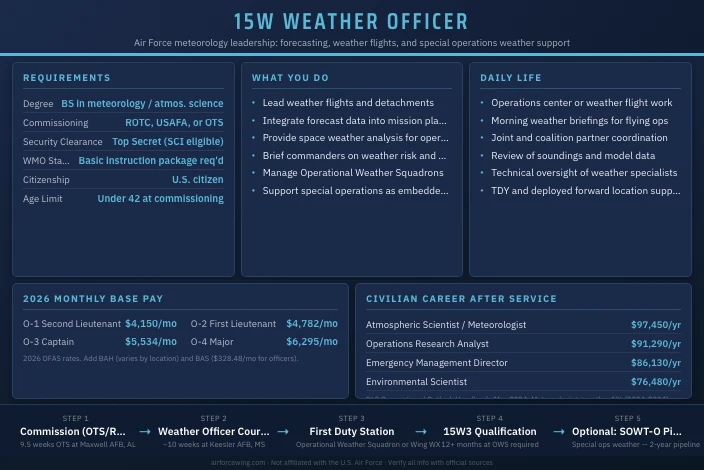
Weather Officers command, manage, and perform weather operations in direct support of U.S. military forces. They integrate meteorological and space weather analysis into operational planning and execution, translate complex atmospheric data into clear guidance for commanders, and lead weather flights and detachments at the squadron and wing level. At senior grades, they manage Operational Weather Squadrons that provide global coverage for joint and coalition forces.
Command and Leadership Scope
A newly commissioned 15W typically serves as a weather flight commander at a wing, leading a small team of enlisted 1W0X1 Weather Specialists. The flight is the basic organizational unit: a lieutenant or captain is responsible for forecasting operations, personnel readiness, and technical quality of every product the flight produces.
At the major level, weather officers move into operations officer and deputy commander billets within Operational Weather Squadrons (OWS). OWS units provide centralized regional forecasting to multiple bases and joint users. By colonel, an officer may command an OWS or serve as a wing director of operations for weather.
The career field is deliberately small. Fewer than 400 active-duty weather officers serve at any given time, which means each officer carries significant responsibility early in their career.
Specific Roles and Designations
| Code | Designation | Notes |
|---|---|---|
| 15W1 | Weather Officer (Entry) | Awarded upon completion of Weather Officer Course |
| 15W3 | Weather Officer (Qualified) | Requires 12+ months at an OWS after entry |
| 15WX | Special Operations Weather Officer | SEI awarded after SOWT-O pipeline; embedded with AFSOC units |
| 15W (Staff) | HQ Weather Staff | Assignments at MAJCOM, HAF, and joint staffs at O-4 and above |
Weather Officers may also earn Special Experience Identifiers (SEIs) for space weather operations and joint staff experience. Officer candidates who want to target this career field should be aware that all commissioning paths require the AFOQT, AFOQT preparation resources are the right starting point regardless of whether you commission through ROTC, OTS, or the Academy.
Mission Contribution
The Air Force’s weather mission runs through two major organizations. The 557th Weather Wing at Offutt AFB, Nebraska, is the Air Force’s central weather production hub, providing global atmospheric and space weather products to joint and coalition forces. Operational Weather Squadrons subordinate to the 557th serve every combatant command region.
At the wing level, weather flights are the local face of the mission, producing terminal aerodrome forecasts, flight weather briefings, and launch and recovery weather criteria for flying operations. In combat, weather officers at the air operations center integrate weather into the air tasking order cycle. Commanders need to know what weather will look like 24, 48, and 72 hours out. That analysis shapes sortie rates, weapons employment choices, and troop movement timing.
Technology and Systems
Weather Officers use a combination of military and civilian forecasting tools:
- Advanced Weather Interactive Processing System (AWIPS) for operational forecasting
- Joint Environmental Toolkit (JET) for integrating weather data into planning products
- Upper air sounding systems and rawinsonde data for vertical atmospheric analysis
- Space weather monitoring systems including solar X-ray flux and geomagnetic storm alerts
- Specialized products for airfield weather windows, winds aloft, and icing analysis
Salary and Benefits
Officer Base Pay
All pay figures come from DFAS 2026 military pay tables.
| Grade | Rank | Less than 2 yrs | 4 yrs | 8 yrs | 12 yrs |
|---|---|---|---|---|---|
| O-1 | 2d Lt | $4,150/mo | $5,222/mo | , | , |
| O-2 | 1st Lt | $4,782/mo | $6,485/mo | , | , |
| O-3 | Capt | $5,534/mo | $7,383/mo | $8,126/mo | $8,788/mo |
| O-4 | Maj | $6,295/mo | $7,881/mo | $8,816/mo | $9,888/mo |
Base pay is the starting point. Officers also receive Basic Allowance for Housing (BAH), which varies by duty location and dependent status, a Captain at a major installation typically receives $1,500 to $2,200 or more per month depending on the ZIP code. All officers receive Basic Allowance for Subsistence (BAS) of $328.48 per month.
Special Pays
Weather Officers serving in the SOWT-O pipeline are eligible for hazardous duty pay for parachute operations and other high-risk activities. All officers assigned to special operations units may qualify for Special Duty Assignment Pay (SDAP). There are no aviation-specific bonuses for 15W because it is a non-rated career field.
Accession bonuses for non-rated officer career fields vary by year and authorized specialty. The Air Force periodically offers selective incentives for critical non-rated fields. Check with your recruiter for current 15W bonus eligibility.
Benefits Package
Active-duty Weather Officers receive:
- TRICARE Prime at zero cost for the officer (no enrollment fee, no deductible, no copay)
- 30 days paid annual leave accruing at 2.5 days per month
- Tuition Assistance up to $4,500 per year and $250 per semester hour for off-duty education
- Post-9/11 GI Bill transferable to dependents after six years of service with a four-year obligation
- Blended Retirement System: 20-year pension at 40% of high-36 average base pay, plus TSP matching up to 5% of base pay
BAH at higher-cost installations for a Captain with dependents can reach $2,500 or more monthly. The full compensation package for an O-3 at mid-career, including base pay, BAH, and BAS, typically exceeds $8,000 to $10,000 per month before taxes, depending on duty station.
Work-Life Balance
Garrison assignments at an Operational Weather Squadron follow a roughly standard 40-to-50-hour week, with shift coverage required for 24/7 forecasting operations. Flying wings rotate weather flight personnel to cover early morning launch windows. TDY frequency is moderate, weather officers support exercises, deployments, and joint events throughout the year. SOWT-O assignments carry a heavier operational tempo, with more frequent short-notice deployments and exercises.
Qualifications and Eligibility
Scoring well on the AFOQT preparation resources is an early priority for any officer candidate targeting this career field.
Commissioning Sources
All three commissioning sources are available for the 15W career field.
| Commissioning Source | GPA Minimum | Degree Requirements | Age Limit | Physical Standard | Career Field Prerequisite |
|---|---|---|---|---|---|
| AFROTC | 2.5 (scholarship) / 2.0 (non-scholarship) | Meteorology, atmospheric science, or WMO-qualifying STEM field | Under 42 at commissioning | Commissioned officer physical | WMO Basic Instruction Package |
| USAFA | Competitive admissions process | Science curriculum; meteorology major available | Class entry age | Annual physical fitness testing | WMO coursework in curriculum |
| OTS | No formal GPA minimum (competitive) | Bachelor’s degree in meteorology, atmospheric science, or qualifying STEM field | Under 42 | Pre-commissioning physical | Must hold or be completing WMO-qualifying degree |
Degree requirements are strict. The Air Force requires that 15W candidates hold a degree meeting the World Meteorological Organization (WMO) Basic Instruction Package for Meteorologists. Programs in meteorology and atmospheric science at accredited universities typically satisfy this standard. Degrees in adjacent STEM fields may qualify if coursework covers dynamic meteorology, synoptic analysis, thermodynamics, and related topics. Verify your specific degree against WMO requirements before committing to this path.
Test Requirements
Every officer candidate must pass the Air Force Officer Qualifying Test (AFOQT). Minimum scores for non-rated commissioning are Verbal composite 15 and Quantitative composite 10, though competitive scores are significantly higher. The 15W career field does not require the TBAS or a PCSM score, those are for rated (pilot, CSO, RPA) candidates only.
There is no published AFOQT composite minimum specific to the 15W career field beyond the general non-rated thresholds. Career field classification boards weigh GPA, degree relevance, and AFOQT Academic Aptitude composite alongside your overall package.
Career Field Assignment Process
ROTC cadets compete for career field classification in the spring of their senior year. Weather is classified as a non-rated operations career field. Assignment boards weigh academic performance, field ranking, and the AFOQT Academic Aptitude composite. Weather is a small field and competitive pressure varies by year group size and Air Force requirements.
OTS candidates submit career field preferences before board convenes; selections are made based on Air Force needs and board-assessed candidate quality. USAFA graduates complete a preference process with similar weighting.
Officers may cross-train into 15W from other career fields, subject to Air Force needs and completion of the Weather Officer Course. The window for cross-training typically opens between the 4- and 12-year mark.
Upon Commissioning
New 15W officers enter at O-1 (Second Lieutenant). The standard Active Duty Service Commitment (ADSC) for non-rated officers completing OTS is four years. Officers who enter the SOWT-O pipeline incur an additional service commitment tied to the length of that training, which can extend the total ADSC to six or more years.
Work Environment
A Weather Officer’s daily environment depends heavily on their assignment. At a flying wing, you work in the base weather station, a 24/7 operations center attached to the operations group. The schedule rotates around flying schedules, which means early starts before dawn launch windows and shift coverage on weekends and holidays.
At an Operational Weather Squadron, the environment is more centralized and product-focused. OWS forecasters produce regional and global products on rotating shifts, often for multiple customers across a geographic command. This work is analytically intense and more similar to an operational meteorologist position than a traditional military unit environment.
SOWT-O officers operate in a fundamentally different setting. After completing the pipeline, they deploy embedded with special operations forces. Army Rangers, SEALs, Marine Raiders, or other units, and provide weather reconnaissance and analysis directly in the objective area. This involves fieldwork in rugged environments, not a climate-controlled operations center.
Leadership and Chain of Command
At the flight commander level, a 15W lieutenant or captain works under the Operations Group Commander (typically an O-6 rated officer) and alongside a senior enlisted Flight Chief (typically a Master Sergeant or Technical Sergeant). The officer-NCO relationship in weather is collaborative: the Flight Chief brings technical depth and continuity while the flight commander handles administrative leadership, resource management, and direct communication with wing leadership.
Weather Officers at OWS units report through a weather-specific chain. The OWS commander reports to the 557th Weather Wing at Offutt AFB.
Staff vs. Command Roles
Command assignments in the 15W career field include:
- Weather flight command (O-2/O-3 level)
- OWS operations officer (O-4)
- OWS commander (O-5)
Between command assignments, officers fill staff billets at MAJCOMs, combatant commands, the Pentagon (HAF), and joint staffs. Staff tours at these levels build strategic exposure but require geographic relocation and extended TDY to the Washington area for some billets.
Job Satisfaction and Retention
Retention in the 15W career field has historically been solid relative to other non-rated operations fields. The career field’s technical identity, meteorology as a professional discipline, not just a military job, tends to attract officers who stay. Officers who leave early most often cite the shift work model at flying wings, limited flexibility in geographic assignments (the field is small and bases with weather units are fixed), and the allure of NWS or private sector forecasting jobs.
Training and Skill Development
Researching officer training requirements early is worth your time. AFOQT study resources cover the test format and sections that matter most for non-rated career fields.
Pre-Commissioning Training
- AFROTC: 3 to 4 years of on-campus training with Field Training between sophomore and junior year. Weather cadets complete all standard ROTC curriculum plus meteorology coursework.
- USAFA: 4-year curriculum with weather-specific coursework integrated. Cadets who express interest in 15W pursue meteorology and atmospheric science electives.
- OTS: 9.5 weeks at Maxwell AFB, Alabama. Covers officership, Air Force leadership, and military customs and courtesies. Content is identical for all career fields at this phase.
Initial Skills Training
After commissioning, all 15W officers attend the Weather Officer Course (WOC) at Keesler AFB, Mississippi. The 335th Training Squadron conducts this training.
| Phase | Location | Length | Focus |
|---|---|---|---|
| OTS (if applicable) | Maxwell AFB, AL | 9.5 weeks | Officership and Air Force customs |
| Weather Officer Course (WOC) | Keesler AFB, MS | ~10 weeks | Tactical weather operations, meteorological analysis, and operational products |
| First Duty Station OJT | Assigned unit | 12+ months | On-the-job qualification toward 15W3 status |
The WOC combines classroom instruction, practical exercises, and hands-on forecasting. Officers leave with the entry-level 15W1 AFSC. Qualification to 15W3 requires at least 12 months of experience at an Operational Weather Squadron after completing initial training.
Professional Military Education
PME follows the standard Air Force officer timeline:
- Squadron Officer School (SOS): Completed in-residence at Maxwell AFB or by correspondence at the O-3 level. Roughly 5.5 weeks in-residence. Focuses on leadership, communication, and doctrine.
- Air Command and Staff College (ACSC): Open to O-4 selects, typically completed by correspondence or in-residence at Maxwell. Covers operational and strategic thinking.
- Air War College (AWC): For select O-5 and O-6 officers. Available in-residence at Maxwell or by distance learning. Required for consideration at senior grades.
Additional Schools and Training
Several specialized schools are available to 15W officers:
- SOWT-O Pipeline: For officers who qualify physically and are selected, includes Special Operations Weather Apprentice Course (13 weeks), Basic Airborne Course, SERE training, Underwater Egress Training, and a Tactical Readiness Course (12 months). Total pipeline spans up to two years.
- Air Force Institute of Technology (AFIT): Funded graduate degrees in meteorology, atmospheric science, or related fields. Competitive selection. Creates a service obligation.
- National Weather Service Training Center courses: Advanced operational meteorology topics available to military forecasters.
- Joint exchange programs: Weather officers can be assigned to joint or allied nation weather units for broadening experience.
Career Progression and Advancement
Career Timeline
| Grade | Rank | Typical Time in Grade | Key Developmental Positions |
|---|---|---|---|
| O-1 | 2d Lt | 18 months | Weather flight junior officer, OJT toward 15W3 |
| O-2 | 1st Lt | 2 years | Weather flight commander, OWS forecaster |
| O-3 | Capt | 4 years | Weather flight commander, OWS operations duty officer, SOS |
| O-4 | Maj | 4 years | OWS operations officer, MAJCOM weather staff, ACSC |
| O-5 | Lt Col | 3-4 years | OWS deputy commander, wing-level staff, joint assignment |
| O-6 | Col | Varies | OWS commander, senior HQ staff, AWC |
The key developmental (KD) positions that promotion boards look for in this career field are weather flight command at the O-2/O-3 level and operations officer or deputy OWS commander at the O-4/O-5 level. Officers who skip command billets or spend too much time in staff positions before completing KD jobs face harder board competition at O-5 and above.
Promotion System
O-1 through O-3 promotions are essentially automatic with time-in-grade. O-4 (Major) selection becomes competitive. The Air Force publishes annual selection rates; the promotion rate to Major from Captain historically runs in the 80 to 85 percent range for non-rated career fields. O-5 and O-6 selection rates are lower and more variable by career field and year group.
Promotion boards weigh the officer performance report (OPR) record, job difficulty, breadth of assignments, PME completion, and stratification comments from senior raters. Officers who complete KD positions early, earn AFIT degrees, and complete PME in-residence have a structural advantage over peers who do not.
Cross-Training and Broadening
Weather Officers can cross-train to other non-rated career fields at the 4-to-12-year mark, subject to Air Force needs. Broadening assignments available to 15W officers include:
- AFROTC instructor or detachment commander
- Joint staff weather billets (SOCOM, DIA, NRO)
- Air Force Weather Agency staff
- National Weather Service liaison billets
- Congressional fellowship programs
- Air University research and education roles
Building a competitive record means completing flight command on time, finishing SOS in-residence rather than by correspondence, and securing at least one joint or broadening assignment between command tours.
Physical Demands and Medical Evaluations
Air Force Fitness Assessment
All Air Force officers take the same Air Force Fitness Assessment (FA). Standards are age- and gender-normed. The minimum passing composite score is 75 out of 100.
| Component | Maximum Points | Notes |
|---|---|---|
| 1.5-Mile Run | 60 | Primary aerobic component |
| Waist Circumference / Body Composition | 20 | Measured in inches |
| Push-Ups (1 minute) | 10 | Muscular fitness |
| Sit-Ups (1 minute) | 10 | Core strength |
Every component has an individual minimum. Failing any single component results in an overall Unsatisfactory regardless of the composite score. The FA is administered annually for most officers. Verify current minimum thresholds at af.mil before your assessment.
Career Field-Specific Medical
Standard 15W officers require a commissioned officer physical and must maintain fitness for worldwide deployment. There are no flight physical requirements for typical weather operations.
Officers pursuing the SOWT-O pipeline face significantly higher medical standards:
- Class III Flight Physical (Special Warfare Initial Clearance)
- Vision correctable to 20/20; normal color vision required
- Physical qualification for parachute duty
- Rescue Operator Physical Fitness Test (ROPFT): minimum composite score of 530 points, including 12 heaves, 75 sit-ups, 64 push-ups, a 3-mile run under 22 minutes, and a 1,500-meter surface swim under 32 minutes
The SOWT-O physical standards are among the most demanding in the officer corps. Candidates who do not meet these standards can still have a full 15W career in non-SOWT billets.
Deployment and Duty Stations
Deployment Details
Deployment tempo for standard 15W officers is moderate compared to operational rated career fields. Typical deployment rotations run 6 months, though shorter 90-day rotations exist for some OWS-supported theaters. The Air Force weather mission operates globally, so deployed assignments cover a wide range of combatant command AORs. CENTCOM, INDOPACOM, AFRICOM, and EUCOM all require weather support.
SOWT-O officers deploy more frequently and with shorter notice. Deployment cycles for AFSOC-aligned weather officers track closer to the operational tempo of the special operations units they support.
Officers differ from their enlisted counterparts in that they are more likely to be assigned to command-level staff positions during deployed rotations, rather than primary forecasting duties.
Duty Station Options
The Air Force weather mission is concentrated at a defined set of installations:
- Offutt AFB, NE: 557th Weather Wing headquarters and several OWS units
- Keesler AFB, MS: Initial skills training; some follow-on assignments
- Scott AFB, IL: 15th Operational Weather Squadron
- Davis-Monthan AFB, AZ: 25th Operational Weather Squadron
- Barksdale AFB, LA: 26th Operational Weather Squadron
- Hurlburt Field, FL: 2nd Combat Weather Systems Squadron (AFSOC-aligned)
- Kadena AB, Japan: Pacific weather support billet
- Various OCONUS and CONUS wing weather flights at flying bases
Assignment preferences are submitted through AFPC’s assignment system. Officers with join-spouse situations can request co-location, though the small field size limits options compared to larger career fields.
Risk, Safety, and Legal Considerations
Job Hazards
Standard 15W officers in garrison and deployed environments face typical military service risks: deployment to combat zones, base attacks, and the physical demands of sustained shift work. The risk profile is lower than combat arms or rated career fields.
SOWT-O officers operate in a meaningfully different risk environment. They deploy with special operations forces into direct action and sensitive site exploitation environments, often ahead of main assault forces. This role carries the hazards of airborne operations, maritime infiltration, and small-unit combat support.
Officers, unlike their enlisted counterparts, also bear command liability. If a weather product contains a critical error that contributes to an accident or mission failure, the flight commander can face accountability through the mishap investigation process and, in extreme cases, relief for cause.
Safety Protocols
Weather Officers apply Operational Risk Management (ORM) in all planning cycles. Every product the flight produces carries an implicit risk assessment, a forecast that underestimates turbulence or icing has direct safety consequences. The ORM framework requires briefing commanders on forecast confidence levels and uncertainty ranges, not just the most likely scenario.
Legal and Command Responsibility
As commissioned officers, 15W Weather Officers hold full command authority and UCMJ responsibility over the Airmen they supervise. This includes accountability for the technical accuracy of forecasting products, training currency of subordinates, and the unit’s compliance with applicable regulations. Relief for cause for a weather flight commander typically follows a pattern of either sustained operational failure or command climate issues, both of which are documented in the commander-directed investigation process.
Impact on Family and Personal Life
Family Considerations
Weather Officers move less frequently than rated officers, but the field is small enough that assignment options are limited. Most officers can expect 3-to-4 PCS moves in a 10-to-15-year career. PCS cycles run roughly every 2 to 3 years on average.
The Airman and Family Readiness Center (A&FRC) at every major installation provides financial counseling, spouse employment assistance, and child care referrals. The Key Spouse Program connects family members with a unit representative who helps families find and use installation resources, especially during deployments and TDY absences.
Shift work at flying wing weather stations can create scheduling challenges for families. Extended TDY to support exercises or joint events also contributes to time away from home even outside of formal deployment windows.
Dual-Military and Family Planning
Dual-military couples in which one or both officers are in the weather career field face geographic constraints given the limited number of weather-assigned bases. AFPC manages join-spouse assignments, and the small field size means one partner may need to accept a temporary geographic separation if a joint assignment isn’t immediately available.
Air Force policy supports parental leave for both primary and secondary caregivers. Details on current leave lengths are available through the A&FRC or Air Force Personnel Center.
Reserve and Air National Guard
Component Availability
The 15W career field exists in both the Air Force Reserve and the Air National Guard. Weather Officers in the Reserve serve in units that provide direct support to active-duty missions, including OWS augmentation and deployment support. Air National Guard weather officers serve in state-aligned units but can be activated for federal missions.
Commissioning Paths
Reserve and Air National Guard 15W commissioning follows the same general requirements as active duty:
- ROTC with a Reserve component contract
- OTS through an Air National Guard unit sponsorship
- Direct commission is available for individuals with qualifying degrees and professional meteorology backgrounds
Active-duty officers who complete their ADSC can transfer to Reserve or Guard billets in the 15W career field. This is a common path for officers who want to maintain a weather affiliation while transitioning to civilian meteorology careers.
Drill and Training Commitment
Standard commitment is one weekend per month (Unit Training Assembly) plus two weeks per year (Annual Tour). Weather Reserve and Guard units may require additional training days for forecast certification maintenance, annual weather system currency, and exercises. SOWT-O-qualified officers in Guard or Reserve billets carry heavier training requirements tied to maintaining special operations currency.
Part-Time Pay
An O-3 (Captain) in the Air Force Reserve or Air National Guard earns approximately $554 per drill weekend (based on O-3 with under 2 years of service at the 2026 DFAS rate of $5,534/month, divided by 10 drills). Actual drill pay varies by years of service credited. A Captain at 4 years earns roughly $738 per weekend.
Benefits Differences
| Feature | Active Duty | Air Force Reserve | Air National Guard |
|---|---|---|---|
| Commitment | Full-time | 1 weekend/mo + 2 wks/yr | 1 weekend/mo + 2 wks/yr |
| Base Pay (O-3) | $5,534/mo | Drill pay only (~$554/weekend) | Drill pay only (~$554/weekend) |
| Healthcare | TRICARE Prime (free) | Tricare Reserve Select (premiums apply) | Tricare Reserve Select or state plan |
| Education | TA up to $4,500/yr; GI Bill | Federal TA; GI Bill (earned during service) | Federal TA; state tuition waiver (varies by state) |
| Deployment Tempo | 6-mo rotations, moderate | Periodic mobilizations | Periodic mobilizations |
| Command Opportunities | Flight, OWS, wing | Unit command billets available | Unit command billets available |
| Retirement | 20-yr pension (BRS, 40% high-36) | Points-based Reserve retirement | Points-based Reserve retirement |
Civilian Career Integration
Weather Reserve and Guard officers pair effectively with NWS forecaster positions, private sector meteorology, environmental consulting, and federal civilian positions with NOAA or the Air Force Civilian Service. The Reserve-civilian combination is particularly natural for 15W officers because the technical skills map directly to NWS operational duties. USERRA protections guarantee employment rights and prohibit employer discrimination based on military service obligations.
Post-Service Opportunities
Transition to Civilian Life
Weather Officers leave the Air Force with a portfolio of skills that civilian employers value: meteorological analysis, technical leadership, decision-making under uncertainty, and 24/7 operations management. Transition programs including the Transition Assistance Program (TAP), Hiring Our Heroes, and the American Corporate Partners mentorship program are available at all major installations.
The NWS is the most direct landing zone for former Air Force weather officers. NOAA positions for meteorologists overlap heavily with Air Force weather training. Federal GS positions in atmospheric science are another common path, particularly for officers with AFIT graduate degrees.
Civilian Career Prospects
| Civilian Job Title | Median Annual Salary | Job Outlook (2024-2034) |
|---|---|---|
| Atmospheric Scientist / Meteorologist | $97,450 | +1% (slower than average) |
| Operations Research Analyst | $91,290 | +23% (much faster than average) |
| Emergency Management Director | $86,130 | +3% (average) |
| Environmental Scientist | ~$76,480 | +7% (faster than average) |
Salary data from the BLS Occupational Outlook Handbook, May 2024.
The operations research and emergency management paths reflect the broader leadership and analytical skills that senior weather officers develop, not just the meteorology credential. Officers with command experience and clearances are also competitive for defense contractor and intelligence community positions.
Graduate Education and Credentials
Air Force meteorology training meets WMO professional standards, which is recognized by civilian employers and government agencies. Officers who completed AFIT-funded graduate degrees carry a direct academic credential. The Post-9/11 GI Bill covers up to $29,920.95 per year at private institutions (2025-2026 academic year cap) or full in-state tuition at public universities for officers who use it after separation.
Certifications such as the American Meteorological Society (AMS) Certified Broadcast Meteorologist or Certified Consulting Meteorologist are available to former military forecasters with qualifying experience.
Is This a Good Job for You?
Ideal Candidate Profile
The 15W career field fits officers who studied atmospheric science or meteorology and want to apply that knowledge operationally rather than in a purely academic or research context. You need to be comfortable with shift work, technical briefings to senior leaders, and the pressure of providing forecast guidance when lives and aircraft depend on the answer.
Strong candidates tend to be methodical under pressure, communicate clearly with non-scientists, and thrive in small-unit environments where every person’s performance is visible. An interest in special operations is not required, but officers who want to push into the SOWT-O pipeline need a high physical ceiling and the right temperament for embedded operations work.
Potential Challenges
This career field is small, which cuts both ways. You get responsibility early, but geographic flexibility is limited. Officers who want to choose their base location freely will find the weather field restrictive compared to larger career fields.
Shift work is a genuine quality-of-life factor. Weather flights cover 24-hour operations, which means early mornings, nights, and weekends at the flight level. The operational staff environment at OWS is somewhat more predictable, but the 24/7 forecasting cycle still shapes the schedule.
Officers who prefer individual technical work over people leadership may find the transition from forecaster to flight commander uncomfortable. The job title is “officer”, you lead Airmen, manage resources, and answer for the flight’s performance. If you want to sit at a workstation and forecast all day without management responsibility, the military isn’t the right fit.
Career and Lifestyle Alignment
If you want a 20-year career and retirement, 15W is a viable path. The career field promotes at rates comparable to other non-rated operations fields and offers meaningful command opportunities at every level. If you want a 4-year commitment and transition to the NWS or private sector, the technical training translates well and the ADSC is manageable.
Officers who use the military as a path to cleared defense or intelligence community positions have a strong story to tell: operational meteorology, command experience, and a TS clearance.
More Information
Talk to an Air Force officer recruiter or your nearest ROTC detachment about 15W availability and current classification board schedules. Weather Officer slots are limited, and competition varies significantly by year group. Confirming that your degree meets WMO Basic Instruction Package standards before you apply is a step that saves time.
Every 15W commissioning path requires the AFOQT. AFOQT preparation resources cover the full test format, including the Verbal and Quantitative composites that non-rated classification boards weigh most heavily. Starting preparation at least six months before your target application date gives you time to retake the test if needed, the AFOQT can only be taken twice.
Official sources for current requirements and program details: airforce.com and AFPC.
This site is not affiliated with the U.S. Air Force or any government agency. Verify all information with official Air Force sources before making enlistment or career decisions.
Explore more Air Force Operations officer careers such as the 13B Air Battle Manager and the 18X RPA Pilot.