13N Nuclear and Missile Operations Officer
Somewhere beneath the Great Plains right now, two Air Force officers are sitting 40 feet underground in a hardened capsule, watching over 10 nuclear-armed intercontinental ballistic missiles. They will hold that watch for 24 hours. Their mission is deterrence, not combat, and the weight of that responsibility defines the 13N career field more than any other job description could.
Nuclear and Missile Operations Officers are called missileers. They operate the Minuteman III ICBM force, the land-based leg of the U.S. nuclear triad. The career is demanding, geographically concentrated, and unlike anything else in the Air Force. If you want the technical and strategic weight that comes with America’s ultimate deterrent, this is the career field that carries it.
Job Role and Responsibilities
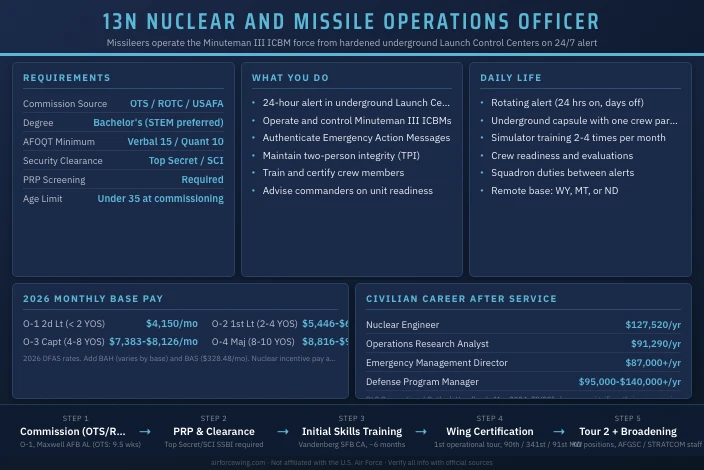
Nuclear and Missile Operations Officers (13N) operate and control intercontinental ballistic missile systems in support of strategic nuclear deterrence. They coordinate nuclear and missile operations policies and programs, establish training standards for missile crews, advise commanders on unit capabilities, and assess weapon system effectiveness across the Minuteman III force. These officers serve as certified missile combat crew members and, over time, as crew commanders, flight commanders, and operations officers for ICBM wings.
Command and Leadership Scope
New 13N officers enter as crew members and spend their first years executing 24-hour alert shifts. By O-3 (Capt), most serve as flight commanders responsible for the readiness, training, and evaluation of 20 to 30 Airmen across their assigned missile flight. Operations officer and squadron commander roles come at O-4 (Maj) and O-5 (Lt Col), managing 100 or more personnel and all crew operations for a missile squadron.
A missile squadron commander oversees the operational readiness of 50 ICBMs and the crews who stand alert on them. Wing-level positions at O-6 (Col) carry responsibility for an entire missile wing and its role in the national nuclear deterrence mission.
Specific Roles and Designations
The 13N designator covers several shredouts and qualification levels tied to crew position and weapon system.
| AFSC | Designation | Primary Role |
|---|---|---|
| 13N1 | Nuclear and Missile Operations | Crew member / crew commander |
| 13N1A | Initial Qualification | Pre-certification missile officer |
| 13N2 | Missile Operations (Senior) | Flight commander / instructor |
| 13N3 | Nuclear Staff Officer | Major command / joint staff billet |
Special Experience Identifiers (SEIs) exist for officers who qualify as instructor crew commanders, evaluators, and weapons officers through the 13N Weapons School program.
Mission Contribution
The Minuteman III is one leg of the U.S. nuclear triad alongside submarine-launched ballistic missiles and nuclear-capable bombers. The land-based ICBM force provides a fixed, hardened, and continuously manned deterrent that adversaries must account for at all times. Unlike other Air Force career fields, the 13N mission is not measured in sorties or strike packages. It is measured in continuous presence and credible response.
In joint and combined operations, 13N officers work within the strategic command architecture under U.S. Strategic Command (USSTRATCOM). They coordinate directly with AFGSC, Twentieth Air Force, and the National Command Authority chain. The field contributes staff officers to joint billets at combatant commands and the Pentagon.
Technology, Equipment, and Systems
The primary system is the LGM-30G Minuteman III, a three-stage, solid-fuel ICBM with a range exceeding 8,000 miles. Officers operate from Launch Control Centers (LCCs), hardened underground capsules that each control up to 10 missiles spread across the surrounding terrain. The Missile Procedure Trainer (MPT) and associated simulators replicate all operational conditions for crew certification and recurring training.
Command and control runs through the Minimum Essential Emergency Communications Network (MEECN) and associated survivable communication systems. Officers use the Air Force Satellite Command and Control System and multiple redundant communication paths to receive and authenticate Emergency Action Messages.
Salary and Benefits
Officer Base Pay
All officer pay is set by DFAS and applies uniformly across the Air Force. The table below reflects 2026 rates.
| Rank | Grade | Typical YOS | Monthly Base Pay |
|---|---|---|---|
| 2d Lt | O-1 | Less than 2 | $4,150 |
| 2d Lt | O-1 | 2 years | $4,320 |
| 1st Lt | O-2 | 2 years | $5,446 |
| 1st Lt | O-2 | 3-4 years | $6,272-$6,485 |
| Capt | O-3 | 4 years | $7,383 |
| Capt | O-3 | 6-8 years | $7,737-$8,126 |
| Maj | O-4 | 8-10 years | $8,816-$9,420 |
Figures reflect 2026 DFAS pay tables.
Special Pays and Incentives
The Air Force has established assignment incentive pay and special duty assignment pay for nuclear career fields. These incentives were approved specifically to recognize the unique demands of continuous alert duty and the limited duty station options available to 13N officers. Verify current rates with AFPC or your recruiting officer, as incentive pay amounts are subject to annual review and congressional authorization.
Officers on alert duty may also qualify for Hazardous Duty Incentive Pay (HDIP) for specific duties performed in connection with missile operations. Confirm current HDIP rates through official DFAS pay tables.
Additional Benefits
Housing: BAH rates for officers are higher than enlisted and vary by installation. Officers without dependents at F.E. Warren AFB, Malmstrom AFB, and Minot AFB can expect BAH well above national averages for those cost-of-living areas. Use the DoD BAH Rate Lookup for exact figures.
Food: Officers receive a monthly Basic Allowance for Subsistence (BAS) of $328.48 (2026 rate).
Healthcare: Active duty officers receive TRICARE Prime at no cost, covering medical, mental health, prescriptions, and hospitalization. Dental care at military treatment facilities is free for active duty members.
Education: The Air Force covers tuition up to $4,500 per year through Tuition Assistance. Officers who separate or retire after service can use the Post-9/11 GI Bill, which covers full in-state tuition at public schools or up to $29,920.95 per year at private institutions (2025-2026 academic year cap).
Retirement: The Blended Retirement System provides a pension equal to 2% of your high-36 average basic pay per year of service at 20 years, 40% total, plus Thrift Savings Plan matching up to 5% of base pay. See militaryonesource.mil for full details.
Work-Life Balance
Alert duty runs 24 hours on, followed by days off the rotation. The duty-day structure differs from a standard 8-to-5 schedule. Most officers work a cycle that alternates alert shifts with crew rest, additional duty days, and training. Deployed tempo for 13N officers is relatively low compared to operational flying career fields, but the alert schedule means limited flexibility during rotation periods.
Officers in staff assignments follow conventional schedules. The trade-off is that most 13N officers spend their first six years close to three relatively remote bases in Wyoming, Montana, and North Dakota.
Qualifications and Eligibility
All 13N candidates must commission as Air Force officers before entering the career field. The process begins well before you wear a uniform.
Starting your preparation now means building AFOQT scores that open the door. AFOQT preparation resources are the right place to begin regardless of which commissioning source you pursue.
Commissioning Sources
| Commissioning Source | GPA Minimum | Degree Requirement | Age Limit | Key Prerequisite |
|---|---|---|---|---|
| AFROTC | 3.0 preferred | Bachelor’s (STEM preferred) | Under 35 at commissioning | AFOQT, field training |
| OTS | 3.0 preferred | Bachelor’s (STEM preferred) | Under 35 at commissioning | AFOQT, competitive package |
| USAFA | N/A (competitive admission) | B.S. (4-year program) | Under 23 at entry | Nomination, competitive selection |
STEM degrees (science, technology, engineering, mathematics) are strongly preferred for 13N because of the technical nature of weapon system operations and the Personnel Reliability Program screening. Officers with degrees outside STEM have commissioned into the career field, but a technical background helps through training.
Test Requirements
All Air Force officer candidates must pass the Air Force Officer Qualifying Test (AFOQT). The AFOQT minimum scores for non-rated officer categories are a 15 Verbal and 10 Quantitative composite. Competitive packages for 13N will typically exceed these minimums. The career field does not require the TBAS (Test of Basic Aviation Skills), 13N is a non-rated position.
Strong performance across the AFOQT Verbal, Quantitative, and Academic Aptitude composites strengthens your commissioning package.
Career Field Assignment and Classification
For ROTC cadets, career field classification occurs through the ROTC Enrollment Allocation process during the senior year. 13N is a non-rated field, so it does not require the same aviation aptitude testing as pilot or CSO tracks. OTS applicants apply with a specific AFSC preference. Competitiveness varies by year based on AFGSC accession needs, which have been deliberately reduced as part of a restructure that prioritizes retention over volume.
Cross-training into 13N from other career fields is possible but not common. Officers cross-training out, particularly into undergraduate pilot training, is a documented career path the Air Force supports.
Upon Commissioning
New 13N officers commission as O-1 (2d Lt). The standard Active Duty Service Commitment (ADSC) for the training pipeline is 4 years after completion of initial missile qualification training. Officers retained after their first assignment, a policy formalized through the 13N career field restructure, will incur additional service commitments.
Work Environment
Setting and Schedule
13N officers work in three distinct environments: the Launch Control Center, the wing headquarters, and staff or broadening assignments. The LCC is the job’s defining space, a reinforced underground capsule shared with one other officer. Crews pull 24-hour alert shifts monitoring missile systems, maintaining communication posture, and standing ready to execute if ordered.
Above ground, officers work in missile alert facility buildings adjacent to each LCC site, in squadron operations buildings on the main base, and in training facilities. Staff tours take officers out of the operational environment into wing, AFGSC, USSTRATCOM, Air Staff, and joint billets.
Alert rotations typically run several times per month. Between alerts, officers complete training requirements, squadron duties, and administrative responsibilities.
Leadership and Chain of Command
Missile combat crew members report to crew commanders, who report to flight commanders, who fall under the operations officer and squadron commander. The chain tracks closely with the standard Air Force squadron structure, but the two-person crew format creates a distinctive dynamic, crew member and crew commander must work as a highly coordinated team under pressure.
Senior NCOs, including the flight chief and operations group superintendent, serve as the experience backbone of wing operations. The officer-NCO relationship in missile wings centers on crew management, training coordination, and standards enforcement. Chiefs bring years of operational knowledge that new officers depend on through their initial qualification period.
Staff vs. Command Roles
The 13N career track cycles between operational crew duty, flight and squadron leadership, and staff positions. Junior officers spend two operational tours at missile wings before moving into broadening assignments. Staff positions at AFGSC, USSTRATCOM, the Air Staff (A10 office), and joint commands occupy the middle years of a career. Return tours to wing command positions cap a successful career at O-5 and O-6.
Job Satisfaction and Retention
The 13N career field has historically faced retention challenges, partly due to remote duty station locations and the demanding alert schedule. The Air Force restructure addressed this directly by reducing accessions and guaranteeing retention after the first assignment, creating a more senior, experienced crew force at wing level. Officers who find purpose in the strategic deterrence mission tend to stay. Those who struggle with remote bases and limited operational variety are more likely to cross-train or separate after their initial commitment.
Training and Skill Development
Pre-Commissioning Training
All paths lead through the same commissioning process. ROTC cadets complete a four-year curriculum including field training and AFOQT qualification. OTS candidates complete 9.5 weeks at Maxwell AFB, Alabama. USAFA graduates complete four years of the Academy program. All three routes result in commissioning as a 2d Lt. The AFOQT preparation guide covers the Verbal, Quantitative, and Academic Aptitude composites that factor into selection.
Initial Skills Training
After commissioning, 13N officers complete initial missile qualification training, commonly called Initial Skills Training (IST): before reaching their first operational wing. Training is conducted through the 381st Training Group at Vandenberg Space Force Base, California, under Twentieth Air Force.
| Phase | Location | Focus | Duration |
|---|---|---|---|
| OTS / Commissioning | Maxwell AFB, AL | Officer fundamentals | 9.5 weeks |
| Nuclear familiarization | Pre-training | Clearance, PRP, admin | Variable |
| Initial Skills Training | Vandenberg SFB, CA | Missile systems, EWO, simulator | Approx. 6 months |
| Wing certification | Operational wing | Local procedures, final certification | Variable |
IST covers three primary areas: academic classroom instruction on Minuteman III weapon and communications systems, Emergency War Order (EWO) training, and hands-on simulator training in the Missile Procedures Trainer. Crew qualification requires demonstrated competency across all three phases before an officer can pull their first operational alert.
Before entering training, officers must complete Personnel Reliability Program (PRP) screening and hold a Top Secret/SCI security clearance based on a Single Scope Background Investigation (SSBI). The clearance process can take several months and is initiated early in the commissioning pipeline.
Professional Military Education
- Squadron Officer School (SOS): Completed by most O-3 captains, either in residence at Maxwell AFB or via correspondence. SOS is a prerequisite for O-4 promotion consideration.
- Air Command and Staff College (ACSC): For O-4 majors, typically completed in residence or by distance at Maxwell AFB. The intermediate PME requirement for promotion to O-5.
- Air War College (AWC): For senior O-5s selected for senior developmental education. Prepares officers for O-6 command and joint duty.
Additional Schools and Training
The Air Force established a 13N Weapons School program modeled on the Air Force Weapons School concept. Graduates earn the Weapons Officer SEI and serve as tactical experts in missile operations, crew training, and standards evaluation. This program is a career-accelerating credential for 13N officers competing for command.
Officers may also pursue fully funded graduate education through the Air Force Institute of Technology (AFIT), particularly in nuclear engineering, operations research, and national security studies, fields directly relevant to missile operations staff work.
Career Progression and Advancement
Career Path
The 13N career is built around two foundational operational tours at missile wings before officers broaden into staff assignments, joint billets, or advanced education.
| Rank | Grade | Typical Time | Key Developmental Positions |
|---|---|---|---|
| 2d Lt | O-1 | Years 1-2 | Initial training, crew member |
| 1st Lt | O-2 | Years 2-4 | Crew member, crew commander |
| Capt | O-3 | Years 4-10 | Crew commander, flight commander (KD) |
| Maj | O-4 | Years 10-16 | Operations officer, staff assignments |
| Lt Col | O-5 | Years 16-22 | Squadron commander (KD), group staff |
| Col | O-6 | Years 22+ | Group commander, wing commander |
Key Developmental (KD) positions for promotion competitiveness: flight commander at O-3/O-4, operations officer at O-4, and squadron commander at O-5. Officers who miss these KD windows face a steep promotion disadvantage.
Promotion System
Promotion from O-1 to O-3 is essentially time-based and automatic for officers in good standing. O-4 and above require board selection. Promotion rates vary annually, but Air Force-wide selectivity increases significantly at the O-4 and especially O-5 board. Officers with strong KD positions, education credentials, and joint experience are more competitive.
Cross-Training and Broadening
The Air Force supports 13N officers who want to pursue undergraduate pilot training (UPT) after meeting minimum service requirements. This cross-training path exists formally and has been a known exit route from the career field. Officers who remain in 13N have access to broadening at AFGSC headquarters (Barksdale AFB, LA), USSTRATCOM (Offutt AFB, NE), the Air Staff, and joint combatant command billets.
Congressional fellowship programs, ROTC instructor duty, and international exchange assignments are also available as broadening options for competitive officers.
Building a competitive record means completing KD positions early, earning the Weapons Officer SEI if selected, completing PME in residence, and pursuing joint assignments in the mid-career window. For officers still preparing to commission, strong AFOQT scores set the foundation for career field selection. The AFOQT study guide covers the verbal and quantitative composites that matter.
Physical Demands and Medical Evaluations
Physical Requirements
13N officers take the same Air Force Fitness Assessment (FA) as all Airmen. There are no AFSC-specific physical performance requirements beyond the standard FA.
| Component | Max Points |
|---|---|
| 1.5-Mile Run | 60 |
| Waist Circumference / Body Composition | 20 |
| Push-Ups (1 minute) | 10 |
| Sit-Ups (1 minute) | 10 |
| Total | 100 |
Minimum passing composite score is 75 points. Each component has its own minimum threshold. Standards are age- and gender-normed. Assessments occur annually for most Airmen.
Flight Physicals and Career Field-Specific Medical
13N is not a rated position and does not require a flight physical. However, officers must meet physical qualifications for Missile Operator duty as part of the Personnel Reliability Program (PRP) screening. PRP is a continuous reliability evaluation that includes medical records review, psychological screening, and command review of personal conduct and financial responsibility.
Officers with disqualifying medical conditions identified during PRP screening may be unable to serve in the missile crew force. Common disqualifying factors include conditions affecting reliability, judgment, or the ability to perform emergency procedures under stress. Specific standards are determined by the PRP certifying official and unit flight surgeon.
Deployment and Duty Stations
Deployment Details
The 13N career field has a lower operational deployment tempo than most Air Force career fields. Alert duty itself functions as a continuous operational mission, missileers are on watch every day of the year. Temporary duty (TDY) assignments for inspections, exercises, and staff support travel are common. Extended combat deployments comparable to those seen in tactical aviation or security forces are less frequent.
Officers may receive short-duration TDYs to USSTRATCOM, Air Staff, test and evaluation centers, or allied nuclear-sharing partner nations through NATO assignments.
Duty Station Options
All three operational ICBM wings fall under Air Force Global Strike Command and Twentieth Air Force.
| Wing | Base | Location | Missiles |
|---|---|---|---|
| 90th Missile Wing | F.E. Warren AFB | Cheyenne, WY | Minuteman III |
| 341st Missile Wing | Malmstrom AFB | Great Falls, MT | Minuteman III |
| 91st Missile Wing | Minot AFB | Minot, ND | Minuteman III |
Assignment to one of these three bases is expected for the first two operational tours. AFPC manages officer assignments through the standard preference worksheet and timing process. Join-spouse programs apply, though the limited number of bases constrains options for dual-military couples.
Post-wing assignments can take 13N officers to Barksdale AFB (AFGSC headquarters), Offutt AFB (USSTRATCOM), the Pentagon, or joint combatant command staff billets.
Risk, Safety, and Legal Considerations
Job Hazards
The inherent hazard for 13N officers is not physical danger in the conventional sense. The risk is procedural: operating systems that have no room for error in authentication, command verification, or equipment handling. Officers follow strict two-person integrity (TPI) protocols at all times when dealing with nuclear weapon systems and Emergency Action Messages. No single officer can complete a launch sequence alone, this is by design and enforced procedurally.
Underground LCC environments introduce occupational health considerations including limited natural light, confined workspace, and shift work disruption to sleep cycles.
Safety Protocols
Operational Risk Management (ORM) and the Nuclear Surety program govern all missile operations. The DoD Nuclear Weapons System Safety Standards require strict technical and administrative controls at every level. Crew training emphasizes checklist discipline and two-person verification for every critical procedure. Evaluation teams conduct regular no-notice inspections to certify crew proficiency and procedural compliance.
Legal and Command Responsibility
13N officers bear full UCMJ accountability for crew performance and technical compliance. A crew commander is legally and professionally responsible for the actions of their crew member. Officers who fail nuclear surety inspections or violate procedures face serious professional and legal consequences. Relief for cause from a nuclear surety failure can end a career at any grade.
Command climate responsibilities are the same as for any Air Force officer. Equal opportunity standards, professional conduct requirements, and financial responsibility directly affect PRP certification status.
Impact on Family and Personal Life
Family Considerations
The three-base assignment reality is the most direct impact on family life. Spouses looking for professional careers or specific urban amenities will find Cheyenne, Great Falls, and Minot limiting compared to larger metro areas. Each base has an Airman and Family Readiness Center (A&FRC) and a Key Spouse Program, but the remote locations require intentional planning.
The 24-hour alert rotation creates a non-standard home schedule. During rotation, officers are away from home overnight multiple times per month. The predictability of the rotation, fixed schedules rather than unpredictable deployments, is an advantage compared to high-tempo flying career fields.
PCS moves happen approximately every two to three years through the first two operational tours, but officers typically cycle between the same three bases rather than moving coast to coast. This can ease school disruption for children compared to career fields with more varied assignments.
Dual-Military and Family Planning
Dual-military officers in the 13N career field face limited join-spouse options because of the concentrated duty station footprint. The Air Force manages join-spouse assignments when possible, but officers at all three missile bases compete for a narrow set of available billets. Planning ahead and communicating preferences early through AFPC is essential.
Family support resources during alert rotations include on-base childcare, military family support programs, and the installation chaplain corps.
Reserve and Air National Guard
Component Availability
The 13N career field is available in the Air Force Reserve and the Air National Guard. Reserve component missileers perform the same crew qualification requirements and pull operational alerts alongside active duty crews. The career field’s nuclear mission means that Reserve and Guard 13N officers must maintain the same PRP status and security clearance as their active counterparts.
Commissioning Paths
Reserve and Guard candidates commission through OTS (Air National Guard-sponsored) or ROTC with a Reserve component contract. Direct commission into the 13N career field is not a standard pathway. Active duty officers who complete their ADSC can transfer to the Reserve or Guard in the 13N career field, and this is one of the more common transition paths for missileers who want to retain the career field connection while pursuing civilian employment.
Drill and Training Commitment
The standard Reserve commitment is one Unit Training Assembly (UTA) weekend per month plus two weeks of Annual Tour. 13N Reserve officers typically have additional training requirements to maintain crew currency and PRP certification beyond the standard UTA schedule. Simulator availability and alert cycles at the operational wings drive additional training days.
Part-Time Pay
An O-3 (Capt) in the Reserve earns drill pay based on four Unit Training Assemblies per UTA weekend. At the O-3 rate with 6 years of service, that is approximately $621 per drill weekend based on 2026 pay tables (4 UTAs x $155 per UTA). Active duty O-3 monthly base pay with 6 years of service is $7,737.
Benefits Differences
| Category | Active Duty | Air Force Reserve | Air National Guard |
|---|---|---|---|
| Commitment | Full-time | ~1 weekend/month + 2 weeks/year | ~1 weekend/month + 2 weeks/year |
| Monthly Base Pay (O-3, 6 YOS) | $7,737 | Drill pay (part-time) | Drill pay (part-time) |
| Healthcare | TRICARE Prime (free) | TRICARE Reserve Select (premiums apply) | TRICARE Reserve Select + state options |
| Tuition Assistance | $4,500/yr (Fed TA) | Federal TA available | Fed TA + state tuition waivers (ANG) |
| Education (GI Bill) | Full Post-9/11 GI Bill | Proportional to activation days | Proportional to activation days |
| Deployment Tempo | Low (alert-focused) | Varies by mobilization | Varies by mobilization |
| Command Opportunities | Yes (flight, sq, group, wing) | Squadron billets available | Squadron billets available |
| Retirement | 20-year pension (BRS) | Points-based reserve retirement | Points-based reserve retirement |
Air National Guard 13N officers may also qualify for state tuition waivers, which vary significantly by state. The Reserve retirement system is points-based, officers earn points for each day of active service, UTA, and other qualifying duty, with full retirement pay not beginning until age 60 in most cases.
Deployment and Mobilization
Reserve and Guard 13N officers can be mobilized for operational alert duty, exercises, and administrative support of the operational wings. Mobilization length varies. ADOS (Active Duty Operational Support) tours are common ways for Reserve component officers to maintain currency and contribute to wing operations.
Civilian Career Integration
The 13N career field pairs well with civilian careers in nuclear energy, national security, defense contracting, and government program management. Reserve and Guard service keeps security clearances active, which is a significant professional asset in the national security sector. USERRA protections cover employment rights during activations.
Post-Service Opportunities
Transition to Civilian Life
13N officers leave the military with a combination of clearance credentials, nuclear systems knowledge, leadership experience, and analytical problem-solving skills that translate well into government and private sector roles. The Transition Assistance Program (TAP) and Hiring Our Heroes fellowships support the transition process. Many former missileers move into roles at national laboratories, defense contractors, and federal agencies with nuclear portfolios.
Civilian Career Prospects
| Civilian Role | Median Annual Salary | Job Outlook (2024-2034) |
|---|---|---|
| Nuclear Engineer | $127,520 | -1% (stable, limited openings) |
| Operations Research Analyst | $91,290 | +21% (much faster than average) |
| Emergency Management Director | $87,000+ | Steady |
| Program Manager (Defense) | $95,000-$140,000+ | Stable (contractor dependent) |
Salary data from BLS Occupational Outlook Handbook (May 2024). Defense program manager salaries vary widely by contractor and clearance level.
The Top Secret/SCI clearance that 13N officers hold is one of the most valuable credentials in the civilian national security market. Contractors supporting USSTRATCOM, AFGSC, the Department of Energy’s National Nuclear Security Administration, and the intelligence community actively recruit cleared former nuclear officers.
Graduate Education and Credentials
13N officers do not earn civilian certifications directly from their training, missile operations is a unique military system. But many pursue graduate degrees in nuclear engineering, international security, or public policy during or after their service using Post-9/11 GI Bill benefits or AFIT programs. The combination of an advanced degree and a nuclear background opens doors at national laboratories (Los Alamos, Sandia, Lawrence Livermore), the Defense Threat Reduction Agency, and arms control organizations.
Is This a Good Job for You?
Ideal Candidate Profile
The best-fit 13N candidate is someone who genuinely cares about strategic deterrence and can find purpose in a mission that succeeds by never being used. Officers who thrive in this career field tend to be detail-oriented, technically capable, psychologically composed, and comfortable working in isolated environments with high stakes and low immediate feedback.
STEM backgrounds help. Strong analytical reasoning, checklist discipline, and the ability to perform precisely under stress matter more than any specific degree. Candidates who drew toward nuclear policy, arms control, or national security studies during college often find this career deeply satisfying.
Potential Challenges
The two most common reasons 13N officers leave after their initial obligation are the remote duty stations and the operational monotony. Alert duty is demanding but repetitive, the mission is deterrence, and deterrence looks the same every day. Officers who need variety, travel, or dynamic operational environments will find missile wings limiting.
The three-base concentration means limited school options for children, limited employment markets for spouses, and fewer amenities than larger Air Force bases. Officers with partners who have portable careers tend to adapt better than those with spouses tied to specific metropolitan job markets.
Career and Lifestyle Alignment
For officers who want a full military career to O-6, 13N offers a clear path with two strong KD positions, well-defined broadening options, and genuine promotion opportunities. The career field’s restructure created a more senior crew force, which means fewer officers competing for the same rungs.
For officers considering a one-and-done approach, the 13N pipeline still produces a clearance, technical credibility, and leadership experience that converts to strong civilian compensation in the defense sector. The field does not suit someone who expects the adventure or operational tempo of aviation career fields. But for the right person, no other Air Force job puts you this close to the center of American strategic power.
More Information
Official information on the 13N career field is available through Air Force Global Strike Command and the Air Force Personnel Center. The USSTRATCOM website covers the broader strategic deterrence mission that 13N officers support.
Officers preparing for commissioning can build competitive AFOQT scores with the AFOQT study guide before applying to OTS or ROTC. Talk to a recruiter through the official Air Force website for current 13N accession timelines and available slots.
This site is not affiliated with the U.S. Air Force or any government agency. Verify all information with official Air Force sources before making enlistment or career decisions.
Explore more Air Force Operations officer careers such as 18X RPA Pilot and 15W Weather Officer.