13B Air Battle Manager
Most Air Force pilots get the headlines. The officer sitting at the radar console on the E-3 Sentry, coordinating 40 aircraft across a contested airspace picture, typically does not. Air Battle Managers run the air battle. They deconflict airspace, vector fighters onto targets, and integrate every aircraft type in the joint force into a coherent operation. When a mission requires precise airspace management at scale, in real time, in a denied environment, that’s the 13B’s job.
Rated officer positions require a passing TBAS score. Our TBAS study guide covers all subtests. OTS candidates also need competitive ASVAB scores. See our AFOQT study guide.
Job Role
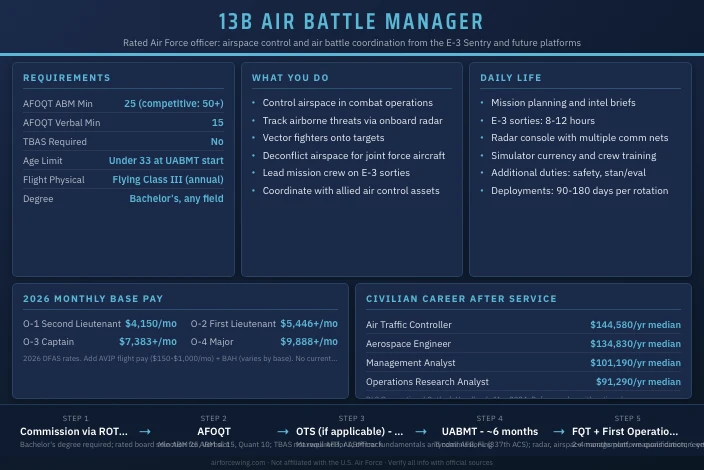
Air Battle Managers are rated Air Force officers who plan, direct, and control air operations from airborne command and control platforms. They manage airspace deconfliction, threat assessment, and the coordination of multiple aircraft in a joint battlespace. ABMs lead Airmen, make time-critical decisions with incomplete information, and are accountable for airspace safety and mission effectiveness from the moment they plug in.
Command and Leadership Scope
New ABMs enter at O-1 (2d Lt) and spend the early years in crew positions, qualifying on their assigned platform and building operational hours. By O-3 (Capt), most are flight commanders with 15 to 25 Airmen under them. They run training programs, manage crew qualification currencies, and serve as mission crew commanders on operational sorties.
At O-4 (Maj) and above, ABMs move into operations officer and squadron commander roles. A squadron commander at O-5 (Lt Col) manages a full flying squadron, including the flying schedule, crew training programs, safety functions, and the careers of 200 or more personnel.
Specific Roles and Designations
| Designation | Title | Platform | Mission Focus |
|---|---|---|---|
| 13B1 | Air Battle Manager | E-3 Sentry (AWACS) | Airborne airspace control, threat tracking |
| 13B1 | Air Battle Manager | E-8 Joint STARS | Ground surveillance and battle management |
| 13BX | Senior ABM | Various | Operations officer, squadron command |
The 13B designator is the foundation. After Undergraduate Air Battle Manager Training, officers are assigned to a specific platform and unit. Most new ABMs go to an E-3 AWACS unit, which is the most common platform in the career field. Special Experience Identifiers (SEIs) are added to the record as officers gain qualifications in specific mission areas such as airspace control authority or weapons director certification.
Mission Contribution
The Air Battle Manager career field exists to solve a problem that no single aircraft can solve on its own: how do you coordinate dozens of aircraft across hundreds of miles of contested airspace without fratricide, without gaps in coverage, and without getting in each other’s way? ABMs answer that question in real time.
In joint and combined operations, ABMs work with Navy and Marine E-2 Hawkeye crews, allied AWACS operators, and ground-based radar controllers to maintain a unified air picture. That coordination role becomes critical when allied air forces are sharing airspace during coalition strikes or humanitarian response operations.
Technology, Equipment, and Systems
The primary platform for most ABMs is the E-3 Sentry, the Air Force’s airborne warning and control system aircraft. The E-3 carries a rotating radar dome and an onboard mission crew of 13 to 19 specialists. ABMs on the E-3 use integrated radar, data links, and communications systems to track airborne targets and direct friendly aircraft.
The Air Force has also begun transitioning to the Boeing E-7A Wedgetail as the next-generation replacement for the E-3. Officers entering the career field today will likely serve during the transition period.
A smaller number of ABMs operated on the E-8 Joint STARS, a ground surveillance and battle management aircraft based at Robins AFB, Georgia. As the Joint STARS has been retired, ABM assignments have consolidated primarily around AWACS and future platforms.
Salary
Financial Benefits
ABMs enter service as O-1 (2d Lt) and receive military base pay set by DFAS pay tables. Aviation Incentive Pay (AVIP) begins after completing training and qualifying in a rated position. The table below shows 2026 base pay rates at typical career stages.
| Rank | Grade | Typical Time | Monthly Base Pay |
|---|---|---|---|
| Second Lieutenant | O-1 | Entry | $4,150 |
| First Lieutenant | O-2 | ~2 years | $5,446 |
| Captain | O-3 | ~4 years | $7,383 |
| Major | O-4 | ~10 years | $9,888 |
Figures from DFAS 2026 pay tables.
Aviation Incentive Pay (AVIP) adds $150 to $1,000 per month depending on years of aviation service, on top of base pay. Rated officers can also qualify for Continuation Pay under the Blended Retirement System, which provides a lump sum in exchange for additional service.
There is no specific accession bonus for ABMs at this time. Verify current incentive programs with a recruiter, as special pays change based on Air Force manning priorities.
Additional Benefits
Officers receive BAH based on duty station, pay grade, and dependency status. At most CONUS installations, O-3 BAH runs roughly $1,500 to $2,500 per month. ABM duty stations in higher cost-of-living areas like Joint Base Elmendorf-Richardson and Kadena AB push BAH toward the upper end of that range. BAS for officers is $328.48 per month in 2026.
Healthcare is covered under TRICARE Prime at no cost for active duty members and their families, with zero enrollment fees, zero deductibles, and zero copays for covered services.
The retirement system for officers commissioned after January 2018 is the Blended Retirement System, which combines a defined benefit pension at 40% of high-36 average basic pay after 20 years with Thrift Savings Plan matching up to 5% of basic pay. Officers on older retirement systems follow the legacy 20-year pension at the same multiplier.
Work-Life Balance
Garrison life for ABMs involves a normal duty day plus additional requirements for flight currency, training events, and officer duties. Deployment cycles for AWACS units typically run 90 to 180 days, with operational squadrons rotating through overseas deployments regularly. TDY travel for exercises and theater support adds to time away from home.
The Air Force provides 30 days of paid leave per year, accruing at 2.5 days per month. Work tempo varies by unit and mission, but AWACS units are operationally busy and forward deployments are common throughout a career.
Qualifications
Commissioning Sources
ABMs commission through one of three paths, then compete for a rated slot on the annual rated board.
Rated board selection is separate from commissioning. Candidates must first earn a commission, then compete for an ABM slot. Selection is based on AFOQT scores, GPA, physical qualifications, and commander ranking.
| Commissioning Source | GPA Minimum | Degree Requirements | Age Limit | Physical |
|---|---|---|---|---|
| AFROTC | 2.0 cumulative | Bachelor’s, any field | Under 33 at UABMT start | Flying Class III |
| Officer Training School (OTS) | 2.5 recommended | Bachelor’s required | Under 33 at UABMT start | Flying Class III |
| Air Force Academy (USAFA) | N/A (competitive admissions) | Bachelor’s earned at graduation | Under 33 at UABMT start | Flying Class III |
OTS is the most common path for non-ROTC and non-Academy candidates. It is located at Maxwell AFB, AL and runs approximately 9.5 weeks. ROTC cadets who graduate with a rated slot proceed directly to the training pipeline.
Test Requirements
All ABM candidates must complete the Air Force Officer Qualifying Test (AFOQT). The ABM-specific composite measures spatial ability, aviation knowledge, and battle management aptitude. Minimum scores for ABM selection are:
- ABM composite: 25 minimum (competitive candidates typically score 50 or higher)
- Verbal: 15 minimum
- Quantitative: 10 minimum
ABM candidates do not require the TBAS or a PCSM score. That testing requirement applies to pilot and RPA candidates only. AFOQT scores are the primary selection metric alongside GPA and command ranking.
Candidates preparing for the AFOQT can use AFOQT study resources to prepare for the verbal, quantitative, and aviation composites.
Career Field Assignment and Classification
Rated boards for pilot, ABM, CSO, and RPA slots are held annually. ROTC cadets compete at their ROTC rated board; OTS applicants submit packages reviewed by a central selection board. The board scores each candidate and ranks them. ABM slots are fewer than pilot slots and competition is real, though the career field is generally less competitive than 11X Pilot.
ABMs do not cross-train into pilot or CSO positions. Officers can request a career field reassignment later in their career, but rated positions rarely cross-train laterally between flying career fields after initial training investment.
Upon Commissioning
Officers enter at O-1 (2d Lt). The Active Duty Service Commitment upon graduation from Undergraduate Air Battle Manager Training is 6 years. This is shorter than the 10-year commitment for UPT graduates, reflecting the difference in training investment.
The 6-year ADSC begins at UABMT graduation, not at commissioning. Time spent in training before UABMT does not count against the commitment. Verify current ADSC policy with a recruiter, as commitments can change.
Work Environment
Setting and Schedule
ABMs work primarily in flying operations environments: operations centers, mission planning rooms, and onboard aircraft during sorties. At home station, a typical day involves pre-mission planning, intelligence briefs, simulator events, and operations center duties in between sorties. During deployments, the pace is higher and the mission hours are longer.
E-3 sorties run 8 to 12 hours including pre- and post-mission activities. ABMs spend a significant portion of their career at radar consoles, wearing headsets, managing a continuous stream of communications, radar tracks, and tactical data.
Leadership and Chain of Command
New ABMs report to experienced crew commanders and mission directors. By Capt, they are leading flights of junior officers and enlisted battle management specialists. The enlisted backbone of AWACS units, including 1C5X1 Battle Management Operators, works directly for ABM officers. That NCO relationship, especially with senior Technical Sergeants and Master Sergeants who have more hours on the platform than the lieutenant does, is something effective ABMs learn to respect early.
At the squadron level, ABMs work under an O-5 squadron commander and alongside an operations officer (Maj or Lt Col). The operations group commander at O-6 level oversees multiple flying squadrons.
Staff vs. Command Roles
Between command assignments, officers fill staff roles at wing, numbered air force, and major command headquarters. These tours cover operations planning, requirements development, and liaison assignments with joint or combined organizations. Staff experience is necessary for promotion but pulls officers away from flying operations for 2 to 3-year stretches.
The ratio of time in operational flying assignments vs. staff assignments shifts as officers progress. Captains and majors fly regularly. Lieutenant Colonels may be in a command or staff role with little or no flying. Colonels are almost entirely in command or senior staff roles.
Job Satisfaction and Retention
ABM retention tracks the broader rated officer community. Officers who leave after their initial ADSC typically cite deployment tempo, limited base options, and the transition opportunity available in the civilian aviation and defense sectors. Officers who stay typically describe the mission focus, crew camaraderie, and command track as primary reasons.
The career field’s future is also in a transition period, as the E-7A Wedgetail begins replacing the E-3 Sentry. Officers entering now will be part of that platform evolution, which brings new opportunities for early expertise but also some uncertainty about force structure.
Training
Pre-Commissioning Training
Commissioning training depends on the source. AFROTC cadets complete a 4-year program at their host university alongside college coursework, graduating with their degree and a commission. OTS candidates complete a 9.5-week program at Maxwell AFB that covers officer fundamentals, leadership, and Air Force culture. USAFA graduates a 4-year program at Colorado Springs.
All three paths produce the same O-1 commission. The difference is timing, academic requirements, and the competitive environment for rated slots.
Initial Skills Training
ABMs bypass the Initial Flight Training (IFT) course that pilot candidates attend. They proceed directly from commissioning to UABMT.
| Phase | Location | Duration | Focus |
|---|---|---|---|
| Officer Training School (if OTS) | Maxwell AFB, AL | 9.5 weeks | Commissioning, officer fundamentals |
| Undergraduate Air Battle Manager Training (UABMT) | Tyndall AFB, FL | ~6 months | Radar operations, airspace management, weapons control |
| Follow-on Qualification Training (FQT) | Assigned unit | 2-4 months | Platform-specific qualification on E-3 or assigned aircraft |
The 337th Air Control Squadron at Tyndall AFB runs UABMT. The course covers radar theory, airspace management procedures, weapons director certification, intercept geometry, and the crew coordination skills required on a multi-crew aircraft. Total time from commissioning to operational qualification is roughly one year.
UABMT is a demanding academic and operational course. Candidates who struggle with spatial reasoning, multi-task communications management, or rapid decision-making under time pressure will find it difficult. ABM school washout does occur, and officers who do not complete it may be reassigned to a non-rated career field.
Professional Military Education
PME follows the standard Air Force officer timeline:
- Squadron Officer School (SOS): Completed by Captains, typically in-residence at Maxwell AFB or by correspondence. Covers officer leadership, communication, and operational planning fundamentals.
- Air Command and Staff College (ACSC): Completed around the Major level. In-residence at Maxwell AFB or by distance learning. Required for O-5 promotion competitiveness.
- Air War College (AWC): For senior officers at the O-6 level. Covers strategic leadership, national security policy, and joint operations.
Additional Schools and Training
Experienced ABMs can pursue advanced training at the Air Force Weapons School at Nellis AFB, NV. The Weapons School produces weapons officers who serve as the tactical and academic experts in their career field. ABM Weapons School graduates carry the WSO designation and serve as instructors and evaluators.
Officers can also pursue advanced academic degrees through the Air Force Institute of Technology (AFIT) or through fully funded civilian university programs. Graduate education in operations research, systems engineering, or national security studies aligns well with ABM skill sets.
Qualifying TBAS and ASVAB scores come first. See our TBAS study guide and AFOQT study guide.
Career Progression
Career Path
| Rank | Grade | Time in Grade | Key Developmental Position |
|---|---|---|---|
| Second Lieutenant | O-1 | 18 months | Initial training, UABMT |
| First Lieutenant | O-2 | 2 years | Crew member, duty position qualification |
| Captain | O-3 | ~4 years | Flight commander, mission crew commander |
| Major | O-4 | ~5 years | Operations officer, division chief (staff) |
| Lieutenant Colonel | O-5 | ~3 years | Squadron commander (KD), operations group deputy |
| Colonel | O-6 | Variable | Operations group commander, senior staff |
Promotion from O-1 to O-3 is essentially time-based for officers in good standing. O-4 and above is board-selected. The board reviews the officer’s personnel record, performance reports, and the competitiveness of their KD positions.
Promotion System
The most important career milestone is squadron command, which is the key developmental position for O-5 promotion. Officers who do not serve as a squadron commander have a significantly reduced chance of making O-6. Below squadron command, service as a flight commander (O-3 level) and operations officer (O-4 level) are the expected stepping stones.
Current promotion rates for rated officers vary by fiscal year and career field manning. ABM promotion rates at O-4 typically run in the 80-90% range. O-5 rates are more competitive, typically in the 60-70% range. O-6 becomes highly selective. Verify current rates through AFPC.
Cross-Training and Broadening
Broadening assignments available to ABMs include:
- AFROTC instructor duty (Capt/Maj level, 3-year tour)
- Joint staff assignments (Pentagon, combatant commands)
- Air Force fellowship programs
- International exchange officer assignments with allied AWACS forces (UK, NATO, Japan)
- Defense acquisition positions
Exchange assignments with allied air forces give ABMs experience on foreign AWACS platforms and coalition command structures, which are high-value qualifications for senior leadership positions.
Physical Demands
Physical Requirements
All Air Force officers take the same Air Force Fitness Assessment regardless of career field. The assessment includes four components scored on a 100-point scale. A minimum composite score of 75 is required to pass.
| Component | Max Points |
|---|---|
| 1.5-Mile Run | 60 |
| Waist Circumference / Body Composition | 20 |
| Push-Ups (1 minute) | 10 |
| Sit-Ups (1 minute) | 10 |
Scoring standards are age- and gender-normed. Each component has its own minimum threshold that must be met regardless of composite score.
Flight Physical and Career Field-Specific Medical
ABMs require a Flying Class III physical, the same standard required for CSOs. This is less restrictive than the Flying Class I physical required for pilot candidates, but it disqualifies a range of common conditions. Flying Class III standards cover vision, hearing, cardiovascular health, neurological status, and a range of systemic conditions.
Candidates with correctable vision issues may qualify with LASIK or PRK following Air Force waiver review. A waiver process exists for some conditions, but not all disqualifying findings are waiverable.
ABMs undergo an annual aviation physical throughout their flying career. Flying duties can be suspended if a condition develops that does not meet Class III standards.
Deployment
Deployment Details
AWACS units deploy frequently. The 552nd Air Control Wing at Tinker AFB operates a continuous forward presence in multiple theaters, rotating crews through deployments that typically run 90 to 180 days. During peak operations, deployment tempo can exceed one rotation per year.
Deployments are operational. ABMs fly combat and combat support missions supporting joint and coalition forces in active theaters. This is not a garrison-only career field, and candidates who are not prepared for a high-tempo deployed environment should consider that carefully.
Duty Station Options
The primary duty stations for 13B ABMs are:
- Tinker AFB, Oklahoma: Home of the 552nd Air Control Wing, the largest AWACS unit in the Air Force
- Elmendorf-Richardson, Alaska: E-3 unit supporting Pacific theater operations
- Kadena AB, Japan: Forward-deployed AWACS supporting Pacific Command
- Robins AFB, Georgia: Historical E-8 Joint STARS basing; with JSTARS retirement, ABM presence has shifted
AFPC manages officer assignments through the Developmental Team and assignment cycle. Officers submit preference worksheets, but the needs of the Air Force drive final assignments. The career field’s duty station options are more limited than larger AFSCs, so flexibility in location preferences is an advantage.
Officers with join-spouse situations should address location preferences early with their assignment officer, as the limited number of ABM bases can make colocation challenging.
Risk/Safety
Job Hazards
ABMs fly on large, aging multi-crew aircraft. The E-3 Sentry has been in service since the late 1970s, and maintenance demands for an aging fleet create operational risk. Flight hazards for AWACS crews include the standard risks of military aviation: weather, mechanical failure, and the elevated risk of operating in or near contested airspace.
The leadership responsibilities of an ABM extend to airspace safety. An ABM who incorrectly clears an aircraft into an occupied block of airspace or misidentifies a friendly as a threat has directly caused a mishap. That accountability is built into the training and the crew resource management culture from day one.
Safety Protocols
ABMs train extensively in Crew Resource Management (CRM) and Operational Risk Management (ORM). CRM on a large multi-crew aircraft requires structured communication protocols, clearly defined crew roles, and a culture where junior crew members can challenge a senior one if they see an error. ABMs as crew commanders are responsible for setting that culture on their missions.
Legal and Command Responsibility
ABMs in command positions hold UCMJ authority over their subordinates. Command climate surveys, equal opportunity requirements, and the professional conduct of every officer in the unit are command responsibilities. Relief for cause ends a command career and, in most cases, an operational flying career.
Officers at every level are responsible for the conduct of their personnel. That accountability is one of the defining features of the ABM role, both on the crew and on the ground.
Impact on Family
Family Considerations
The deployment tempo in AWACS units is real. Families at Tinker AFB and other ABM installations deal with frequent TDY travel and regular 3 to 6-month deployments. The Air Force offers support through the Airman and Family Readiness Center (A&FRC), the Key Spouse Program, and Military OneSource.
PCS moves occur roughly every 2 to 4 years. The limited number of ABM bases makes PCS moves somewhat predictable compared to larger career fields, but they remain a regular feature of military family life.
Tinker AFB as a Primary Duty Station
The 552nd Air Control Wing at Tinker AFB, just outside Oklahoma City, is the career field’s center of gravity. Most ABMs spend at least one, and often multiple, assignments in the Oklahoma City metro area. Oklahoma City has a low cost of living relative to most military markets, a diversified economy, and active military family support programs through the installation. On-base housing waitlists are manageable, and off-base housing options are plentiful at rates well within BAH coverage for most pay grades.
Oklahoma City’s school districts vary by suburb and neighborhood. Families with school-age children should research specific districts before purchasing or leasing near the base. Midwest City and Del City are the closest communities, while Edmond and Moore are popular choices with more residential options.
Spouse employment in the Oklahoma City area is supported by a substantial aerospace and defense contractor presence, including Boeing and Northrop Grumman facilities. That alignment with the local economy helps some military spouses find work relevant to the base’s mission.
Alaska and Japan Assignments
JBER (Joint Base Elmendorf-Richardson) and Kadena AB assignments offer operationally rich environments with significant lifestyle adjustments. JBER is in the Anchorage metro area, expensive for housing relative to BAH in some cases, but with COLA (Cost of Living Allowance) offsetting higher consumer prices. Kadena is an overseas assignment with OCONUS allowances including overseas housing allowance (OHA) and COLA. Both are historically popular assignment choices despite, or because of, the geographic remoteness.
Dual-Military and Family Planning
Dual-military ABM couples face challenges given the small number of duty stations. AFPC handles join-spouse requests through formal policy, and every effort is made to collocate couples, but the career field’s concentrated basing makes guarantees difficult. Officers in this situation should plan early and communicate clearly with their assignment officer.
Childcare services, family support groups, and the installation community at major ABM bases are well-developed given the high operational tempo those bases sustain.
Reserve and Air National Guard
Component Availability
The 13B Air Battle Manager career field exists in both the Air Force Reserve and the Air National Guard. Guard and Reserve ABM units operate E-3 AWACS aircraft and participate in real-world operational missions alongside active-duty units. This is a career field where the reserve component genuinely flies operational sorties, not just training flights.
Commissioning Paths
Reserve and Air National Guard officers commission through the same paths as active duty: AFROTC with a Reserve component contract, OTS through a Guard or Reserve-sponsoring unit, or transfer from active duty after completing an ADSC. The Guard path typically requires a unit to sponsor the candidate’s rated slot before the selection board.
Active-duty ABMs can transfer to the Guard or Reserve after their ADSC. Many do, allowing them to maintain their flying currency and qualifications while pursuing a civilian career.
Drill and Training Commitment
The standard reserve commitment is one weekend per month (Unit Training Assembly) plus two weeks per year (Annual Tour). AWACS units typically require additional training days to maintain flying currency, crew qualification, and mission readiness beyond the standard schedule. Expect more than the minimum required days.
Part-Time Pay
An O-3 (Capt) in the Reserve or Guard earns roughly $738 per drill weekend (4 drill periods per weekend at the O-3 less than 4 years rate). Monthly base pay for the same O-3 on active duty is $5,534 to $7,737 depending on years of service. The drill rate is significantly lower but provides the supplemental income of a military paycheck alongside a civilian salary.
Benefits Differences
| Category | Active Duty | Air Force Reserve | Air National Guard |
|---|---|---|---|
| Commitment | Full-time, continuous | 1 weekend/month + 2 weeks/year + additional training | Same as Reserve |
| Monthly Pay (O-3) | $5,534-$8,788 | ~$738/drill weekend | ~$738/drill weekend |
| Healthcare | TRICARE Prime (no cost) | TRICARE Reserve Select (premiums apply) | TRICARE Reserve Select + state options |
| Education Benefits | Full GI Bill + Tuition Assistance | GI Bill (based on activation) | State tuition waivers + Federal TA |
| Retirement | 20-year pension (40% high-36) | Points-based Reserve pension at age 60 | Points-based, potential early retirement with activation |
| Deployment Tempo | High (90-180+ days/year) | Mobilization-dependent | Mobilization-dependent |
| Command Opportunities | Flight, squadron, group, wing | Squadron and group billets available | Squadron and group billets available |
Guard and Reserve ABMs can attend SOS, ACSC, and AWC at the same eligibility points as active-duty officers, though scheduling around civilian jobs requires coordination.
Deployment and Mobilization
Reserve and Guard AWACS units have deployed to combat theaters regularly since 2001. Mobilizations can run 6 to 12 months. Officers who are mobilized receive full active-duty pay and benefits during the deployment. USERRA protects civilian employment during activated service, and most Guard-friendly employers have established processes for managing military absences.
Civilian Career Integration
The ABM skill set pairs well with careers in aviation operations, air traffic management, defense contracting, and national security analysis. Common civilian roles include FAA air traffic control management, defense intelligence analysis, aerospace program management, and operations research. Many ABMs pursue airline careers, where military aviation experience and an instrument-rated background are competitive advantages.
Post-Service
Transition to Civilian Life
ABMs leave service with a clearance, leadership experience at scale, and deep knowledge of airspace management and joint military operations. Those three things are highly marketable. The transition to civilian defense, aviation, and leadership roles is typically smooth for officers who plan ahead.
The Transition Assistance Program (TAP) is available at most installations and covers resume writing, federal employment applications, and civilian interview preparation. Programs like Hiring Our Heroes specifically focus on veteran officer placement in corporate leadership roles.
Civilian Career Prospects
| Job Title | Median Annual Salary | Job Outlook |
|---|---|---|
| Air Traffic Controller | $144,580 | +1% (2024-2034) |
| Aerospace Engineer | $134,830 | +6% (2024-2034) |
| Operations Research Analyst | $91,290 | +23% (2024-2034) |
| Management Analyst | $101,190 | +11% (2024-2034) |
Salary data from BLS Occupational Outlook Handbook, May 2024. National medians shown; defense sector roles with active clearances typically pay above median.
Air traffic control is a natural transition for ABMs given the direct overlap in airspace management skills. The FAA has experienced significant controller shortages in recent years, and military-trained controllers receive expedited certification credit.
Graduate Education and Credentials
The GI Bill covers up to 36 months of education at $29,920.95 per year for private schools (2025-2026 cap) or full in-state tuition for public universities. Officers who serve 6 or more years can also transfer GI Bill benefits to dependents with an additional 4-year service obligation.
Military training does not directly transfer to FAA controller certification, but ABMs receive significant credit through the military crosswalk process. The AFIT program and civilian graduate fellowships are available during service for officers pursuing advanced degrees.
Is This a Good Job
Ideal Candidate Profile
The ABM career field rewards candidates who think clearly in high-noise environments. You need to track multiple aircraft, manage several radio nets simultaneously, make fast recommendations to the mission commander, and keep the airspace picture accurate while the situation changes around you. If that sounds like something you’d want to do for a living, keep reading.
Strong ABM candidates typically:
- Perform well under cognitive load, spatial reasoning, pattern recognition, rapid prioritization
- Prefer coordination and control roles over single-platform combat
- Are comfortable with a career built around crew operations rather than solo performance
- Want a rated career without the pilot selection pressure of PCSM scores and 10-year commitments
- Can tolerate a small duty station footprint and regular deployments
Potential Challenges
The career field has a limited number of bases. If you have a strong preference for a specific geographic region, the ABM assignment pool may not accommodate it. The E-3 fleet is aging, and the platform transition to the E-7A Wedgetail creates some uncertainty about force structure and mission requirements.
Officers who want maximum tactical autonomy in a single-seat aircraft, or who are motivated primarily by close air combat, will find the ABM mission less satisfying than the pilot track. The ABM role is about managing the whole board, not individual sorties.
Staff assignments between flying tours can feel like a long detour for officers who joined to fly. That grind is real, and it affects retention at the 6-year ADSC mark.
Career and Lifestyle Alignment
For officers who want a rated career with a shorter initial commitment than UPT, a compelling operational mission, and a clear transition path into defense or aviation industries, the 13B field is worth serious consideration. The 6-year ADSC vs. 10 years for pilots is a meaningful difference for candidates who want to maintain options.
Officers planning a long military career and targeting O-6 command will find the ABM field provides that path. The career field is small enough that strong performers get noticed, and senior ABMs serve in joint and combined command positions that carry significant influence.
More Information
Contact a local Air Force recruiter or your AFROTC detachment to discuss rated board timelines and how to build a competitive package for an ABM slot. AFOQT preparation is the primary test requirement for this career field, AFOQT study resources are the best starting point for any officer candidate.
A few specifics worth confirming when you make contact:
UABMT class schedules: Training class sizes at Tyndall AFB are smaller than those at UPT locations, and seat availability depends on the annual training plan. Ask your recruiter or ROTC commander how many ABM slots are projected for your graduating class year.
Medical qualification timing: The Flying Class III physical is required before UABMT begins. Candidates with known hearing, vision, or cardiovascular issues should see a flight surgeon early, before submitting their commissioning package, rather than discovering a disqualifying condition at the MEPS physical. Some conditions are waiverable; others are not. The earlier you know, the more options you have.
The E-7A Wedgetail transition: The Air Force has selected the Boeing E-7A as the replacement for the E-3 Sentry. Officers entering the career field now will likely serve on both platforms at some point. The transition timeline and how it affects training and assignments is worth asking a recruiter or current ABM about, as the operational details continue to develop.
AFOQT ABM composite: The ABM composite score is calculated from specific AFOQT subtests. Unlike the Pilot composite, it does not include a psychomotor section. It emphasizes spatial ability, aviation knowledge, and reading comprehension. Targeted preparation for those sections, rather than treating the entire AFOQT as a single test, will produce better ABM composite scores than a general review alone.
The 13B career field is smaller and less well-known than pilot or CSO, which means general recruiters may have less familiarity with it. Finding a recruiter who has worked with officer accession candidates for non-rated positions, or reaching out directly to an ROTC detachment, will get you more specific and accurate information.
This site is not affiliated with the U.S. Air Force or any government agency. Verify all information with official Air Force sources before making enlistment or career decisions.
Explore more Air Force Operations officer careers such as the 11X Pilot and the 12X Combat Systems Officer.