12X Combat Systems Officer
Most people picture a fighter jet pilot when they think about Air Force aviation. But on many of those same aircraft, there’s a second officer in the backseat making the mission work. Combat Systems Officers operate the weapons, sensors, and navigation systems that pilots rely on to accomplish the mission. On a B-52, the CSO targets and releases weapons over coordinates hundreds of miles away. On an F-15E, the Weapons System Officer (WSO) manages targeting pods and precision munitions in real time. On an AC-130, the CSO controls sensors and fires weapons in direct support of troops on the ground. The 12X career field is a rated officer position with an aeronautical rating, flight pay, and the same path to command as any other pilot.
Rated officer positions require a passing TBAS score. Our TBAS study guide covers all subtests. OTS candidates also need competitive ASVAB scores. See our AFOQT study guide.
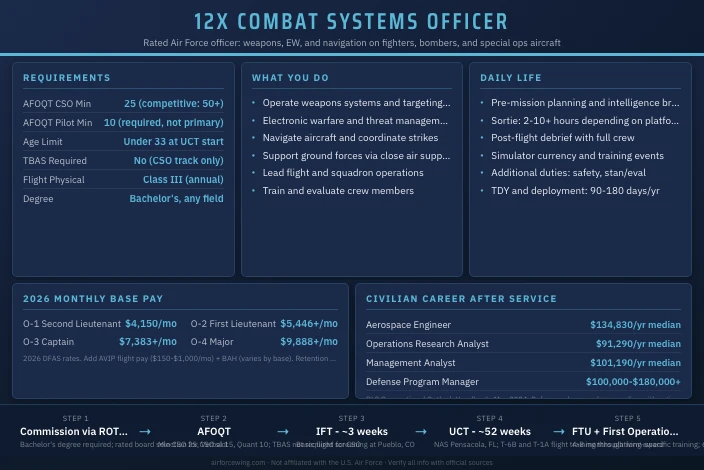
Job Role
Combat Systems Officers are rated Air Force officers who operate weapons systems, electronic warfare equipment, navigation systems, and sensors aboard military aircraft. They work alongside pilots to execute the full spectrum of Air Force missions, from precision strike and electronic warfare to intelligence collection and special operations support. At every career stage, CSOs lead Airmen, own training programs, and make real-time decisions that determine whether a mission succeeds.
Command and Leadership Scope
New CSOs enter at O-1 (2d Lt) and spend the early years mastering the systems on their assigned platform. By O-3 (Capt), most are serving as flight commanders with 15 to 25 Airmen in their flight. They run training programs, manage currency requirements, and write performance reports for junior officers and enlisted aircrew.
At O-4 (Maj) and above, CSOs move into operations officer and squadron commander billets. A squadron commander at O-5 (Lt Col) manages an entire flying squadron, which can include 200 or more personnel. Senior CSOs serve as group and wing commanders, overseeing multiple squadrons and multi-mission flying programs at major installations.
Specific Roles and Designations
The 12X designator is a broad umbrella. After completing Undergraduate Combat Systems Officer Training, officers receive a specialized shredout based on platform assignment and mission type.
| Shredout | Title | Primary Platforms |
|---|---|---|
| 12BX | Bomber CSO | B-52H Stratofortress, B-2 Spirit |
| 12FX | Fighter CSO (WSO) | F-15E Strike Eagle |
| 12GX | Generalist CSO | Multiple airframes |
| 12HX | Rescue CSO | HC-130J, HH-60G |
| 12KX | Trainer CSO | T-1A Jayhawk, T-6B Texan II |
| 12MX | Mobility CSO | C-130 variants |
| 12RX | Reconnaissance/EW CSO | RC-135, EA-18G (exchange) |
| 12SX | Special Operations CSO | AC-130W/J, MC-130H/J |
| 12UX | Remotely Piloted Aircraft CSO | MQ-9 Reaper (sensor operator role) |
Special Experience Identifiers (SEIs) are added to the base shredout to denote additional qualifications, such as weapons officer, instructor, or evaluator status. These designators appear in an officer’s official records and affect assignment eligibility and board selection.
Mission Contribution
CSOs are embedded in nearly every major Air Force mission set. A B-52 crew relies on the CSO to manage weapons employment, load targeting data, and coordinate with intelligence feeds. On the F-15E, the WSO runs the targeting pod, acquires and designates targets, and employs air-to-ground and air-to-air munitions while the pilot manages the aircraft. In special operations, AC-130 CSOs control fire control systems that enable precision strikes within feet of friendly forces.
In joint operations, CSOs work directly with Army and Marine ground units through close air support coordination, and with Navy and allied aircraft through combined strike packages. The career field contributes directly to the Air Force’s core missions of global strike, air superiority, and special operations.
Technology, Equipment, and Systems
The systems a CSO operates depend on the platform. Across the career field, officers work with:
- Targeting and weapons systems: LITENING and Sniper Advanced Targeting Pods, Joint Direct Attack Munitions (JDAMs), Advanced Medium-Range Air-to-Air Missiles (AMRAAM), and GPS-guided precision munitions
- Electronic warfare systems: AN/ALQ-135 Internal Countermeasures System on the F-15E; jamming and threat warning systems on EW-designated platforms
- Navigation and sensor systems: Terrain-following radar, forward-looking infrared (FLIR), synthetic aperture radar (SAR), and full-motion video (FMV) systems
- Command and control systems: LINK 16 tactical data network, secure voice and data communications, and joint interoperability systems
Salary
Base Pay and Flight Pay
CSOs receive officer base pay based on grade and years of service. At the O-3 (Capt) level with four years of service, that’s $7,383 per month in base pay, rising to $8,126 with eight years. These figures come from the 2026 DFAS pay tables.
| Grade | Title | Entry Pay (<2 yrs) | Mid-Career Pay (4-6 yrs) |
|---|---|---|---|
| O-1 | 2d Lt | $4,150/mo | $5,222/mo |
| O-2 | 1st Lt | $4,782/mo | $6,485/mo |
| O-3 | Capt | $5,534/mo | $7,383/mo |
| O-4 | Maj | $6,295/mo | $7,881/mo |
All rated officers receive Aviation Incentive Pay (AVIP), which adds $150 to $1,000 per month depending on years of aviation service. CSOs also qualify for Hazardous Duty Incentive Pay when flying certain mission types.
Retention Bonuses
The Air Force actively competes with airlines and defense contractors for experienced rated officers. CSOs and navigators are eligible for the Experienced Aviator Retention Incentive, which offers up to $50,000 per year in retention bonuses. Multi-year contracts can reach total values of $45,000 to $360,000 depending on years committed. Bonus amounts and contract lengths change annually; verify current offers with your assignment officer or at myairforcebenefits.us.af.mil.
Additional Benefits
Beyond base pay and flight pay, all active-duty CSOs receive:
- BAH: Monthly housing allowance that varies by duty location and dependency status. An O-3 at a typical CONUS installation can expect several hundred to over $2,000 per month depending on the base.
- BAS: Officers receive $328.48 per month for food.
- TRICARE Prime: Full medical, dental, vision, and prescription coverage with no premiums, no deductibles, and no copays.
- 30 days paid leave per year (accrues at 2.5 days per month).
- TSP retirement matching: The Blended Retirement System contributes 1% automatically and matches up to 4% of basic pay when you contribute.
Work-Life Balance
Flying squadrons are demanding. Garrison schedules typically run five days a week but extend into evenings and weekends during exercises and inspections. Deployment cycles vary by platform and combatant command requirements. A B-52 crew may spend 120 days per year deployed or on temporary duty (TDY). An F-15E WSO in an ACC unit can deploy at similar rates. Most CSOs report that the flying and mission focus offset the schedule demands, but the pace is real, especially in junior officer years.
Qualifications
Commissioning Sources
CSOs must commission before beginning flight training. Three primary paths lead to an officer commission:
| Commissioning Source | GPA Min | Degree Requirements | Age Limit | CSO-Specific Notes |
|---|---|---|---|---|
| ROTC | Typically 3.0+ | Bachelor’s, any field | Under 33 at UCT start | Rated slot selection at Field Training; competitive board |
| OTS | Typically 3.0+ | Bachelor’s degree required | Under 33 at UCT start | Civilian applicants; rated slots selected at OTS board |
| USAFA | N/A (internal GPA) | USAFA degree (BS) | Admitted by age ~18-22 | Rated preference submitted senior year |
There is no Direct Commission path into the rated officer career fields. All CSOs earn their commission through ROTC, OTS, or the Academy before proceeding to flight training.
Test Requirements
All officer candidates take the Air Force Officer Qualifying Test (AFOQT). For the 12X career field, candidates need minimum scores on four composite areas:
- Pilot Composite: 10 minimum (not the primary selection criterion for CSOs, but required)
- CSO Composite: 25 minimum
- Verbal Composite: 15 minimum
- Quantitative Composite: 10 minimum
These are minimums, not competitive targets. Boards routinely select candidates well above them. A CSO Composite in the 50s or higher puts you in a genuinely competitive position. Strong AFOQT scores in the verbal and quantitative areas also affect academic aptitude ratings used in officer selection boards.
The AFOQT can only be taken twice in a lifetime. There is no exception policy. Prepare thoroughly before your first attempt. Test prep resources for the AFOQT are available through Air Force test prep guides.
Unlike the pilot career field, CSOs are not required to take the TBAS (Test of Basic Aviation Skills). The PCSM score, which combines TBAS results with AFOQT and flight hours, is specific to pilot selection and does not apply to CSO candidates.
Career Field Assignment
At ROTC detachments, cadets apply for rated positions during Field Training and are ranked against peers across the country. AFOQT scores, GPA, physical fitness scores, and commander ratings all factor into the rated board. OTS candidates compete similarly at their selection board.
The rated career field is competitive but less so than the pilot track. USAFA graduates similarly submit platform preferences during their senior year assignment process, with the Air Force filling requirements against available rated slots.
Upon Commissioning
Officers commission as O-1 (2d Lt) and incur a 6-year Active Duty Service Commitment (ADSC) upon receiving their aeronautical rating at UCT graduation. This commitment begins from the date wings are awarded. Officers who accept retention bonuses take on additional commitment years beyond the baseline 6.
Work Environment
Setting and Schedule
The daily work environment for a CSO shifts constantly between the operations center, the flight line, the simulator, and the deployed location. On a typical flying day, the crew arrives hours before takeoff for mission planning, weather briefs, and intelligence updates. The sortie itself runs anywhere from a few hours to well over ten hours on long-range missions. Post-flight debrief often takes as long as the sortie.
Between flying events, CSOs manage additional duties: they run training programs, review currency records, write evaluations, coordinate with maintenance, and prepare for inspections. Staff tours between flying assignments pull officers into roles managing wing-level programs from a desk, without flight operations as the daily rhythm.
Leadership and Chain of Command
Early-career CSOs report to a flight commander and operations officer. By O-3, they are the flight commander, responsible for junior officers and enlisted personnel within their flight. The relationship with senior NCOs is central to the Air Force officer experience. The flight chief, typically a senior Master Sergeant or Technical Sergeant, runs the day-to-day ground operations while the flight commander sets training priorities and handles personnel issues. Effective CSOs work closely with their NCOs rather than around them.
Staff vs. Command Roles
The typical Air Force officer spends roughly one-third to one-half of their career in non-flying staff assignments. These tours might be at a numbered air force, major command, joint staff, or Pentagon. Staff assignments are required for promotion to O-5 and above. Officers who resist staff work often stall at O-4. Building a competitive record requires demonstrating both flying proficiency and staff performance.
Job Satisfaction and Retention
The Air Force’s retention challenge in the rated officer community is well-documented. Airlines actively recruit experienced CSOs with sign-on packages and early career paths. Officers in their mid-career years, typically at the 6 to 12 year mark, are the most heavily targeted by civilian recruiters. The Air Force’s bonus programs are a direct response to this competition. Officers who stay tend to cite the mission, the aircraft, and command opportunities as their primary reasons. Those who leave often cite deployments, PCS tempo, and pay differential with airlines.
Training
Pre-Commissioning Training
ROTC cadets complete a four-year curriculum combining military science coursework with their degree program, attending a six-week Field Training camp typically between their sophomore and junior years. OTS candidates complete a 9.5-week officer commissioning course at Maxwell AFB, AL. USAFA graduates complete the four-year Academy program.
Undergraduate Combat Systems Officer Training (UCT)
After commissioning, newly minted second lieutenants await a UCT training slot and report to Naval Air Station Pensacola, FL, where the 479th Flying Training Group runs the Air Force’s only CSO training pipeline. Before arriving at Pensacola, candidates complete Initial Flight Training (IFT) in Pueblo, CO.
| Phase | Location | Length | Focus |
|---|---|---|---|
| Initial Flight Training (IFT) | Pueblo, CO | ~3 weeks | Basic airmanship, flight screening |
| UCT Phase 1: Ground Academics | NAS Pensacola, FL | ~8 weeks | Aircraft systems, navigation, weapons theory |
| UCT Phase 2: Simulator | NAS Pensacola, FL | Several weeks | Applied procedures, instrument work |
| UCT Phase 3: Flight Training | NAS Pensacola, FL | Several months | T-6B Texan II, T-1A Jayhawk flight hours |
| UCT Total Duration | NAS Pensacola, FL | ~52 weeks | Full CSO curriculum through wing award |
Students fly the T-6B Texan II and T-1A Jayhawk during flight training phases. On Drop Night, students receive their platform assignment and begin planning for follow-on qualification training. After UCT graduation and wing award, officers proceed to 4 to 8 months of aircraft-specific training at their gaining unit’s formal training unit (FTU).
Professional Military Education (PME)
PME is mandatory for promotion and runs in parallel with operational assignments throughout a career.
- Squadron Officer School (SOS): Captains attend a five-week course at Maxwell AFB, AL, focusing on leadership, communication, and operational art. Officers who cannot attend in residence may complete SOS by correspondence, but in-residence attendance is preferred for competitive records.
- Air Command and Staff College (ACSC): Majors selected for the in-residence program spend a year at Maxwell AFB. Most officers complete ACSC by correspondence during their O-4 years.
- Air War College (AWC): Senior officers at the O-6 level competing for general officer consideration attend AWC either in residence at Maxwell or via distance learning.
Additional Schools and Training
The Air Force Weapons School at Nellis AFB, NV accepts top-tier CSOs for a six-month advanced weapons and tactics course. Graduates earn the prestigious “Patch” and return to operational units as subject matter experts. Weapons School is a key career differentiator for officers competing for O-5 and O-6 boards.
Other options include AFIT graduate programs, which offer fully funded master’s degrees in engineering, systems analysis, and other technical fields relevant to the platforms and missions CSOs fly. Exchange programs with Navy and allied air forces are also available for rated officers with strong records.
Qualifying TBAS and ASVAB scores come first. See our TBAS study guide and AFOQT study guide.
Career Progression
Career Path
The typical CSO career follows a structured progression from flight-line operator to commander and staff leader. Developmental tours in staff positions are expected between flying assignments and are required for senior promotion.
| Grade | Title | Typical Time in Grade | Key Developmental Positions |
|---|---|---|---|
| O-1 | 2d Lt | 18 months | UCT student, new wingman/crew member |
| O-2 | 1st Lt | 2 years | Mission-qualified operator, assistant flight commander |
| O-3 | Capt | 4-5 years | Flight commander (Key Developmental), instructor, evaluator |
| O-4 | Maj | 4-5 years | Operations officer (Key Developmental), staff tour, Weapons School |
| O-5 | Lt Col | 4-5 years | Squadron commander (Key Developmental), joint or senior staff |
| O-6 | Col | Varies | Group commander, wing vice commander, joint staff |
The flight commander and operations officer positions at O-3 and O-4 are Key Developmental (KD) jobs. Missing a KD position significantly hurts promotion prospects at the O-5 and O-6 boards.
Promotion System
O-1 through O-3 promotions are essentially automatic with time in service, assuming satisfactory performance. O-4 and above are board-selected. The Air Force scores officers primarily on the Promotion Recommendation Form (PRF) written by the rater and senior rater, Officer Performance Reports (OPRs), and demonstrated leadership in KD positions. Officers with gaps in KD or strong staff records but no command experience rarely make O-5.
Cross-Training and Broadening
CSOs can cross-train to other career fields after their initial ADSC, subject to Air Force needs and board approval. Common broadening assignments include ROTC instructor duty, Defense Advanced Research Projects Agency (DARPA) fellowships, congressional fellowships, and joint staff tours at U.S. Strategic Command or U.S. Special Operations Command. Broadening assignments strengthen a competitive file and are particularly valuable at the O-5 board.
A strong 12X officer record combines a KD flight commander or operations officer tour, at least one staff assignment, one broadening or joint assignment, and ideally Weapons School or an advanced degree. No single item is disqualifying on its own, but missing multiple elements makes promotion to O-5 difficult.
Physical Demands
Fitness Assessment
All Air Force officers take the Air Force Fitness Assessment (FA), regardless of career field. The FA is administered annually and scored on a 100-point scale across four components. Officers must score at least 75 overall and meet minimum scores on each component.
| Component | Maximum Points | Minimum Score (Under 25, Male) | Minimum Score (Under 25, Female) |
|---|---|---|---|
| 1.5-Mile Run | 60 | 9:12 (42 pts) | 10:48 (42 pts) |
| Push-Ups (1 min) | 10 | 33 reps (minimum) | 18 reps (minimum) |
| Sit-Ups (1 min) | 10 | 38 reps (minimum) | 34 reps (minimum) |
| Waist Circumference | 20 | Varies by height | Varies by height |
Verify current standards at af.mil. Standards are age- and gender-normed; the table above shows representative minimums for the under-25 bracket.
Flight Physicals
CSOs require a Class III Flight Physical to enter and maintain their flying status. This is an annual examination covering vision, cardiovascular health, neurological function, and hearing. Vision requirements for CSOs are less restrictive than for pilots: uncorrected vision of 20/200 or better correctable to 20/20 is generally acceptable, though specific waivers exist and standards can change.
Common disqualifying medical conditions for the CSO career field include untreated sleep apnea, certain cardiovascular conditions, and any neurological condition that affects coordination or cognition under g-forces. A waiver process exists for some conditions; the flight surgeon at the officer’s gaining unit manages the waiver submission. Officers who lose their medical qualification after receiving their rating may be reassigned to non-flying duties rather than separated, depending on the circumstances.
Deployment
Deployment Tempo
CSOs deploy at rates driven by combatant command requirements and the mission sets of their assigned platform. Bomber crews typically deploy on rotational schedules to forward locations supporting deterrence missions and global strike taskings. F-15E WSOs in combat aviation advisory units or ACC fighter wings may deploy to active combat theaters. Special operations CSOs on AC-130 or MC-130 platforms often have the highest operational tempo, with sustained combat rotations not unusual.
A realistic expectation for most CSOs is 90 to 180 days per year away from home station, combining deployments, TDYs, exercises, and formal training events. The tempo varies meaningfully by platform and current operational requirements.
Duty Stations
CSO assignments follow the aircraft. Primary installations include:
- Seymour Johnson AFB, NC: F-15E Strike Eagles (4th Fighter Wing)
- Barksdale AFB, LA: B-52H Stratofortress (2d Bomb Wing)
- Whiteman AFB, MO: B-2 Spirit (509th Bomb Wing)
- Hurlburt Field, FL: AC-130, MC-130 (Air Force Special Operations Command)
- Cannon AFB, NM: Special operations platforms (27th Special Operations Wing)
- Davis-Monthan AFB, AZ: Various platforms (355th Wing)
The Air Force Personnel Center (AFPC) manages officer assignments. CSOs submit preference worksheets, but operational requirements drive the final assignment. Join-spouse programs exist to keep dual-military couples at the same installation, subject to available billets.
Risk/Safety
Job Hazards
Flying military aircraft carries inherent risk. CSOs on combat missions face hostile fire, surface-to-air missiles, and electronic jamming. Even in garrison, aircraft mishaps and training accidents occur in every generation of aviators. Platform-specific hazards vary: ejection systems, pressurization failures, and in-flight emergencies are part of the operational environment.
CSOs on special operations platforms often operate at low altitude and at night, increasing the risk profile. Electronic warfare missions expose crews to dense threat environments.
Safety Protocols
The Air Force applies Operational Risk Management (ORM) across all flying operations. Crew Resource Management (CRM) training is mandatory and recurrent, teaching crews to communicate clearly, challenge assumptions, and manage threats as a team rather than individually. Every sortie includes a formal crew brief covering threats, contingencies, and abort criteria. Mishap reporting and the Air Force safety investigation system are designed to identify systemic causes rather than assign blame, encouraging honest reporting.
Command Responsibility
As an officer, a CSO holds command authority and is accountable under the Uniform Code of Military Justice (UCMJ) for the Airmen they lead. Relief for cause is a career-ending action that affects retirement eligibility and post-service employment prospects in the defense sector. Command climate surveys are taken seriously at the Air Force level: squadron commanders can be and are relieved based on toxic command climate findings.
Impact on Family
Family Considerations
The 12X career field places real demands on families. Deployments and TDYs consume large portions of the year. PCS moves typically occur every two to three years, requiring spouses to restart careers, establish new schools, and rebuild social networks. The Air Force’s Airman and Family Readiness Center (A&FRC) provides financial counseling, relocation support, and transition services at every major installation.
The Key Spouse Program trains and organizes unit spouses to support each other during deployments. Unit family readiness groups offer structured support networks for families with deployed members. These programs vary in quality by unit but are designed to reduce isolation during long separations.
Specific Duty Station Considerations
CSO assignments are platform-specific, which concentrates billets at particular installations. Seymour Johnson AFB near Goldsboro, North Carolina is the only active F-15E base, which means families spend at least one assignment in a mid-sized Eastern Carolina market. Housing is affordable, and the Raleigh-Durham metro is about 90 minutes away for larger retail and employment options.
Barksdale AFB near Bossier City, Louisiana is the B-52 hub. The Shreveport-Bossier City area has a moderate cost of living, and spouse employment options within commuting distance are reasonable if not abundant. Whiteman AFB near Knob Noster, Missouri is in a rural area with limited local employment for spouses, which pushes many families toward Kansas City (90 minutes) for major employers.
Hurlburt Field and Cannon AFB assignments put CSOs in special operations communities. Hurlburt is in the Destin-Fort Walton Beach corridor, which has a high military concentration and above-average cost of living for a non-metro area. Cannon AFB near Clovis, New Mexico is in one of the more isolated settings in the Air Force, the Albuquerque metro is 3 hours away, and spouse employment in Clovis itself is limited.
NAS Pensacola and UCT Families
New CSOs spend roughly a year at NAS Pensacola for UCT. The Pensacola area is a popular military community with beach access, reasonable housing costs, and a well-developed military family support infrastructure. Officers should request base housing early, wait times can run 3 to 6 months, and connect with the base housing office as soon as orders are received.
Dual-Military and Family Planning
Dual-military couples where both members are CSOs or rated officers face assignment challenges. AFPC manages join-spouse requests but cannot guarantee co-location when both officers have platform-specific assignment requirements. Couples planning a family should talk to an assignment officer early to understand the options, particularly around parental leave policy and the timing of PCS moves relative to birth or adoption.
Reserve and Air National Guard
Component Availability
The 12X career field exists in both the Air Force Reserve and the Air National Guard. Reserve CSO units operate bombers and special operations aircraft at installations like Barksdale AFB and various Guard bases. The Air National Guard operates fighters, bombers, and special operations aircraft at state-level wings, many of which have CSO billets.
Commissioning Paths
Reserve component officers commission through ROTC with a Reserve component contract, through the Air National Guard’s OTS pipeline, or by transferring from active duty after completing their ADSC. Guard units often prefer prior-service CSOs with operational experience, but some accept civilians who commission and complete UCT.
Drill and Training Commitment
The standard Reserve or Guard commitment is one weekend per month (Unit Training Assembly) and two weeks per year (Annual Tour). CSOs in flying units typically exceed this baseline. Maintaining flight currency requires regular simulator events, ground training, and flying sorties that often exceed the minimum weekend schedule. Most flying Guard and Reserve CSOs plan for 30 to 60 additional days per year to maintain qualification.
Part-Time Pay
A Reserve or Guard CSO at O-3 (Capt) earns drill pay based on the same DFAS pay scale as active duty, calculated per drill period. A standard drill weekend consists of four drill periods. At the O-3 entry rate of $5,534 per month, a single drill weekend pays approximately $1,107 (four periods at one-thirtieth of monthly pay per period).
Benefits Comparison
| Factor | Active Duty | Air Force Reserve | Air National Guard |
|---|---|---|---|
| Monthly Base Pay | Full O-grade pay | Per-drill (4x per weekend) | Per-drill (4x per weekend) |
| Healthcare | TRICARE Prime (free) | TRICARE Reserve Select (premiums apply) | TRICARE Reserve Select or state plan |
| Education | Tuition Assistance ($4,500/yr) | Federal TA ($4,500/yr when on orders) | Federal TA + state tuition waivers (varies) |
| Retirement | BRS pension at 20 years + TSP match | Points-based reserve retirement | Points-based reserve retirement |
| Deployment Tempo | 90-180+ days/yr | Periodic mobilizations (30-270 days) | Periodic mobilizations (30-270 days) |
| Command Opportunities | Flight, squadron, group, wing | Squadron and group in larger units | Squadron and group at wing level |
| Flight Currency | Maintained by unit | Maintained by unit; extra training days required | Maintained by unit; extra training days required |
Civilian Career Integration
Reserve and Guard CSOs pair military flying with civilian careers in aerospace, defense contracting, government program management, and aviation. Defense contractors actively recruit officers with current platform experience and active security clearances. Airlines also recruit Guard and Reserve CSOs, and many units have relationships with regional carriers that accommodate drill schedules. USERRA protections require civilian employers to protect the jobs and benefits of reservists while on federal military duty.
Post-Service
Transition to Civilian Life
CSOs leave the Air Force with a security clearance, leadership experience, systems knowledge, and a flight record that translates directly into high-demand civilian roles. The Transition Assistance Program (TAP) provides pre-separation workshops covering resume writing, interview preparation, and federal hiring procedures. Hiring Our Heroes runs corporate fellowship programs specifically for transitioning military officers.
Civilian Career Prospects
| Civilian Role | Median Annual Salary | Job Outlook (2024-2034) |
|---|---|---|
| Aerospace Engineer | $134,830 | +6% (about 4,500 openings/yr) |
| Operations Research Analyst | $91,290 | +21% (about 9,600 openings/yr) |
| Management Analyst | $101,190 | +9% (about 98,100 openings/yr) |
Salary data from the Bureau of Labor Statistics Occupational Outlook Handbook (May 2024). Former CSOs most commonly transition into defense program management, systems engineering, intelligence analysis, and defense contracting. Security clearances significantly expand salary ranges above the median in defense and government sectors.
Graduate Education and Credentials
The Post-9/11 GI Bill covers full in-state tuition at public universities or up to $29,920.95 per year at private institutions for officers with qualifying service. Officers who complete AFIT programs leave active duty with fully funded master’s degrees already in hand. The GI Bill is transferable to dependents after six years of service with a four-year additional commitment, subject to meeting service requirements while on active duty.
Is This a Good Job
Ideal Candidate Profile
The best CSO candidates are technically minded, comfortable with spatial tasks, and thrive in crew environments where success depends on clear communication under pressure. Academic backgrounds in engineering, physics, mathematics, and computer science appear frequently among successful candidates, but the Air Force does not require a specific major. What matters more is intellectual curiosity about how complex systems work and the ability to learn and apply that knowledge under time pressure.
If you want to be part of a small, high-performing crew executing missions that matter, and you’re willing to do the non-flying work (staff jobs, additional duties, PME) that comes with officer life, the CSO path fits well.
Potential Challenges
The CSO path is not for officers who want to minimize deployments or stay in one place. The rated community moves frequently and deploys regularly. Staff assignments between flying tours can last two to three years with little or no flying. Officers who need to be the sole decision-maker rather than half of a crew may find the WSO or navigator role frustrating. The backseat of an F-15E is an intense place; so is the rear crew position on a B-52 over contested airspace.
Retention bonuses address the financial gap with airlines, but the non-financial demands, particularly PCS tempo and time away, drive most departures. Officers with young children or spouses with career-dependent jobs face the hardest tradeoffs.
Career and Lifestyle Alignment
For officers committed to 20 years, the CSO path offers command at every level, a clear KD structure, and genuine opportunities to lead people through demanding missions. For officers who plan to serve their initial obligation and transition, the combination of a security clearance, platform experience, and leadership record makes the post-service job market very favorable. Officers considering the Guard or Reserve route can maintain flying status alongside a civilian career in aerospace or defense, which many find to be the best of both options.
Compared to a civilian career in aerospace engineering or defense consulting, the military CSO path involves lower early-career pay but significantly more responsibility, faster leadership development, and better long-term benefits if the officer retires at 20 years.
More Information
Contact your local Air Force recruiter or ROTC detachment to learn about rated officer slots for the current year. Competition for CSO training positions varies by class and fiscal year. Start preparing for the AFOQT early, well before your commissioning board date. Strong verbal and quantitative preparation pays off in the CSO composite and boosts your overall selection package. Resources for Air Force officer test preparation can help you build the foundation the AFOQT tests.
When you talk to a recruiter or ROTC detachment, ask specifically about:
- Current rated board timelines: ROTC classification boards and OTS application windows have annual cycles. Missing a window means waiting a full year for the next one. Know when the board meets before you finalize your study schedule.
- CSO composite minimum vs. competitive range: The published minimum CSO composite score of 25 is not what boards actually select at. Ask what scores recently selected candidates have posted, that gives you a real target rather than a floor.
- Platform demand: The Air Force’s aircraft needs shift year to year. A fiscal year with high F-15E or B-52 retention may have fewer CSO seats than one where a new platform is generating training requirements. Your recruiter or ROTC commander should have a sense of current demand.
- Vision waiver options: CSO vision standards are less restrictive than pilot standards, and waiver paths exist for candidates who fall slightly outside the standard. If you have a known vision issue, get a preliminary evaluation from a flight surgeon before your commissioning physical. Surprises at MEPS delay timelines.
Unlike the pilot track, the CSO path does not require TBAS scores. Your AFOQT scores, GPA, and ROTC or OTS performance are the primary competitive factors. Investing in thorough AFOQT study guide is the single most controllable input in your application package.
This site is not affiliated with the U.S. Air Force or any government agency. Verify all information with official Air Force sources before making enlistment or career decisions.
Explore more Air Force operations officer careers including the 11X Pilot and other rated career fields in the operations community.