11X Pilot
Flying is the reason most officers put on Air Force blue. The 11X career field puts you in the cockpit of the world’s most capable aircraft, from F-35 fighters in combat airspace to C-17s hauling tanks across oceans. The path is long, highly competitive, and deeply demanding. But for candidates who make it through, no other job in uniform comes close.
Rated officer positions require a passing TBAS score. Our TBAS study guide covers all subtests. OTS candidates also need competitive ASVAB scores. See our AFOQT study guide.
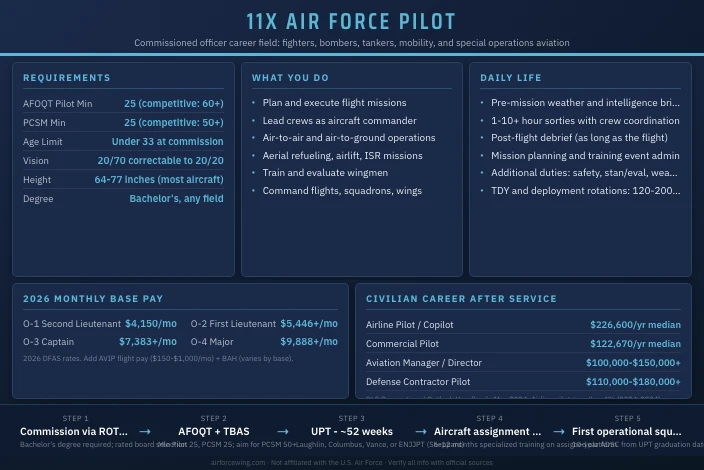
Job Role
Air Force pilots plan and execute flight operations across the full spectrum of Air Force missions. They fly fighter aircraft, bombers, tankers, airlift platforms, reconnaissance jets, and remotely piloted aircraft. A pilot leads their crew or flight, makes real-time tactical decisions, and is accountable for the aircraft, the mission, and the people on board.
Command and Leadership Scope
New pilots enter at O-1 (2d Lt) and spend their first years as crew members and flight leads. By the time they reach O-3 (Capt), most are flight commanders responsible for 15 to 25 Airmen and overseeing the training currency and readiness of their flight. At O-4 (Maj) and above, pilots move into operations officer and squadron commander roles managing 200 or more personnel and an entire flying program.
The span of control grows fast. A squadron commander at O-5 (Lt Col) owns the flying schedule, maintenance coordination, safety program, and the careers of everyone under them. At group and wing level, senior pilots oversee fleets worth billions of dollars and entire installation flying operations.
Specific Roles and Designations
The 11X designator covers multiple shredouts, each tied to a specific aircraft category and mission.
| AFSC | Designation | Primary Platforms |
|---|---|---|
| 11F | Fighter Pilot | F-22, F-35, F-15, F-16, A-10 |
| 11B | Bomber Pilot | B-52, B-1, B-2, B-21 |
| 11M | Mobility Pilot | C-17, C-5, C-130, KC-46, KC-135 |
| 11H | Helicopter Pilot | MH-139, CV-22, HH-60W |
| 11R | Reconnaissance / Special Mission | U-2, RC-135, E-3, E-8 |
| 11S | Special Operations Pilot | MC-130J, AC-130, CV-22 |
| 11U | RPA Pilot | MQ-9, RQ-4 |
Aircraft assignment happens at the end of Undergraduate Pilot Training (UPT) based on class ranking, instructor recommendations, student preferences, and Air Force requirements.
Mission Contribution
Air Force pilots operate at the leading edge of every contingency the United States enters. Fighters enforce no-fly zones and strike time-sensitive targets. Tankers extend the range of every other aircraft in the joint force. Mobility pilots deliver tanks, Humvees, and relief supplies to places no other platform can reach. The 11X career field sits at the center of air superiority, global reach, and global strike, the three pillars the Air Force was built around.
In joint and combined operations, Air Force pilots fly alongside Navy, Marine Corps, Army, and allied aircraft. Many assignments rotate through NATO partner units, and ENJJPT-trained pilots serve alongside pilots from 13 other countries before they ever reach their first operational squadron.
Technology and Systems
Pilots interface with aircraft systems ranging from legacy analog cockpits in older C-130H variants to fully digitized glass cockpit environments in the F-35 and B-21. Beyond the aircraft itself, pilots work with datalinks, radar systems, electronic warfare suites, targeting pods, and encrypted voice and data communications. Most operational aircraft connect to the Air Operations Center through the C2 architecture, giving pilots real-time situational awareness in contested airspace.
Salary
Officer Base Pay
All officer pay is set by DFAS and applies uniformly across the Air Force. The table below reflects 2026 pay rates.
| Rank | Grade | Typical YOS | Monthly Base Pay |
|---|---|---|---|
| Second Lieutenant | O-1 | Under 2 | $4,150 |
| First Lieutenant | O-2 | 2-3 years | $5,446 |
| Captain | O-3 | 4-6 years | $7,383 |
| Major | O-4 | 10-12 years | $9,888 |
| Lieutenant Colonel | O-5 | 16-18 years | $11,714 |
| Colonel | O-6 | 20-22 years | $13,751 |
Figures from DFAS 2026 Military Pay Tables.
Aviation Incentive Pay
On top of base pay, rated pilots receive Aviation Incentive Pay (AVIP). Rates increase with years of aviation service:
| Years of Aviation Service | Monthly AVIP |
|---|---|
| 2 or less | $150 |
| Over 2 | $250 |
| Over 6 | $700 |
| Over 12 | $1,000 |
| Over 22 | $700 |
| Over 24 | $450 |
Aviation Bonuses
The Air Force has sustained significant pilot retention bonuses to address shortfalls in the rated force. Under recent bonus programs, experienced pilots can earn up to $50,000 per year under multi-year retention contracts. Bonus amounts and eligibility windows change with each fiscal year’s aviation manning requirements, so verify current offers with your personnel office or Air Force recruiter.
Additional Benefits
Officers receive a Basic Allowance for Housing (BAH) that varies by location, pay grade, and dependent status. At a mid-sized base like Joint Base San Antonio, an O-1 without dependents receives approximately $1,584 per month in BAH. An officer’s Basic Allowance for Subsistence (BAS) is $328.48 per month.
Healthcare under TRICARE Prime costs nothing for active-duty members, no enrollment fee, no deductible, no copays. Coverage includes medical, dental, vision, mental health, prescriptions, and hospitalization.
The Blended Retirement System (BRS) provides a 20-year pension equal to 40% of high-36 basic pay, combined with government TSP matching up to 5% of base pay. Officers also have access to Tuition Assistance covering up to $4,500 per year toward undergraduate or graduate coursework while on active duty.
Work-Life Balance
Flying is not a 9-to-5 job. When deployed or during surge operations, 12-hour duty days are common. At a home station, most pilots work a structured flying day anchored around the flight schedule, with mission planning, briefs, debriefs, and training requirements filling the rest. Annual leave accrues at 30 days per year and can generally be taken during non-surge periods. The flying community tends to be close-knit, and squadron culture plays a big role in quality of life.
Qualifications
Every Air Force pilot must first commission as an officer. There are three paths to get there, each with its own process and timeline.
Commissioning Sources
| Source | GPA Minimum | Degree Requirement | Age at Commission | Key Prerequisite |
|---|---|---|---|---|
| Air Force Academy (USAFA) | N/A (competitive) | Awarded at graduation | 17-22 at entry | Congressional nomination |
| Air Force ROTC | 2.5 cumulative | Bachelor’s from host school | Under 31 at commission | ROTC scholarship or contract |
| Officer Training School (OTS) | 3.0+ competitive | Bachelor’s in any field | Under 33 for pilot track | Degree in hand at application |
For all three sources, no specific degree major is required to become a pilot. Engineering, science, and math degrees are competitive and common, but the Air Force commissions pilots with degrees across a wide range of fields.
Test Requirements
All pilot candidates must complete the Air Force Officer Qualifying Test (AFOQT). The minimum Pilot composite score is 25; the Navigation composite minimum is 10. Competitive applicants score considerably higher, the average selected pilot candidate typically posts Pilot scores in the 60s or above.
Pilot candidates must also complete the Test of Basic Aviation Skills (TBAS), a computerized battery that measures psychomotor control, spatial orientation, multitasking, and instrument comprehension. TBAS scores feed directly into the Pilot Candidate Selection Method (PCSM), which also incorporates your AFOQT Pilot composite and logged civilian flying hours.
PCSM scores range from 1 to 99. A minimum of 25 is required to apply for Undergraduate Pilot Training. Scores of 50 and above place candidates in a competitive pool; scores of 75 or higher are top-tier. Logging civilian flying hours before taking the TBAS can meaningfully boost your PCSM score, 200+ hours provides the maximum points bonus.
You can take the TBAS a maximum of twice, with at least 180 days between attempts. Scores are valid for life.
The PCSM score is one of the most important factors in rated selection boards. If you’re serious about flying, take the TBAS prep seriously. Even 40-50 hours of civilian flight time can move your PCSM score by several points. Start logging hours as early as possible.
Medical and Vision Requirements
Rated officers undergo a Class I Flying Physical through the Air Force Medical Evaluation Board. Vision requirements for pilots are distant visual acuity correctable to 20/20, with no worse than 20/70 uncorrected. Color vision must meet Air Force standards. Standing height limits apply for cockpit fit; most aircraft require pilots to fall between 64 and 77 inches standing height.
Career Field Assignment
ROTC cadets list their career field preferences during their junior year. USAFA graduates compete for rated slots during the fall of their senior year. OTS candidates apply specifically for rated positions through a separate board process. In all cases, rated selection is competitive, not every applicant who meets the minimums will receive a pilot slot. Board scores, leadership evaluations, academic performance, and PCSM scores all factor into selection.
Upon Commissioning
New pilots enter at O-1 (2d Lt). The Active Duty Service Commitment (ADSC) for UPT is 10 years from the date of UPT graduation. Officers who accept aviation bonuses incur additional ADSCs tied to their contract terms.
See our TBAS study guide for a structured prep plan, and our AFOQT study guide if commissioning through OTS.
Work Environment
Pilots spend most of their working hours on the flight line, in the operations desk, or in mission planning rooms. The day typically starts an hour or two before takeoff with weather briefings, intelligence updates, mission planning, and crew coordination. Flights range from one-hour local training sorties to 10-plus-hour missions with aerial refueling. Post-flight debrief takes as long as the flight itself in many communities.
Between flying events, officers handle additional duties, they serve as stan/eval officers, weapons school representatives, flight safety officers, or any of dozens of other additional duties that keep a squadron running. Staff tours, school assignments, and joint billets take pilots out of the cockpit periodically, but flying currency is generally maintained when operationally possible.
Officer-NCO Dynamic
Senior NCOs run the day-to-day mechanics of the squadron. The First Sergeant owns the enlisted welfare function. Maintenance Chiefs coordinate the aircraft. Flight Chiefs manage crew scheduling. Pilots who build strong working relationships with their NCOs accomplish more than those who don’t. The Air Force officer-NCO dynamic is collaborative, experienced NCOs often know more about aircraft and base procedures than a newly arrived pilot, and the best officers recognize that fast.
Staff vs. Command Roles
Most officers spend roughly half their career in operational flying assignments and the other half in staff, training, or joint positions. Staff tours at major commands, Air Staff, OSD, or joint headquarters are not optional for promotion-competitive records above O-4. Pilots who want to make O-5 and O-6 need a mix of flying credibility and staff performance.
Retention
The Air Force has faced a pilot shortage for over a decade. Retention bonuses, assignment incentives, and quality-of-life programs reflect the demand for experienced pilots. Many pilots who separate go directly into commercial aviation, where demand from major airlines remains high. Officers who stay typically value the mission, the community, and the leadership opportunities that come with command.
Training
Pre-Commissioning Training
ROTC cadets complete a four-year curriculum of military science courses, field training, and leadership labs alongside their degree. USAFA students complete an intensive four-year academic and military program at Colorado Springs. OTS candidates attend a 9.5-week commissioning course at Maxwell AFB, AL, covering officership, military law, leadership, and Air Force culture.
Undergraduate Pilot Training Pipeline
UPT is approximately 52 weeks long and takes place at one of four Air Force bases.
| Phase | Location | Duration | Content |
|---|---|---|---|
| Phase 1 | UPT base (varies) | 2-3 weeks | Academics, systems, procedures |
| Phase 2 | UPT base (varies) | 13-15 weeks | Primary flight training (T-6A Texan II) |
| Phase 3 (Jet) | Laughlin AFB / Columbus AFB / Vance AFB / ENJJPT | 18-20 weeks | Intermediate and advanced jet training (T-38C) |
| Phase 3 (Mobility/Airlift) | Columbus AFB or other | 18-20 weeks | Multi-engine training (T-1A Jayhawk) |
UPT bases include Laughlin AFB (TX), Columbus AFB (MS), Vance AFB (OK), and Sheppard AFB (TX). Sheppard hosts the Euro-NATO Joint Jet Pilot Training (ENJJPT) program, the only internationally manned and operated pilot training program in the world, training pilots from 14 NATO nations.
Aircraft assignment happens at the completion of Phase 2, based on class standing, instructor recommendations, student preferences, and Air Force requirements. Pilots assigned to fighters and bombers head into the T-38C track. Those assigned to mobility and tanker aircraft fly the T-1A.
After UPT graduation, pilots proceed to aircraft-specific training at their formal training unit (FTU), ranging from six months to over a year depending on the airframe.
Logging civilian flight hours before UPT improves your PCSM score and can also help you arrive better prepared for the pace of primary flight training. Many successful UPT graduates had 50 to 150 hours of civilian time before Day 1.
Professional Military Education
| Course | Rank | Location | Duration |
|---|---|---|---|
| Squadron Officer School (SOS) | Capt (O-3) | Maxwell AFB, AL | 6 weeks in residence (or correspondence) |
| Air Command and Staff College (ACSC) | Maj (O-4) | Maxwell AFB, AL | 10 months (residence) or distance |
| Air War College (AWC) | Lt Col/Col | Maxwell AFB, AL | 10 months (senior officers only) |
PME is mandatory for promotion consideration above O-3. Completing SOS and ACSC in residence (rather than by correspondence) is viewed favorably on officer performance reports.
Advanced Training Opportunities
The Air Force Weapons School at Nellis AFB, NV trains the most tactically proficient pilots in any career field to become Weapons Officers. The Air Force Institute of Technology (AFIT) provides fully funded graduate school for selected officers. The Air Force Test Pilot School at Edwards AFB, CA is a one-year program that produces experimental test pilots and flight test engineers. Exchange programs with the Navy, Marines, and allied air forces are available to competitive mid-career officers.
Qualifying TBAS and ASVAB scores come first. See our TBAS study guide and AFOQT study guide.
Career Progression
Officer Career Timeline
| Rank | Grade | Typical TIG | Key Developmental Positions |
|---|---|---|---|
| Second Lieutenant | O-1 | 18 months | UPT student, initial assignment |
| First Lieutenant | O-2 | 2 years | Mission-ready wingman, flight lead training |
| Captain | O-3 | 4-5 years | Flight commander, assistant ops officer (KD) |
| Major | O-4 | 4-5 years | Operations officer, staff tour (KD) |
| Lieutenant Colonel | O-5 | 4-5 years | Squadron commander (most competitive KD) |
| Colonel | O-6 | 4-5 years | Group or wing commander, major command staff |
Key developmental (KD) positions are the assignments that boards specifically look for. Flight commander at O-3 and operations officer at O-4 are the two primary KD positions for pilots on a command track. Squadron command at O-5 is the most competitive and most career-defining assignment.
Promotion System
O-1 through O-3 promotions are largely time-in-grade and essentially automatic for officers meeting standards. Promotion to O-4 (Maj) and above is board-selected and competitive. Promotion rates vary by career field and fiscal year. In-line performance reports, stratifications, and job performance in KD positions drive board outcomes more than any other factor.
Building a Competitive Record
Officers who compete well for promotion and command share a few characteristics: they consistently perform in the top of their peer group, they complete KD positions with documented results, they finish PME in residence, and they accumulate a broadening assignment or two (joint staff, ROTC instructor, fellows program) that demonstrates versatility. Flying hours and aircraft qualifications matter for the rated community, so does staying current and continuing to build tactical proficiency.
Physical Demands
Air Force Fitness Assessment
All officers take the Air Force Fitness Assessment (FA) annually. The FA is scored on a 100-point scale across four components. A minimum composite score of 75 is required to pass.
| Component | Max Points | Notes |
|---|---|---|
| 1.5-Mile Run | 60 | Primary aerobic component |
| Waist Circumference | 20 | Body composition measure |
| Push-Ups (1 minute) | 10 | Muscular fitness |
| Sit-Ups (1 minute) | 10 | Core fitness |
Standards are age- and gender-normed. Each component has its own minimum passing threshold, failing any single component means failing the entire assessment. Verify current standards with official Air Force sources.
Flight Physical Requirements
Rated pilots complete a Class I Flying Physical through the Aerospace Medicine community before entering UPT and periodically throughout their career. This physical is more rigorous than the standard officer entry physical. Key standards include:
- Distant visual acuity correctable to 20/20 (no worse than 20/70 uncorrected)
- Color vision within Air Force standards
- Hearing within Air Force hearing conservation standards
- Standing height between 64 and 77 inches (for most cockpits)
- No disqualifying cardiovascular, neurological, or orthopedic conditions
A waiver process exists for some conditions. Certain LASIK and PRK procedures are accepted, candidates who have had corrective eye surgery should verify their eligibility with the Aeromedical Consult Service at Wright-Patterson AFB.
The flying physical is a hard gate. Meet with a flight surgeon early in the commissioning process to assess your medical status. Discovering a disqualifying condition after you’ve committed to the rated track costs time you can’t get back.
Deployment
Deployment Tempo
Pilot deployment tempo depends heavily on aircraft and career phase. Fighter pilots in active operations periods can expect multiple deployments per year, some as short as 30 days and others running three to six months. Mobility and tanker pilots operate on Air Expeditionary Force (AEF) rotation cycles, with typical deployments of 90 to 120 days. Bomber pilots at B-52 or B-1 bases have historically deployed regularly in support of INDOPACOM and EUCOM commitments.
Total time away from home station, including TDY for exercises, competitions, and training events, can run 120 to 200 days per year in a high-tempo operational assignment.
Duty Station Options
Pilot assignments span the continental United States, Hawaii, Alaska, Europe, Japan, and South Korea. AFPC manages assignments through the Air Force Assignment System. Officers submit preference worksheets but receive no guarantee of a specific base.
Fighter platforms are concentrated at bases including Luke AFB (AZ), Langley AFB (VA), Eglin AFB (FL), Hill AFB (UT), and Kadena AB (Japan). Mobility and tanker pilots serve at bases such as Travis AFB (CA), McChord AFB (WA), Scott AFB (IL), and Fairchild AFB (WA). Bomber pilots are assigned primarily to Barksdale AFB (LA), Dyess AFB (TX), Ellsworth AFB (SD), and Whiteman AFB (MO).
The assignment process differs from enlisted. Officers have fewer available bases for each airframe but more visibility into the process through career field managers at AFPC.
Risk/Safety
Operational Hazards
Military aviation carries real risk. Aircraft malfunctions, spatial disorientation, bird strikes, and equipment failures occur even during peacetime training. Combat operations add threats from surface-to-air missiles and adversary fighters. Mid-air collision risk is managed through disciplined airspace deconfliction, but it remains a hazard in high-density training environments.
The physical demands of high-performance flight also carry long-term health implications. G-force exposure in fighter aircraft causes cumulative stress on the spine and cardiovascular system. Hypoxia incidents in certain aircraft types have been a documented safety concern across multiple platforms.
Safety Protocols
Air Force aviation safety operates on a foundation of Crew Resource Management (CRM) and Operational Risk Management (ORM). Every mission brief includes a formal risk assessment. Mishap reporting is designed to be non-punitive for honest errors, with the goal of identifying systemic risks before they cause fatal accidents.
The Air Force Safety Center tracks aviation mishap rates and publishes safety data for each major command. Pilots at all levels participate in safety boards, and safety officer is a common additional duty at the flight and squadron level.
Command Responsibility and Legal
Pilots hold formal command authority over their aircraft and crew. Mistakes that result in mission failure, property damage, or personnel injury can lead to a Line of Duty investigation, Mishap Investigation Board, or administrative action. Command climate surveys and equal opportunity requirements apply to all officers with supervisory authority. A relief for cause action, removal from a command position for poor performance or misconduct, is career-ending for most officers.
Impact on Family
Military aviation asks a lot of families. High-tempo operational assignments generate frequent TDYs, deployment rotations, and schedule uncertainty that is difficult to plan around. Assignments to remote bases or overseas locations can limit a spouse’s career options. PCS (permanent change of station) moves happen every two to three years on average, which means children change schools and spouses restart professional networks regularly.
The Air Force provides support through the Airman and Family Readiness Center (A&FRC) at every installation, the Key Spouse Program, and spouse employment programs through Hiring Our Heroes. Remote work options have improved spousal employment portability, but it remains a real quality-of-life challenge for many pilot families.
Installation and Community Differences
Pilot duty stations vary widely in size, cost of living, and family quality of life. Langley AFB in Hampton Roads, Virginia, is in a large military metro with strong school options and spouse employment. Luke AFB in the Phoenix suburbs offers a large civilian economy but high housing costs. Dyess AFB near Abilene, Texas, is a smaller market with lower housing costs but fewer major employer options for spouses. Overseas assignments to Kadena in Okinawa and Osan and Kunsan in South Korea carry overseas allowances but require families to adjust to an international environment.
DODEA schools on overseas installations provide consistent academic quality for military children. In CONUS, school districts vary by base, and the school liaison officer at the installation A&FRC can help families evaluate local options before a PCS.
Managing Long-Term Career Stability
The 10-year UPT commitment is among the longest initial service commitments in the Air Force. Families entering pilot life should plan for at least that period of continuous active-duty service before separation becomes a realistic option. That long horizon, with multiple PCS moves, deployments, and schedule shifts built into it, is the actual context families need to prepare for, not just the first assignment.
Officers who reach the 10-year mark typically have a clearer sense of whether they will stay for command (and a likely 20-year career) or separate and transition to commercial aviation. Families benefit from having that conversation early and revisiting it as circumstances change, rather than treating it as a distant problem.
Dual-Military Couples
Dual-military couples in the rated community face assignment challenges because fighter and bomber bases are geographically concentrated. AFPC manages join-spouse assignments when possible, but rated career tracks can pull couples in different directions. Couples should engage their assignment officers early and maintain realistic expectations.
Reserve and Air National Guard
The Air National Guard and Air Force Reserve fly the same aircraft as active duty and participate in real-world operations through AEF rotations and mobilizations. Many Guard and Reserve units have dedicated flying squadrons with assigned aircraft, and competition for pilot slots in these units is sometimes as intense as on active duty.
Commissioning Paths
Officers can commission into Guard and Reserve units directly through OTS with an Air National Guard or Reserve contract, through ROTC with a Reserve component scholarship, or by transferring from active duty after completing their initial ADSC. Many active-duty pilots separate and immediately join a Guard or Reserve unit flying the same or similar aircraft.
Drill and Training Commitment
Standard Reserve and Guard commitment is one Unit Training Assembly (UTA) weekend per month and 15 days of Annual Tour per year. Pilots must also maintain flying currency, which typically requires additional flying days beyond the standard UTA schedule. Annual certifications for night vision goggles, instrument proficiency, and weapons qualifications add further training requirements.
Component Comparison
| Feature | Active Duty | Air Force Reserve | Air National Guard |
|---|---|---|---|
| Commitment Model | Full-time | 1 UTA/month + 15 days/yr | 1 UTA/month + 15 days/yr |
| Monthly Pay (O-3) | ~$7,383 base | Drill pay only (~$590/UTA) | Drill pay only (~$590/UTA) |
| Healthcare | TRICARE Prime (free) | TRICARE Reserve Select (premium) | State-specific + TRICARE RS |
| Education Benefits | TA + full GI Bill eligibility | TA + GI Bill (qualifying service) | State tuition waivers + TA |
| Deployment Tempo | Frequent (rotational) | Moderate (mobilizations) | Moderate (mobilizations) |
| Command Opportunities | Full progression to wing | Squadron and group billets | Squadron and group billets |
| Retirement System | 20-year pension (BRS) | Points-based Reserve retirement | Points-based Reserve retirement |
Part-Time Pay
An O-3 Captain earns approximately $493 per drill day. A standard UTA weekend involves four drill days, so monthly drill pay runs roughly $1,972 before taxes. That figure does not include flight pay or any activated-duty entitlements during mobilizations.
Civilian Career Integration
Guard and Reserve pilots work as commercial airline pilots, corporate aviation pilots, and flight instructors in their civilian careers. The military-to-airline pipeline is well-worn, airlines actively recruit military pilots because of their training background, crew resource management skills, and instrument proficiency. USERRA protections ensure employers cannot penalize Guard and Reserve members for military service.
Post-Service
Civilian Transition
Military pilots separate with qualifications that have direct civilian market value. Most hold commercial pilot certificates or can obtain them with minimal additional training. Airline transport pilot (ATP) certificate requirements include 1,500 flight hours, most military pilots far exceed that threshold.
The Transition Assistance Program (TAP) and Hiring Our Heroes both offer resources specifically for transitioning aviators. The Aviation Career Education and Training (ACET) program connects separating pilots with hiring pipelines.
Civilian Career Prospects
| Civilian Role | Median Annual Wage | Job Outlook |
|---|---|---|
| Airline Pilot / Copilot / Flight Engineer | $226,600 (May 2024) | +4% through 2034 |
| Commercial Pilot | $122,670 (May 2024) | +4% through 2034 |
| Aviation Manager / Director | $100,000-$150,000+ | Steady demand |
| Defense Contractor Pilot / Test Pilot | $110,000-$180,000+ | Strong in defense sector |
Salary data from BLS Occupational Outlook Handbook, May 2024.
Major airlines including the legacy carriers actively recruit former military pilots. Regional airlines and cargo carriers also compete for military-trained aviators. Defense contractors hire former test pilots and experienced tactical pilots for flight test, systems integration, and government customer support roles.
Education and Credentials
The Post-9/11 GI Bill covers full in-state tuition at public universities or up to $29,920.95 per academic year at private institutions for eligible members. Officers who separate after six or more years of qualifying service can transfer GI Bill benefits to dependents, subject to a four-year additional ADSC. The Air Force Institute of Technology provides fully funded graduate degrees through AFIT programs for selected officers while on active duty.
Is This a Good Job
Ideal Candidate
The best pilot candidates are comfortable with high-stakes decision-making under pressure, can absorb large amounts of technical information quickly, and perform well in competitive environments. Spatial reasoning, strong hand-eye coordination, and genuine enthusiasm for aviation help, but so does leadership drive. Pilots who succeed at O-5 and above are officers first and aviators second.
Candidates who earned civilian flight certificates during college, maintained rigorous GPAs in demanding majors, and demonstrated leadership in ROTC or varsity athletics consistently appear at the top of rated selection boards.
Where People Struggle
UPT has a real washout rate. Candidates who struggle typically have difficulty absorbing the academics-to-cockpit pace, managing G-forces and spatial disorientation, or meeting the precision standards required at each flight evaluation. The program does not slow down for anyone.
Officers who expect to fly exclusively and avoid staff work will find the Air Force career model frustrating. After the first operational tour, staff assignments, PME, and additional duties become unavoidable requirements for career progression. Pilots who resent time out of the cockpit often separate after their initial ADSC.
Frequent moves, long absences, and schedule unpredictability are real costs. Officers who thrive in this career genuinely embrace the mission, the community, and the lifestyle, those who are primarily motivated by the pay or the prestige tend not to stay long.
Career Path Fit
Candidates drawn to a 20-year career should plan for a diverse record: multiple aircraft, a staff tour, PME in residence, and ideally a command opportunity. Candidates who want to fly for a few years and transition to commercial aviation can do exactly that, finish the 10-year ADSC and walk out the door with qualifications that put them at the front of every airline hiring pool. Guard and Reserve service offers a third option: stay connected to military aviation part-time while building a civilian career.
More Information
Talk to an Air Force officer recruiter or your nearest ROTC detachment about rated program availability and current board schedules. If you’re a ROTC cadet or OTS applicant, starting TBAS and AFOQT preparation now, well before your application board, gives you the best shot at a competitive PCSM score. For officer candidates on all tracks, solid AFOQT study guide matters whether you’re aiming for fighters or mobility aircraft.
PCSM score building: The most controllable variable in rated board selection is your PCSM score. Civilian flight hours are the most reliable way to raise it before you test. Sixty to 80 hours of civilian time, obtained through a local flight school or a discovery flight program, can move a borderline PCSM score into the competitive range. Hours logged before you take the TBAS are counted; hours logged after do not improve your score. Start as early as possible.
AFOQT Pilot composite: The Pilot composite score on the AFOQT measures table reading, instrument comprehension, aviation information, and arithmetic reasoning. A six- to eight-week preparation program using dedicated AFOQT study materials produces measurable improvement for most candidates. The test may only be taken twice, so your first attempt should be your most prepared attempt.
Medical clearance: The Class I Flying Physical is a hard gate. If you have any known vision, cardiovascular, or orthopedic conditions, visit an AMC-certified flight surgeon before submitting your commissioning package. Finding a disqualifying condition after you have committed to the rated track and notified your chain of command costs you credibility and time. Getting medical clearance early, even informally, lets you address issues before they become surprises.
Aircraft type preferences: Rated boards do not guarantee a specific aircraft. The Air Force fills requirements based on force structure needs. Candidates who list only fighters and get mobility aircraft sometimes struggle with that outcome. Going into UPT with genuine interest in the full aircraft portfolio, fighters, bombers, mobility, helicopters, gives you flexibility and a better mindset for the course regardless of what you fly.
Contact a local Air Force recruiter or ROTC detachment to check current board dates and application requirements.
This site is not affiliated with the U.S. Air Force or any government agency. Verify all information with official Air Force sources before making enlistment or career decisions.
Explore more Air Force Operations officer careers to find other flying and aviation career field options.