Air Force Psychiatry Physician Assistant: The 42G Behavioral Health Path
An Air Force psychiatry physician assistant provides behavioral-health care within the 42G PA field. Suffix N is earned through the required PA qualification and accepted specialty preparation; it is not a civilian entry promise.
The decision involves the work as well as the credential: assessment, medication management, crisis response, and the limits of confidentiality in military care. Clinical duties depend on the facility’s privileges and the team rather than a universal division of every task between professions.
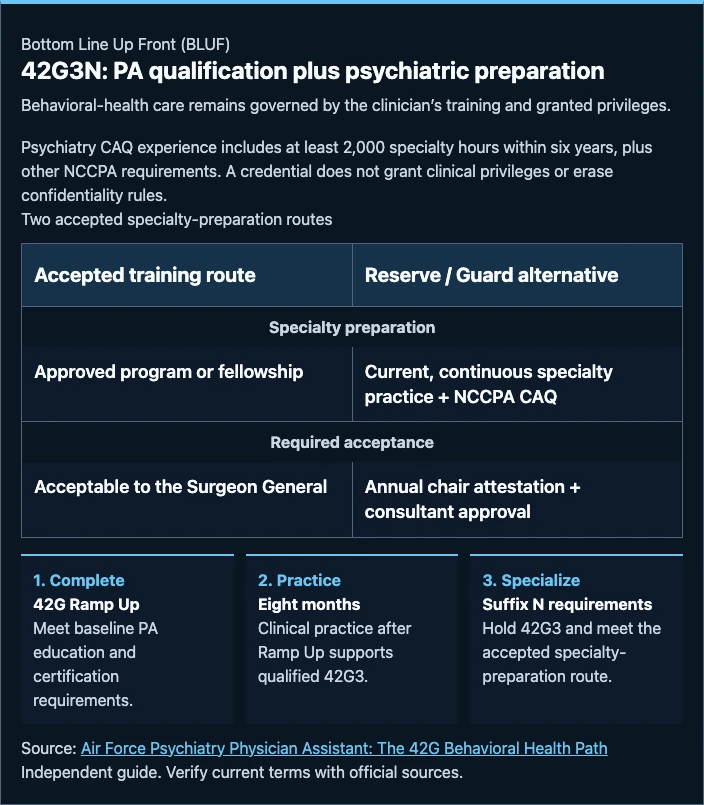
Psychiatry CAQ experience includes at least 2,000 specialty hours within six years, plus other NCCPA requirements. A credential does not grant clinical privileges or erase confidentiality rules.
| Accepted training route | Reserve / Guard alternative |
|---|---|
| Specialty preparation | |
| Approved program or fellowship | Current, continuous specialty practice + NCCPA CAQ |
| Required acceptance | |
| Acceptable to the Surgeon General | Annual chair attestation + consultant approval |
- Complete42G Ramp UpMeet baseline PA education and certification requirements.
- PracticeEight monthsClinical practice after Ramp Up supports qualified 42G3.
- SpecializeSuffix N requirementsHold 42G3 and meet the accepted specialty-preparation route.
Source: Air Force Psychiatry Physician Assistant: The 42G Behavioral Health Path
Independent guide. Verify current terms with official sources.
On this page
Job Role and Responsibilities
Air Force psychiatry physician assistants (AFSC 42G, suffix N) assess and treat mental health conditions in serving members and their families. They take the psychiatric interview, reach a differential diagnosis, build the treatment plan, manage psychiatric medication, handle crisis and risk, and coordinate care with therapists and physicians. The job belongs to the 42G physician assistant field and adds behavioral health practice to general PA work.
Certification, military clinical privileges, and the care team’s responsibilities are separate matters. The certifying body describes the knowledge and experience behind its credential; it does not grant a military clinic’s privileges. The National Commission on Certification of Physician Assistants lists the elements a psychiatric PA is expected to handle: the psychiatric interview, differential diagnosis and treatment plan, psychiatric pharmacology, treatment implementation, crisis intervention and risk management, and the ethical and legal issues that come with the specialty.
Its list of conditions runs from mood, anxiety and psychotic disorders through substance use, personality disorders, and the cognitive and adjustment problems that show up in a military population.
A Day Split Three Ways
Psychiatric practice in a military clinic tends to divide into three kinds of work:
- Intake and assessment: A new patient needs a full history, a differential, and a plan that says what happens next and who is responsible for it.
- Medication management: Psychiatric prescribing needs follow-up rather than a single visit, so it fills much of the schedule for many PAs.
- Crisis work: A risk call can arrive mid-morning and take the rest of the day.
The three do not stay in their boxes. A medication follow-up becomes a crisis when a patient describes a plan. An intake becomes a medication discussion when the history points somewhere the first appointment did not expect.
What the PA Does Not Do
A psychiatry PA is not a psychiatrist and not a psychologist, and the difference is credential rather than interest.
A psychiatrist completes medical school and a psychiatry residency, which is at least eight years after a bachelor’s degree. A psychologist completes a doctoral program in psychology and is the person who does formal psychological testing and, in many settings, the structured therapy. A PA completes the required PA program and practices within granted clinical privileges and applicable professional arrangements.
These professions can work together, with responsibilities assigned according to training and privileges. A PA may contribute medical assessment and treatment, while other clinicians supply additional diagnostic or therapeutic expertise. The clinic’s actual care model matters more than a rigid division inferred from the profession names.
Specific Roles and Designations
The 42G field tracks skill and specialty in one code.
| Code | Meaning |
|---|---|
| 42G1 | Entry level and student |
| 42G3 | Qualified physician assistant |
| 42G4 | Staff |
| 42G3A | Orthopedics |
| 42G3B | Otolaryngology |
| 42G3C | General surgery |
| 42G3E | Emergency medicine |
| 42G3N | Psychiatry |
| 42G3P | Aeromedical |
Suffix N sits beside the other clinical specialties in the same field, and each one has its own award rule. The 42G Physician Assistant profile covers the shared accession and pay rules for all of them.
Mission Contribution
Mental health care affects whether people stay in the service and whether they can do the job in front of them. A clinic that can see someone quickly, assess honestly and treat properly keeps trained people in uniform. A clinic that cannot sends them out of the gate instead.
The military context also shapes the work. Deployments, family separation, shift work and the culture of self-reliance all push against asking for help. A PA who understands that is more likely to get an honest history than one who treats the appointment as a box to tick.
Technology, Equipment, and Systems
The tools are modest. PAs document in the military health record, order labs to rule out medical causes, and use structured risk assessments for suicide and violence. Telehealth carries a growing share of follow-up appointments, particularly for members at small bases without a mental health clinic.
The clinical skill is the interview, and no system replaces it.
Salary and Benefits
A psychiatry PA is paid as a 42G officer. The suffix itself does not establish an additional payment; compare the actual entitlements and service agreements.
| Rank | Pay Grade | Years of Service | Monthly Base Pay | Annual Base Pay |
|---|---|---|---|---|
| Second Lieutenant (2d Lt) | O-1 | 2 or less | $4,150 | $49,802 |
| First Lieutenant (1st Lt) | O-2 | Over 2 | $5,446 | $65,354 |
| Captain (Capt) | O-3 | Over 4 | $7,383 | $88,592 |
| Major (Maj) | O-4 | Over 10 | $9,420 | $113,040 |
Source: DFAS 2026 pay tables. Figures reflect the 2026 pay raise.
Base pay follows rank and years. The food allowance for officers is $328.48 a month, and housing pay varies by base, rank and family status.
Special Pays
Medical special pays have their own eligibility, certification, agreement, and effective-period rules. Holding a PA certification or a clinical suffix does not establish entitlement to every payment shown on a health-professions pay table.
Before comparing an accession offer with civilian work, request the current written Air Force terms for board certification pay, incentive pay, and any bonus. Identify the agreement length, additional service obligation, and whether payments can be combined; do not budget from an undated range or another profession’s schedule.
What the Pay Comparison Actually Says
Civilian offers vary by employer, location, and experience. Compare the complete military package, including allowances, healthcare eligibility, and the applicable retirement plan, against an actual civilian offer.
The comparison depends on service length as well as pay. A shorter period of service and a career reaching retirement eligibility can produce different outcomes, and neither should be reduced to a comparison of base salaries alone.
Qualifications and Eligibility
The 42G Floor
The officer classification directory defines 42G qualification and suffix award. The Air Force PA recruiting page supplies the public accession overview and currently lists 8.5 weeks of officer training at Maxwell; confirm the course allocated to your program.
Every PA in the field meets the same baseline before a suffix enters the picture. The classification directory requires:
- A master’s degree from a PA program accredited by the Accreditation Review Commission on Education for the Physician Assistant (ARC-PA).
- At least 12 months of hands-on clinical rotations in the final year.
- A commissioning program to reach the qualified skill level.
- Initial certification through the National Commission on Certification of Physician Assistants (NCCPA) exam within 12 months of graduation.
The directory strongly encourages a state PA license and requires current NCCPA certification for the qualified level. Certification and clinical privileges must be maintained; a lapse requires action under the applicable personnel and credentialing rules.
Two Ways In
| Route | Entry grade | What it requires |
|---|---|---|
| Health Professions Scholarship Program | O-1 | Enrolled in an accredited PA master’s program, scholarship support, Commissioned Officer Training during the program |
| Direct accession | O-2 | Completed master’s degree and current NCCPA certification before entry on active duty |
Reserve and Air National Guard units also take PAs by direct accession against a unit vacancy. The parent profile covers both routes in detail, including the service commitment each one carries.
How Suffix N Is Awarded
The classification directory awards the psychiatric suffix only after two conditions are met. The officer must hold the qualified 42G3 level, and the officer must complete a suffix-specific training program or fellowship acceptable to the Surgeon General.
The qualified level is not automatic at commissioning. A new PA completes the 42G Ramp Up, then eight months of clinical practice, and holds current certification before the 42G3 is awarded. Psychiatry comes after that, not instead of it.
There is a second route for Reserve and Guard PAs who already practice in the specialty. In place of an approved fellowship, the directory accepts current and continuous practice in the specialty, an NCCPA Certificate of Added Qualifications, an annual attestation from a civilian department chair covering case logs and performance, and annual approval by the Consultant to the Surgeon General for PA Specialties.
The Certificate That Anchors the Second Route
The NCCPA offers a Certificate of Added Qualifications in psychiatry, and it is the credential the Reserve and Guard route leans on. Its requirements include:
- Current PA-C certification and an unrestricted license or federal privileges.
- At least 2,000 hours of psychiatry practice within the six-year experience window.
- At least 75 Category 1 continuing education credits focused on psychiatry within six years, including 25 within the last two years.
- A signed attestation that the PA can perform the relevant patient management.
- A specialty exam.
The certificate is maintained on a ten-year cycle.
The attestation is the part worth understanding. A collaborating physician, a lead or senior PA, or a postgraduate program director who works in psychiatry has to certify that the PA can handle the psychiatric interview, differential diagnosis and treatment planning, psychopharmacology, treatment implementation, crisis intervention and risk management, and the ethical and legal issues in the field.
What That Means for a New Applicant
A PA student cannot apply for the psychiatric suffix. A certified PA with behavioral health experience cannot be promised it at accession either. The suffix is earned inside the Air Force, after the qualified level, and both the fellowship list and the selection timing change from year to year.
Two questions are worth putting to a health recruiter before signing: whether the current accession can lead to a behavioral health billet, and how the specialty fellowship selects officers that year.
Test Requirements
PA certification and clinical qualifications are the relevant professional preparation here. Do not assume that attending an officer commissioning course creates an AFOQT requirement.
Ask a health-professions recruiter which examinations apply to your accession program, and confirm that answer before buying test preparation. This page does not recommend a paid preparation product because no relevant approved offer has been established for the clinical route described.
Work Environment
The Clinic Day
A mental health clinic runs on appointments, and the appointments are longer than most. An intake can take an hour. A medication follow-up is shorter but still needs enough time to ask what changed.
PAs who try to run a primary care tempo in a behavioral health clinic get shallow histories and miss the thing that mattered.
The physical setting is ordinary: an office, a desk, a chair that is not the same as the patient’s, and a door that closes. The clinic may sit inside a medical treatment facility or stand alone as a mental health flight. Either way, the work is quiet and the noise is in what people say.
Inpatient Coverage
Larger facilities run inpatient psychiatric units, and PAs on those services cover admissions, daily rounds and discharge planning. An inpatient rotation is a different job from clinic work. Patients are sicker, the observation is continuous, and the decision about discharge is a safety judgment rather than a scheduling one.
Crisis and After Hours
Behavioral health carries an on-call component in most units, though how much depends on the facility. A crisis may arrive as a phone call from a commander, an emergency department consult, or a member who walks in without an appointment. The PA assesses risk, decides what happens next, and documents the reasoning.
That work does not respect a schedule. A risk assessment at the end of a Friday is still a risk assessment, and the disposition has to be defensible on Monday.
The Team
A military mental health clinic brings together psychiatrists, psychologists, psychiatric PAs, clinical social workers, and enlisted technicians who manage appointments and intake screening. The team meets to discuss complex cases, and the meetings are where the risk decisions get tested by people who see the patient from a different angle.
Staff and Command
Early in a career the work is almost entirely clinical. As a PA promotes, the job adds supervision, privileging files, quality review and training for technicians and junior PAs. A senior PA may run a clinic’s daily operation while the psychiatrist covers the service’s medical direction.
Training and Skill Development
The Path in Order
| Stage | Where | Length | Focus |
|---|---|---|---|
| Officer commissioning course | Maxwell AFB, Alabama | Recruiting page lists 8.5 weeks; confirm accession allocation | Officership, customs, leadership basics |
| 42G Ramp Up | First duty station | Not stated in the classification directory | Supervised clinical practice before the qualified level is awarded |
| Qualified 42G3 | First duty station | Eight months of clinical practice after Ramp Up | Qualified PA work with current certification |
| Psychiatric suffix training or fellowship | Assigned by the Air Force | Program-specific | Behavioral health practice acceptable to the Surgeon General |
| Behavioral health assignment | Gaining medical treatment facility | Ongoing | Assessment, medication management, risk work |
The lengths the directory does not print are the ones that vary most. The fellowship length depends on the program, and the Ramp Up is supervised practice rather than a fixed course.
What the Fellowship Adds
A PA may enter specialty training with different amounts of prior psychiatric experience. The fellowship teaches the interview as a diagnostic instrument, the medication decisions that follow from it, and the risk assessment that decides whether someone goes home, goes to a unit watch, or goes to hospital.
The hardest part is not pharmacology. It is learning to ask a question twice in two different ways, because the first answer was what the patient thought the PA wanted to hear.
The Subspecialty Route
The 42G1X route into a fellowship is separate and stricter than the suffix. It requires a qualified 42G3 with at least 36 months of clinical experience at the start of the program; that requirement does not specify that every month must be in general medicine.
Professional Military Education
Squadron Officer School comes early, usually as a captain. Air Command and Staff College follows for majors selected for it, and Air War College serves lieutenant colonels and colonels. None of it involves patients, and all of it counts at promotion boards.
Keeping the Credential
Certification is not a one-time event. PAs recertify on a cycle and complete continuing education throughout, and a psychiatric PA who holds a Certificate of Added Qualifications maintains that on its own ten-year cycle. The Air Force ties continued service to holding the certification and the privileges that go with it.
Career Progression and Advancement
Promotion Timeline
| Rank | Career context, not a promotion date | Typical duties |
|---|---|---|
| O-1, second lieutenant | Entry grade for scholarship students | Training and supervised practice |
| O-2, first lieutenant | Entry grade for qualified PAs | General clinic work, building the record |
| O-3, captain | Eligibility and performance rules apply | Independent practice, psychiatric fellowship, Squadron Officer School |
| O-4, major | Board selected | Clinic leadership, staff work, specialty practice |
| O-5, lieutenant colonel | Board selected | Flight or squadron leadership, senior clinical roles |
| O-6, colonel | Board selected, few positions | Medical group leadership |
Where This Ladder Sits Against the Alternatives
The comparison people actually want is the one between the three behavioral health careers, and the honest version is about time.
A psychiatrist spends four years in medical school and at least four in a psychiatry residency, so eight years or more after a bachelor’s degree before independent practice. A psychologist spends five to seven years in a doctoral program after the bachelor’s degree, then supervised hours. A PA spends about two years in a master’s program and starts supervised practice immediately.
These are different professional qualifications, not three ranks of the same job. Psychiatrists provide physician care, psychologists provide services within their psychology training and privileges, and PAs provide medical care within their own training and privileges.
The PA’s work depends on training, clinical privileges, and the care arrangement at the facility.
Broadening
PAs can pursue the other 42G suffixes, and the 42G1X fellowship route broadens a career inside the same field. Wider assignments include recruiting, instructor duty, joint staff and fellowships. A PA who wants to command should say so early, because the file that wins a board is built years before the board meets.
Physical Demands and Medical Evaluations
Fitness Assessment
Officers take the general fitness test. The current assessment scores a run or shuttle run, strength and core events, and a waist-to-height measure, with 75 points as the passing total and a minimum on each event chosen.
| General test, under age 25 | Male | Female |
|---|---|---|
| Minimum satisfactory total | 75 points | 75 points |
| Event minimums | Meet each chosen event’s chart minimum | Meet each chosen event’s chart minimum |
| Failure despite 75 total | A missed event minimum can make the result unsatisfactory | A missed event minimum can make the result unsatisfactory |
The current age and sex score sheets were not checked for this page. Use the official charts on the Air Force fitness page.
A Sedentary Job With Sharp Edges
The physical demands are low and the psychological demands are not. A psychiatric PA sits for most of the day, and the strain is in sustained attention rather than exertion. The exception is crisis work, where a patient may be agitated, and where the clinic’s safety plan, the layout of the room and the presence of technicians matter more than fitness scores.
Medical Standards
A psychiatric PA does not need a flight physical. Entry requires the health standards for new officers, and clinical work requires privileges granted under the Defense Health Agency quality rule the classification directory names. A PA in a non-clinical assignment must still be able to hold those privileges when the next assignment returns them to patient care.
Deployment and Duty Stations
Mental Health Forward
Deployed mental health support travels with the force, and it looks different from the clinic at home. The work is short-term and focused: acute stress, sleep problems, risk assessment, and the decision about whether someone stays in theater or moves back. Continuity of care is the constraint, because the patient leaves when the rotation ends.
A psychiatric PA deployed without a psychiatrist on site carries more of the risk decision. That is where the fellowship training earns its place, and where documentation matters most.
Tempo
Deployment tempo follows the unit rather than the specialty. A PA assigned to a unit that rotates regularly deploys more often than one at a large stateside hospital. The Air Force does not publish deployment rates by specialty, so any figure quoted for this field is an estimate rather than a record.
Duty Stations
Behavioral health services exist at the larger military treatment facilities and at many smaller bases through a mental health flight or a clinic element. The Air Force also assigns PAs to staff and training positions where patient care is a memory rather than a daily routine.
Assignments run through the officer assignment system, with preference worksheets and the needs of the Air Force deciding the outcome. A PA who wants to stay clinical should say so at every assignment cycle.
Risk, Safety, and Legal Considerations
Suicide Risk Is the Core Risk
The clinical risk in this specialty concentrates in one question: is this patient safe. A PA assesses that with a structured interview, a history of prior attempts, access to lethal means, and the patient’s own account of intent and plan. The disposition that follows is a judgment, and it is documented so that the reasoning can be reviewed later.
An assessment can lead to outpatient follow-up, urgent consultation, or hospital care, depending on the clinical circumstances. The account should explain the reasoning and planned follow-up without pretending that a risk assessment predicts an individual outcome with certainty.
Confidentiality and the Commander
Military mental health care has confidentiality protections as well as defined circumstances for command notification. DoDI 6490.08 is the controlling command-notification instruction; clinicians should use the current policy and local procedures rather than a shortened list as a disclosure checklist.
The practical questions are why notification is needed, who is authorized to receive it, and what minimum information is necessary. A patient should receive a clear explanation of those limits; a PA should consult the clinical chain and privacy staff when a proposed disclosure is uncertain.
This distinction matters because command notification and release of a complete medical record are different actions. Do not promise absolute secrecy or imply that a commander automatically receives a complete account of voluntary treatment.
Fitness for Duty
Commanders ask whether a member can do the job, and clinicians answer. That answer is a duty determination, not a treatment summary, and the distinction matters for the member and for the PA who writes it. A profile that restricts duties has consequences, and it should say what it means and how long it lasts.
Officer Accountability
A PA is an officer first. That carries command responsibility over assigned personnel, duties under military law, and the standards that apply to equal opportunity and climate. Clinical performance and command responsibilities are assessed through their applicable processes; neither should be reduced to a universal claim about how every adverse event affects a career.
Impact on Family and Personal Life
The Emotional Load
This is the part of the job that does not appear in a position description. A psychiatric PA hears accounts of trauma, loss and intent, week after week, and carries the responsibility for decisions that sometimes go wrong. That accumulates.
Supervision, peer consultation and a deliberate boundary between work and home are what keep people in the field. A PA who cannot leave the clinic at the clinic burns out, and burnout in this specialty is not a private problem, because a tired clinician makes worse risk decisions.
The Schedule
Clinic hours are predictable in a way that surgical or flying schedules are not. The unpredictability sits in crisis work and on-call, which can interrupt a weekend without warning. Some units run a regular on-call rotation, and some cover it through the emergency department.
Moves
Permanent change of station timing varies by assignment and component. Each one resets schools, jobs, and a spouse’s career. Behavioral health services exist at most bases, which gives a psychiatric PA more location options than a surgical specialty, but the number of specialty billets is still small.
Deployment and Absence
A deployed PA is gone for months, and the clinic is short while the officer is away. Ask the installation support center about family readiness services, unit spouse support, and military family life counseling available locally. The practical advice is to use them before a deployment rather than during one.
Reserve and Air National Guard
Availability
The 42G field exists in the Air Force Reserve and the Air National Guard, and both components take PAs by direct accession against a unit vacancy. Behavioral health is one of the skills a unit may need, and a civilian psychiatric PA brings the experience with them.
The Alternative Route to the Suffix
This is the part of the specialty where the Reserve and Guard differ most from active duty, and it fits psychiatric practice better than it fits most others.
For Reserve and Guard PAs, the classification directory accepts an alternative to an approved fellowship. It requires current and continuous practice in the specialty, an NCCPA Certificate of Added Qualifications, an annual attestation from a civilian department chair covering case logs and performance, and annual approval by the Consultant to the Surgeon General for PA Specialties.
A civilian psychiatric PA who has worked in behavioral health for two years, holds the psychiatry certificate, and joins a unit that needs the skill can document the specialty this way. The route does not shorten the 42G3 requirement, and it does not guarantee a behavioral health billet. It changes how the specialty is evidenced rather than how it is earned.
Commitment and Pay
The standard commitment is one unit training assembly a month plus two weeks of annual tour, with additional clinical days in some units to keep skills and privileges current.
| Component | Grade | Approximate monthly drill pay, four periods |
|---|---|---|
| Air Force Reserve or Air National Guard | O-3, over four years | $984.36 for four drill periods |
The 2026 DFAS officer drill pay table lists $246.09 for one paid drill period at that grade and service point. Four periods total $984.36 before deductions. Annual training and active orders follow separate pay rules.
Benefits Compared
| Feature | Active duty | Air Force Reserve | Air National Guard |
|---|---|---|---|
| Pay | Full base pay and allowances | Drill pay unless mobilized | Drill pay unless mobilized |
| Healthcare | TRICARE Prime at no cost | TRICARE Reserve Select with premiums | TRICARE Reserve Select or state coverage |
| Education | GI Bill and tuition assistance | Partial GI Bill eligibility and tuition assistance | State tuition waivers vary, and tuition assistance is available |
| Retirement | Applicable retirement plan and eligibility | Points-based reserve retirement | Points-based reserve retirement |
| Clinical currency | Full-time patient access | Depends on the unit and its clinical agreement | Depends on the unit and its clinical agreement |
| Special pays | Subject to eligibility and agreements | Component and agreement rules apply | Component and agreement rules apply |
The clinical row decides the choice for a psychiatric PA. Keeping a behavioral health skill sharp needs patients, and a unit without a clinical affiliation may not provide them.
Post-Service Opportunities
What the Experience Is Worth
A psychiatric PA can document assessment, treatment, and crisis-care experience from military practice when applying for civilian work. Patient volume and responsibilities vary by assignment; military service does not establish that every officer has more experience than a civilian-trained peer.
Psychiatric practices, community mental health organizations, hospital systems and the Department of Veterans Affairs hire military PAs directly. A new employer still verifies credentials, state licensing, and any requested specialty certification. The Transition Assistance Program and Hiring Our Heroes are the usual first stops in the year before separation.
Civilian Pay
| Civilian role | Median annual pay | Outlook, 2025 to 2035 |
|---|---|---|
| Physician assistant | $135,880 (May 2025) | 21 percent growth, much faster than average |
This is an occupation-wide median, not a salary estimate for this specialty or an offer to a separating officer. Specialty, location, experience, and the employer’s requirements can change an actual offer.
Credentials and Further Study
Certification remains subject to renewal, and civilian practice requires the applicable state license. A specialty certificate does not replace either requirement. A PA who wants to teach or lead can use the Post-9/11 GI Bill for a graduate degree, and the Air Force funds some graduate education through the Air Force Institute of Technology while the officer is serving.
Is This a Good Job for You? The Right (and Wrong) Fit
Who Thrives
This job suits a PA who is comfortable with uncertainty and interested in people over procedures. If you can sit with someone who is describing the worst year of their life, and still ask the next clinical question, the work fits. It also suits people who are rigorous about risk without being frightened by it.
Psychiatric practice requires clinical steadiness as well as respectful communication. The job rewards someone who can hold a difficult conversation without needing the patient to like them, and who documents the reasoning that made the decision defensible.
Who Should Choose Something Else
If you want procedures, this is the wrong specialty. The work is talk, judgment and medication, and the procedures are rare. If you need visible results, psychiatric care often delivers them slowly and sometimes not at all.
If long-term psychotherapy is your main interest, compare the actual training and privileges of each profession rather than assuming every behavioral-health billet offers the same work. If you want to be the person who carries the medical authority for the hardest cases, that is medical school and a psychiatry residency.
The Comparison That Matters
Against the general surgery PA, the difference is the day rather than the status. Both are 42G officers with a suffix earned after the qualified level. The surgical PA stands in an operating room and manages a ward.
The psychiatric PA sits in a clinic and manages risk.
Against a psychiatrist, the difference is authority and time. The psychiatrist carries eight years or more of training and the medical responsibility for the service. The PA carries the medical management of common conditions and the follow-up, and works within granted clinical privileges and the applicable care arrangement.
More Information
Ask a health recruiter whether the current accession can lead to a behavioral health billet, and ask how the specialty fellowship selects officers this year. Then ask a psychiatric PA at the nearest military treatment facility what the fellowship involved and what the on-call rotation looks like.
The 42G Physician Assistant profile covers shared accession, pay and training. The Emergency Medicine Physician Assistant and Aeromedical Physician Assistant pages cover the acute care and aircrew sides of the same field, and the Medical officer group shows how the whole community fits together.