Air Force Aeromedical Physician Assistant: The 42G Flight Medicine Path
Flying is hard on a body, so the Air Force checks aircrew before, during, and after they fly. The person who runs those checks at a squadron is not always a doctor. In many flight clinics, the aeromedical PA clears aircrew for duty and handles the health issues that come with height and long days. That PA also keeps the flying plan on track.
This job sits where care meets aviation. It is the only 42G path that needs time in a flight medicine unit before the suffix is awarded. If you want field medicine rather than clinic duty, the real question is how this job differs from a flight surgeon and a flight nurse.
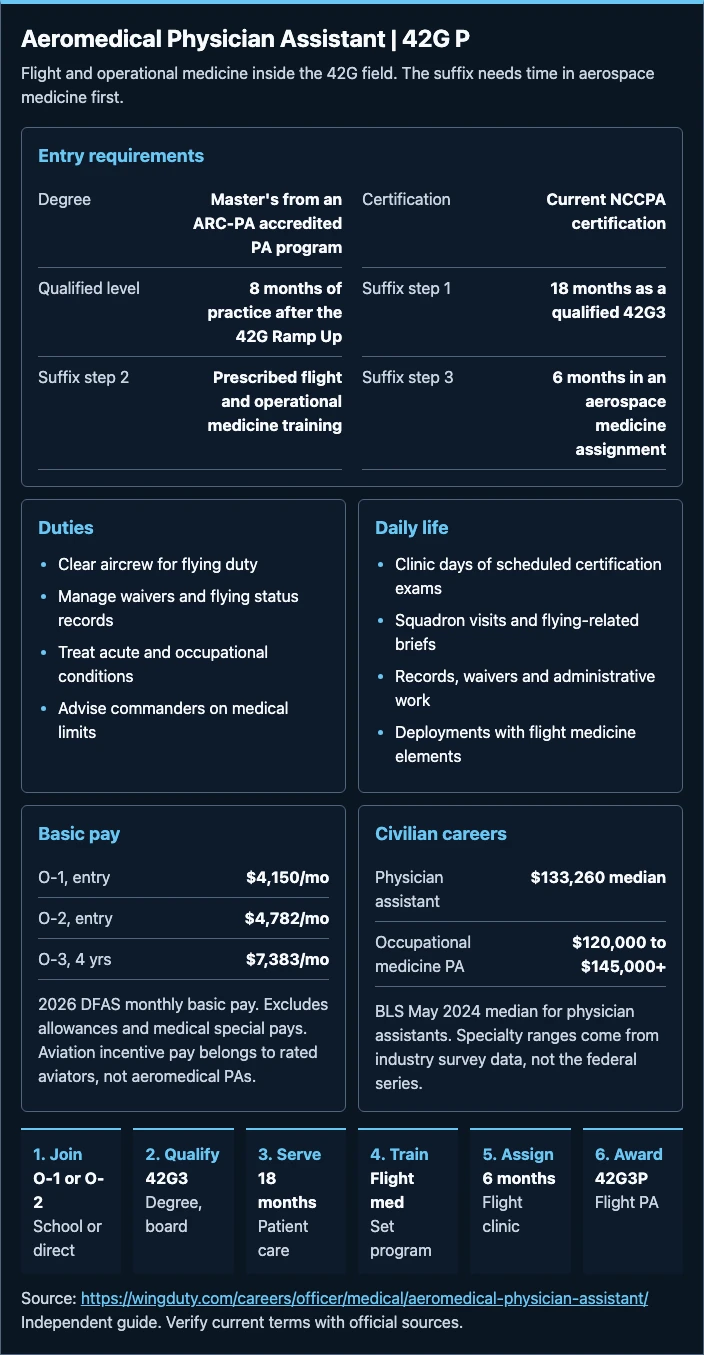
Entry requirements
- Degree
- Master's from an ARC-PA accredited PA program
- Certification
- Current NCCPA certification
- Qualified level
- 8 months of practice after the 42G Ramp Up
- Suffix step 1
- 18 months as a qualified 42G3
- Suffix step 2
- Prescribed flight and operational medicine training
- Suffix step 3
- 6 months in an aerospace medicine assignment
Duties
- Clear aircrew for flying duty
- Manage waivers and flying status records
- Treat acute and occupational conditions
- Advise commanders on medical limits
Daily life
- Clinic days of scheduled certification exams
- Squadron visits and flying-related briefs
- Records, waivers and administrative work
- Deployments with flight medicine elements
Basic pay
- O-1, entry
- $4,150/mo
- O-2, entry
- $4,782/mo
- O-3, 4 yrs
- $7,383/mo
2026 DFAS monthly basic pay. Excludes allowances and medical special pays. Aviation incentive pay belongs to rated aviators, not aeromedical PAs.
Civilian careers
- Physician assistant
- $133,260 median
- Occupational medicine PA
- $120,000 to $145,000+
BLS May 2024 median for physician assistants. Specialty ranges come from industry survey data, not the federal series.
- JoinO-1 or O-2School or direct
- Qualify42G3Degree, board
- Serve18 monthsPatient care
- TrainFlight medSet program
- Assign6 monthsFlight clinic
- Award42G3PFlight PA
Source: Air Force Aeromedical Physician Assistant: The 42G Flight Medicine Path
Independent guide. Verify current terms with official sources.
On this page
Wing Duty is supported by purchases through our links, which may earn us a commission.
Job Role and Responsibilities
Air Force aeromedical physician assistants (AFSC 42G, suffix P) work in flight and field medicine. They run aircrew health exams and look after the health of flying units. They treat sudden and work-related problems, help with mishap response, and advise commanders on health issues that affect the mission. The job sits inside the 42G PA field and adds an aviation and field focus to the general PA scope.
Command and Leadership Scope
An aeromedical PA works in a flight clinic or a flight medicine squadron, often seated with the flying units it serves. A senior PA can run the clinic and lead medics and assistants. The PA also acts as the health advisor in a squadron where flying calls rest on medical advice. The span of control is small, but the influence is not, because a grounding call stops a pilot from flying.
Specific Roles and Designations
The Air Force tracks skill and job in one code, and the suffix marks flight and field work.
| Code | Meaning |
|---|---|
| 42G1 | Entry level and student |
| 42G3 | Qualified physician assistant |
| 42G4 | Staff |
| 42G3P | Aeromedical |
| 42G3A | Orthopedics |
| 42G3B | Otolaryngology |
| 42G3C | General surgery |
| 42G3E | Emergency medicine |
| 42G3N | Psychiatry |
Mission Contribution
The Air Force cannot fly without aircrew who pass their health checks, so an aeromedical PA keeps that line moving. Exams happen on time, waivers are documented, work hazards are tracked, and mishaps get prompt support. On deployment and in joint work, the same PA looks after aircrew, maintainers, and support staff where the nearest hospital is a flight away.
Technology, Equipment, and Systems
The equipment covers routine clinic work and flight medicine tools. That means hearing and vision screening, breathing tests, heart traces, and the systems that record a member’s flying status. The PA also works in the health record used across Air Force clinics, and links to the air evacuation system when a patient has to move.
Salary and Benefits
Base Pay
Base pay follows rank and years of service. A fully trained PA with a current board credential enters at O-2. A student who joins under the Health Professions Scholarship Program enters at O-1.
| Rank | Pay Grade | Years of Service | Monthly Base Pay | Annual Base Pay |
|---|---|---|---|---|
| Second Lieutenant (2d Lt) | O-1 | 2 or less | $4,150 | $49,802 |
| First Lieutenant (1st Lt) | O-2 | Over 2 | $5,446 | $65,354 |
| Captain (Capt) | O-3 | Over 4 | $7,383 | $88,592 |
| Major (Maj) | O-4 | Over 10 | $9,420 | $113,040 |
Source: DFAS 2026 pay tables. Figures reflect the 2026 pay raise.
The food allowance for officers is $328.48 a month. Housing pay depends on rank, base, and family, so there is no single figure for the field. Flight pay goes to rated aircrew, not to aeromedical PAs, so plan on the health special pays rather than flight pay.
Special Pays
Special pays often top base pay for PAs. Variable special pay goes to PAs with a credential, at a rate set by law and printed each year. Board pay adds $2,500 to $6,000 a year for PAs with a current board credential, scaled by years of service. Incentive special pay is open to PAs who are past first training and who sign a service deal.
Entry bonuses have been offered at $37,500 for a three-year deal and $60,000 for four years. Terms change with Air Force staffing needs each year. Check current terms with a health recruiter, and do not plan around an old notice.

Housing, Food, and Healthcare
Housing pay varies by base, rank, and family status. A single O-3 at a base in the lower 48 often lands between about $1,200 and more than $2,000 a month. The food allowance is the same everywhere, and TRICARE Prime costs active duty members nothing. Care at a base clinic carries no bill for the member.
Retirement and TSP
An officer who serves 20 years gets a pension worth 40 percent of high-36 average base pay under the Blended Retirement System. The government adds 1 percent of base pay to the Thrift Savings Plan after 60 days of service. It also matches what the member puts in, up to 4 percent. The most the government puts in is 5 percent.
Work-Life Balance
Officers get 30 days of paid leave a year. Hours at a flight clinic sit closer to a normal day than an ER shift, with booked exams and office work on waivers and records. Deployment, temporary duty, and drills break that rhythm. A PA with a flying unit keeps a schedule that follows the flying plan rather than the clinic diary.
Qualifications and Eligibility
Commissioning Paths
There are two main routes into the 42G field. Both start with a master’s degree from a PA program with the right accreditation. The Health Professions Scholarship Program pays tuition, fees, and a stipend for up to 36 months while you finish a PA program. You attend Commissioned Officer Training during the program.
Direct accession is the route for PAs who already hold the degree and a current board credential. Applicants on that route apply between November and July, and a board meets in the fall. Reserve and Air National Guard units also take PAs by direct accession.
Minimum Requirements
The classification directory sets the floor. A master’s degree from a PA program with the right accreditation is required. The last year of training must include at least 12 months of hands-on patient rotations. A commissioning program is needed to reach the full skill level.
That can be Officer Training School, the Reserve Officer Training Corps, or a service academy. A current and active board credential is required. A state licence to practice is strongly urged. You must pass the national PA exam within 12 months of graduation.
| Route | Entry grade | What the route requires |
|---|---|---|
| Health Professions Scholarship Program | O-1 | Enrolled in an accredited PA master’s program; scholarship support; Commissioned Officer Training during the program |
| Direct accession | O-2 | Completed master’s degree and current NCCPA certification before entry on active duty |
Test Requirements
The AFOQT is the test for standard entry through Officer Training School. Direct-entry health officers, and that is most 42G applicants, often sit outside that rule. The current rules depend on the path you take, so check the test rule with an Air Force health recruiter before you buy anything. If you do go through Officer Training School, an AFOQT course and the AFOQT study guide cover the book work.
Assignment Process
The flight suffix has the tightest entry rules of the three PA paths. For 42G3P, a PA must have at least 18 months of patient care as a full 42G3 and complete the set training under the flight and field medicine program. The classification directory also requires 6 months in a flight medicine unit.
Reserve and Guard PAs may qualify through current and steady work in the field instead of the course. They also need a board credential for the added skill, a yearly letter from a civilian department chair on case logs and results, and yearly approval from the Consultant to the Surgeon General for PA Specialties. The suffix remains a later step, not an entry option.
Upon Commissioning
Fully trained direct-entry PAs come in at O-2, and scholarship students come in at O-1. The active duty commitment for an unsponsored direct commission runs three years. Scholarship time is counted on its own, by the years of support you took.
Work Environment
Daily Setting
A clinic day is a list of exams: new aircrew, set checks, waivers, and the sudden problems that walk in. The work mixes flight physiology, occupational health, and plain primary care. Some days bring a squadron visit, a flight brief, or support to a drill. The room is quieter than an ER and more tied to flying than a hospital clinic.
Officer-NCO Dynamic
Flight clinics run on medics who manage the records system, the booking list, and the files. The PA brings the call and the flight health view, while the NCOs bring the knowledge of how the unit flies and who is due for what. In a flying squadron, that team is what keeps the plan honest.
Staff vs. Clinical Roles
Early postings are almost all patients. As a PA moves to captain and major, office time grows. That means waiver files, quality review, protocol updates, and the paper that keeps a clinic certified. A lieutenant colonel may hold a lead role with less time in the exam room. That is a real cost for someone who picked the work for the care.
Job Satisfaction and Retention
Aeromedical PAs who like flying and field medicine tend to stay sharp, because the work sits close to the mission. Its rub points are easy to name. Office work grows with rank, and some moves take a PA away from flying. The outside market pays well for work health and walk-in care. The Air Force does not print retention rates by field, so treat any hard number you hear with doubt.
Training and Skill Development
Pre-Commissioning Training
Scholarship students attend Commissioned Officer Training. It is a short course at Maxwell Air Force Base, Alabama, that covers officership, customs and courtesies, and basic leadership. It is not the full Officer Training School course. Direct-entry PAs attend the same course after they are picked.
Initial Skills and Pipeline
| Stage | Where | Length | Focus |
|---|---|---|---|
| Commissioned Officer Training | Maxwell AFB, Alabama | About five and a half weeks | Officership, military customs, leadership basics |
| 42G Ramp Up | The first duty station | Not stated in the classification directory | Clinical practice under supervision before the qualified skill level is awarded |
| Flight and operational medicine training | Prescribed by the program | Not stated in the classification directory | Aviation physiology, certification standards, occupational health |
| Aerospace medicine assignment | An aerospace medicine unit | 6 months | Aircrew care and certification practice before the suffix is awarded |
Flight and Operational Medicine Path
The flight route is the most structured of the three suffixes, because a PA needs at least 18 months as a full 42G3. That PA also needs the set training under the flight and field medicine program, plus 6 months in a flight medicine unit before the suffix is awarded. The health standards a PA must meet to fly on duty come from the flight medicine program. Check the current rule with the field consultant, and do not assume a ground duty pass is enough.
Professional Military Education
Squadron Officer School usually comes during the captain years and can be completed in person or by correspondence. For officers who remain in service, Air Command and Staff College follows at major, with Air War College for lieutenant colonels and above. These schools are not about patient care, but they count toward promotion.
Specialized Training
Other options include graduate school through the Air Force Institute of Technology and flight medicine courses. You must keep up with continuing education to hold a board credential. That upkeep is not optional, because losing it means losing the career.
Career Progression and Advancement
Promotion Timeline
| Rank | Time in grade | Typical duties |
|---|---|---|
| O-1, second lieutenant | Initial grade for scholarship students | Training and supervised clinical practice |
| O-2, first lieutenant | Entry grade for fully qualified PAs | Clinic practice, building the record |
| O-3, captain | Promotions to captain are routine with time in grade | Independent practice, aerospace medicine assignment, Squadron Officer School |
| O-4, major | Board selected | Flight medicine leadership, staff work, aeromedical practice |
| O-5, lieutenant colonel | Board selected | Squadron or flight leadership, senior clinical roles |
| O-6, colonel | Board selected, few positions | Group or medical group leadership |
Building a Competitive Record
Boards read a file, not a rumour. A strong file shows patient volume, a finished suffix, and leadership at flight or squadron level, along with school done on time. Field postings and deployments count, and so does proof that you taught medics and junior PAs.
Aeromedical PAs build a record by keeping flight medicine running reliably: conducting aircrew evaluations, handling waiver documentation, working with medics on occupational-health concerns and communicating findings through the required flight-health process. As officers move toward clinic leadership, they must show they can maintain that work across a team, not merely complete more appointments. A flight-medicine qualification expands the work an officer can perform; it does not independently guarantee promotion.
Cross-Training and Broadening
PAs can go after the other 42G suffixes. The 42G1X route broadens the career inside the same field, not a change of field. Wider postings include recruiting, instructor slots, joint staff, and fellowships. A PA who wants to run a hospital should say so early, because the file has to be built years before the board sits.
Physical Demands and Medical Evaluations
Fitness Assessment
Officers take the same fitness test as everyone else. The current test uses a two-mile run or a shuttle run, adds strength and core events, and rounds out with a waist-to-height measure. The pass mark is 75 points, and each event you pick also has a floor. A missed floor can fail you even with 75 points. The Air Force fitness page and DAFMAN 36-2905 own the charts.
| General test, under age 25 | Male | Female |
|---|---|---|
| Minimum satisfactory total | 75 points | 75 points |
| Event minimums | Meet each chosen event’s chart minimum | Meet each chosen event’s chart minimum |
| Failure despite 75 total | A missed event minimum can make the result unsatisfactory | A missed event minimum can make the result unsatisfactory |
Medical Standards for Commissioning
Flight work adds a health side that a standard entry exam does not cover. Entry still needs the health standards for new officers, and patient work needs privileges granted under the Defense Health Agency quality rule. Any flying duty carries its own health pass under the flight medicine program. Lose the board credential and you cannot stay in.
Deployment and Duty Stations
Deployment Tempo
Aeromedical PAs deploy with flight medicine teams, field health units, and airlift and fighter units. Some roles put the PA on the flight line rather than in a clinic. The pace follows the unit, not the field. The Air Force does not print deployment rates by field, so check any figure you are given against the current posting.
A flying unit needs medical support where its aircrews work, whether that is a base clinic, a flight line or a deployed location. An aeromedical PA may balance routine examinations with urgent illness, workplace exposure concerns and coordination of care that cannot be provided locally. Before requesting a billet, ask how the unit handles flight-status reviews, who provides specialist support and whether the PA routinely joins exercises away from the home base.
Primary Duty Stations
Flight medicine slots sit at bases with flying missions, at flight medicine squadrons, and at deployed sites with an air arm. Posting wish lists drive the process, and so do join spouse needs and the needs of the Air Force. Ask for the current list of flight slots, and do not plan around a base list that may have changed.
Risk, Safety, and Legal Considerations
Job Hazards
The risks mix clinic and flight line. Bloodborne germs, needle sticks, and radiation from scans are all in the room, and noise and fumes on the flight line add to the load. Flying on duty brings the usual air risks, and the health pass that allows it is checked again and again.
Flight-medicine work combines ordinary clinical hazards with noise, exhaust and other exposures around aircraft. An inaccurate medical record or poorly communicated waiver request can also affect an aircrew member’s ability to perform assigned duties. The PA needs to document findings, follow the flight-health review process and distinguish a decision within the PA’s clinical privileges from one requiring additional aviation-medical approval.
Safety Protocols and Legal Framework
Risk review, privileges, and peer review govern the work. Flight medicine adds its own set checks and waiver process with written standards. The PA also holds command duties as an officer, which include the Uniform Code of Military Justice and equal opportunity rules. A relief for cause carries a mark. A grounding call has career weight for the member concerned, which is why notes matter.
Impact on Family and Personal Life
PCS Tempo
Permanent change of station moves usually come every two to three years, and flight slots follow flying missions rather than big cities. Each move resets schools, jobs, and friends for a spouse and children. Some bases sit in small towns with fewer jobs outside the gate.
Flight clinics follow the needs of their flying units. Aircrew examination deadlines, exercises and visits to the flight line may change a medical officer’s normal schedule, while an assignment to a smaller flying base may limit a spouse’s nearby work options. Families should compare the actual unit’s travel, duty and clinic hours with their childcare and employment needs before assuming medical work means a predictable weekday schedule.
Dual-Military Couples
Dual-military couples can ask for a join spouse posting. The Air Force tries hard when both members are in fields that fit. The needs of the Air Force still decide, and a flying base may have no slot for the other member.
Deployments and Family Stability
A deployed PA leaves a clinic short and a family without a partner for six months or more. Family support centres sit on every base, and so do key spouse groups and family counsellors. Ask early, not in a crisis.
Reserve and Air National Guard
Component Availability
The 42G field exists in both the Air Force Reserve and the Air National Guard, and flying units in both need flight health support. The Reserve and Guard route to the suffix is the one exception to the fellowship rule. That makes it the practical path for a civilian PA who already works in work health or walk-in care.
A flight medicine opening depends on the unit’s actual staffing and clinical mission, not merely the presence of a 42G position. Ask whether the unit can support the flight medicine suffix requirements and how much patient care, readiness work, and additional training the billet entails.
Commissioning Paths
Reserve and Guard PAs come in by direct accession, with the same degree and board credential rules. Some units also take officers who started under the scholarship with a Reserve deal. Ask the unit health recruiter for the rules at that unit.
Commitment and Schedule
The standard commitment is one unit training assembly a month, usually a weekend, plus two weeks of annual tour. Flight slots may add patient days to keep your skills and privileges current at the linked clinic, and flying duty may add training days.
A flight medicine assignment can involve clinic work tied to aircraft schedules, medical waiver decisions, and travel for exercises. Before accepting the position, ask how many clinical days are expected outside normal drills and whether the unit can offer the training needed for the intended qualification.
Part-Time Pay
| Component | Grade | Approximate monthly drill pay, four periods |
|---|---|---|
| Air Force Reserve or Air National Guard | O-3, over four years | $984.36 for four drill periods |
The 2026 DFAS officer drill pay table lists $246.09 for one paid drill period for an O-3 with over four years of service. Four periods total $984.36 before taxes and deductions. Annual training and active orders follow their own pay rules; drill pay does not include all active-duty allowances.
Benefits: Reserve vs. Active vs. Guard
| Feature | Active duty | Air Force Reserve | Air National Guard |
|---|---|---|---|
| Pay | Full base pay and allowances | Drill pay unless mobilized | Drill pay unless mobilized |
| Healthcare | TRICARE Prime at no cost | TRICARE Reserve Select with premiums | TRICARE Reserve Select or state coverage |
| Education | GI Bill and tuition assistance | Partial GI Bill eligibility and tuition assistance | State tuition waivers vary; tuition assistance available |
| Retirement | 20-year pension based on high-36 | Points-based reserve retirement | Points-based reserve retirement |
| Deployment tempo | Follows the unit | Lower, mission dependent | Lower, mission dependent |
| Command opportunities | Multiple pathways | Unit level | Unit level |
| Special pays | Full medical special pays | Proportional during active service | Proportional during active service |
Civilian Career Integration
Reserve and Guard work fits well with outside occupational health, walk-in care, or primary care. A federal law, USERRA, protects the job when you are called up and bars bias based on service.
Post-Service Opportunities
Transition to Civilian Practice
A PA who serves six to ten years leaves with patient volume, flight health work, and the habit of making calls with real-world weight. Work health groups, walk-in systems, hospitals, and the Department of Veterans Affairs hire military PAs straight away. The Transition Assistance Program and Hiring Our Heroes are good first stops in the year before you leave.
Civilian Career Prospects
| Civilian role | Median annual pay | Outlook, 2024 to 2034 |
|---|---|---|
| Physician assistant | $133,260 | 20 percent growth, much faster than average |
| Occupational medicine PA | $120,000 to $145,000 or more | Moderate demand, often with regular hours |
| Urgent care PA | $125,000 to $150,000 or more | Steady demand with predictable hours |
The field ranges come from industry surveys, not the federal series. The Bureau of Labor Statistics expects about 12,000 new PA slots a year, which is one of the fastest rates in health care.
Graduate Education and Credentials
A board credential carries over to civilian work unchanged, and flight medicine experience stands out in occupational health hiring. The Post-9/11 GI Bill can pay for more school if you want to teach or lead.
An aeromedical PA can describe experience with occupational-health problems, fitness-for-duty assessments and primary care when applying for civilian roles, provided no protected patient or operational information is disclosed. These experiences may be relevant to workplace-health and general PA positions, but civilian employers still assess current certification, state licensure and the scope of practice required for the opening. Keep a record of unclassified duties and continuing education during service.
Is This a Good Job for You? The Right (and Wrong) Fit
Ideal Candidate Profile
You will do well here if the field side of care draws you. It helps to like telling people why they cannot fly, and a call that stops someone doing their job has to feel worth making. The work rewards clean records and patience with waivers.
Potential Challenges
This is the longest path of the three suffixes. Eighteen months as a full PA, the set training, and six months in a flight medicine unit come before the award. A PA who wants ER drama will find the clinic slow, and a PA who hates paper will find the set check system heavy.
Career and Lifestyle Alignment
A full career to O-5 or O-6 with a flight clinic practice fits someone who wants to lead, fly, and still see patients. One tour plus a Reserve deal fits someone who wants the training and the credential without the moves. Decide which one you are before you apply, because the posting system will not wait for you to pick.
More Information
Ask a health recruiter which entry route fits your degree and board credential. Ask what the current bonus terms are. Then ask an aeromedical PA at your nearest flying base what the suffix path looks like this year, since the training line and the board dates change.
The AFOQT study course is the first paid option on this page and this is an affiliate link. A study guide costs less if that fits your budget. The free AFOQT guide on this site explains the parts of the test and what each one measures. That matters only if you go through Officer Training School.
Compare the Medical officer group to see how this field fits the wider community. The Orthopedic Physician Assistant and Emergency Medicine Physician Assistant pages cover the other two PA paths in this batch. The 42G Physician Assistant profile covers shared pay, training, and entry.