48X Dental Officer
Dental readiness sounds less dramatic than flight operations or deployed trauma care until you realize how quickly untreated oral-health problems can remove people from the mission. The Air Force solves that with dentists who are both clinicians and officers. This site uses 48X Dental Officer as the hub shorthand for that path. Current public recruiting pages usually show the dental corps through general-dentist and specialty-dentist family codes instead of a single 48X landing page, but the mission is still the same: keep Airmen dentally ready and provide high-quality oral care across the force.
If you are comparing dental direct commission against a normal officer application, the AFOQT study guide helps frame the broader officer-accession side.
Job Role
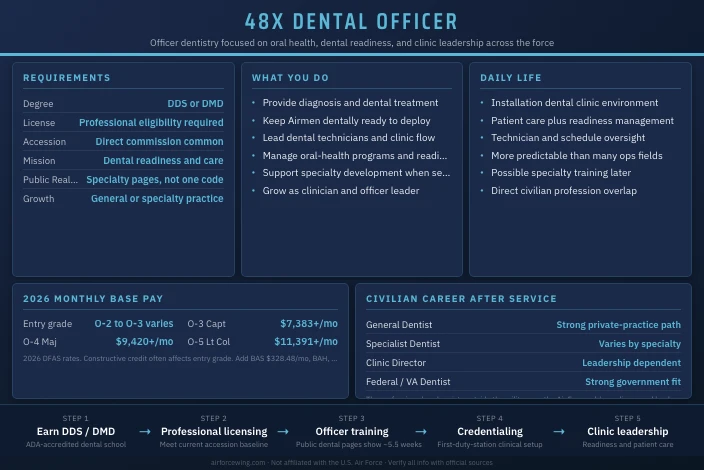
48X Dental Officers provide dental diagnosis, treatment, readiness care, and oral-health leadership for Air Force patients. They run dental clinics, supervise support teams, and may practice in general dentistry or move into one of several specialty areas after accession.
Leadership Scope
A new dentist officer starts with patients and a clinic mission, not abstract staff work. Even early in the career, though, the officer is also supervising enlisted dental technicians, managing schedules, and helping the clinic maintain readiness standards for the installation population.
As officers progress, they can become flight commanders, clinic leaders, residency-trained specialists, or senior dental leaders inside a medical group.
Public Family Context
The public recruiting site currently breaks the dental corps into specific tracks such as general dentist and specialty dentist pages. This site keeps 48X as the shorthand comparison label in the medical hub.
| Site Label | Public Recruiting Reality |
|---|---|
| 48X Dental Officer | Broad corps-level comparison label |
| 47G / 47D / 47K and other codes | Current public specialty-specific dental pages |
Mission Contribution
Dental readiness is part of force readiness. The field keeps Airmen deployable, manages urgent dental problems, and supports long-term oral health so routine issues do not become mission-killing ones.
Salary
Officer Base Pay
2026 compensation follows the DFAS military pay tables.
| Rank | Grade | Typical YOS | Monthly Base Pay |
|---|---|---|---|
| Entry-grade officer | O-2 to O-3 depending credit | Entry varies | $5,446-$7,383+ |
| Captain | O-3 | 4-10 years | $7,383-$8,376 |
| Major | O-4 | 10-16 years | $9,420-$10,402 |
| Lieutenant Colonel | O-5 | 16-22 years | $11,391-$12,515 |
Direct-commission dentists often receive constructive credit that affects entry grade. Exact rank depends on degree, specialty training, and current accession policy.
Additional Compensation
Like other healthcare officers, dentists receive standard officer allowances and may also qualify for profession-specific accession or retention incentives depending on current Air Force needs.
- BAH: location based
- BAS: $328.48 monthly
- TRICARE Prime
- BRS retirement and TSP matching
Civilian Value
Civilian crossover is obvious because the field is already a civilian profession. The military difference is readiness care, leadership, and the possibility of funded specialty development.
Qualifications
Baseline Requirements
The public Air Force dental pages consistently point to the same baseline:
| Requirement | Typical Public Standard |
|---|---|
| Degree | DDS or DMD from an ADA-accredited school |
| License | Current professional eligibility or license |
| Commissioning | Officer accession / direct commission |
| Age | Specialty medical accessions often allow entry up to 48; verify current limit |
| Specialty training | Required only for specialty tracks |
Accession Path
This is primarily a professional-entry field. The Air Force is not teaching someone how to become a dentist from scratch. It is commissioning a dentist and then teaching that person how to practice inside the military system.
If you are still comparing professional accession against a regular line-officer package, the AFOQT study guide is useful background on the broader officer side of the house.
Upon Commissioning
New dentists arrive with clinical training, but they still need Air Force-specific credentialing, military customs, and readiness-process seasoning before they feel fully at home in the system.
Work Environment
Setting And Schedule
Most dental officers work in installation dental clinics and medical-group environments. The daily rhythm is more predictable than some operational fields, but patient load, urgent dental issues, and readiness deadlines can still make it busy.
Officer-NCO Dynamic
Dental officers work closely with enlisted dental technicians and administrative staff. The best officers treat the clinic like a team, not a personal practice, because readiness metrics and patient flow depend on everyone.
Specialty Development
The Air Force dental system can support specialty growth over time. General dentists may pursue additional training in areas such as oral surgery, pathology, orthodontics, or pediatric dentistry depending on force needs and career timing.
Training
Training Pipeline
| Phase | Location | Length | Focus |
|---|---|---|---|
| Professional degree | Civilian dental school | 4 years typical | Dental qualification |
| Officer accession training | Maxwell AFB, AL | Public specialty pages show about 5.5 weeks | Military officership for health professionals |
| Clinic orientation / credentialing | First duty station | 1-8 weeks | Air Force systems and privileges |
| Specialty training if selected | Various programs | Specialty dependent | Advanced dental practice |
The public dentist specialty pages consistently show a shorter health-professions officer-training course rather than the standard longer OTS model. Candidates should still verify the exact current accession course and any specialty-school sequencing with a Health Professions Recruiter.
Before that point, use the AFOQT study guide if you want context on how professional officer accession differs from the general route.
Additional Development
The field rewards technical excellence, patient management, and the ability to lead a clinical team without losing sight of readiness requirements.
Career Progression
Timeline
| Rank | Grade | Typical Timeline | Development Focus |
|---|---|---|---|
| Entry-grade dental officer | O-2 to O-3 depending credit | Entry | Clinical credibility and readiness support |
| Captain | O-3 | Early career | Clinic leadership and specialty consideration |
| Major | O-4 | Mid-career | Flight leadership or specialty practice |
| Lieutenant Colonel | O-5 | Senior career stage | Squadron or enterprise dental leadership |
| Colonel | O-6 | Top dental leadership roles | Senior medical-group influence |
Promotion Drivers
Clinical quality, readiness outcomes, patient trust, and leadership inside the clinic matter more than flashy extras. The Air Force wants dentists who are both credible clinicians and reliable officers.
Broadening
Dental officers can move into specialty training, education, senior clinic management, and broader medical staff roles later in their career.
Physical Demands
Fitness Standards
48X officers take the standard Air Force Fitness Assessment.
| Component | Max Points |
|---|---|
| 1.5-mile run | 60 |
| Push-ups | 10 |
| Sit-ups | 10 |
| Waist or body composition | 20 |
The clinical work is not highly tactical, but long patient days, precise procedures, and occasional deployed support still demand solid baseline fitness and endurance.
Deployment
Deployment Tempo
Deployment tempo is usually lower than fields built around aviation or special operations, but dental officers can still deploy to support readiness and expeditionary medical missions.
Duty Stations
Assignments usually follow larger installations and medical-group footprints where the Air Force maintains substantial patient populations and clinic capacity.
Risk/Safety
Main Risks
The primary risks are clinical and professional:
- Patient-care errors
- Infection-control failures
- Readiness backlogs affecting deployability
- Burnout from sustained clinic demand
Control Measures
The field depends on licensure, credentialing, infection-control discipline, and clinic leadership that treats readiness and patient safety as the same mission.
Impact on Family
This is one of the steadier medical officer fields for daily routine, which can make it attractive for families. The tradeoff is that professional-entry fields often require years of civilian education before the Air Force career even starts.
Reserve and Air National Guard
Component Availability
Reserve-component opportunities exist, but they depend on unit demand and specialty. General dental support is easier to map across components than some narrower specialties.
Civilian Integration
Civilian integration is excellent because the profession exists fully outside the military. The Air Force adds leadership, readiness, and federal-clinical experience on top of that base profession.
Post-Service
Civilian Career Paths
| Civilian Role | Typical Direction |
|---|---|
| General Dentist | Private or group practice |
| Specialist Dentist | Oral surgery, orthodontics, pathology, pediatric care |
| Clinic Director | Group or institutional practice leadership |
| Federal / VA Dentist | Government healthcare systems |
Is This a Good Job
48X is a strong fit if you already want dentistry and want to practice it in a system that ties oral health directly to force readiness. It is a weak fit if you are still undecided about dentistry itself. Like other professional-entry medical fields, the profession has to come first.
More Information
- Review the Air Force Healthcare careers page for the current dental specialty menu
- Review an example current dental specialty page such as Oral and Maxillofacial Pathologist
- If you are still comparing commissioning routes, use the AFOQT study guide
This site is not affiliated with the U.S. Air Force or any government agency. Verify all information with official Air Force sources before making enlistment or career decisions.
Explore more Air Force medical officer careers and compare the physician lane at 44X Medical Officer or the allied-health side at 43H Biomedical Sciences Corps.