46N Flight Nurse
When you purchase through links on our site, we may receive compensation at no extra cost to you.
A flight nurse is not a clinic nurse who happens to travel. The job exists because patients still need critical care when the hospital is now an aircraft cabin and the nearest higher-level treatment facility is several hours away. In this site’s medical structure, that lane is tracked as 46N Flight Nurse. Current public recruiting pages often surface the family as 46FX, but the mission boils down to this: move sick or injured patients by air without letting their care break down in transit.
If you are comparing this against a standard officer-accession lane, use the AFOQT study guide as background before you go deeper into medical commissioning.
Job Role and Responsibilities
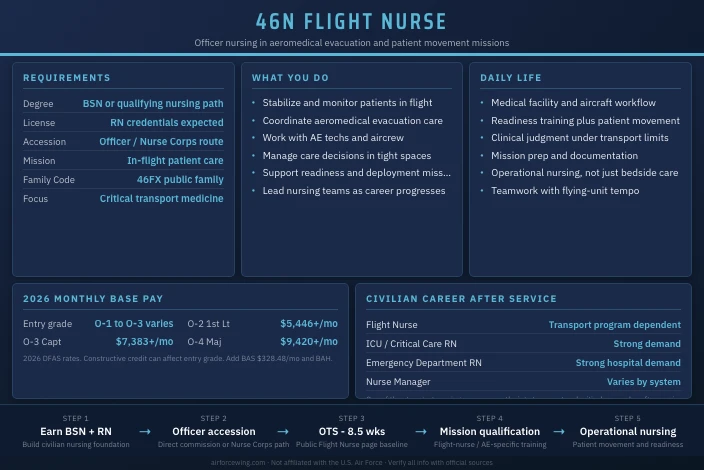
46N Flight Nurses provide in-flight nursing care during aeromedical evacuation and other patient-movement missions. They assess, stabilize, monitor, and coordinate care for patients who are too sick or injured to move without an experienced clinical team in the aircraft.
Leadership Scope
Even early in the field, the work carries more responsibility than the title might suggest. A flight nurse is responsible for patient care decisions in a constrained environment, often coordinating with aeromedical evacuation technicians, physicians, aircrew, and receiving facilities while the aircraft is already moving.
The officer leads the aeromedical crew on the aircraft. That means directing the care plan, making real-time triage calls, and adjusting medications or interventions when the patient’s condition changes at altitude. If a patient deteriorates mid-flight, the flight nurse decides what happens next. There is no on-call physician in the next room.
On the ground, flight nurses also own their section’s training readiness, equipment currency, and clinical protocols. They supervise enlisted aeromedical evacuation technicians who do hands-on patient care tasks, and they are accountable for keeping that crew mission-ready through exercises, evaluations, and continuing education requirements.
As officers progress, they also move into section leadership, squadron-level nursing responsibilities, clinical policy work, and broader Nurse Corps leadership roles.
Public Family Context
The public Air Force recruiting site currently uses a broader family code for the mission. This guide uses 46N as a concise label for the flight-nurse path.
| Label | Meaning |
|---|---|
| 46N | Hub shorthand used on this site |
| 46FX | Current public recruiting family label for Flight Nurse |
Mission Contribution
Aeromedical evacuation is how the force bridges point-of-injury or contingency care to definitive treatment. The job matters because patient movement is not administrative. It is clinical. The aircraft environment changes oxygen, vibration, noise, communication, and access to the patient all at once. A C-17 flying from a theater to a major military medical center can be in the air for many hours. The patients on it are not stable enough to wait. The flight nurse is the reason that gap does not become a death gap.
Salary and Benefits
Officer Base Pay
2026 compensation follows the DFAS military pay tables.
| Rank | Grade | Typical YOS | Monthly Base Pay |
|---|---|---|---|
| Second Lieutenant | O-1 | Under 2 | $4,150 |
| First Lieutenant | O-2 | 2-4 years | $5,446-$6,485 |
| Captain | O-3 | 4-10 years | $7,383-$8,376 |
| Major | O-4 | 10-16 years | $9,420-$10,402 |
Direct-commission nurses may receive constructive credit that affects entry grade. A nurse entering with several years of licensed clinical experience often commissions as an O-2 or O-3 rather than O-1. Exact rank depends on experience and current accession policy.
Allowances And Benefits
- BAH: location based, paid in addition to base pay, and can be substantial in high-cost metro areas near major medical centers
- BAS: $328.48 monthly
- TRICARE Prime: full medical, dental, and vision coverage for the service member; family coverage available at low cost
- BRS retirement and TSP matching: Blended Retirement System with government contributions to your Thrift Savings Plan account from day one
- Continuing education support: the Air Force supports nursing professional development, conference attendance, and advanced degree programs through tuition assistance and funded graduate programs
Civilian Value
Flight nursing military experience translates directly into the most competitive civilian transport and critical-care markets. Programs hiring for air-medical, HEMS, and fixed-wing transport roles view Air Force aeromedical evacuation background as a strong differentiator. The leadership and clinical judgment developed at altitude under constrained conditions is exactly what civilian programs want from senior nurses.

Qualifications and Eligibility
Baseline Requirements
The public Air Force Flight Nurse page is the clearest current public reference point.
| Requirement | Typical Public Baseline |
|---|---|
| Degree | Bachelor of Science in Nursing or qualifying nursing degree path |
| License | Active RN license required; lapsed licenses will delay or prevent accession |
| Commissioning | Officer accession required; direct commission is the typical path |
| Age | Verify current medical-officer accession limits with a Health Professions Recruiter |
| Physical screening | Required for commission and flight environment; includes altitude-chamber screening |
| Critical care experience | Not formally required at every entry point but strongly preferred; ICU or ED experience improves candidacy |
The Air Force is not training nurses from scratch. Candidates must arrive with a real RN license and credible clinical foundation before the commissioning process begins.
Accession Paths
This field sits closer to direct commission than to a standard line-officer accession. Some nurses enter from civilian practice. Others arrive through programs such as the Nurse Enlisted Commissioning Program (NECP), which sponsors qualified enlisted members through nursing school and into a commission. What matters is that you are already on a real nursing track before the Air Force adds the uniform.
OTS graduates who arrive via standard line-officer accession without a nursing background cannot access this specialty directly. The professional degree and active license are prerequisites, not afterthoughts.
If you are still comparing medical direct commission against a normal OTS application, the AFOQT study guide helps frame the difference.
Upon Commissioning
New flight-nurse candidates do not become expert transport clinicians overnight. Early development focuses on Air Force nursing standards, readiness culture, and the transition from hospital-floor assumptions to patient care in an aircraft environment. Officers also complete military-specific credentialing before they can practice independently in Air Force medical facilities. That process typically takes several weeks at the first duty station.

Work Environment
Setting And Schedule
This field splits time between medical facilities, readiness training, and aircraft-based patient movement. Some days look like nursing administration, records review, equipment checks, and crew training. Others look like loading unstable patients onto a transport aircraft and managing them continuously for the duration of a multi-hour mission.
The pace is not uniform. Alert periods and exercises can compress your schedule in ways that do not fit a standard clinical shift. Flight nurses at active aeromedical evacuation units often experience stretches of moderate activity followed by surge periods tied to real-world patient movement requirements.
Most assignments include an attachment to a medical group or treatment facility in addition to the aeromedical evacuation mission, meaning these officers have dual accountability: clinical readiness and transport proficiency.
Officer-NCO Dynamic
Flight nurses work closely with enlisted aeromedical evacuation technicians and aircrew. The officer is clinically accountable, but the mission depends on a tight team that understands aircraft constraints as well as patient care. Senior AE technicians carry deep mission-specific knowledge. A junior flight nurse who ignores that experience base will make avoidable errors. The officer relationship here is collaborative and credibility-based, not rank-enforcement-based.
Broader Nurse Corps Context
The field also sits inside the wider Nurse Corps. That means later-career assignments can include inpatient leadership, education, policy, and squadron-level nursing management, not just flight missions forever. Officers who build strong clinical and leadership records can move into medical group nursing roles, joint medical assignments, and health-system program management.
Training and Skill Development
Training Pipeline
| Phase | Location | Length | Focus |
|---|---|---|---|
| Officer Training School | Maxwell AFB, AL | 8.5 weeks | Officership fundamentals |
| Nurse Corps orientation / accession training | Verify current sequence | Verify current length | Air Force nursing standards and readiness |
| Flight nurse or aeromedical-evacuation qualification | Verify current course | Verify current length | In-flight patient care and mission procedures |
| First assignment OJT | Medical group or AE unit | 12-24 months | Clinical seasoning and transport mission experience |
Direct-commission nurses typically attend a shortened commissioning course rather than the full OTS program. The exact sequencing depends on how you enter the service and which program sponsors your commission.
The aeromedical evacuation qualification course covers in-flight patient assessment, oxygen physiology at altitude, aircraft-specific equipment operation, crew resource management, and emergency procedures for inflight medical crises. Candidates should expect that this training is operationally focused and does not give you a lot of room to work things out as you go. You need a solid clinical foundation going in.
The public recruiting site gives the broad outline but not every detail. That is normal in medical careers. Candidates should verify the exact current training sequence with a Health Professions Recruiter before assuming course names or lengths.
Before you get there, make sure your officer-accession baseline is solid with the AFOQT study guide.
Additional Development
This field rewards critical-care judgment, communication under pressure, and comfort working in teams where both aviation and medicine matter at the same time. Officers who continue developing their clinical skills through advanced certifications such as CCRN, CEN, or flight nursing credentials strengthen both their Air Force performance and their post-service options. Advanced degrees in nursing, healthcare administration, or public health also open doors later in the career.
Career Progression and Advancement
Timeline
| Rank | Grade | Typical Timeline | Development Focus |
|---|---|---|---|
| Entry-grade nurse officer | O-1 to O-3 depending credit | Entry | Clinical seasoning and mission qualification |
| Captain | O-3 | Early career | Flight leadership and patient-movement expertise |
| Major | O-4 | Mid-career | Nursing management and program leadership |
| Lieutenant Colonel | O-5 | Senior career stage | Squadron and medical-group leadership roles |
| Colonel | O-6 | Senior Nurse Corps track | Senior nursing and health-system leadership |
Promotion Drivers
Clinical credibility, readiness, deployment performance, and leadership inside the Nurse Corps matter more here than resume padding. Flight nurses who stay sharp clinically, maintain mission qualification, and demonstrate sound officer judgment build competitive records. The field is unforgiving of weak fundamentals, and promotion boards can tell the difference between an officer who was technically present and one who actually led.
Deployments are significant promotion inputs. An officer who performs well under operational pressure during a real aeromedical evacuation mission accumulates a kind of professional credibility that exercises alone do not fully replicate.
Broadening
Later-career opportunities can include education, inpatient nursing leadership, readiness programs, and staff assignments across the Air Force medical system. Officers with strong records may be selected for senior leader development programs, joint assignments, or medical group leadership roles that sit above the Nurse Corps specialty level.
Physical Demands and Medical Evaluations
Fitness Standards
46N officers take the standard Air Force Fitness Assessment.
| Component | Max Points |
|---|---|
| 1.5-mile run | 60 |
| Push-ups | 10 |
| Sit-ups | 10 |
| Waist or body composition | 20 |
Passing is 75 points. Officers are expected to score above that threshold consistently, not squeak by.
The real job-specific physical demand goes beyond the fitness assessment. Patient movement requires lifting, positioning, and managing patients in constrained aircraft cabins. A typical aeromedical evacuation aircraft is not set up like a hospital ward. Patients may be on litters stacked vertically, with limited access. Moving equipment, adjusting IV lines, and performing assessments in that environment requires physical coordination and the ability to work for long periods in noise and vibration.
Flight nurses also go through altitude-chamber training as part of qualification, which includes controlled hypoxia exposure. Officers must pass a flight physical in addition to the standard commission physical, and that flight physical has specific visual and cardiovascular standards tied to the aircraft environment.
Deployment and Duty Stations
Deployment Tempo
This field can deploy anywhere aeromedical evacuation or transport-capable nursing support is needed. Historical deployment patterns have included support for combat operations, humanitarian missions, and theater medical support. The rhythm varies by unit, current operational tempo, and Air Force-wide tasking. Some officers deploy multiple times in a career; others spend longer periods at home station supporting the training and readiness mission.
Units with primary aeromedical evacuation missions tend to have higher deployment exposure than those assigned to medical treatment facilities with a secondary AE role.
Duty Stations
Common assignment locations for aeromedical evacuation missions include installations with large military medical centers and those on primary patient-movement corridors. Scott AFB, Illinois, serves as a major hub for Air Mobility Command patient movement operations. Other assignments track with major medical facilities at installations such as Joint Base San Antonio, Wright-Patterson AFB, and overseas locations with established medical operations.
The basing picture is narrower than general medical-surgical nursing but still broader than many people expect when they first research the field.
Risk, Safety, and Legal Considerations
Main Risks
The risk profile is clinical and operational:
- Unstable patients in flight with limited backup resources
- Limited physical access to patients stacked on litters during transport
- Fatigue from long missions with no meaningful rest opportunity
- Rapid changes in patient condition at altitude when cabin pressure or oxygen availability limits intervention options
- Legal accountability for patient care decisions made without direct physician supervision
Control Measures
This field depends on training, checklists, crew coordination, and clinical discipline. Good transport teams prepare hard because improvisation is expensive in the air. Flight nurses are also subject to military nursing credentialing standards and scope-of-practice regulations. Practicing outside scope, even with good intentions, carries professional and legal consequences.
Officers must also understand the medical-legal framework around patient consent, documentation, and care handoffs in a mobile military setting. Proper documentation of in-flight care is both a clinical and a legal requirement.
Impact on Family and Personal Life
The schedule can be less predictable than standard clinic nursing because missions, alerts, exercises, and deployments can all move quickly. A flight nurse on an alert rotation may have limited personal schedule control during that period. Families who understand the operational tempo up front usually handle the field better than those who expect a conventional hospital routine.
PCS moves happen on standard officer cycles, typically every two to three years. The medical community has a somewhat narrower set of installations compared to line officer fields, so families should research basing options before committing to a long-term family location plan. Spouse employment and school stability are common planning considerations given the relocation frequency.
The Air Force offers family support programs, chaplain services, and military family advocacy resources at most major installations. Officers in high-tempo fields often find that proactive family communication about schedule uncertainty matters more than any formal support program.
Reserve and Air National Guard
Component Availability
The public Flight Nurse page lists Active Duty, Air National Guard, and Air Force Reserve. That makes the field relevant for both full-time and part-time nursing plans.
Reserve and ANG flight nurses often work in civilian nursing roles and activate for aeromedical evacuation training, exercises, and real-world patient movement missions. The dual-track nature of this field is one reason it attracts experienced civilian nurses who want military service without leaving a civilian career permanently.
Reserve component billet availability varies by unit and region. Candidates interested in a Guard or Reserve path should contact a healthcare recruiter for their specific component rather than assuming slots are uniformly available.
Civilian Integration
This field pairs exceptionally well with civilian critical-care, emergency, and transport nursing because the Air Force mission sharpens those same fundamentals under harder conditions. Civilian flight nursing programs at major hospital systems and air-medical services actively recruit veterans with aeromedical evacuation experience.
Post-Service Opportunities
Civilian Career Paths
| Civilian Role | Typical Direction |
|---|---|
| Flight Nurse | Air-medical and fixed-wing transport programs |
| ICU / Critical Care RN | Hospital critical-care environments |
| Emergency Department RN | Trauma and acute-care settings |
| Nurse Manager / Educator | Clinical leadership and training |
| Healthcare Administrator | Medical operations and program management |
The post-service outlook is strong. Critical care and transport nursing are perennial high-demand specialties. Veterans with Air Force AE experience often enter civilian transport programs at senior levels because the Air Force mission already exceeds civilian experience in scope and acuity. Officers who separate at captain or major also enter civilian healthcare leadership tracks with meaningful management experience that civilian nurses at the same experience level often do not have.
Nurses who separate with advanced degrees or certifications such as a Certified Flight Registered Nurse credential expand their options further into education, policy, and program director roles at major healthcare systems.
Is This a Good Job for You? The Right (and Wrong) Fit
46N is a strong fit if you already want nursing, already respect the clinical seriousness of transport medicine, and want an operational edge civilian nursing jobs rarely provide. It is also a good fit for nurses who want to serve without giving up clinical identity, because this career keeps you practicing real critical-care skills throughout your time in service.
It is a poor fit if you want a predictable desk schedule or if the aircraft environment sounds like a side detail instead of the mission. It is also a poor fit if you are pursuing nursing as a path into military service rather than because you want to be a nurse. The Air Force can tell the difference, and so will your patients.
Officers who thrive in this lane tend to be self-directed, calm under pressure, comfortable with ambiguity, and genuinely motivated by clinical patient care rather than by rank progression alone.
Air Force officer candidates take the AFOQT for commissioning and career-field placement. See our AFOQT study guide for the 6-composite breakdown and a 30-day plan.
Or go straight to an AFOQT study course.

More Information
- Review the Air Force Flight Nurse page
- Compare the broader corps-level view at Air Force Medical officer careers
- If you are still comparing commissioning routes, use the AFOQT study guide
Explore more Air Force medical officer careers and compare the physician side at 44X Medical Officer or the enlisted patient-care lane at 4N0X1 Aerospace Medical Technician.