46N Flight Nurse
A flight nurse is not a clinic nurse who happens to travel. The job exists because patients still need critical care when the hospital is now an aircraft cabin and the nearest higher-level treatment facility is several hours away. In this site’s medical structure, that lane is tracked as 46N Flight Nurse. Current public recruiting pages often surface the family as 46FX, but the mission is the same at its core: move sick or injured patients by air without letting their care break down in transit.
If you are comparing this against a standard officer-accession lane, use the AFOQT study guide as background before you go deeper into medical commissioning.
Job Role
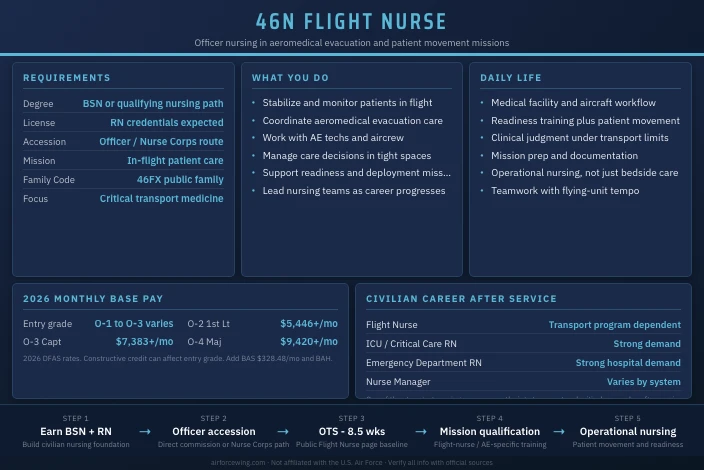
46N Flight Nurses provide in-flight nursing care during aeromedical evacuation and other patient-movement missions. They assess, stabilize, monitor, and coordinate care for patients who are too sick or injured to move without an experienced clinical team in the aircraft.
Leadership Scope
Even early in the field, the work carries more responsibility than the title might suggest. A flight nurse is responsible for patient care decisions in a constrained environment, often coordinating with aeromedical evacuation technicians, physicians, aircrew, and receiving facilities while the aircraft is already moving.
As officers progress, they also move into section leadership, squadron-level nursing responsibilities, clinical policy work, and broader Nurse Corps leadership roles.
Public Family Context
The public Air Force recruiting site currently uses a broader family code for the mission. This page uses 46N to match the medical hub structure in the repo.
| Label | Meaning |
|---|---|
| 46N | Hub shorthand used on this site |
| 46FX | Current public recruiting family label for Flight Nurse |
Mission Contribution
Aeromedical evacuation is how the force bridges point-of-injury or contingency care to definitive treatment. The job matters because patient movement is not administrative. It is clinical. The aircraft environment changes oxygen, vibration, noise, communication, and access to the patient all at once.
Salary
Officer Base Pay
2026 compensation follows the DFAS military pay tables.
| Rank | Grade | Typical YOS | Monthly Base Pay |
|---|---|---|---|
| Second Lieutenant | O-1 | Under 2 | $4,150 |
| First Lieutenant | O-2 | 2-4 years | $5,446-$6,485 |
| Captain | O-3 | 4-10 years | $7,383-$8,376 |
| Major | O-4 | 10-16 years | $9,420-$10,402 |
Direct-commission nurses may receive credit that affects entry grade. Exact rank depends on experience and current accession policy.
Allowances And Benefits
- BAH: location based
- BAS: $328.48 monthly
- TRICARE Prime
- BRS retirement and TSP matching
Civilian Value
This field transfers cleanly into critical-care nursing, transport nursing, flight nursing, emergency nursing, and healthcare leadership after service.
Qualifications
Baseline Requirements
The public Air Force Flight Nurse page is the clearest current public reference point.
| Requirement | Typical Public Baseline |
|---|---|
| Degree | Bachelor of Science in Nursing or qualifying nursing degree path |
| License | Active RN credentials expected |
| Commissioning | Officer accession required |
| Age | Verify current medical-officer accession limits |
| Physical screening | Required for commission and flight environment |
Critical-care experience is highly relevant and often what makes a candidate competitive for patient-movement work, even when the public page keeps the description broad.
Accession Paths
This field sits closer to direct commission than to a standard line-officer accession. Some nurses enter from civilian practice. Others arrive through programs such as NECP or other Nurse Corps pathways. What matters is that you are already on a real nursing track before the Air Force adds the uniform.
If you are still comparing medical direct commission against a normal OTS application, the AFOQT study guide helps frame the difference.
Upon Commissioning
New flight-nurse candidates do not become expert transport clinicians overnight. Early development focuses on Air Force nursing standards, readiness culture, and the transition from hospital-floor assumptions to patient care in an aircraft environment.
Work Environment
Setting And Schedule
This field splits time between medical facilities, readiness training, and aircraft-based patient movement. Some days look like nursing administration, records, and training. Others look like loading unstable patients onto a transport aircraft and managing them for the duration of the mission.
Officer-NCO Dynamic
Flight nurses work closely with enlisted aeromedical evacuation technicians and aircrew. The officer is clinically accountable, but the mission depends on a tight team that understands aircraft constraints as well as patient care.
Broader Nurse Corps Context
The field also sits inside the wider Nurse Corps. That means later-career assignments can include inpatient leadership, education, policy, and squadron-level nursing management, not just flight missions forever.
Training
Training Pipeline
| Phase | Location | Length | Focus |
|---|---|---|---|
| Officer Training School | Maxwell AFB, AL | Public page shows 8.5 weeks | Officership fundamentals |
| Nurse Corps orientation / accession training | Verify current sequence | Verify current length | Air Force nursing standards and readiness |
| Flight nurse or aeromedical-evacuation qualification | Verify current course | Verify current length | In-flight patient care and mission procedures |
| First assignment OJT | Medical group or AE unit | 12-24 months | Clinical seasoning and transport mission experience |
The public recruiting site gives the broad outline but not every detail. That is normal in medical careers. Candidates should verify the exact current training sequence with a Health Professions Recruiter before assuming course names or lengths.
Before you get there, make sure your officer-accession baseline is solid with the AFOQT study guide.
Additional Development
This field rewards critical-care judgment, communication under pressure, and comfort working in teams where both aviation and medicine matter at the same time.
Career Progression
Timeline
| Rank | Grade | Typical Timeline | Development Focus |
|---|---|---|---|
| Entry-grade nurse officer | O-1 to O-3 depending credit | Entry | Clinical seasoning and mission qualification |
| Captain | O-3 | Early career | Flight leadership and patient-movement expertise |
| Major | O-4 | Mid-career | Nursing management and program leadership |
| Lieutenant Colonel | O-5 | Senior career stage | Squadron and medical-group leadership roles |
| Colonel | O-6 | Senior Nurse Corps track | Senior nursing and health-system leadership |
Promotion Drivers
Clinical credibility, readiness, deployment performance, and leadership inside the Nurse Corps matter more here than flashy resume padding. The job is unforgiving of weak fundamentals.
Broadening
Later-career opportunities can include education, inpatient nursing leadership, readiness programs, and staff assignments across the Air Force medical system.
Physical Demands
Fitness Standards
46N officers take the standard Air Force Fitness Assessment.
| Component | Max Points |
|---|---|
| 1.5-mile run | 60 |
| Push-ups | 10 |
| Sit-ups | 10 |
| Waist or body composition | 20 |
The real job-specific demand is patient movement. Lifting, long missions, aircraft noise, vibration, and limited space all make the work more physically taxing than many hospital settings.
Deployment
Deployment Tempo
This field can deploy anywhere aeromedical evacuation or transport-capable nursing support is needed. The deployment rhythm varies by unit and era, but patient movement remains one of the most operationally visible nursing missions in the Air Force.
Duty Stations
Assignments usually track medical centers, air-evacuation missions, and installations with strong operational medical footprints. The basing picture is narrower than general medical-surgical nursing but still broader than many people expect.
Risk/Safety
Main Risks
The risk profile is clinical and operational:
- Unstable patients in flight
- Limited physical access during transport
- Fatigue and time pressure on missions
- Rapid changes in patient condition away from a full hospital
Control Measures
This field depends on training, checklists, crew coordination, and clinical discipline. Good transport teams prepare hard because improvisation is expensive in the air.
Impact on Family
The schedule can be less predictable than standard clinic nursing because missions, alerts, exercises, and deployments can all move quickly. Families who understand that operational tempo up front usually handle the field better than those who expect a conventional hospital routine.
Reserve and Air National Guard
Component Availability
The public Flight Nurse page lists Active Duty, Air National Guard, and Air Force Reserve. That makes the field relevant for both full-time and part-time nursing plans.
Civilian Integration
This field pairs exceptionally well with civilian critical-care, emergency, and transport nursing because the Air Force mission sharpens those same fundamentals under harder conditions.
Post-Service
Civilian Career Paths
| Civilian Role | Typical Direction |
|---|---|
| Flight Nurse | Air-medical and transport programs |
| ICU / Critical Care RN | Hospital critical-care environments |
| Emergency Department RN | Trauma and acute-care settings |
| Nurse Manager / Educator | Clinical leadership and training |
Is This a Good Job
46N is a strong fit if you already want nursing, already respect the clinical seriousness of transport medicine, and want an operational edge civilian nursing jobs rarely provide. It is a poor fit if you want a predictable desk schedule or if the aircraft environment sounds like a side detail instead of the mission.
More Information
- Review the Air Force Flight Nurse page
- Compare the broader corps-level view at Air Force Medical officer careers
- If you are still comparing commissioning routes, use the AFOQT study guide
This site is not affiliated with the U.S. Air Force or any government agency. Verify all information with official Air Force sources before making enlistment or career decisions.
Explore more Air Force medical officer careers and compare the physician side at 44X Medical Officer or the enlisted patient-care lane at 4N0X1 Aerospace Medical Technician.