44X Medical Officer (Physician)
Most military officers choose the Air Force and then pick a career field. Physicians are different. They spend a decade earning a medical degree and training in a specialty, then decide where to practice it. If that decision leads to Air Force blue, the 44X Medical Officer career field is waiting with a scope of practice, and a leadership track, that most civilian jobs can’t offer at the same career stage.
OTS candidates need competitive ASVAB scores. Our AFOQT study guide covers exactly how to prepare.
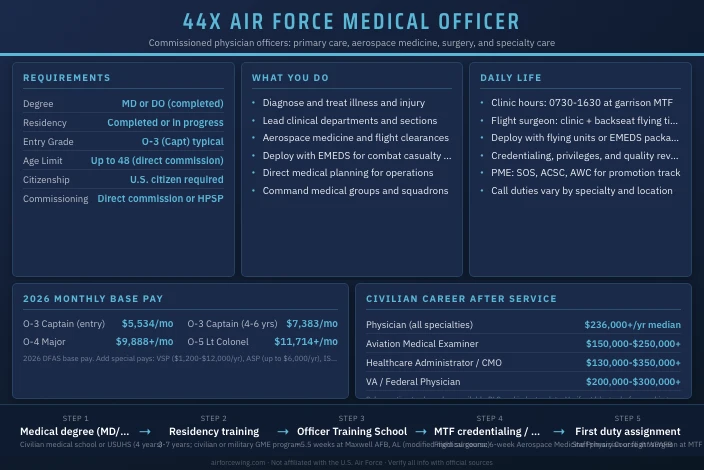
Job Role
44X Medical Officers are commissioned Air Force physicians who provide clinical care, lead military medical units, and support the health and deployability of the force. They diagnose and treat illness and injury, direct clinical staff, establish medical policies and procedures, and plan medical operations for both garrison and deployed environments. The 44X designator covers every physician specialty the Air Force maintains, from primary care and aerospace medicine to surgery, emergency medicine, and psychiatry.
Command and Leadership Scope
New physicians typically enter as O-3 (Capt) with credit for medical school and residency training. At that level, they work as staff physicians under the medical group leadership, seeing patients and building clinical currency in their specialty. By O-4 (Maj), most are taking on department chief or flight surgeon roles with direct responsibility for a section of clinical providers and support staff. The typical clinical flight has 10 to 40 personnel depending on specialty and base size.
At O-5 (Lt Col) and O-6 (Col), medical officers move into medical squadron commander and medical group commander roles. A Medical Group Commander oversees the entire installation healthcare mission, hundreds of personnel, multiple clinical departments, and a patient population that includes active-duty Airmen, retirees, and family members. That command track is open to physicians in any specialty who build the right developmental record.
Specific Roles and Designations
The 44X designator is a broad career field. Each physician is further coded by specialty through a numerical shredout system. Common subspecialty designators include:
| AFSC | Specialty |
|---|---|
| 44A | Aerospace Medicine |
| 44B | Preventive Medicine |
| 44E | Emergency Medicine |
| 44F | Family Practice |
| 44G | General Surgery |
| 44H | Internal Medicine |
| 44M | Psychiatry |
| 44R | Radiology |
| 44S | Surgical Subspecialties |
| 44T | Occupational Medicine |
| 44Y | Critical Care Medicine |
Aerospace Medicine (44A) is unique to the Air Force and has no direct civilian equivalent. Flight Surgeons are physicians who complete the Aerospace Medicine Primary Course and become the primary healthcare providers for rated aircrew. They fly in the aircraft their aircrews fly, understand the physiological stresses of the mission, and manage the medical fitness of the pilots and crew they support.
Mission Contribution
The Air Force cannot deploy, fight, or sustain operations without a healthy force. The 44X career field ensures that Airmen at every level, from junior enlisted to senior officers, stay medically qualified for their duties. In deployed environments, medical officers operate in Expeditionary Medical Support (EMEDS) structures that bring hospital-level capability to austere locations. Trauma surgeons, emergency physicians, and critical care specialists stabilize casualties before aeromedical evacuation moves patients to higher levels of care.
Physicians also contribute to joint medical operations. Air Force medical officers serve on joint medical staffs, NATO medical planning elements, and Combined Joint Task Forces. A 44G surgeon deployed to a combat theater isn’t just treating Air Force patients, they’re often supporting Army, Marine Corps, and coalition casualties at the same facility.
Technology, Equipment, and Systems
Air Force physicians work with the same clinical tools available in major civilian health systems, electronic health records through the MHS Genesis platform, advanced imaging equipment, surgical suites, and laboratory systems at larger military treatment facilities. In deployed settings, they adapt. An EMEDS hospital packs into a field kit and can be operating within hours of arrival at a forward location.
Flight surgeons add a layer of specialized tools: altitude chambers, centrifuge facilities for G-force physiology training, and aeromedical evacuation systems that turn military transport aircraft into flying intensive care units.
Salary
Officer Base Pay
Medical officers enter service with pay credit for postgraduate training, which typically places them at O-3 (Capt) at minimum. The table below reflects 2026 DFAS pay rates.
| Rank | Grade | Typical YOS | Monthly Base Pay |
|---|---|---|---|
| Captain | O-3 | Under 2 | $5,534 |
| Captain | O-3 | 4-6 years | $7,383 |
| Major | O-4 | 10-12 years | $9,888 |
| Lieutenant Colonel | O-5 | 16-18 years | $11,714 |
| Colonel | O-6 | 20-22 years | $13,751 |
Figures from DFAS 2026 Military Pay Tables.
Medical Officer Special Pays
Base pay is only part of the picture for Air Force physicians. Multiple special pay programs stack on top of basic pay:
- Variable Special Pay (VSP): All active-duty physicians receive VSP based on years of creditable service, ranging from roughly $1,200 to $12,000 annually.
- Additional Special Pay (ASP): Board-certified physicians receive up to $6,000 annually. Physicians agree to a one-year service agreement in exchange.
- Board Certified Pay (BCP): An additional retention tool for physicians who maintain board certification, up to $6,000 annually.
- Incentive Special Pay (ISP): Surgeons, subspecialists, and other physicians in high-demand fields can receive ISP of up to $36,000 annually, tied to multiyear service agreements.
- Medical Officer Retention Bonus: Physicians with specific in-demand specialties may qualify for retention bonuses ranging from $15,000 to $75,000 or more per year, depending on specialty and commitment length. Verify current amounts with your recruiter, as these change based on force requirements.
Medical officer special pays change frequently based on DoD manning requirements. Always confirm current rates with an Air Force Health Professions Recruiter before making a service decision.
Additional Benefits
Officers receive BAH (Basic Allowance for Housing) based on pay grade, location, and dependency status. At O-3 through O-5, BAH at most major Air Force installations ranges from roughly $1,500 to $2,500 monthly or more depending on the duty station. Officers also receive BAS (Basic Allowance for Subsistence) of $328.48 monthly.
Healthcare through TRICARE Prime covers the officer and their family at no enrollment fee and zero copays for active-duty care. Dental and vision coverage is included. Retirement under the Blended Retirement System (BRS) combines a pension at 20 years (40% of high-36 average basic pay) with Thrift Savings Plan (TSP) matching of up to 5% of basic pay.
The Air Force also offers the Health Professions Scholarship Program (HPSP), which covers medical school tuition, fees, and a monthly stipend for students who commit to serving after graduation. That program effectively eliminates medical school debt in exchange for active-duty service.
Work-Life Balance
Garrison work for a staff physician follows clinic hours, typically 0730 to 1630, five days a week, with some call duties. After-hours call schedules vary by specialty and installation. Flight surgeons add flying time to their schedule, which most report as a benefit rather than a burden. On deployment or TDY, hours stretch and the environment is less predictable. Most physicians report that the structured clinical environment at home station is one of the better work-life setups in medicine.
Qualifications
Commissioning Sources
Air Force physicians commission primarily through Direct Commission: meaning they complete medical education and residency training in the civilian world, then apply for commission as a fully trained physician. A second major pathway is the Health Professions Scholarship Program (HPSP), in which the Air Force funds medical school education in exchange for active-duty service after residency.
A third path is the Uniformed Services University of the Health Sciences (USUHS) in Bethesda, MD, the federal medical school that trains physicians for military service directly. Graduates commission as O-3 upon completing residency.
The standard commissioning path through OTS, ROTC, or the Air Force Academy does not apply to physicians as a normal entry route. Medical officers are accessed as fully or partially trained professionals, not as general officer candidates.
| Commissioning Source | Degree Required | Residency Required | Entry Grade | Age Limit |
|---|---|---|---|---|
| Direct Commission | MD or DO + completed residency | Yes | O-3 to O-5 (based on training credit) | Up to 48 at commission |
| HPSP | Enrolled in accredited MD/DO program | Completed after graduation | O-1 during school, O-3+ after residency | Up to 41 at start |
| USUHS | Federal medical school graduate | Completed at military facility | O-3 | Up to 32 at entry |
Test Requirements
Physicians commissioned through direct commission or USUHS are not required to take the AFOQT (Air Force Officer Qualifying Test). That test is for general officer candidates, not healthcare professionals accessing through the medical corps. HPSP candidates who have not yet commissioned may be required to take it depending on their processing timeline, verify with a Health Professions Recruiter.
The ASVAB is an enlisted accession test and is not relevant for officer commissioning.
Career Field Assignment
The Air Force matches incoming physicians to specialties based on the force’s needs and the physician’s trained specialty. You cannot commission as a 44X and change to a different specialty, your subspecialty code (44F, 44G, 44M, etc.) reflects your clinical training. Physicians who wish to complete additional fellowship training may have opportunities through Air Force-funded graduate medical education programs.
Aerospace Medicine (44A) is different from other 44X specialties. It can be entered by physicians from multiple clinical backgrounds who complete the Aerospace Medicine Primary Course at Wright-Patterson AFB, OH. Some non-physician officers (e.g., physician assistants and nurses) work adjacent to this specialty but under different designators.
Upon Commissioning
Entry grade depends on postgraduate training credit:
- 1 year of residency = O-2 credit
- 2+ years of residency = O-3 entry
- Full residency + fellowship = O-4 entry possible for certain specialties
Most physicians enter at O-3 (Capt). The Active Duty Service Commitment (ADSC) depends on the commissioning path:
- Direct commission: typically 3 years for most specialties
- HPSP: 1 year of service for each year of scholarship funding (minimum 2 years)
- USUHS: 7-year ADSC after completing residency
ADSC lengths and special pay amounts are subject to change. Verify your specific commitment with the Air Force Health Professions Recruiting team before signing.
OTS candidates can find a focused study plan in our AFOQT study guide.
Work Environment
Setting and Schedule
Staff physicians work in Military Treatment Facilities (MTFs): Air Force clinics and hospitals on installations. Larger bases have full hospitals with inpatient capacity; smaller bases have ambulatory care clinics. At major medical centers like Wilford Hall Ambulatory Surgical Center at Joint Base San Antonio-Lackland or Mike O’Callaghan Federal Medical Center at Nellis AFB, physicians work in a full academic medical environment with residents, fellows, and complex patients.
Flight surgeons split their time between the clinic and the flight line. Their job is to understand the mission well enough to make good medical judgments about who is fit to fly. That means flying backseat rides in the jets their Airmen operate, which puts them in a category unlike any other physicians in the country.
Deployed environments are different. An EMEDS hospital in a forward location runs around the clock. Physicians rotate through 24-hour call cycles, patient loads are unpredictable, and the clinical resources are deliberately austere. Most physicians who have deployed describe it as the most demanding, and most professionally satisfying, work they’ve done.
Leadership and Chain of Command
Medical officers report up through the Medical Group Commander to the installation Wing Commander for administrative purposes. Clinically, they answer to their department chief and specialty consultants. The Chief of Medical Staff role at the medical group level is typically held by a senior physician and functions as the senior clinical advisor to the Medical Group Commander.
The officer-NCO relationship in the medical corps is collaborative. Medical Group Superintendents and First Sergeants handle Airmen welfare and administrative matters while officers manage the clinical program. Medical NCOs handle the operating room, clinic administration, and technical functions, a structure that mirrors civilian hospital administration more than it resembles line Air Force units.
Staff vs. Command Roles
Most medical officers spend the majority of their careers in clinical staff roles, seeing patients, running departments, and supervising residents and mid-level providers. Command positions in the medical world are relatively few: each installation has one Medical Group Commander (O-6), one or two Medical Squadron Commanders (O-5/O-6), and department chief positions at the O-4/O-5 level.
Officers who want the command track need to demonstrate leadership early: take on additional duties, deploy, take the Squadron Officer School in residence, and build a record that earns a command line on the promotion board. Many physicians are content to focus on clinical excellence and retire without commanding, both tracks are legitimate within the career field.
Job Satisfaction and Retention
Retention in the 44X career field varies significantly by specialty. Primary care and family medicine physicians have higher retention rates than surgeons and subspecialists, who face enormous pay differentials between military and civilian practice. The Air Force uses special pays and retention bonuses to address this gap. Internal medicine, emergency medicine, and aerospace medicine physicians tend to stay at comparably high rates. Psychiatrists and certain surgical subspecialists are harder to keep past their initial commitment.
Training
Pre-Commissioning Training
Direct commission physicians and HPSP graduates complete a streamlined Officer Training School (OTS) program at Maxwell AFB, AL. The course runs approximately 5.5 weeks and focuses on Air Force culture, leadership fundamentals, customs and courtesies, and the officer’s role within the chain of command. It does not include the tactical and physical training of the full 9.5-week OTS course, medical officers have a modified curriculum appropriate for professionals acceding with existing degrees and training.
USUHS students commission early in their medical training and receive military-specific education integrated into their four-year curriculum.
Initial Skills Training
After commissioning, physicians complete the Aerospace Medicine Primary Course (AMPC) at Wright-Patterson AFB, OH if they are entering the flight surgeon track. This six-week course covers aerospace physiology, altitude and hypoxia, spatial disorientation, human factors in aviation accidents, and the specific medical standards used to certify Airmen for flying duty. Upon completion, physicians are designated as Flight Surgeons.
Physicians entering other clinical specialties typically receive orientation at their first duty station rather than a formal tech school. They complete Air Force-specific credentialing and privileging processes through the medical group, which is required before seeing patients independently.
| Phase | Location | Duration | Focus |
|---|---|---|---|
| Officer Training (medical) | Maxwell AFB, AL | ~5.5 weeks | Officer leadership, Air Force culture |
| Aerospace Medicine Primary (44A/flight surgeons) | Wright-Patterson AFB, OH | 6 weeks | Aviation physiology, flight medicine |
| MTF orientation and credentialing | Duty station | 1-4 weeks | Credentialing, privileges, clinic procedures |
| GME residencies (USUHS/military GME programs) | Various military hospitals | 3-7 years | Specialty clinical training |
Professional Military Education (PME)
Medical officers follow the same PME track as all Air Force officers:
- Squadron Officer School (SOS): Required for promotion to Maj. Can be completed by correspondence or in residence at Maxwell AFB. In-residence is strongly preferred for officers seeking command.
- Air Command and Staff College (ACSC): For O-4 through O-5 in the developmental education pipeline. Builds joint and operational planning skills.
- Air War College (AWC): For O-6-track officers. Focuses on senior leader decision-making and strategic leadership.
Additional Training
The Air Force funds graduate medical education for physicians in specialties where military training programs exist. Wilford Hall, Walter Reed, and other military medical centers operate accredited residency programs in most major specialties. Physicians who commission through USUHS or HPSP may complete their residency in a military program, which counts toward ADSC rather than adding to it.
The Uniformed Services University offers master’s degrees in public health, tropical medicine, and other health science disciplines for military physicians seeking additional credentials. The Air Force Institute of Technology (AFIT) has pathways for physicians pursuing research or graduate education in health-related technical fields.
Before OTS, you need qualifying scores, see our AFOQT study guide.
Career Progression
Career Path
Medical officers follow a modified version of the standard officer promotion timeline. The pace is roughly the same as other career fields, but the developmental milestones differ, clinical credentialing, deployment, and department chief assignments matter more than flight hours or weapons officer school.
| Rank | Grade | Typical Time in Service | Key Developmental Positions |
|---|---|---|---|
| Captain | O-3 | Entry to ~6 years | Staff physician, flight surgeon, clinic chief |
| Major | O-4 | ~10 years | Department chief, SGPF flight commander, staff roles |
| Lieutenant Colonel | O-5 | ~16 years | Medical squadron commander, medical staff officer |
| Colonel | O-6 | ~22 years | Medical Group Commander, Air Staff medical advisor |
Promotion System
Promotion from O-1 to O-3 is essentially time-based for medical officers who maintain satisfactory performance. Promotion to O-4 (Maj) is board-selected and requires competitive performance reports, PME completion, and developmental experience. Promotion rates for 44X officers to O-4 and O-5 are broadly comparable to other Air Force officer career fields, though board statistics vary by year and specialty.
Officers who want to compete for O-5 command should complete SOS in residence, take a deployment, hold a flight commander or department chief role, and earn top-block evaluations consistently from their raters. The officer performance report (OPR) is the primary promotion currency.
Cross-Training and Broadening
Medical officers can pursue broadening assignments outside the clinical environment. Physicians serve on the Air Staff at the Pentagon, in AFPC manpower positions, as ROTC detachment instructors, and in joint medical staffs at combatant commands. The Air Force Surgeon General’s staff at the Pentagon is the senior policy and planning element for Air Force medicine, and field-grade medical officers rotate through it regularly.
Fellowship training in a specialty not previously trained is possible but requires a compelling force-needs justification and approval through the medical readiness chain. Most officers who pursue additional training do so in subspecialties closely related to their primary designation.
Physical Demands
Physical Requirements
All Air Force officers, including medical officers, take the Air Force Fitness Assessment (FA) annually. The assessment is age- and gender-normed and scored on a 100-point scale. A score of 75 or higher is required to pass. Every component must meet the minimum standard independently.
| Component | Max Points |
|---|---|
| 1.5-Mile Run | 60 |
| Push-Ups (1 minute) | 10 |
| Sit-Ups (1 minute) | 10 |
| Waist Circumference | 20 |
Scoring components from Air Force Fitness Assessment standards.
There are no AFSC-specific physical standards beyond the Fitness Assessment for most 44X physicians. Flight surgeons, however, must meet the Air Force Class III flight physical standard to serve in flying positions. This includes vision, cardiovascular, and neurological standards appropriate for backseat flight duties. Flight surgeons are not required to meet the more stringent Class I/II standards required of rated aircrew.
Medical Evaluations for Flight Surgeons
Physicians pursuing the flight surgeon track (44A) must pass a periodic Flying Class III physical to maintain their flight status. This physical is administered by an aviation medicine specialist and must be renewed on a cycle determined by age and health status. Flight surgeons who develop conditions that disqualify them from flying can continue practicing medicine in a non-flying capacity without losing their 44X commission.
Clinical physicians in non-flight roles have no special medical evaluation requirements beyond the standard commissioning physical and periodic Periodic Health Assessments (PHA) required of all Airmen.
Deployment
Deployment Details
Medical officers deploy at rates that vary significantly by specialty. Flight surgeons deploy frequently alongside their assigned flying units, a squadron flight surgeon deploys when the squadron deploys. Depending on the unit’s operations tempo, that could mean 90 to 180 days per year in some high-OPTEMPO periods. EMEDS physicians: primarily emergency medicine, surgery, and critical care, deploy in rotational packages to support theater medical operations.
Primary care and specialty clinic physicians at large MTFs deploy less frequently than flight surgeons, though everyone in the 44X career field should plan for at least one deployment per four-to-five-year assignment cycle.
Duty Station Options
Air Force physicians serve at installations with Military Treatment Facilities. The largest concentration of Air Force medical career opportunities is at:
- Joint Base San Antonio-Lackland, TX: Wilford Hall Ambulatory Surgical Center, the Air Force’s largest medical facility
- Wright-Patterson AFB, OH: Air Force Research Laboratory and the Aerospace Medicine Center
- Nellis AFB, NV: Mike O’Callaghan Federal Medical Center
- Travis AFB, CA: David Grant USAF Medical Center
- Langley-Eustis AFB, VA: 633rd Medical Group
- Scott AFB, IL: 375th Medical Group
Flight surgeons are typically assigned to their parent flying unit’s base rather than a large medical center. If flying medicine is your goal, the assignment lands you wherever your unit lives.
Assignments are managed by AFPC and are based on Air Force needs, the physician’s specialty, and available billets. Medical officers submit assignment preference worksheets, but final placement is the Air Force’s call. Join-spouse programs exist for dual-military officers and are factored into the assignment process when possible.
Risk/Safety
Job Hazards
Clinical medicine carries the risks inherent to any medical practice: needle-stick injuries, exposure to infectious disease, and the mental health impact of working with seriously ill patients. Deployed physicians add battlefield casualty care, potential exposure to hostile fire, and the physical demands of austere field conditions.
Flight surgeons accept the risks associated with military flight. They fly in aircraft without ejection training equivalents in many cases, and backseat riding in high-performance jets carries real aeromechanical risk. The Air Force accepts this as a feature of the job, not a flaw.
Command Responsibility
Officers at the O-4 level and above who hold command or department chief positions are accountable under the UCMJ for the conduct of their units. Medical Group and Squadron Commanders can be relieved for cause based on command climate failures, patient safety events attributed to leadership negligence, or individual misconduct. The standard is high and consequences for failure are career-ending. Medical officers in command roles manage this accountability the same way other Air Force commanders do, through disciplined oversight, clear standards, and proactive engagement with the Inspector General and equal opportunity programs.
Physicians also operate under the specific requirements of the American Board of Medical Specialties or equivalent certifying bodies, and malpractice liability is managed through the Federal Tort Claims Act rather than individual malpractice insurance, which is one benefit of military practice many physicians value.
Impact on Family
Family Considerations
Medical officer assignments typically last two to three years before a Permanent Change of Station (PCS) move. The PCS tempo is comparable to other Air Force career fields, roughly every two to three years is standard, though some officers negotiate back-to-back tours at a preferred location. Frequent moves affect spouse employment, children’s schooling, and established social networks.
The Air Force supports military families through the Airman and Family Readiness Center (A&FRC) at every installation. Resources include financial counseling, spouse employment assistance, child development centers on base, and transition support. The Key Spouse Program provides unit-level peer support for families during deployments.
Flight surgeons who deploy frequently put an additional strain on family life. Partners at home during deployments carry the full weight of household management, and that stress is real. Units with strong family support programs and engaged Key Spouses make a measurable difference during extended absences.
Dual-Military Considerations
Dual-military physician couples have it both complicated and somewhat easier than other fields. Both officers will need MTF billets at the same installation, a requirement that limits assignment options but doesn’t make co-location impossible, especially at large medical centers like JBSA-Lackland. AFPC has a join-spouse program, but it cannot always accommodate both officers’ specialty requirements at the same base. Flexibility and willingness to negotiate alternate arrangements (like one officer serving at a different installation within commuting distance) helps.
Reserve and Air National Guard
Component Availability
The 44X career field is available in both the Air Force Reserve and the Air National Guard. Reserve and Guard physicians staff medical groups and medical squadrons at installations across the country, and many serve as flight surgeons for Reserve and Guard flying units. The demand for part-time physicians is high because military medicine faces the same physician shortage affecting the civilian healthcare system.
Commissioning Paths
Reserve and Guard physicians can commission through:
- Direct Commission into a Reserve or Guard medical unit as a fully trained physician
- Transfer from active duty after completing an active-duty ADSC
- HPSP with a Reserve component option in some cases (verify availability with a recruiter)
Many physicians use the Reserve or Guard to maintain military service alongside a civilian clinical career. The financial and professional incentives are different from active duty but still substantial.
Drill and Training Commitment
The standard Reserve commitment is one Unit Training Assembly (UTA) weekend per month and two weeks of Annual Tour (AT) per year. Medical officers in Reserve or Guard units often exceed this minimum due to additional clinical training requirements, certification renewals, and exercises. Flight surgeons assigned to flying units follow the flying schedule rather than a rigid UTA structure.
Part-Time Pay
An O-3 (Capt) with fewer than 2 years of service earns approximately $5,534 per month on active duty. A Reserve or Guard officer earns 1/30th of that monthly rate per drill day, roughly $185 per drill day at that grade. A standard UTA weekend (4 drill periods) pays approximately $740 before special pays. Reserve and Guard physicians may also qualify for Selected Reserve Incentive Programs that add bonus pay for specific specialties.
Benefits Comparison
| Feature | Active Duty | Air Force Reserve | Air National Guard |
|---|---|---|---|
| Commitment | Full-time | 1 weekend/mo + 2 wks/yr | 1 weekend/mo + 2 wks/yr |
| Monthly Base Pay (O-3) | $5,534-$7,383 | Drill days only | Drill days only |
| Healthcare | TRICARE Prime (free) | TRICARE Reserve Select (premiums apply) | TRICARE Reserve Select + state options |
| Education Benefits | Full GI Bill, Tuition Assistance | Montgomery GI Bill - SR, federal TA | State tuition waivers vary by state |
| Deployment Tempo | Moderate to high | Low to moderate | Low to moderate |
| Command Opportunities | Yes, at MTFs | Yes, at Reserve medical units | Yes, at ANG medical units |
| Retirement | 20-year active pension | Points-based Reserve retirement | Points-based Reserve retirement |
Civilian Career Integration
Reserve and Guard service pairs naturally with civilian medical practice. Many physicians in these components use military service to maintain leadership skills, stay connected to a professional community, and access benefits like retirement points and GI Bill transferability for dependents. USERRA protects civilian employment during military activations, employers cannot discriminate against employees based on Reserve or Guard service. Some civilian hospital systems and healthcare organizations actively support physician-military service through flexible scheduling and pay differential programs.
Post-Service
Transition to Civilian Life
Air Force physicians leave service with credentials, leadership experience, and clinical skills that transfer directly to civilian healthcare. The Transition Assistance Program (TAP) provides pre-separation counseling, resume support, and job placement resources. Hiring Our Heroes runs fellowships and career fairs specifically for transitioning veterans, including healthcare professionals.
The biggest post-service advantage is experience. A physician who spent a decade as a flight surgeon has expertise in occupational medicine, human factors, and aviation physiology that is genuinely rare in the civilian market. A trauma surgeon who deployed to a combat theater has operated in conditions that no stateside civilian program replicates.
Civilian Career Prospects
| Civilian Role | Median Annual Salary | Job Outlook |
|---|---|---|
| Physician (all specialties) | $236,000+ (median wage 2024) | +4% (2023-2033) |
| Aviation Medical Examiner | $150,000-$250,000+ | Niche, growing with aviation demand |
| Healthcare Administrator / CMO | $130,000-$350,000+ | +28% for medical managers |
| Occupational Medicine Physician | $200,000-$270,000+ | +6% |
| VA / Federal Healthcare | $200,000-$300,000+ | Stable, strong demand |
Salary figures are estimates based on available BLS and industry data. Verify current data at bls.gov before making career decisions.
Graduate Education and Credentials
Medical officers who completed residency in the military carry full civilian board certification. The military residency programs accredited by the ACGME are equivalent to civilian programs, boards passed in the military are recognized by every state medical licensing board. Physicians who used HPSP funding do not accumulate medical school debt, which gives them significantly more financial flexibility at separation than civilian peers.
The GI Bill is available for graduate education after separation, though most physicians have already completed their advanced degrees before or during service. The more common post-service education path is a Master’s in Public Health (MPH), MBA, or subspecialty fellowship funded through civilian or VA programs.
Is This a Good Job
Ideal Candidate Profile
The 44X career field draws physicians who want more from their career than a clinic practice. The right fit is someone who wants to practice medicine at an operational level, who genuinely wants to understand how aircraft and warfare affect human physiology, who gets energized by leading a medical team through a complex deployment, and who finds the leadership track of military medicine more satisfying than seeing a higher patient volume in a private practice.
The clearest sign of fit is the reaction to the HPSP offer. If a medical student hears “we’ll pay for medical school and you’ll serve for at least two years” and thinks that sounds like an adventure, they’re probably going to do well. If it sounds like a burden to get through, that’s a signal worth paying attention to.
Potential Challenges
The pay gap between military and private practice is real, and it widens significantly for surgical subspecialists. An Air Force orthopedic surgeon earning base pay plus special pays will earn considerably less than a peer in private practice. The Air Force tries to close the gap with ISP and retention bonuses for in-demand specialties, but it never fully closes. Physicians who measure career success primarily through compensation will find military service frustrating.
PCS moves every two to three years also create challenges. Physicians who build long-term patient relationships in their practice model won’t get that in most military assignments. Credential re-privileging at each new MTF adds administrative burden to every move. Spouses with established careers, particularly in medicine themselves, face real obstacles with every relocation.
Lifestyle Alignment
For the physician who wants to lead, deploy, and practice medicine in environments that civilian training never creates, the 44X career field is hard to beat. The commitment structure is predictable: initial ADSC, then retention decisions at each re-up point. The exit on-ramp is straightforward, most specialties transition cleanly to civilian practice. The benefits during service, particularly for family healthcare and education, are substantial.
For physicians who are unsure, the HPSP pathway offers a low-risk entry: fund medical school, complete a short service commitment, and decide then. The physicians who stay and build full careers are typically the ones who genuinely loved the work, not the ones who were managing an obligation.
More Information
Contact an Air Force Health Professions Recruiter to discuss HPSP scholarship availability, current specialty needs, and your specific accession timeline. If you’re still working through your commissioning qualifications, your nearest ROTC detachment can also answer questions about direct commission pathways for healthcare professionals.
Official resources:
- Air Force Medical Service (AFMS), the command managing Air Force healthcare operations; specialty needs and manning data that affect HPSP scholarship targeting are visible through this command
- Uniformed Services University of the Health Sciences (USU), federal medical school that commissions graduates as military medical officers; tuition-free in exchange for a service commitment; an alternative to HPSP for applicants who want to attend medical school within the military system
- Defense Health Agency, manages military treatment facilities and coordinates joint medical operations; context for understanding the institutional environment 44X officers work within
Related career profiles on this site:
- Air Force medical officer careers hub, all Air Force medical officer designators including nurse corps, dental, medical service corps, and allied health roles
- Additional 44X specialty profiles are available within the medical officer section, compare surgical, internal medicine, and primary care career paths within the physician designator
Practical preparation:
The HPSP scholarship is the most common path Air Force physicians take to commission. Competition for HPSP seats is based on medical school academic performance, specialty interest alignment with Air Force needs, and the commissioning package itself. Identifying your target specialty early and researching whether the Air Force has needs in that area helps you frame your application around current Air Force priorities rather than generic physician needs.
If you are already in medical school or residency, the direct commission path through the Uniformed Services Health Professions program is the more likely route. A Health Professions Recruiter, separate from a standard Air Force recruiter, is the right contact for those pathways.
OTS candidates who need to prepare for the AFOQT should start with our AFOQT study guide, which covers the quantitative and verbal reasoning sections that matter most for commissioning applications. Most candidates need dedicated preparation time to perform at their ceiling on the first attempt.
This site is not affiliated with the U.S. Air Force or any government agency. Verify all information with official Air Force sources before making enlistment or career decisions.
Explore more Air Force medical officer careers for related healthcare roles across the medical career field.