Air Force ICBM Maintenance Officer: The 21M-I Path
ICBM maintenance is the middle branch of the 21M career field. The Air Force tags it with the letter I. It covers the missiles that sit in silos and the systems that support them, not the crews who launch them.
The distinction matters. Missile maintenance and missile operations are two different officer jobs with two different codes. This page covers the maintenance side and explains where it stops.
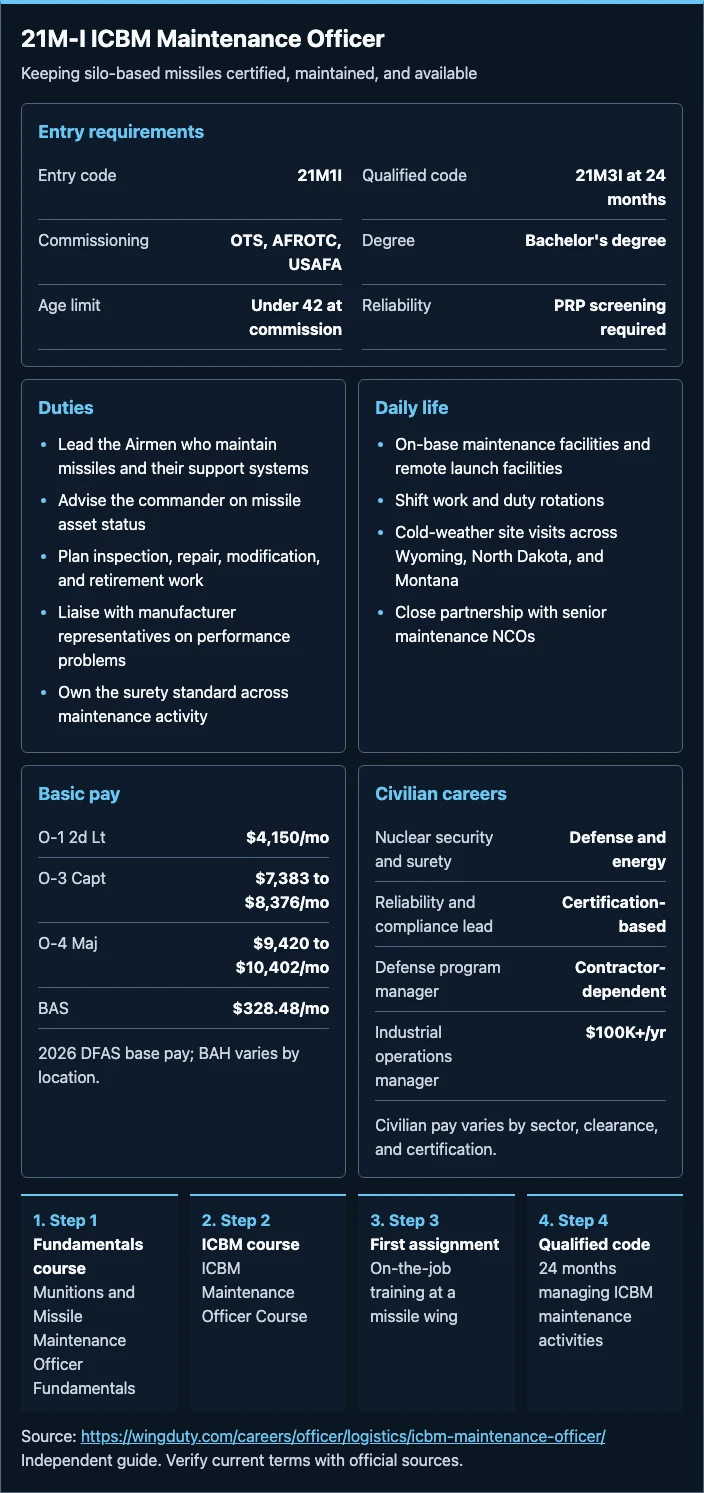
Entry requirements
- Entry code
- 21M1I
- Qualified code
- 21M3I at 24 months
- Commissioning
- OTS, AFROTC, USAFA
- Degree
- Bachelor's degree
- Age limit
- Under 42 at commission
- Reliability
- PRP screening required
Duties
- Lead the Airmen who maintain missiles and their support systems
- Advise the commander on missile asset status
- Plan inspection, repair, modification, and retirement work
- Liaise with manufacturer representatives on performance problems
- Own the surety standard across maintenance activity
Daily life
- On-base maintenance facilities and remote launch facilities
- Shift work and duty rotations
- Cold-weather site visits across Wyoming, North Dakota, and Montana
- Close partnership with senior maintenance NCOs
Basic pay
- O-1 2d Lt
- $4,150/mo
- O-3 Capt
- $7,383 to $8,376/mo
- O-4 Maj
- $9,420 to $10,402/mo
- BAS
- $328.48/mo
2026 DFAS base pay; BAH varies by location.
Civilian careers
- Nuclear security and surety
- Defense and energy
- Reliability and compliance lead
- Certification-based
- Defense program manager
- Contractor-dependent
- Industrial operations manager
- $100K+/yr
Civilian pay varies by sector, clearance, and certification.
- Step 1Fundamentals courseMunitions and Missile Maintenance Officer Fundamentals
- Step 2ICBM courseICBM Maintenance Officer Course
- Step 3First assignmentOn-the-job training at a missile wing
- Step 4Qualified code24 months managing ICBM maintenance activities
Source: Air Force ICBM Maintenance Officer: The 21M-I Path
Independent guide. Verify current terms with official sources.
On this page
Wing Duty is supported by purchases through our links, which may earn us a commission.
Job Role and Responsibilities
A 21M ICBM maintenance officer keeps intercontinental ballistic missiles and their supporting systems ready across a service life measured in decades. The officer plans inspection, repair, modification, and retirement work, and advises the commander on the status of the missile force.
Command and Leadership Scope
A new lieutenant in this branch leads a maintenance section at a missile wing, working beside senior noncommissioned officers who hold the hands-on expertise. The first tour is about learning the technical order system, the surety rules, and the inspection rhythm that governs every task on a missile.
Captains move to flight-level leadership, where the officer owns scheduling, training currency, and the maintenance posture for a set of facilities. Majors take squadron operations or staff roles that set policy for missile maintenance across a wing or a numbered air force.
The officer does not sit on a launch crew. That is the 13N Nuclear and Missile Operations Officer career field, which runs crew operations, instructor and evaluator duties, and weapons qualification. The two fields work together. One keeps the weapon system ready. The other operates it. If you want the launch console, you want 13N. If you want the maintenance organization that keeps the missiles viable, you want this shredout.
Specific Roles and Designations
| Code | Level | What earns it |
|---|---|---|
| 21M1I | Entry | The Munitions and Missile Maintenance Officer Fundamentals Course, then the ICBM Maintenance Officer Course |
| 21M3I | Qualified | At least 24 months managing ICBM maintenance activities and the career field education and training plan |
The fundamentals course is a prerequisite for every shredout course. The ICBM branch then has its own officer course.
One detail stands out when you compare the three branches. The conventional and nuclear shredouts each require one more named course for the qualified code. The ICBM shredout lists the 24-month experience requirement and the career field education and training plan, with no third course named.
Mission Contribution
The land-based leg of the nuclear triad depends on missiles that are certified, maintained, and available on demand. A maintenance officer’s decisions about inspection intervals, repair priorities, and modification schedules reach directly into strategic deterrence. The work is quiet, and the consequence of an unready missile is national rather than local.
Technology and Systems
The knowledge list for this shredout is specific. It runs through missile and re-entry systems, suspension and release equipment, weapon employment, and nuclear surety. It also includes joint nuclear procedures, the test and handling equipment the field depends on, and the evolution of missiles.
The technical depth goes further. Officers are expected to know missile operations, the performance of solid and liquid rocket motors, the maintenance capabilities and limitations of missile equipment, and ICBM life cycle logistics. That last item is the thread that runs through a career. An ICBM is a system with a long service life, and maintenance officers plan for inspection, repair, modification, and eventual retirement across decades.
Salary and Benefits
Officer Base Pay
Pay follows the standard officer table. 2026 figures come from the DFAS military pay tables.
| Rank | Grade | Typical YOS | Monthly Base Pay |
|---|---|---|---|
| Second Lieutenant | O-1 | Under 2 | $4,150 |
| First Lieutenant | O-2 | 2-4 years | $5,446-$6,485 |
| Captain | O-3 | 4-10 years | $7,383-$8,376 |
| Major | O-4 | 10-16 years | $9,420-$10,402 |
Allowances and Benefits
- BAH: set by duty location, zip code, and dependency status
- BAS: $328.48 monthly for officers
- TRICARE Prime: health and dental coverage for the officer and eligible dependents
- Retirement: Blended Retirement System with government matching of up to 5 percent of base pay into the Thrift Savings Plan
- Leave: 30 days paid annually
Missile wing assignments can carry nuclear duty-related compensation that varies by role and location. The rules change, so verify current entitlements through official finance channels instead of planning around a figure from a forum.
Work-Life Balance
Missile wings run on alert and duty rotations, which makes the home-station calendar more predictable than a combat air forces base. The trade is location. Most missile wings sit in rural areas, which shapes both the commute and the family’s access to work and services.
Qualifications and Eligibility
Commissioning Sources
| Source | Degree | Age | Key prerequisite |
|---|---|---|---|
| OTS | Bachelor’s degree | Must commission before 42 | Competitive officer selection board |
| AFROTC | Bachelor’s degree | Must commission before 42 | Career assignment on commissioning |
| USAFA | Degree on graduation | Standard academy limits | Assignment at graduation |
Test Requirements
Officer candidates take the Air Force Officer Qualifying Test before commissioning or career-field placement. The AFOQT study guide explains the composites the Air Force uses. This branch does not require the TBAS.
Screening and Clearance
Entry into 21M requires screening for the Personnel Reliability Program. The field also requires routine access to Tier 5 information and systems. Award of the entry level is allowed before the Tier 5 investigation finishes, as long as an interim Top Secret clearance is in place.
Air National Guard and Air Force Reserve officers are exempt from that entry screening, and PRP-designated duties still carry PRP eligibility standards. Reliability screening is where most candidates learn that this family of jobs has a higher bar than a standard Secret clearance. Financial problems, drug history, or a legal record can end the nuclear path regardless of technical aptitude.
Upon Commissioning
New officers enter as second lieutenants, complete the officer courses, and report to a missile wing. The service commitment follows the standard officer obligation for a non-rated commission.
Work Environment
Setting and Schedule
The work splits between on-base maintenance facilities and remote launch facilities distributed across a wide geographic area. Officers drive or ride to those sites in all weather, inspect equipment, and supervise maintenance activity under surety rules that govern every step.
Shift work and duty rotations are normal. A missile wing does not stop for the weekend, and lieutenants should expect to cover alerts, inspections, and maintenance windows outside a standard day.
Chain of Command
The officer reports through the maintenance squadron to the maintenance group and the wing commander, and works alongside the operations group that flies the mission. The relationship with senior noncommissioned officers carries the job. They know the equipment and the local hazards, and the officer leads, enforces the standard, and makes the call when a technical problem competes with a schedule.
Training and Skill Development
| Phase | Location | Focus |
|---|---|---|
| Commissioning source or OTS | Maxwell AFB, AL or source dependent | Officership basics |
| Munitions and Missile Maintenance Officer Fundamentals | Current Air Force course location | Weapons systems, maintenance leadership, safety |
| ICBM Maintenance Officer Course | Current Air Force course location | Missile and re-entry systems, rocket motors, life cycle logistics |
| First assignment on-the-job training | Missile wing | Local qualification and maintenance leadership |
Beyond the schools, this branch carries recurring certification. Nuclear surety training, reliability program refreshers, and system-specific qualification updates arrive on a fixed cycle, and officers who let currency lapse lose the credibility the job depends on.
Career Progression and Advancement
| Rank | Grade | Typical timeline | Development focus |
|---|---|---|---|
| Second Lieutenant | O-1 | Entry to 2 years | Learn the standards, lead a section |
| First Lieutenant | O-2 | 2-4 years | Section leadership, maintenance scheduling |
| Captain | O-3 | 4-10 years | Flight commander or maintenance operations |
| Major | O-4 | 10-16 years | Squadron operations or staff roles |
| Lieutenant Colonel | O-5 | 16-22 years | Squadron command or senior maintenance staff |
Promotion turns on disciplined leadership, surety compliance, inspection results, and readiness. Officers who have run flights, passed nuclear surety inspections cleanly, and mentored enlisted technicians build the strongest records for command.
Physical Demands and Medical Evaluations
Officers take the standard Air Force Fitness Assessment: a 1.5-mile run, push-ups, sit-ups, and a waist or body composition measure. The job adds outdoor site work in cold weather, with launch facilities spread across states such as Wyoming, North Dakota, and Montana, so officers need to handle long drives and winter conditions.
PRP-designated duties add medical standards beyond the commissioning physical. Prescription medications and mental health treatment that would be routine elsewhere can trigger a reliability re-evaluation, which is why candor with the flight surgeon matters here.
Deployment and Duty Stations
Deployment exposure is lower than in the conventional branch. The mission is fixed to its silos, so officers mostly serve where the missiles are rather than deploying to build weapons operations forward.
Assignments cluster at the three missile wings: Minot AFB in North Dakota, Malmstrom AFB in Montana, and F.E. Warren AFB in Wyoming. That is a short list, and it means the assignment picture is predictable in a way that broader logistics fields are not.
Risk, Safety, and Legal Considerations
The risks in this branch are surety risks. Nuclear surety rules govern personnel reliability, equipment certification, and procedural compliance, and violations are investigated rather than handled as administrative shortfalls. Officers in nuclear-related roles work under the directives that implement these standards, including Air Force Instruction 13-526 and related nuclear surety publications.
The two-person rule means officers are rarely alone with nuclear-related systems, and every action in those spaces is witnessed and documented. That is a protection, and it is also an expectation. A maintenance officer who treats documentation as paperwork will not last in the field.
Impact on Family and Personal Life
Home-station life at a missile wing is stable and predictable. The counterweight is location. Minot, Malmstrom, and F.E. Warren sit in rural or semi-rural areas with fewer spousal employment options and fewer amenities than a major metropolitan base.
Moves follow the officer norm of two to four years, and because the list of suitable billets is short, families should expect less flexibility in stating location preference than officers in broader fields enjoy.
Reserve and Air National Guard
The 21MX family lists Active Duty, Air National Guard, and Air Force Reserve as component options, though ICBM billets are concentrated in the active force. Guard and Reserve officers are exempt from the entry PRP screening, while PRP-designated duties still carry full eligibility standards.
For a Guard or Reserve officer, this branch pairs with civilian work in defense programs, nuclear security, or industrial operations where the same discipline and clearance carry value.
Post-Service Opportunities
| Civilian role | Typical pay | Outlook |
|---|---|---|
| Nuclear security or surety specialist | Varies widely | Niche, defense and energy sectors |
| Defense program manager | Sector dependent | Strong with contractors |
| Reliability and compliance lead | Varies by certification | Stable |
| Industrial operations manager | Often $100K and up | Strong |
Defense contractors and energy companies value officers who have run controlled maintenance programs under inspection. Arms control, nuclear security consulting, and weapons program management are realistic destinations for officers with clean records and strong performance.
Is This a Good Job for You? The Right (and Wrong) Fit
This branch suits an officer who wants technical depth, a defined standard, and strategic consequence without a combat deployment rhythm. The right fit takes satisfaction in a missile that passes inspection because the maintenance program was run properly.
It is a poor fit for someone who wants variety, frequent travel, or a fast-moving operational tempo. The work is deliberate, the location list is short, and the standard does not flex.

More Information
- Review the Air Force Munitions and Missile Maintenance Officer page
- Start with the parent 21M profile for shared commissioning, pay, and screening detail
- Compare the launch side at 13N Nuclear and Missile Operations Officer
- Read the other two branches: Conventional Munitions Officer and Nuclear Munitions Officer
- Prepare for the officer test with the AFOQT study guide or a structured AFOQT study course