21R Logistics Readiness Officer
Aircraft do not launch because someone wants them to. They launch because fuel is available, cargo is moving, vehicles are running, and the supply chain did not break. The officer who owns that bigger picture is the 21R Logistics Readiness Officer. This is one of the broadest support jobs in the Air Force. It combines distribution, fuels, vehicle operations, contingency planning, and logistics policy into one career field that sits directly under mission generation.
If you are applying through OTS, start with the AFOQT study guide before your package window.
Job Role
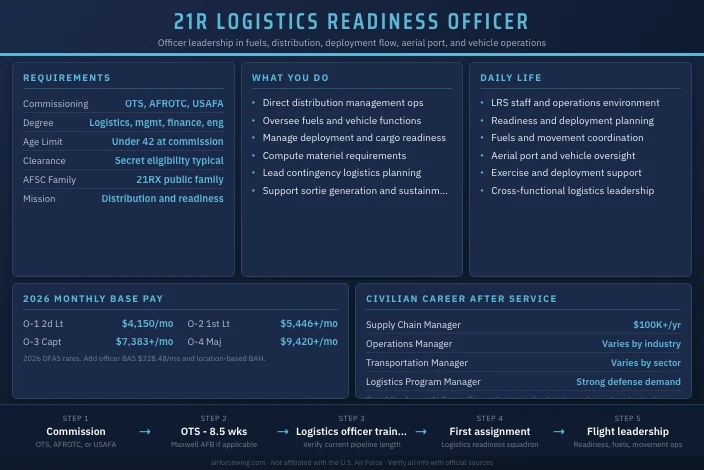
21R Logistics Readiness Officers direct the logistics systems that move personnel, fuel, cargo, and supplies for Air Force operations. They lead distribution management, fuels management, vehicle operations, aerial port support, and contingency logistics programs for both home-station and deployed missions.
Leadership Scope
A new 21R often starts in a logistics readiness squadron or a major section inside one, leading Airmen in fuels, deployment planning, vehicle operations, or supply-distribution support. By captain and major, the job expands into flight command, readiness oversight, and larger cross-functional logistics leadership.
Family Code Context
The public recruiting site lists this field as 21RX Logistics Readiness Officer. This page uses the 21R code label to match the officer hub structure in the repo.
| Designation | Meaning |
|---|---|
| 21R | Logistics Readiness Officer label used in this site’s hub |
| 21RX | Public recruiting family code |
Mission Contribution
This field keeps operations moving. A logistics officer decides how supplies get distributed, how fuel support is sustained, how deployment flows are managed, and whether the unit can actually execute what operations planners want. That makes 21R one of the most mission-linked support officer fields in the Air Force.
Systems And Tools
You will work around readiness reporting, fuels operations, deployment planning documents, vehicle-management systems, aerial port coordination, and materiel forecasting. The job is more operational than a normal office role, even though much of the work still happens through staff processes and control systems.
Salary
Officer Base Pay
2026 pay follows the DFAS military pay tables.
| Rank | Grade | Typical YOS | Monthly Base Pay |
|---|---|---|---|
| Second Lieutenant | O-1 | Under 2 | $4,150 |
| First Lieutenant | O-2 | 2-4 years | $5,446-$6,485 |
| Captain | O-3 | 4-10 years | $7,383-$8,376 |
| Major | O-4 | 10-16 years | $9,420-$10,402 |
Allowances
This field uses standard officer compensation rather than special aviation pay:
- BAH: location based
- BAS: $328.48 monthly
- TRICARE Prime
- BRS and TSP matching
Career Value
The civilian translation is strong because logistics leadership is valued in transportation, supply chain, warehousing, energy, and operations management sectors.
Qualifications
Commissioning Requirements
The Air Force Logistics Readiness Officer page provides the clearest public baseline.
| Commissioning Source | Degree Requirement | Age Limit | Notes |
|---|---|---|---|
| OTS | Bachelor’s degree | Must commission before 42 | Competitive officer selection |
| AFROTC | Bachelor’s degree | Must commission before 42 | Career assignment at commissioning |
| USAFA | Degree on graduation | Standard academy limits | Assignment at graduation |
Competitive degree areas include logistics management, economics, management, business administration, computer science, information management systems, finance, accounting, petroleum engineering, chemical engineering, and industrial management.
Screening
The public page calls for knowledge of distribution management, materiel management, and contingency operations. That means the field values organizational thinking and operational judgment, not just classroom theory.
OTS candidates can strengthen the front end of their package with the AFOQT study guide.
Upon Commissioning
New accessions enter as O-1 and move into a logistics readiness unit after commissioning. Early assignments are usually broad, which is part of the field’s value. You get visibility across multiple logistics functions fast.
Work Environment
Setting And Schedule
21R is broader than most support officer jobs. Some days are staff and planning heavy. Others put you on the flight line, at a vehicle fleet area, inside a mobility-processing setup, or working with fuels operations. The schedule is more dynamic than a pure office officer job because logistics supports whatever tempo the base is running.
Officer-NCO Dynamic
This field depends on senior enlisted logistics experts. A young officer learns quickly from fuels NCOs, vehicle managers, aerial port leaders, and deployment planners who know the real pace of operations.
Command And Staff Balance
This field has a credible command track inside logistics readiness squadrons and support groups. Staff work also matters, especially for officers who later move into major command, air staff, or joint logistics roles.
Training
Training Pipeline
| Phase | Location | Length | Focus |
|---|---|---|---|
| Commissioning source or OTS | Maxwell AFB, AL or source dependent | OTS 8.5 weeks | Officership basics |
| Logistics readiness officer qualification | Current Air Force training location | Verify current length | Distribution, fuels, vehicle, contingency logistics |
| First assignment OJT | Logistics readiness squadron | 12-24 months | Local mission qualification and team leadership |
The public recruiting page highlights OTS and Maxwell, but not a prominent separate public course duration. The hub in this repo carries ~4 months as the working planning estimate for the broader qualification pipeline, which should be verified with an accession source before publication-sensitive updates later.
The AFOQT study guide is the first prep step for OTS candidates before that training ever starts.
Additional Development
This field rewards later experience in contingency logistics, fuels, transportation, and headquarters planning. The breadth of the early career is one of its biggest advantages.
Career Progression
Timeline
| Rank | Grade | Typical Timeline | Development Focus |
|---|---|---|---|
| Second Lieutenant | O-1 | Entry to 2 years | Broad logistics fundamentals |
| First Lieutenant | O-2 | 2-4 years | Flight-level leadership |
| Captain | O-3 | 4-10 years | Flight commander and readiness leadership |
| Major | O-4 | 10-16 years | Squadron operations or staff planning |
| Lieutenant Colonel | O-5 | 16-22 years | Squadron command or senior logistics staff |
Promotion Drivers
Breadth matters in 21R. Officers who can show success across multiple logistics functions tend to build stronger records than officers who stay too narrow too long.
Posture For Later Jobs
The field can feed senior support command roles, joint logistics jobs, and civilian supply-chain leadership positions after service.
Physical Demands
Fitness Standards
21R officers take the standard Air Force Fitness Assessment.
| Component | Max Points |
|---|---|
| 1.5-mile run | 60 |
| Push-ups | 10 |
| Sit-ups | 10 |
| Waist or body composition | 20 |
No separate public field-specific physical screen is emphasized beyond normal commissioning and worldwide deployability.
Deployment
Deployment Tempo
This field deploys regularly because logistics readiness is required anywhere the Air Force moves people or equipment. That makes deployment a normal part of the career rather than an exception.
Duty Stations
Nearly every major Air Force installation needs logistics officers. The field offers broad stateside and overseas assignment variety, plus a strong path into expeditionary support roles.
Risk/Safety
Main Risks
The risks are operational and leadership based:
- Mission delay from broken distribution or fuel support
- Vehicle or movement-control failures
- Poor contingency planning
- High accountability for readiness shortfalls
Control Measures
The field relies on planning discipline, logistics systems, maintenance coordination, and experienced enlisted execution. Officers succeed by staying ahead of the next movement problem, not reacting late.
Impact on Family
This field can be busier and more deployment-heavy than office-centric support jobs. Families should expect more irregular tempo during exercises and real-world movements, but also a broad set of duty-station options.
Reserve and Air National Guard
Component Availability
The public recruiting page lists Active Duty, Reserve, and Guard availability for 21RX. That makes the field viable for candidates who want part-time service paired with a civilian logistics career.
Civilian Integration
The overlap with civilian supply chain, transportation, warehousing, fleet, and operations management is strong. Few Air Force officer fields translate more directly.
Post-Service
Civilian Career Paths
| Civilian Role | Median Pay | Outlook |
|---|---|---|
| Supply Chain Manager | Often $100K+ | Strong |
| Operations Manager | Varies by industry | Strong |
| Transportation / fleet manager | Varies by sector | Stable |
| Logistics program manager | High demand in defense sector | Strong |
Is This a Good Job
21R is a strong fit if you want broad operational leadership without going rated. It is a weak fit if you prefer a narrow technical specialty or a steady office-only rhythm. The job is about moving the mission, not just planning it.
More Information
- Review the Air Force Logistics Readiness Officer page
- Compare enlisted feeder fields like 2G0X1 Logistics Plans and 2T0X1 Traffic Management
- Prepare your OTS package with the AFOQT study guide
This site is not affiliated with the U.S. Air Force or any government agency. Verify all information with official Air Force sources before making enlistment or career decisions.
Explore more Air Force logistics officer careers and compare this field with 21M Munitions and Missile Maintenance Officer and enlisted 2F0X1 Fuels.