21M Munitions and Missile Maintenance Officer
Few officer jobs in the Air Force carry more procedural weight than 21M. You are not just leading maintainers. You are leading the people responsible for conventional munitions, missile maintenance, nuclear-accountable systems, and some of the most tightly controlled technical processes in the service. A bad decision here is not an inconvenience. It can become a safety, security, or strategic problem fast. That is why 21M is respected across the logistics world.
OTS applicants should start with the AFOQT study guide before they submit a package.
Job Role
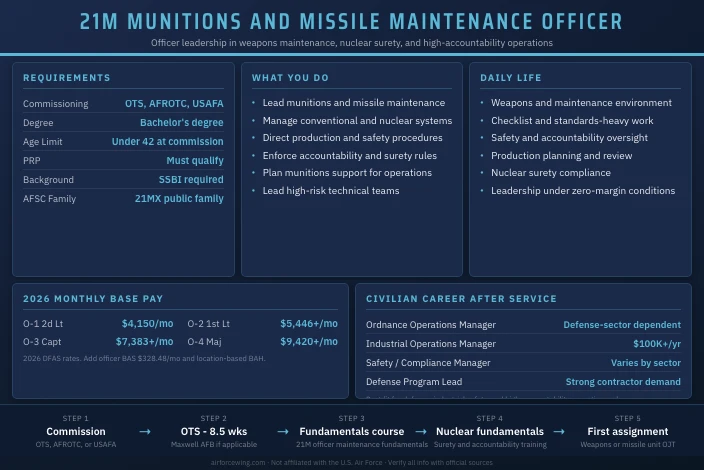
21M Munitions and Missile Maintenance Officers lead the Air Force organizations that store, assemble, maintain, test, and sustain conventional munitions, missiles, and certain nuclear-related systems. They direct production, safety, security, accountability, and readiness across high-risk weapons operations.
Leadership Scope
A new 21M may lead a munitions or missile section under close supervision, but responsibility comes quickly. These officers manage enlisted specialists working around highly regulated weapons processes, and the standard for technical discipline is high from day one.
At higher ranks, the officer can oversee larger production operations, nuclear-support activities, or full squadron-level maintenance programs. The field combines leadership with exact process control.
Family Code Context
The public recruiting site lists this role as 21MX Munitions and Missile Maintenance Officer. This page uses 21M to match the repo’s officer hub structure.
| Designation | Meaning |
|---|---|
| 21M | Hub label used in this site |
| 21MX | Public recruiting family code |
Mission Contribution
The Air Force cannot generate combat power without weapons that are properly stored, assembled, maintained, and moved under strict control. The same logic applies even more strongly in nuclear-related mission areas. 21M officers are part of the chain that keeps those systems safe, available, and ready.
Systems And Tools
This field revolves around storage and accountability systems, maintenance procedures, safety checklists, nuclear surety rules, and production-control tools. The officer role is leadership under high regulation, not improvisation.
Salary
Officer Base Pay
2026 pay follows the DFAS military pay tables.
| Rank | Grade | Typical YOS | Monthly Base Pay |
|---|---|---|---|
| Second Lieutenant | O-1 | Under 2 | $4,150 |
| First Lieutenant | O-2 | 2-4 years | $5,446-$6,485 |
| Captain | O-3 | 4-10 years | $7,383-$8,376 |
| Major | O-4 | 10-16 years | $9,420-$10,402 |
Allowances
This field usually follows normal officer compensation:
- BAH: location based
- BAS: $328.48 monthly
- TRICARE Prime
- BRS and TSP matching
Career Value
The strongest civilian transfer paths are in explosives safety, ordnance management, defense program operations, industrial maintenance leadership, and high-accountability operations management.
Qualifications
Commissioning Requirements
The public Air Force page for Munitions and Missile Maintenance Officer provides the cleanest current baseline.
| Commissioning Source | Degree Requirement | Age Limit | Key Prerequisites |
|---|---|---|---|
| OTS | Bachelor’s degree | Must commission before 42 | Competitive officer selection |
| AFROTC | Bachelor’s degree | Must commission before 42 | Career assignment on commissioning |
| USAFA | Degree on graduation | Standard academy limits | Assignment at graduation |
Security And Reliability Screening
This field has heavier security screening than many officer specialties. The public page specifically calls out:
- Personnel Reliability Program (PRP) eligibility
- Single Scope Background Investigation (SSBI) completion
- Knowledge of conventional, missile, and nuclear munitions principles
That makes 21M a high-trust field even before an officer reaches the first duty station.
Use the AFOQT study guide if you are preparing for the officer-accession side of the pipeline.
Upon Commissioning
New officers enter as O-1 and move into munitions or missile-support organizations after commissioning. The early-career goal is learning the technical standards well enough to lead safely and credibly.
Work Environment
Setting And Schedule
This field is not a pure desk job. Officers work in production areas, storage areas, maintenance settings, secure facilities, and planning spaces. The environment can combine industrial procedures with high-end security requirements.
Officer-NCO Dynamic
You will rely heavily on experienced weapons and missile maintenance NCOs. They know the technical rhythm and the local hazards. Your responsibility is to lead, enforce standards, and make the right calls when pressure rises.
Staff And Command Balance
The field supports both operational leadership and later staff roles involving weapons policy, nuclear surety, and sustainment planning. Command-track opportunities exist for officers who build strong technical and leadership records.
Training
Training Pipeline
| Phase | Location | Length | Focus |
|---|---|---|---|
| Commissioning source or OTS | Maxwell AFB, AL or source dependent | OTS 8.5 weeks | Officership basics |
| Munitions and Missile Maintenance Officer Fundamentals | Current Air Force course location | Verify current length | Weapons systems, maintenance leadership, safety |
| Nuclear Fundamentals Course | Current Air Force course location | Verify current length | Nuclear accountability, standards, surety |
| First assignment OJT | Munitions or missile unit | 12-24 months | Local qualification and production leadership |
The public page specifically names the Munitions and Missile Maintenance Officer Fundamentals Course and the Nuclear Fundamentals Course. That is stronger public detail than many officer fields provide and reinforces how technical and tightly controlled this job is.
The AFOQT study guide is still the first prep step for OTS candidates before this training ever matters.
Additional Development
This field rewards deeper experience in nuclear surety, weapons accountability, explosives safety, and production control. Later assignments can become highly specialized and strategically important.
Career Progression
Timeline
| Rank | Grade | Typical Timeline | Development Focus |
|---|---|---|---|
| Second Lieutenant | O-1 | Entry to 2 years | Learn standards and lead small teams |
| First Lieutenant | O-2 | 2-4 years | Section leadership |
| Captain | O-3 | 4-10 years | Flight commander or production oversight |
| Major | O-4 | 10-16 years | Squadron operations or staff roles |
| Lieutenant Colonel | O-5 | 16-22 years | Squadron command or senior maintenance staff |
Promotion Drivers
Credibility in this field comes from disciplined leadership, safety, readiness, and flawless accountability. Officers who cut corners will not last.
Broader Opportunities
Strong 21M officers can move into maintenance leadership, nuclear policy, sustainment planning, and later civilian ordnance or industrial operations roles after service.
Physical Demands
Fitness Standards
21M officers take the standard Air Force Fitness Assessment.
| Component | Max Points |
|---|---|
| 1.5-mile run | 60 |
| Push-ups | 10 |
| Sit-ups | 10 |
| Waist or body composition | 20 |
Field-Specific Physical Reality
The job includes more site presence and industrial exposure than a normal office role. Officers are not doing the full enlisted hands-on workload every day, but they still operate around hazardous, security-sensitive maintenance environments.
Deployment
Deployment Tempo
This field can deploy wherever munitions support is required. Tempo varies by unit and weapons mission, but expeditionary support is a real part of the career.
Duty Stations
Assignments tend to cluster at bases with major munitions, missile, or nuclear missions. That means less universal base coverage than 21R, but higher specialization.
Risk/Safety
Main Risks
This is one of the highest-consequence officer fields in the Air Force from a safety and accountability standpoint:
- Explosives hazards
- Weapons-accountability failures
- Nuclear surety issues
- High consequence from procedural mistakes
Safety And Control
The field runs on checklists, certification, layered review, and disciplined compliance. That is not bureaucracy for its own sake. It is how the Air Force keeps weapons operations safe.
Impact on Family
The family impact is mixed. Home-station tempo can be stable, but the stress level of the work is higher than many support jobs because the consequences of error are higher. PCS options are also narrower than in broader officer fields.
Reserve and Air National Guard
Component Availability
The public recruiting page lists Active Duty, Air National Guard, and Air Force Reserve for the 21MX family. That gives qualified officers multiple component paths, though unit availability will depend on where munitions and missile missions actually exist.
Civilian Integration
This field pairs best with defense, industrial safety, explosives, or high-accountability operations work rather than a generic corporate management role.
Post-Service
Civilian Career Paths
| Civilian Role | Median Pay | Outlook |
|---|---|---|
| Ordnance / explosives manager | Varies widely | Niche but strong in defense sector |
| Industrial operations manager | Often $100K+ | Strong |
| Defense program operations lead | Sector dependent | Strong in contractor space |
| Safety / compliance manager | Varies by certification | Stable |
Is This a Good Job
21M is a strong fit if you want high-accountability leadership in a technical weapons environment. It is a poor fit if you want a relaxed support role or dislike rigid procedures. The field demands seriousness every day.
More Information
- Review the Air Force Munitions and Missile Maintenance Officer page
- Compare the enlisted side at 2W0X1 Munitions Systems and 2W2X1 Nuclear Weapons
- Prepare your OTS package with the AFOQT study guide
This site is not affiliated with the U.S. Air Force or any government agency. Verify all information with official Air Force sources before making enlistment or career decisions.
Explore more Air Force logistics officer careers including 21R Logistics Readiness Officer and adjacent enlisted 2W1X1 Aircraft Armament Systems.