21A Aircraft Maintenance Officer
Every fighter, bomber, tanker, and airlift aircraft that flies today does so because a 21A Aircraft Maintenance Officer said it was ready. No aircraft leaves the ground without maintenance leadership signing off on it. This is one of the largest officer career fields in the Air Force by personnel supervised, a new lieutenant routinely leads 50 to 600 Airmen within the first four years.
Job Role and Responsibilities
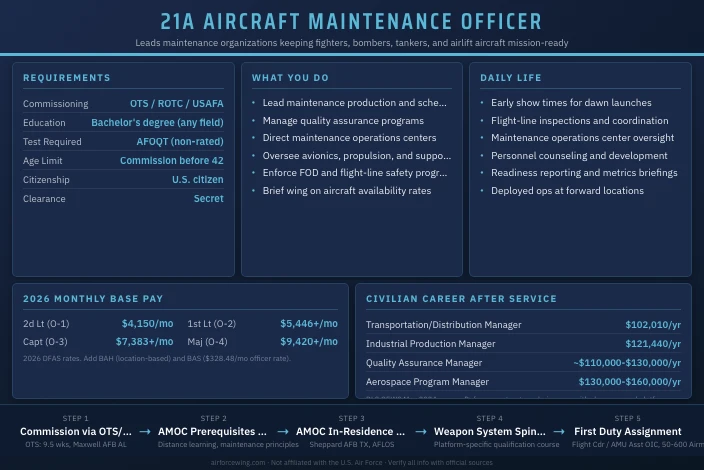
21A Aircraft Maintenance Officers lead and manage the maintenance organizations that keep Air Force aircraft mission-capable. They direct maintenance production, quality assurance programs, plans and scheduling functions, and maintenance operations centers across fighter, bomber, tanker, airlift, helicopter, and special mission weapon systems.
OTS candidates preparing for the AFOQT should review the Air Force officer test prep guide before submitting their package.
Command and Leadership Scope
A new 21A enters as a second lieutenant and typically steps into one of three initial positions: Flight Commander, Assistant Aircraft Maintenance Unit Officer-in-Charge, or Operations Officer within a maintenance group. These roles involve direct leadership of maintenance specialists across airframe, propulsion, avionics, egress, fuel systems, and support equipment functions.
By captain, an officer typically commands an Aircraft Maintenance Unit, managing the daily scheduling, production control, and weapons loading for a specific aircraft fleet. Squadron-level roles expand into directing maintenance operations centers, managing readiness reporting, and overseeing complex maintenance events such as depot-level inspections or battle-damage repair.
The span of control grows significantly with time. A major or lieutenant colonel running a maintenance group may oversee several hundred enlisted Airmen across multiple squadrons. That concentration of leadership responsibility, over people, equipment, and aircraft worth hundreds of millions of dollars, is what distinguishes 21A from most officer career fields.
Shredouts and Designators
| Designator | Meaning |
|---|---|
| 21A1 | Entry-level qualification |
| 21A2 | Mid-level qualification with expanded assignment authority |
| 21A3 | Senior qualification; requires minimum 24 months of aircraft maintenance management experience |
| 21AX | Family code used in recruiting and assignment systems |
Mission Contribution
Aircraft availability is a direct measure of combat capability. An Air Force wing that cannot generate sorties cannot execute its tasking. The 21A career field owns that problem at every level, from the flight line where a maintainer troubleshoots a fault code, to the maintenance operations center that coordinates aircraft across a 24-hour flying schedule, to the group commander who briefs the wing commander on mission capability rates.
In joint operations, 21A officers support Air Expeditionary Wing deployments, agile combat employment concepts, and contingency maintenance at forward operating locations. They lead aircraft recovery operations for disabled aircraft and coordinate with depot personnel on complex maintenance actions that cannot be resolved at the unit level.
Technology and Systems
21A officers work across nearly every major Air Force platform. Career-long assignments may span:
- 4th-generation fighters (F-15, F-16)
- 5th-generation fighters (F-22, F-35)
- Strategic bombers (B-2, B-52, B-21)
- Tankers and mobility aircraft (KC-46, C-17, C-5)
- Special operations aircraft (AC-130, CV-22)
- Rotary-wing platforms (HH-60)
Weapon-system-specific spin-up training is required when transitioning to a new platform. Officers use maintenance information systems, readiness reporting tools, and quality assurance tracking software to manage fleet health and identify maintenance trends.
Salary and Benefits
Officer Base Pay
All figures are 2026 DFAS rates. Pay increases with years of service within each grade.
| Rank | Grade | Typical YOS | Monthly Base Pay |
|---|---|---|---|
| Second Lieutenant | O-1 | Under 2 | $4,150 |
| First Lieutenant | O-2 | 2-4 years | $5,446-$6,485 |
| Captain | O-3 | 4-10 years | $7,383-$8,376 |
| Major | O-4 | 10-16 years | $9,420-$10,402 |
Allowances and Special Pay
The 21A career field does not carry flight pay or rated aviation bonuses. Compensation beyond base pay follows standard officer allowances:
- BAH: Varies by duty location and dependency status. Use the DoD BAH Rate Lookup for your specific base.
- BAS: $328.48 per month (2026 rate)
- TRICARE Prime: No cost to active-duty members for medical, dental, and prescriptions
- TSP matching: Government contributes up to 5% of basic pay under the Blended Retirement System
Retirement and Education Benefits
Under the Blended Retirement System, officers who serve 20 years receive a monthly pension equal to 40% of their high-36 average basic pay. The Post-9/11 GI Bill covers full in-state tuition at public universities or up to $29,920.95 annually at private schools for the 2025-2026 academic year. Tuition Assistance is available during service up to $4,500 per year.
Work-Life Balance
Garrison schedules typically run standard weekday hours, but flying operations and aircraft availability demands can extend the workday depending on sortie generation requirements. Major flying exercises, inspections, and surge operations compress workload significantly. Deployment tempo varies by platform and unit mission but is generally moderate compared to rated and special warfare career fields.
Qualifications and Eligibility
Commissioning Requirements
A bachelor’s degree is required. The Air Force does not mandate a specific major, though engineering, aviation science, or technical degrees are competitive. STEM backgrounds can strengthen an OTS package. All candidates must be U.S. citizens and eligible for a Secret security clearance.
The airforce.com Aircraft Maintenance Officer page confirms the baseline education and age requirements.
| Commissioning Source | Degree Requirement | Age Limit | Notes |
|---|---|---|---|
| OTS | Bachelor’s degree, any field | Commission before age 42 | Competitive officer selection; AFOQT required |
| AFROTC | Bachelor’s degree, any field | Commission before age 42 | Career assignment determined at commissioning |
| USAFA | Degree on graduation | Standard academy limits | Assignment at graduation |
Test Requirements
All OTS applicants must pass the Air Force Officer Qualifying Test (AFOQT). There is no rated aviation test required for the 21A career field, this is a non-rated officer position, so TBAS is not part of the application.
The AFOQT measures verbal and quantitative reasoning, technical aptitude, and leadership. Competitive scores depend on the OTS board cycle. The OTS test prep guide explains the AFOQT in detail and covers what to study. The test can be taken no more than twice in a lifetime, so preparation matters.
Career Field Assignment Process
ROTC cadets rank their career field preferences and receive assignments through the Air Force accessions process. USAFA graduates go through a similar ranking and assignment process at graduation. OTS candidates apply for specific career fields as part of their overall application package.
The 21A field is large, which means assignment rates are generally more accessible than competitive rated slots or intelligence positions. That said, technical aptitude, leadership performance, and academic background still factor into selection. Officers cannot commission directly into 21A from civilian life without going through OTS, ROTC, or the Academy.
Upon Commissioning
New officers enter at O-1 (Second Lieutenant). The standard Active Duty Service Commitment for officers commissioned through OTS is typically four years. Officers accepting certain training investments or broadening programs may incur additional obligations.
Work Environment
Setting and Schedule
The 21A work environment centers on the flight line, maintenance production facilities, and maintenance operations centers. Unlike most officer desk jobs, this career field puts officers in direct contact with aircraft and the Airmen who maintain them every day.
Typical work locations include:
- Flight line and aircraft parking areas: where production control, inspections, and aircraft generation happen
- Maintenance Operations Center (MOC): the coordination hub for scheduling, status tracking, and mission reporting
- Back shops: component repair facilities for avionics, propulsion, egress, and support equipment
- Squadron and group headquarters: for administrative duties, briefings, and planning
Garrison work follows the flying schedule, which means early-morning show times before dawn launches and late nights during surge operations or inspections. At deployed locations, tempo increases and hours extend based on operational requirements.
NCO Relationship
The officer-senior NCO relationship is central to success in this career field. Maintenance chiefs and senior Master Sergeants carry deep technical expertise built over 15 to 20 years. A new lieutenant who understands and respects that expertise, and who leads people rather than trying to out-technical them, will build effective maintenance teams. Those who come in assuming rank substitutes for experience typically struggle.
The relationship works best when the officer owns the command climate, makes decisions, and holds standards, while the senior NCO advises on technical execution and unit culture. That dynamic requires clear communication and mutual accountability.
Staff vs. Command Roles
The typical 21A career moves through a rotation of command and staff positions. Command assignments (flight commander, AMU OIC, squadron command, group command) are the key developmental positions that boards evaluate for promotion. Staff positions at major commands, Air Staff, and joint organizations fill the gaps and broaden the officer’s perspective.
Most officers can expect to spend roughly equal time in command-track and staff roles across a 20-year career. Broadening assignments at ROTC, the Air Force Academy, or joint commands are available but not required at every career level.
Job Satisfaction
21A officers frequently cite two things: the scale of responsibility is unusually high for the rank, and the direct connection between their work and mission execution is visible daily. A flight that launches on time is a tangible outcome of maintenance leadership. That feedback loop is less common in many other officer fields.
Officers who leave after their initial commitment often cite PCS frequency and deployment tempo as primary factors, not dissatisfaction with the work itself.
Training and Skill Development
Pre-Commissioning Training
All commissioning paths include leadership and officer fundamentals:
- OTS: 9.5 weeks at Maxwell AFB, AL
- AFROTC: Four-year program including field training
- USAFA: Four-year program including summer training programs
The AFOQT is part of the OTS application package. The AFOQT study guide covers all subtests and scoring benchmarks competitive candidates should aim for.
Initial Skills Training
After commissioning, all 21A officers attend the Aircraft Maintenance Officer Course (AMOC) at Sheppard AFB, TX, run through Air Force Logistics Officer School (AFLOS). The course totals approximately three months, beginning with a 60-day distance-learning prerequisite and concluding with a 30-day in-residence phase at Sheppard AFB.
| Phase | Location | Length | Focus |
|---|---|---|---|
| Prerequisite / Distance Learning | Online (prior to in-residence) | ~60 days | Maintenance principles, unit-specific context, discussion-based learning |
| AMOC In-Residence | Sheppard AFB, TX | ~30 days | Aircraft systems, maintenance production, quality assurance, scheduling, leadership scenarios |
| Weapon System Spin-Up | Platform-specific location | Varies | Aircraft-specific systems, procedures, and operational qualification |
The AMOC Bridge Course is a 19-day condensed variant for officers who already hold basic officer competency and transition into the career field through a non-standard path. Graduates of the full AMOC course are ready to step into flight commander roles at their first duty assignment.
The curriculum covers avionics, propulsion, weapons, pneudraulics, egress, fuel systems, structural repair, aircraft generation, maintenance operations center functions, and logistics management. The training approach emphasizes scenario-based critical thinking and communication with senior leaders rather than rote procedures.
Professional Military Education
| PME School | Timing | Location | Duration |
|---|---|---|---|
| Squadron Officer School (SOS) | Captain / early Major | Maxwell AFB, AL (or correspondence) | ~6 weeks in-residence |
| Air Command and Staff College (ACSC) | Major | Maxwell AFB, AL (or distance learning) | ~1 year |
| Air War College (AWC) | Senior officers (Lt Col / Col) | Maxwell AFB, AL | ~1 year |
SOS is generally expected for promotion to Major. ACSC is expected before or during the Lieutenant Colonel promotion window. AWC selects a smaller pool of senior officers for strategic-level education.
Advanced Education and Schools
Officers interested in advanced technical education can apply for fully funded graduate degrees through the Air Force Institute of Technology (AFIT). Fellowships at civilian organizations, exchange programs with allied air forces, and joint staff assignments are also available as broadening opportunities.
Career Progression and Advancement
Career Timeline
| Rank | Grade | Typical YOS | Key Positions |
|---|---|---|---|
| Second Lieutenant | O-1 | 0-2 | Flight Commander, AMU Assistant OIC |
| First Lieutenant | O-2 | 2-4 | Flight Commander, Production Superintendent |
| Captain | O-3 | 4-10 | AMU OIC, Maintenance Operations Officer, Staff |
| Major | O-4 | 10-16 | Squadron Operations Officer, Assistant Director of Operations |
| Lieutenant Colonel | O-5 | 16-22 | Maintenance Squadron Commander, Director of Maintenance |
| Colonel | O-6 | 22+ | Maintenance Group Commander, Wing/Numbered Air Force Staff |
Officers are expected to achieve at least Advanced-level proficiency in the five 21A career field competencies before promotion to Lieutenant Colonel. The CFETP defines these competencies across leadership, maintenance operations, resource management, scheduling, and quality assurance.
Promotion System
Promotion from O-1 through O-3 is largely time-based, assuming satisfactory performance evaluations. O-4 and above requires selection by a central promotion board. Board factors include performance report ratings, breadth of assignments, PME completion, and competitive stratification by senior raters.
21A is a large career field, which creates competition at the O-4 board. Officers who complete key developmental positions, particularly AMU command and squadron-level operations roles, have stronger promotion files than those who spend most of their time in staff assignments. Board selection rates for O-4 and O-5 vary by year and Air Force needs; current rates are published by AFPC.
Broadening and Cross-Training
Officers typically spend at least one assignment outside their core AFSC before Major, and two broadening assignments before Colonel. Common options include:
- ROTC detachment commander or instructor
- Air Staff or major command staff (AFMC, AMC, ACC)
- Joint assignments (combatant commands, OSD)
- Security assistance programs and foreign military sales
Cross-training into a different officer career field is possible but requires formal board selection and approval. Most 21A officers who leave the maintenance track do so to move into acquisition, program management, or logistics readiness roles.
Physical Demands and Medical Evaluations
Fitness Assessment
All Air Force officers take the same Air Force Fitness Assessment, regardless of career field. The 21A has no additional physical standards beyond the standard FA.
| Component | Max Points |
|---|---|
| 1.5-Mile Run | 60 |
| Waist Circumference | 20 |
| Push-Ups (1 minute) | 10 |
| Sit-Ups (1 minute) | 10 |
The composite passing score is 75 out of 100. Each component has its own minimum that must be met. Scores are age- and gender-normed. Assessments run annually for most officers. Verify current standards at af.mil.
Medical Standards
The 21A career field does not require a flight physical. Standard officer commissioning physical standards apply. Officers must meet general medical fitness requirements for commissioning and maintain them throughout their service. No rated or Class III flight physical is required.
Physical Work Demands
The flight-line environment presents physical demands that differ from most officer roles. Ramp work involves exposure to jet blast, noise, fuels, hydraulic fluids, and extreme temperatures. Officers are expected to walk production lines, inspect aircraft, and work in confined spaces during maintenance oversight. Personal protective equipment use is mandatory in many areas.
Flight-line exposure includes the following physical factors:
- Noise: Jet engine run-ups and auxiliary power units produce sustained noise above 85 dB; double hearing protection is required in many areas
- Temperature extremes: Officers work on concrete ramps in summer heat exceeding 110°F at desert bases and winter wind chills below zero at northern installations
- Chemical exposure: Aviation fuels, hydraulic fluids, and solvents are present in the work environment; PPE and ventilation requirements apply
- Standing and walking: Production line walks, aircraft inspections, and maintenance oversight require hours on feet across large ramp areas
Officers who maintain personal fitness well above FA minimums report better endurance during extended surge operations and deployed maintenance cycles. The physical demands are not extreme, but the sustained pace during high-tempo operations makes general conditioning matter more than the minimum standards suggest.
Deployment and Duty Stations
Deployment Tempo
The 21A deployment tempo depends heavily on the assigned weapon system and unit mission. Fighter wings, Air Expeditionary units, and global strike forces tend to deploy more frequently than mobility or training units. Typical deployments run 90 to 180 days, with rotational models at many bases reducing extended individual deployments.
21A officers can deploy independently to support contingency operations anywhere aircraft are flying. Agile combat employment concepts have expanded the range of locations and configurations where maintenance officers operate, including forward areas with austere support.
Duty Station Options
21A officers serve wherever the Air Force flies aircraft. Major bases with large maintenance footprints include:
- Fighter: Luke AFB, AZ; Langley-Eustis, VA; Hill AFB, UT; Seymour-Johnson AFB, NC; Eglin AFB, FL
- Bomber/Strike: Barksdale AFB, LA; Minot AFB, ND; Whiteman AFB, MO; Ellsworth AFB, SD
- Mobility/Airlift: Travis AFB, CA; Dover AFB, DE; McChord Field, WA; McGuire-Dix, NJ
- Tanker: Fairchild AFB, WA; Altus AFB, OK; MacDill AFB, FL
- Overseas: RAF Lakenheath, UK; Kadena AB, Japan; Spangdahlem AB, Germany; Osan AB, Korea
Assignment preferences go through AFPC. Officers submit preference worksheets, and AFPC balances individual preferences against Air Force needs. Join-spouse programs help dual-military couples request co-location when positions are available.
Risk, Safety, and Legal Considerations
Job Hazards
Flight-line operations carry real physical risk. Officers bear command responsibility for safety program management and are accountable for the following hazard categories:
- Jet blast and propulsion hazards: Engine run-ups and taxi operations create blast zones that can injure or kill personnel who violate boundaries
- High-pressure hydraulics: Aircraft hydraulic systems operate at 3,000 PSI; line failures can cause serious injury
- Aviation fuels and chemicals: JP-8 fuel, hydraulic fluids, and deicing chemicals present inhalation and skin contact risks
- Egress systems: Ejection seats and canopy actuators contain explosive components that require strict arming and safing procedures
- Ordnance: Weapons loading and handling operations introduce explosive hazards on the flight line
Officer command authority creates additional accountability exposure. A maintenance officer whose unit has a ground mishap involving aircraft or personnel faces formal investigation, and findings can affect the officer’s career regardless of direct involvement.
Risk Management
21A officers apply Operational Risk Management (ORM) as a formal framework for managing maintenance hazards. AFI 91-series publications govern aviation safety and mishap reporting. Officers must be familiar with Air Force Occupational Safety standards and enforce them through leadership rather than delegating safety to enlisted supervisors.
UCMJ and Command Responsibility
Officers in command positions hold authority under the Uniform Code of Military Justice to administer nonjudicial punishment and initiate formal court-martial proceedings. Command climate surveys and equal opportunity compliance are commander responsibilities. Relief for cause, removal from command due to loss of confidence, is one of the most severe career consequences available to senior officers and terminates most promotion prospects. Maintaining a healthy command climate is a core leadership obligation, not a secondary concern.
Impact on Family and Personal Life
PCS Tempo
21A officers can expect PCS moves every two to three years throughout their career. Over 20 years, that typically means six to eight moves to different installations. The assignment footprint is large, 21A billets exist worldwide, so duty station variety is high, but family stability requires planning and flexibility.
The Air Force Family Readiness Center (A&FRC) at each installation provides relocation support, financial counseling, employment assistance for spouses, and childcare referrals. The Key Spouse Program connects unit families to command support networks.
Family support resources available to 21A officers and their families:
- Military OneSource: Free 24/7 counseling, financial planning, relocation assistance, and non-medical counseling for service members and dependents
- Exceptional Family Member Program (EFMP): Screens assignment locations to match family members’ special medical or educational needs before PCS orders are issued
- Military Spouse Employment Partnership: Connects spouses with employers committed to hiring and retaining military spouses at each new duty station
- School Liaison Officers: Installation-level staff who help families transition children between school systems during PCS moves
Dual-Military Families
The Air Force manages join-spouse requests through AFPC when two-career military families need co-location. Outcomes depend on available billets at requested locations for both AFSCs. Dual-21A couples have an advantage because the career field is large and present at most major installations. Officers should submit join-spouse requests well before their assignment cycle to allow AFPC maximum flexibility in matching locations.
Deployment Impact
Standard family support programs cover deployment periods: unit family readiness groups, A&FRC services, and the Military OneSource counseling line are available throughout. Most 21A deployments are planned rotational events rather than emergencies, which gives families more preparation time than high-tempo combat career fields. Officers who involve their families in pre-deployment planning through unit family readiness groups report smoother transitions during both deployment and reintegration phases.
Reserve and Air National Guard
Component Availability
The 21A career field is available in both the Air Force Reserve (AFRC) and the Air National Guard (ANG). Reserve and Guard units fly the same aircraft as active duty and require the same maintenance leadership. Many ANG and Reserve wings operate F-16s, A-10s, C-130s, and KC-135s, and they need 21A officers to lead those maintenance organizations.
Commissioning Paths
Reserve and Guard 21A officers commission through:
- AFROTC with a Reserve component contract
- OTS through the Air National Guard state recruiting process
- Direct appointment from active duty to Reserve or Guard (following active-duty service)
Drill and Training Commitment
The standard Reserve and Guard commitment is one Unit Training Assembly weekend per month and 15 days of Annual Tour per year. 21A officers in Reserve and Guard units typically require additional training for weapon system qualification and periodic currency requirements for maintenance management certification.
Part-Time Pay
An O-3 (Capt) in the Reserve or Guard earns approximately $612-$838 per drill day (based on 2026 DFAS drill-pay rates), with four drill periods in a standard weekend. Monthly drill pay for an O-3 with 4-10 years of service runs roughly $2,500-$3,400 per UTA weekend.
| Component | Commitment | Monthly Pay (O-3) | Healthcare | Retirement |
|---|---|---|---|---|
| Active Duty | Full-time | $7,383-$8,376 | TRICARE Prime (free) | 20-yr pension (BRS) |
| Air Force Reserve | 1 UTA/month + 15-day AT | ~$2,500-$3,400/UTA | TRICARE Reserve Select (premiums apply) | Points-based at age 60 |
| Air National Guard | 1 UTA/month + 15-day AT | ~$2,500-$3,400/UTA | TRICARE Reserve Select + state benefits | Points-based at age 60 |
Benefits Differences
TRICARE Reserve Select requires monthly premium payments, unlike the no-cost TRICARE Prime available on active duty. ANG members may also have access to state tuition benefits that vary by state. The Reserve retirement system calculates points earned across drill weekends, annual tours, and any active-duty service; the pension begins at age 60 rather than immediately upon retirement.
Command and Promotion
Reserve and Guard 21A officers compete for squadron and group command billets within their unit structure. Promotion timing generally mirrors active duty timelines but can vary by component and state (for ANG). Officers can attend SOS, ACSC, and AWC through in-residence or distance learning options.
Civilian Career Integration
A Guard or Reserve 21A officer working in aviation, aerospace, or manufacturing management finds the part-time commitment reinforces civilian technical leadership skills directly. Commercial airlines, aerospace contractors, and fleet maintenance companies value the maintenance management experience. USERRA protections require civilian employers to protect job rights during military service and deployments.
Post-Service Opportunities
Civilian Career Translation
The 21A career field translates well because the leadership scope, managing large organizations, driving production metrics, maintaining safety systems, and delivering complex technical outcomes, matches what private-sector management roles demand.
Industries that actively recruit former 21A officers include:
- Commercial aviation maintenance (MRO providers, airlines)
- Defense contracting (Boeing, Lockheed Martin, Northrop Grumman)
- Fleet operations management (logistics companies, cargo carriers)
- Quality assurance and production management (aerospace manufacturing)
Transition programs available at separation include the Transition Assistance Program (TAP), Hiring Our Heroes, and Airman & Family Readiness Center transition services. Officers typically separate with strong project management experience and documented leadership of 100-plus person organizations.
Civilian Salary Outlook
Data from the Bureau of Labor Statistics Occupational Outlook Handbook and May 2024 OEWS survey:
| Civilian Role | Median Annual Salary | Job Outlook |
|---|---|---|
| Transportation, Storage and Distribution Manager | $102,010 | +6% (2023-2033) |
| Industrial Production Manager | $121,440 | +2% (2024-2034) |
| Quality Assurance Manager | ~$110,000-$130,000 | Stable |
Salaries at defense contractors are often higher for former military officers with clearances and platform-specific experience. Program manager roles at aerospace OEMs can reach $130,000-$160,000 for officers with 10-plus years of maintenance leadership experience.
Graduate Education and Certifications
The Post-9/11 GI Bill provides full funding at public schools and up to $29,920.95 annually at private schools for the 2025-2026 year. Many 21A officers pursue MBAs or master’s degrees in systems engineering, operations management, or project management after separation.
Professional certifications that align with the 21A background include PMP (Project Management Professional), ASQ quality certifications, and APICS supply chain credentials. None require additional licensing exams; they primarily validate existing experience through documented work history and a written exam.
Is This a Good Job for You?
The Right Fit
This career field fits people who want to lead large teams quickly and who are comfortable with accountability for complex, high-stakes outcomes. A 21A officer is not a technician, the job is running a maintenance organization, not turning wrenches. Officers who are energized by people leadership, production management, and mission impact thrive here.
Strong candidates tend to have:
- Demonstrated leadership in college (ROTC, athletics, organizations)
- Mechanical or technical curiosity without requiring deep specialization
- Tolerance for shift work, surge operations, and unpredictable schedules
- Interest in logistics, production management, or operations
Potential Challenges
Officers who prefer deep technical specialization over people management often find the 21A role frustrating. The job is fundamentally about leading Airmen, not mastering aircraft systems. An officer who spends time trying to out-technical the senior NCO workforce instead of building trust will struggle.
The PCS frequency is real. Six to eight moves over 20 years affects partner careers, children’s schooling, and family stability in ways that accumulate over time. Maintenance surge periods, exercises, inspections, major flying events, can consume evenings and weekends with little advance notice.
Long-Term Career Paths
Officers who stay for 20 years and make colonel typically command at the maintenance group level and move into wing or numbered Air Force staff positions. Those who leave after their initial commitment often transition into civilian aviation or defense industry roles within a year. The Guard and Reserve offer a middle path: continued mission connection and part-time income while building a parallel civilian career.
The 21A career field is not for someone who wants predictable hours and a fixed technical specialty. It is a strong fit for someone who wants to lead a large organization, work directly in the mission environment, and build the kind of management experience that is genuinely valued both inside the Air Force and in the civilian sector afterward.
More Information
Contact an Air Force ROTC detachment or officer recruiter to discuss 21A career field application timelines, OTS board cycles, and current accession needs. ROTC detachment finders are available at airforce.com. All OTS candidates must complete the AFOQT; the OTS test prep guide covers the exam structure, subtests, and study strategies in detail. The AFOQT has a two-attempt lifetime limit, so prepare before testing.
This site is not affiliated with the U.S. Air Force or any government agency. Verify all information with official Air Force sources before making enlistment or career decisions.
Explore more Air Force Logistics Readiness officer careers such as the 21M Munitions and Missile Maintenance Officer and the 21R Logistics Readiness Officer.