71S Special Investigations Officer
Most Air Force officers wear a uniform and work inside a visible chain of command. The 71S Special Investigations Officer does neither. These officers serve as federal law enforcement agents inside the Air Force Office of Special Investigations (AFOSI), operating in plainclothes, carrying arrest authority, and reporting directly to the Secretary of the Air Force rather than the local base commander.
AFOSI investigates criminal activity, counterintelligence threats, economic crimes, computer intrusions, and personnel suitability. The mission spans installations across the United States and detachments in dozens of countries. OSI agents, both officer and enlisted, are credentialed federal law enforcement officers, not traditional military police. The cases are real, the jurisdiction is broad, and the work rarely repeats itself.
Only a handful of officers earn the 71S designation each year. The selection cap has historically been fewer than ten annual quotas, with dozens of competitive applicants for each cycle. If federal investigative work interests you, this is one of the few military pathways where you’ll spend a career doing exactly that.
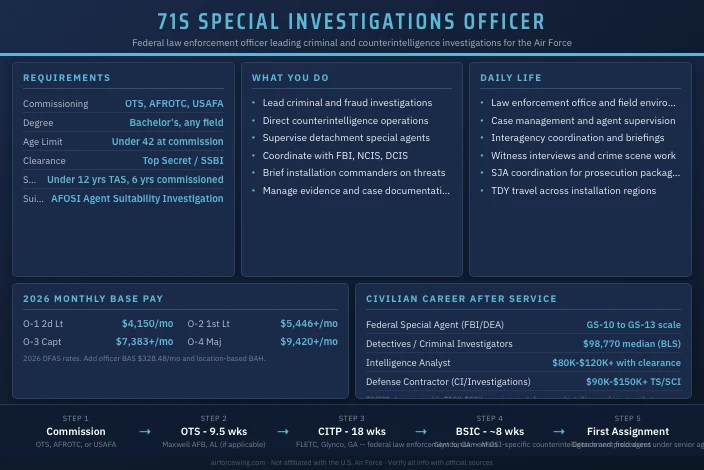
Job Role and Responsibilities
The 71S Special Investigations Officer serves as a commissioned federal law enforcement officer within AFOSI, responsible for planning, directing, and conducting criminal, counterintelligence, fraud, and special inquiry investigations affecting Air Force and Space Force personnel, installations, and programs. Officers formulate investigative policy, manage counterintelligence and fraud intelligence systems, coordinate with other federal agencies, and provide legal and investigative advice to commanders across their area of responsibility.
Command and Leadership Scope
At the junior level (O-1 to O-3), 71S officers function as case agents and special agents assigned to AFOSI detachments. They conduct interviews, develop sources, analyze evidence, and write investigative reports. Supervisory responsibility grows with experience, but even new officers carry full federal law enforcement authority from day one.
By O-4 and above, officers move into supervisory and command roles. A Field Investigations Region (FIR) headquarters position, detachment command, or staff assignment at AFOSI headquarters at Quantico, Virginia becomes typical. At O-5 and O-6, officers may lead major investigative programs, oversee counterintelligence operations for a geographic region, or serve in joint assignments with agencies like the FBI, DIA, or NSA.
Specific Roles and Shredouts
| Designation | Focus | Notes |
|---|---|---|
| 71S | Special Investigations Officer (base) | All commissioned agents |
| 71S3 | Special Investigations, Counterintelligence | CI specialty track |
| 71S4 | Special Investigations, Computer Crimes | Cyber/digital forensics track |
| Special Experience Identifiers (SEIs) | Force Protection, Economic Crimes, Personnel Suitability | Added via operational experience |
Mission Contribution
AFOSI protects Air Force and Space Force assets from threats inside and outside the wire. Counterintelligence operations guard weapons programs, technology, and personnel from foreign intelligence services. Criminal investigations handle everything from drug trafficking and sexual assault to procurement fraud. Computer crimes agents pursue intrusions targeting Air Force networks and systems.
OSI operates independently from local base commanders by design, which means agents can investigate anyone on the installation, including senior officers. That structural independence makes the organization effective but also means every agent understands the stakes of the work.
Technology and Systems
OSI agents use federal law enforcement databases shared across the intelligence community, including classified systems for counterintelligence analysis. Digital forensics tools for computer crime investigations are a growing part of the mission. Agents also use standard federal law enforcement equipment: firearms, surveillance gear, and biometric collection tools in deployed settings.
Salary and Benefits
Officer Base Pay
The table below shows 2026 monthly base pay from DFAS for the O-1 through O-4 range. Most officers enter at O-1 and promote on a standard timeline.
| Rank | Grade | Entry Pay (under 2 yrs) | 4 Yrs Service | 8 Yrs Service |
|---|---|---|---|---|
| 2d Lt | O-1 | $4,150/mo | $5,222/mo | , |
| 1st Lt | O-2 | $4,782/mo | $6,485/mo | , |
| Captain | O-3 | $5,534/mo | $7,383/mo | $8,126/mo |
| Major | O-4 | $6,295/mo | $7,881/mo | $8,816/mo |
Base pay excludes allowances. An O-3 stationed at a CONUS installation also receives Basic Allowance for Housing (BAH), which varies by location and dependency status, and Basic Allowance for Subsistence (BAS) of $328.48 per month. Total compensation including allowances is substantially higher than base pay alone.
Special Pay and Bonuses
The 71S career field does not receive aviation bonus or hazardous duty pay. Officers may qualify for special duty assignment pay in certain billets. Enlistment and retention bonuses for 71S officers vary by year and Air Force manpower needs. Check current availability with the AFPC 71S Assignment Officer, as bonus offerings change annually.
Additional Benefits
Health coverage through TRICARE Prime costs nothing in premiums or copays for active-duty members. Dental care at military treatment facilities is free. Officers receive 30 days of paid leave per year.
The Blended Retirement System (BRS) provides a pension worth 40% of high-36 average basic pay after 20 years, plus Thrift Savings Plan (TSP) matching up to 5% of basic pay. Officers who leave before 20 years take the TSP contributions with them.
Air Force Tuition Assistance covers up to $4,500 annually toward a degree while on active duty. The Post-9/11 GI Bill covers full in-state tuition at public schools after separation.
Qualifications and Eligibility
Getting into AFOSI as a 71S officer is a two-stage process: first, compete for and earn an OTS commission; second, be selected by AFOSI’s own board from among the OTS candidates who designated 71S as their first-choice AFSC.
Commissioning Requirements Table
| Requirement | Detail |
|---|---|
| Education | Bachelor’s degree (or within one year of completion) |
| AFOQT | Passing score required; verbal and quantitative composites minimum 15/10 |
| Age | 18-42 at time of application |
| Citizenship | U.S. citizen |
| Prior service | Fewer than 12 years total active federal service |
| Prior commissioned service | No more than 6 years commissioned service |
| Commissioning source | OTS, ROTC, or Air Force Academy |
| Interview | Favorable interview with an AFOSI detachment commander required |
| Physical | Normal color vision; valid state driver’s license; qualified to bear firearms |
ROTC candidates apply through a separate AFOSI board process. USAFA graduates may also compete. All three sources feed into the same selectivity: AFOSI accepts fewer than ten 71S officers per year across all commissioning paths.
Security Clearance Process
A pre-existing clearance is not required for application and will not give a candidate an edge in selection. Once selected, AFOSI initiates an Agent Suitability Investigation (ASI), an independent evaluation of the candidate’s emotional stability, physical fitness, and overall suitability for special agent duty. A favorable ASI triggers the paperwork for a Top Secret / Sensitive Compartmented Information (TS/SCI) clearance processed through the Office of Personnel Management. Officers begin their clearance investigation after selection, not before.
Career Field Assignment
OTS applicants submit 71S as their top AFSC choice. The standard OTS selection board convenes first. Candidates selected by OTS are then reviewed by a separate AFOSI selection board composed of senior special agents and OSI professional staff. Both boards must say yes. ROTC cadets interested in 71S follow a parallel but separately timed application cycle managed by AFOSI.
Officers commission at O-1 (Second Lieutenant). The standard Active Duty Service Commitment (ADSC) for non-rated OTS graduates is four years. Verify current ADSC requirements with your recruiter, as AFPC policy can update.
Candidates serious about commissioning should start with the OTS preparation guide to understand what the application package requires.
Work Environment
Setting and Schedule
OSI agents work in plainclothes, not uniform. Day-to-day settings range from interrogation rooms and courtrooms to airport terminals, embassy compounds, and deployed forward operating bases. Active cases drive the schedule, not a fixed shift. Agents follow leads when leads appear.
At garrison, work is office-based during non-operational periods: writing reports, managing sources, reviewing intelligence products, coordinating with federal agency partners. During active investigations, hours extend unpredictably. Surveillance operations, search warrants, and arrest operations run on their own timeline.
TDY travel is common and sometimes international. Agents may travel to interview witnesses, support investigations at other installations, or deploy to austere locations in support of combat commands.
Chain of Command and Independence
OSI operates under the Secretary of the Air Force, not the installation commander. A 71S officer on a base does not report to the wing commander for investigative matters. That independence is structural and intentional, it allows agents to investigate anyone on the installation. Officers understand early that this creates friction with some commanders, and managing those relationships professionally is part of the job.
Senior NCOs within OSI work alongside officers as credentialed special agents. The officer-NCO dynamic in AFOSI differs from most career fields: both are federal law enforcement officers, and the relationship is more collaborative than hierarchical during field work. Rank matters for administrative and command purposes; in the field, experience and judgment carry equal weight.
Job Satisfaction and Retention
The career field attracts officers who value investigative work over the traditional military advancement track. Officers who stay typically describe the independence, the variety of cases, and the federal law enforcement identity as the primary reasons. The small size of the community, fewer than ten new officers per year, creates a tight cohort, but also limits assignment variety compared to larger career fields.
Officers who leave early commonly cite PCS tempo, plainclothes lifestyle that disconnects them from the broader military community, and the tension that comes with investigating peers. These are legitimate considerations worth understanding before applying.
Training and Skill Development
Initial Skills Training Table
| Phase | Location | Length | Focus |
|---|---|---|---|
| OTS | Maxwell AFB, AL | ~9.5 weeks | Officership, leadership, Air Force customs |
| Agent Suitability Investigation | Varies | Variable | Emotional, physical, and suitability evaluation |
| Criminal Investigator Training Program (CITP) | FLETC Glynco, GA | ~18 weeks | Federal law enforcement fundamentals, evidence, law |
| Basic Special Investigators Course (BSIC) | AFOSI Academy, Glynco, GA | ~8 weeks | AFOSI mission, CI doctrine, case procedures, firearms |
| First detachment assignment | Varies | Ongoing | On-the-job investigative development |
Professional Military Education
- Squadron Officer School (SOS): Completed around the O-3/O-4 transition, either in residence at Maxwell AFB or by correspondence. Covers leadership, airpower theory, and critical thinking.
- Air Command and Staff College (ACSC): For O-4s selected for major. Resident program at Maxwell AFB or distance learning. Positions officers for O-5 and staff leadership roles.
- Air War College (AWC): Senior-level PME at Maxwell AFB for O-5s and O-6s. Attendance is selective and career-enhancing for officers targeting general officer potential.
Additional Training
OSI agents can earn qualifications in computer crimes, counter-threat finance, and personnel suitability investigations. Joint-duty assignments with the FBI, DIA, CIA, or NSA are available at mid-career and provide exposure to federal law enforcement and intelligence community partnerships. Air Force Institute of Technology (AFIT) programs support graduate degrees in fields relevant to OSI work, including cyber, forensic science, and criminal justice.
Career Progression and Advancement
Officer Career Timeline
| Rank | Grade | Typical Timeline | Key Developmental Positions |
|---|---|---|---|
| 2d Lt | O-1 | 0-18 months | Case agent, detachment special agent |
| 1st Lt | O-2 | 18 months to ~3.5 years | Case agent, lead investigator on major cases |
| Captain | O-3 | ~3.5 to ~9 years | Senior agent, operations officer, detachment leadership |
| Major | O-4 | ~9 to ~15 years | Detachment commander, FIR staff, AFOSI HQ staff |
| Lt Col | O-5 | ~15 to ~21 years | FIR deputy, AFOSI command staff, joint assignments |
| Colonel | O-6 | ~21+ years | FIR commander, AFOSI senior leadership |
Key developmental positions for promotion competitiveness include detachment command at O-4, operations officer billets, and joint assignments. The career field is small enough that every officer’s record is known to the senior leadership. Building an early reputation for sound judgment and written communication, a core OSI skill, pays long-term dividends. Officers who entered through OTS and want to strengthen foundational academic knowledge alongside their professional development may find the AFOQT preparation guide useful for understanding the reasoning and verbal benchmarks that shaped their commissioning scores.
Promotion System
O-1 through O-3 promotions are essentially time-in-grade, assuming satisfactory performance. O-4 (Major) and above are board-selected. Promotion rates for non-rated line officers vary by year. Officers can view current rates through AFPC, but the 71S community’s small size means the board evaluates a limited pool. Strong records earn promotions; mediocre records do not.
Cross-Training and Broadening
Cross-training out of 71S is possible but uncommon. OSI invests significant resources in agent training and wants to retain qualified officers. Broadening assignments outside OSI include joint intelligence staff positions, Air Staff billets, ROTC instructor duty, and congressional fellowship programs.
Physical Demands and Medical Evaluations
Air Force Fitness Assessment
All Air Force officers take the same Fitness Assessment (FA) regardless of career field. The FA uses a 100-point scoring scale with a minimum passing composite of 75. Each component requires a minimum score.
| Component | Max Points |
|---|---|
| 1.5-Mile Run | 60 |
| Push-Ups (1 min) | 10 |
| Sit-Ups (1 min) | 10 |
| Waist Circumference / Body Composition | 20 |
Standards are age- and gender-normed. For current scoring thresholds by age group, see official Air Force publications at af.mil. The FA is administered annually for most Airmen.
Career Field-Specific Physical Requirements
Beyond the FA, 71S officers must qualify to bear firearms. This requires meeting physical standards for firearms qualification and maintaining those standards throughout the career. Normal color vision is required. The Agent Suitability Investigation includes a physical component. No flight physical is required, 71S is not a rated position.
Deployment and Duty Stations
Deployment Details
AFOSI deploys agents to support combat commands, joint task forces, and geographic combatant commands. Deployment tempo is generally lower than rated and combat-support career fields, but OSI agents do deploy and can be sent to austere locations. Deployed assignments often involve force protection investigations, counterintelligence collection, and supporting commanders with threat assessments.
Individual deployments typically run 90 to 180 days, though special operational support tours can extend longer. Reserve and Air National Guard OSI agents are mobilized for both planned and contingency deployments.
In deployed environments, OSI agents often work directly alongside host-nation law enforcement, intelligence personnel, and military commanders from other services. Counterintelligence collection at forward bases requires agents to manage human sources, analyze threat reporting, and brief commanders on personnel security risks. These assignments carry additional physical and operational stress compared to garrison duty, and agents who have deployed consistently describe them as among the most professionally demanding and rewarding periods of their career.
Duty Station Options
AFOSI maintains detachments at major Air Force and Space Force installations throughout the United States and at locations worldwide spanning Europe, the Pacific, the Middle East, and Africa. Assignment decisions are made by AFPC in coordination with AFOSI manpower requirements. Agents generally rotate assignments every three to four years.
Geographic preference is considered but is not guaranteed. The small size of the career field limits choices compared to larger AFSCs. Popular CONUS assignments include installations in the Washington, D.C. area near AFOSI headquarters, as well as major bases in the Southeast, Southwest, and Pacific Northwest. Officers who request overseas assignments may be placed at installations in Germany, Japan, Korea, or the United Kingdom, where OSI detachments support both base security and intelligence community partnerships.
Risk, Safety, and Legal Considerations
Job Hazards
OSI agents carry firearms and can make arrests. Criminal investigations involving drug trafficking, human trafficking, and violent crimes carry inherent risk. Counterintelligence work involves contact with foreign intelligence operatives and potentially dangerous individuals. Deployed assignments can place agents in locations where force protection threats are active.
Officers bear the additional weight of command responsibility. Mistakes in investigative judgment, improperly obtained evidence, procedural errors on a warrant, or mishandled source relationships, can compromise cases, expose the Air Force to litigation, and end careers.
Court testimony is a regular part of the job at the senior agent level. Officers who have worked major cases will testify at courts-martial and, in cases involving federal criminal charges, in Article III courts. Testifying under cross-examination from experienced JAG defense attorneys or civilian defense counsel requires thorough case preparation and precise, factual recollection of investigative steps. Agents who cut procedural corners during an investigation rarely appreciate the consequences until the moment they are on the stand.
Safety Protocols
OSI uses federal law enforcement risk management protocols and coordinates with host-nation law enforcement for international operations. Agents receive firearms qualification training and recertification on a regular schedule. Operational safety planning for high-risk operations follows established federal law enforcement procedures. Surveillance operations, arrests, and search warrant executions are planned as team efforts with designated roles, contingency plans, and coordination with military security forces or civilian law enforcement when applicable.
Legal and Command Responsibility
OSI agents operate under the Uniform Code of Military Justice and federal criminal statutes. Officers are subject to both military and federal law enforcement accountability standards. Investigations that result in courts-martial or federal prosecution are subject to scrutiny from military judges, JAG attorneys, and civilian courts. Relief for cause in this career field carries serious professional consequences given the small community size. Because OSI operates independently of the installation commander, officers must also manage the political dimension of their work with discretion, maintaining the trust of commanders while preserving investigative independence.
Impact on Family and Personal Life
Family Considerations
The plainclothes lifestyle affects family life in ways that a uniformed assignment does not. Partners and family members may find it harder to connect with base community resources when the service member’s role isn’t visible. OSI’s operational security culture also limits what agents can share about their caseload, which some families describe as an additional layer of separation. The PCS cycle runs every three to four years, consistent with most Air Force career fields.
Irregular schedules during active investigations mean that evenings, weekends, and holiday periods can be disrupted by case developments. Unlike many Air Force career fields where duty hours are relatively predictable outside of exercises, investigators follow leads on the timeline cases dictate. Families who adapt best to this environment tend to build strong local support networks independent of the service member’s work schedule.
Support programs include the Airman and Family Readiness Center (A&FRC), Key Spouse Programs at installations, and DoD spouse employment resources. AFOSI’s small community tends toward a tight internal network that extends to families during deployments and high-tempo periods. The OSI community is small enough that families often know each other across multiple assignments, which creates genuine long-term support structures.
Dual-Military and Family Planning
AFOSI attempts to accommodate join-spouse requests, but the limited number of installations with OSI detachments makes co-location harder than in larger career fields. Dual-military couples where one member is a 71S officer should plan for the possibility of remote tours or geographic separation. Family planning during deployments follows standard Air Force policies for leave, support, and family care plans. Service members with dependents must maintain a current family care plan, since OSI deployment requirements can move quickly.
Reserve and Air National Guard
Component Availability
The 71S career field exists in both the Air Force Reserve and the Air National Guard. Reserve OSI agents support the same investigative mission as their active-duty counterparts, including criminal investigations, counterintelligence, fraud, and force protection. Reserve components have their own detachments and can be found embedded at installations across the country.
Commissioning Paths
Reserve and Air National Guard 71S officers commission through OTS or ROTC with a Reserve component contract, then attend the same AFOSI training pipeline (agent suitability investigation plus Special Investigations Academy at Glynco). Direct commission into the Reserve 71S is possible for candidates with prior federal law enforcement experience, contact your specific Air Force Reserve unit for current eligibility criteria.
Active-duty 71S officers can transfer to the Reserve or Air National Guard after completing their ADSC. Prior experience as an AFOSI agent is a competitive advantage for Reserve positions.
Drill and Training Commitment
Standard Reserve commitment is one Unit Training Assembly (UTA) weekend per month plus a two-week Annual Tour. 71S officers may have additional certification requirements for firearms qualification and may participate in exercises beyond the standard drill schedule depending on their unit’s operational tasking.
Part-Time Pay
An O-3 (Captain) with four years of service earns approximately $7,383 per month on active duty. That same officer on a Reserve drill weekend earns a fraction of that, approximately four days of base pay per UTA. The difference is significant, but Reserve service keeps skills current and maintains TS/SCI clearance access, which has direct civilian career value.
Benefits Comparison
| Factor | Active Duty | Air Force Reserve | Air National Guard |
|---|---|---|---|
| Commitment | Full-time | 1 weekend/mo + 2 wks/yr | 1 weekend/mo + 2 wks/yr |
| O-3 Monthly Pay | ~$5,534-$8,126 | Drill pay (days worked) | Drill pay (days worked) |
| Healthcare | TRICARE Prime (free) | TRICARE Reserve Select (premiums apply) | TRICARE Reserve Select / state options |
| Education | Tuition Assistance + GI Bill | Federal TA (on orders); GI Bill eligibility | State tuition waivers vary; GI Bill eligibility |
| Deployment | Varies by assignment | Periodic mobilization | Periodic mobilization |
| Retirement | 20-yr pension (high-36) | Points-based Reserve retirement | Points-based Reserve retirement |
| Command Billets | Available | Detachment/unit command billets | Detachment/unit command billets |
Civilian Career Integration
Reserve and Air National Guard 71S officers commonly work in federal law enforcement, intelligence agencies, or corporate security between drill weekends. The TS/SCI clearance maintained through Reserve service is a marketable credential that opens doors at federal agencies, defense contractors, and financial institutions. USERRA protections require civilian employers to accommodate Reserve drill obligations and reinstate members returning from mobilization.
Post-Service Opportunities
Transition to Civilian Life
AFOSI experience translates directly to federal law enforcement. The investigative background, TS/SCI clearance, and specific agency knowledge are valued at FBI, DEA, DHS, NCIS, DCIS, and other federal law enforcement and intelligence organizations. Officers who leave after one commitment often move into GS-1811 criminal investigator positions with federal agencies, frequently entering at mid-grade (GS-11 to GS-13) based on prior experience.
Transition resources include the Transition Assistance Program (TAP), Hiring Our Heroes for corporate connections, and Air Force-specific career counseling through the A&FRC.
Civilian Career Prospects
| Civilian Job Title | Median Annual Salary (May 2024) | Job Outlook (2024-2034) |
|---|---|---|
| Detective / Criminal Investigator | $77,270 | +3% |
| Intelligence Analyst | ~$100,410 | Varies by agency |
| Corporate Security Manager | ~$105,700+ | +4% |
| Compliance Officer | ~$80,990 | +5% |
Salary data from the BLS Occupational Outlook Handbook.
Federal law enforcement positions at agencies like the FBI and DEA are highly competitive, but AFOSI experience is a direct pipeline credential. Intelligence community roles at NSA, DIA, and CIA actively recruit former AFOSI counterintelligence officers.
Graduate Education and Credentials
AFOSI training does not directly produce civilian professional licenses, but the federal law enforcement background, combined with a GI Bill-funded graduate degree in criminal justice, cyber forensics, or intelligence studies, builds a strong post-service package. Some officers pursue the Certified Fraud Examiner (CFE) credential during or after service. The Post-9/11 GI Bill covers full in-state tuition at public universities or up to $29,920.95 per academic year at private schools (2025-2026 cap).
Is This a Good Job for You?
Ideal Candidate Profile
The 71S career field suits officers who think analytically, write clearly, and can work independently without a defined daily task list. Investigators who succeed early in AFOSI tend to be naturally curious, comfortable with ambiguity, and able to build rapport quickly with strangers. Comfort operating outside a traditional uniform environment matters, you won’t have rank visible on your clothing most days.
Academic backgrounds in criminal justice, psychology, political science, and cybersecurity are common, but OSI accepts officers from any degree field. What carries more weight than major is the ability to reason through complex situations, communicate findings precisely, and maintain judgment under pressure.
Potential Challenges
The career field’s small size is its biggest structural tension. Fewer than ten officers per year means limited assignment options, limited peer competition for promotions within the field, and intense visibility at every career stage. A weak performance report in year three is hard to recover from when the board reviewing your O-4 file knows everyone in the community.
The investigative lifestyle doesn’t suit officers who want a predictable schedule, consistent supervision, or a clear uniform identity. Cases don’t end at 1700. Deployments happen on short notice. The independence that appeals to many candidates is the same quality that isolates others.
Career and Lifestyle Alignment
Officers with a long-term goal of federal law enforcement or intelligence community work after service will find 71S an excellent alignment. The AFOSI background and clearance create direct civilian pathways that are genuinely difficult to build any other way.
Officers who want breadth of Air Force experience, different career fields, rated assignments, acquisition work, will find 71S constraining. The career field is narrow by design. You are an AFOSI special agent for most of your military career, with occasional broadening assignments. That depth is an asset if it matches your goals, and a frustration if it doesn’t.
This site is not affiliated with the U.S. Air Force or any government agency. Verify all information with official Air Force sources before making enlistment or career decisions.
More Information
The best starting point for 71S applicants is the AFOSI officer careers page and your local AFOSI detachment commander, who must conduct your required pre-selection interview. ROTC cadets should begin that conversation with their detachment commander at least a year before their commissioning year. OTS applicants should list 71S as their first AFSC choice and contact the AFPC 71S Assignment Officer for current cycle guidance.
Commissioning into any Air Force officer career field starts with the AFOQT. The OTS test prep guide covers what the exam includes and how to prepare, including the verbal and quantitative composite minimums that apply to all officer candidates.
Explore more Air Force legal officer careers including the 51J Judge Advocate for a different path that combines law and military service.